
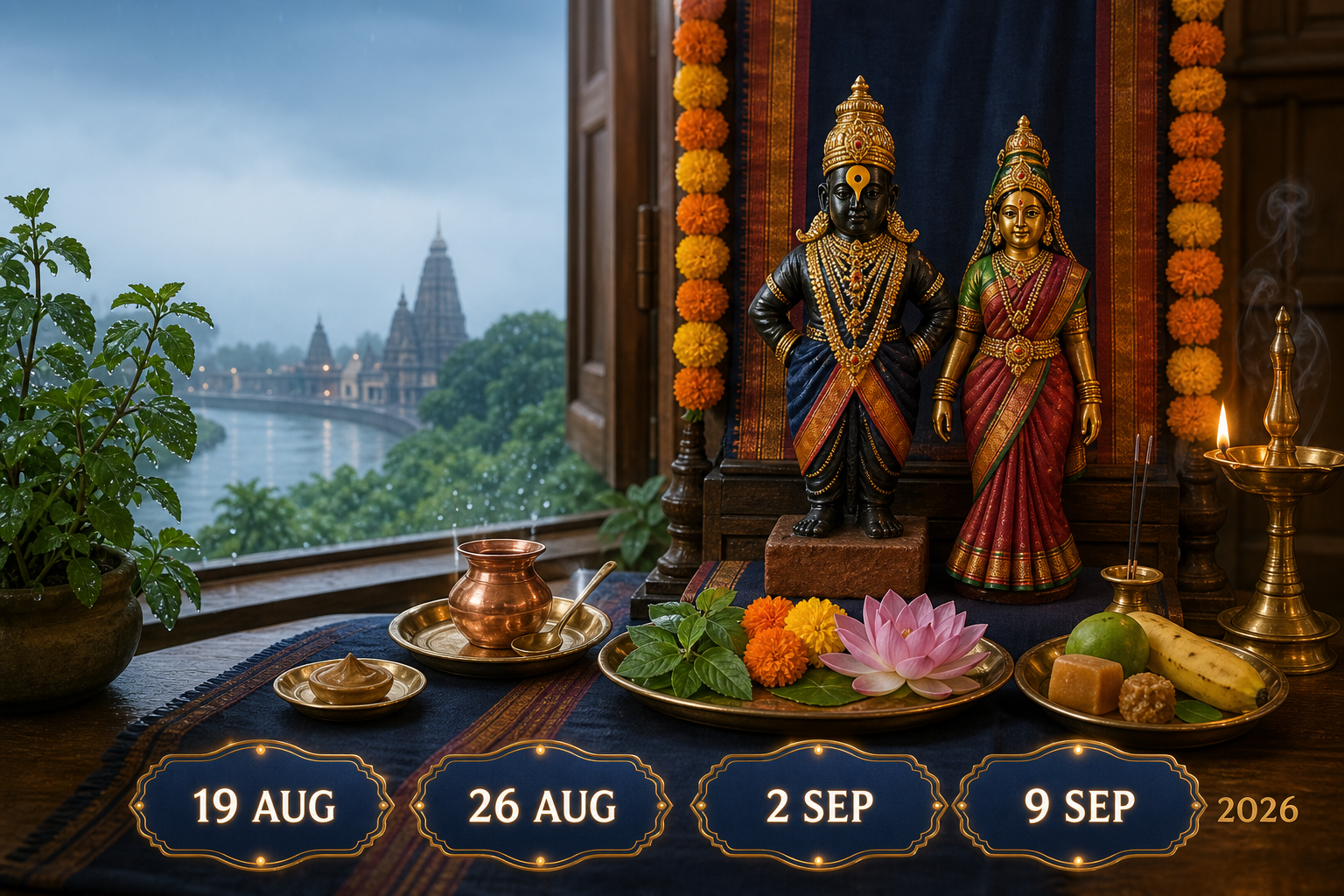
Vittal Pujan on Shravan Budhvar is a regional devotional observance in which Wednesdays during Shravan Maas are dedicated to Lord Vitthal, also known as Vittal, Vithal, Vithoba, Panduranga and Pandharinath. The practice is especially associated with Maharashtra and parts of North Karnataka. The concise source account of the observance identifies Pandharpur as its principal devotional centre and notes that devotees may perform special pujas or visit the Shri Vitthal-Rukmini Temple. It is best understood as a living household and regional tradition rather than a single, universally prescribed vrata observed identically by every Hindu community.
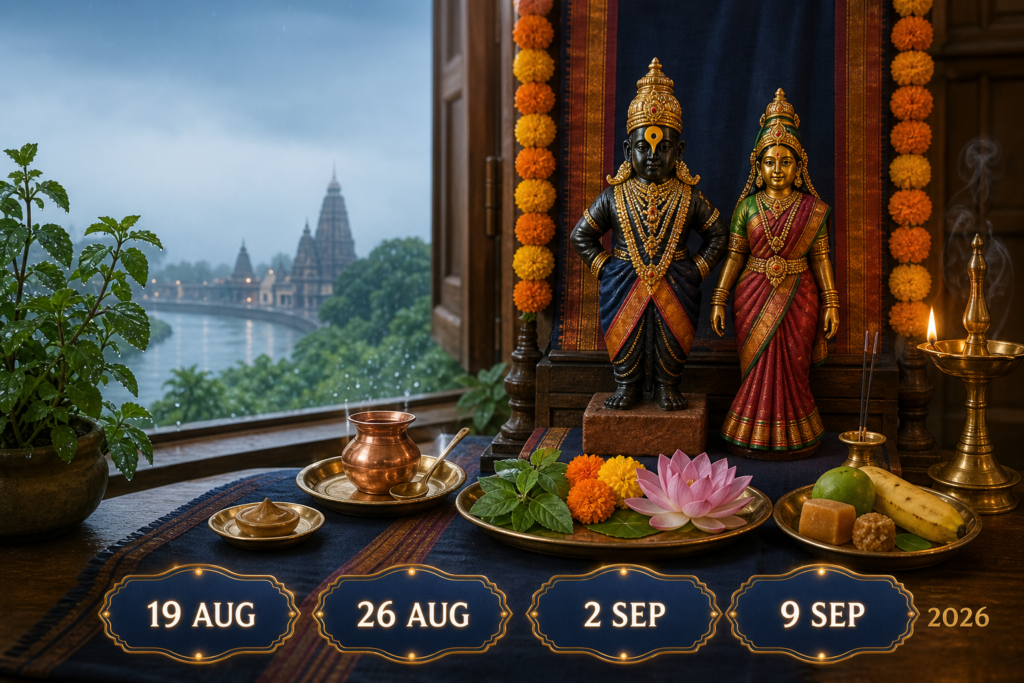
Verified Shravan Budhvar dates for Maharashtra in 2026: Wednesday, 19 August 2026; Wednesday, 26 August 2026; Wednesday, 2 September 2026; and Wednesday, 9 September 2026. This calculation follows the Amavasyanta, or Amanta, lunar calendar commonly used in Maharashtra. Both the 2026 HinduPad calendar entry and a location-based panchang for Maharashtra place the beginning of Shravan on Thursday, 13 August 2026, and its conclusion on Friday, 11 September 2026. The four Wednesdays falling within those boundaries are therefore the regular Shravan Budhvar observances.
Why does 12 August appear in some published lists? Some online calendars add Wednesday, 12 August 2026, because Shravan Shukla Pratipada begins late that night, at approximately 11 p.m. in Maharashtra-focused calculations. Under the customary sunrise rule used for ordinary panchang days, however, 12 August begins as Ashadha Amavasya in the Marathi Amavasyanta system, while the first Shravan sunrise occurs on 13 August. For that reason, 12 August is more accurately treated as a lunar-month boundary date than as a full Shravan Budhvar. A family whose inherited panchang or priest explicitly includes the late-night transition may follow that tradition, but a general public calendar should distinguish it from the four Wednesdays wholly situated within Marathi Shravan.
The calendar logic is astronomical as well as customary. A tithi is not a fixed 24-hour date. It is calculated from the changing angular separation of the Moon and Sun, with each successive interval of 12 degrees constituting one tithi. A tithi may therefore begin or end at any civil-clock time and may overlap two Gregorian dates. The Amavasyanta month followed in Maharashtra begins after Amavasya and places Shukla Paksha first. The Purnimanta system used across much of North India begins the named month after Purnima and places Krishna Paksha first. In 2026, North Indian Purnimanta Shravan runs from 30 July to 28 August, whereas Marathi Amavasyanta Shravan runs from 13 August to 11 September. Neither system is intrinsically more authentic; each represents an established regional method of naming the same lunar phases.
Local verification still matters. Panchang calculations depend on geographic coordinates, local sunrise and the convention used to assign a tithi to an observance. Devotees in Mumbai, Pune, Solapur, Nagpur, Kalaburagi or Bidar may see small differences in transition times even when the civil observance remains on the same date. A printed family panchang, a trusted local temple calendar or a location-specific digital panchang should therefore be consulted before making a formal sankalpa. This caution is especially important when a lunar transition occurs near sunrise or midnight. It is less important for a simple weekly devotion whose primary marker is Wednesday itself.
Vitthal’s identity explains the observance’s devotional character. The Shri Vitthal-Rukmini Temple describes Vitthal as a form of Krishna or Vishnu and identifies Rakhumai, or Rukmini, as his consort. The spellings Vitthal, Vithal, Vittal and Vithoba reflect regional languages and transliteration practices rather than different deities. Panduranga and Pandharinath are also widely used names. This plurality of names is characteristic of a devotional culture in which an intimate, local form of the divine remains connected to the broader Vaishnava understanding of Vishnu and Krishna.
The familiar icon shows Vitthal standing upright on a brick with his hands placed on his hips. Devotional tradition connects this posture with Pundalik, whose service to his parents was said to be so attentive that he offered the arriving Krishna a brick on which to wait. Krishna remained there as Vitthal, honouring a form of devotion expressed through everyday duty. The account should be presented as sacred narrative rather than documentary history. Its enduring theological message is nevertheless clear: care, patience and service can themselves become modes of worship, and ritual devotion is incomplete when separated from ethical conduct.
Pandharpur is the cultural and sacred centre of Vitthal bhakti. The town stands beside the Bhima River, whose crescent-shaped course at Pandharpur is traditionally called Chandrabhaga. The Shri Vitthal-Rukmini Mandir, the Namdev Gate, the nearby presence of Rakhumai and the memory of numerous saint-poets make the town a layered sacred landscape rather than an isolated shrine. Maharashtra Tourism’s account of Pandharpur describes the temple, Chandrabhaga and the Wari pilgrimage as central expressions of Maharashtra’s religious and cultural heritage. Medieval inscriptions attest the shrine’s antiquity, while successive additions show that the present temple complex developed over a long period.
The Varkari tradition gives Vitthal worship its distinctive social vocabulary. Varkari devotion is shaped by pilgrimage, nama-smarana, kirtan, abhang singing, ethical discipline and recurring darshan of Vitthal. Sant Dnyaneshwar, Sant Namdev, Sant Janabai, Sant Chokhamela, Sant Eknath, Sant Tukaram, Sant Savata Mali, Sant Kanhopatra and other figures contributed to a devotional literature that crossed boundaries of occupation, caste and gender. The Maharashtra State Gazetteer’s account of the Varkari movement emphasizes its family-like spiritual community and its role in religio-cultural synthesis. Shravan Budhvar Pujan is not identical to the major Ashadhi and Kartiki Wari pilgrimages, but it draws emotional meaning from the same world of Vitthal bhakti.
The practice also reflects a Maharashtra-Karnataka cultural bridge. The original regional account associates Shravan Wednesday worship with North Karnataka districts including Kalaburagi, formerly Gulbarga; Bidar; Belagavi, formerly Belgaum; Vijayapura, formerly Bijapur; Bagalkot; Gadag; and Koppal. The Maharashtra State Gazetteer similarly identifies Vitthal as a cultural link between Maharashtra and Karnataka. This connection is visible in pilgrimage routes, shared deity names, musical traditions and the movement of devotees across modern state boundaries. It does not mean that every household in these districts follows one ritual formula. Kannada, Marathi, Varkari, Haridasa and family-specific practices may overlap while retaining their own liturgical features.
Shravan supplies the seasonal setting. In Maharashtra, the month arrives during the monsoon, when agricultural life, temple calendars and household rhythms are closely attuned to rain and renewal. Shravan contains a dense succession of weekly pujas, vratas and festivals. Different weekdays may be associated with Shiva, Mangala Gauri, Budha, Brihaspati, Jara Jivantika, Maruti, Aditya or a household deity, depending on the region and parampara. Vitthal worship on Wednesday belongs within this broader pattern of repeated weekly discipline. The repetition gives the month a steady devotional cadence: the lamp is lit again, familiar names are sung again and ordinary domestic time is reorganized around remembrance.
Budhvar does not have one exclusive ritual meaning. The weekday’s name is associated with Budha, the planetary deity corresponding to Mercury, and some almanacs describe Wednesday in Shravan as a day for Budha-graha puja. Other households emphasize Ganesha, while the regional practice under discussion centres Vitthal. These customs should not be collapsed into a claim that all Wednesday worship is directed to the same deity. In a Vitthal-observing family, Budhvar identifies the recurring weekday selected for devotion; it does not automatically turn the ceremony into an astrological remedy. Family parampara and local temple guidance provide the most reliable interpretive context.
The central purpose is devotional recollection, not ritual display. A Shravan Budhvar puja may express gratitude, seek steadiness in dharmic life, honour an inherited family custom or renew a connection with Pandharpur. Its emotional force often lies in familiarity: an elder recalls an abhanga, a child places a flower near the image, and a family living far from Maharashtra hears the names Vitthal and Rakhumai in the home again. Such experiences do not require an elaborate ceremony. In the Varkari ethos, sincere remembrance, ethical conduct and compassionate service can carry as much spiritual significance as material abundance.
Preparation begins with clarity and proportion. The worship space may be cleaned, and the devotee may bathe or wash before beginning. A murti or framed image of Vitthal may be placed on a stable, clean surface; an image of Rakhumai may be placed beside it when available. The arrangement should be dignified but need not be expensive. A small cloth, a safe lamp, clean water, sandalwood paste or another customary fragrance, unbroken rice if used in the family, flowers, tulsi, incense and a modest food offering are generally sufficient. A household should use only materials it can obtain responsibly and should not treat purchasing power as a measure of devotion.
A practical materials set may remain simple. It can include a Vitthal-Rakhumai image; a clean seat or altar cloth; one water vessel and spoon; gandha; akshata where customary; one or more flowers; tulsi leaves; dhupa or incense; a ghee or oil lamp; fruit, milk, cooked food or another sattvic naivedya compatible with family practice; a bell if normally used; and a plate for arati. Substitutions are acceptable when health, availability, disability, travel or environmental conditions make the traditional set impractical. An electric lamp may replace an open flame where fire safety is a concern, and mental offerings may replace physical substances when circumstances require.
Panchopachara and Shodashopachara describe levels of ritual hospitality. A concise Panchopachara puja commonly centres five offerings such as gandha, pushpa, dhupa, dipa and naivedya, although lists vary. A fuller Shodashopachara sequence treats the deity as an honoured guest through acts such as invocation, offering a seat, water for the feet and hands, bathing, clothing, fragrance, flowers, light and food. Shravan Budhvar worship does not require every household to reproduce the longest sequence. A five-offering puja performed attentively is more appropriate than an elaborate procedure conducted without understanding. Permanently worshipped or consecrated images may also have rules different from those governing a temporary image, so inherited practice should be respected.
Step one is establishing the space. The devotee sits facing the altar, steadies the breath and reduces avoidable distraction. The lamp is placed where clothing, curtains, children and animals cannot disturb it. Water and offerings are arranged before the ritual begins so that the sequence remains calm. A brief purification may consist of washing the hands, sipping water only if that practice is known and medically appropriate, and mentally setting aside anger or haste. The aim is not to declare the physical world impure; it is to mark a deliberate transition from routine activity to focused worship.
Step two is the sankalpa. A formal practitioner may state the location, lunar month, paksha, tithi, weekday, name, family lineage and purpose of the puja. A simpler household sankalpa may state in plain language that the worship is being offered to Shri Vitthal and Rakhumai on Shravan Budhvar for devotion, gratitude, ethical strength and the welfare of all beings. No one should invent a gotra or calendar detail merely to make the declaration sound complete. When the precise tithi is uncertain, the local panchang should be checked or the intention should be expressed without a technical claim.
Step three is dhyana and respectful invocation. Attention may be placed on Vitthal’s standing form, the brick beneath his feet, his patient posture and his relationship with Rakhumai and Pundalik. A permanent household deity is not always invoked and dismissed in the same way as a temporary ritual image; family custom determines the correct form. For a simple framed image, the devotee may merely request the divine presence to be recognized in the worship. Theologically, this moment changes the quality of attention rather than claiming that the limitless divine has been physically confined to an object.
Step four is the offering of upacharas. Water may be offered symbolically, followed by gandha, akshata if customary, flowers and tulsi. Incense is moved respectfully before the image, and the lamp is shown with controlled clockwise movements. Each substance represents hospitality and attention: water refreshes, fragrance honours, flowers express beauty, light signifies awareness and food represents the fruits of labour. The items should be offered in small quantities. Excessive use of milk, flowers, plastic decorations or disposable packaging adds no necessary spiritual value and can create avoidable waste.
Abhisheka requires judgment. Water, milk or panchamrita should be poured only over a murti made for ritual bathing and only where that procedure belongs to the household’s practice. Paper images, painted surfaces, wood, electrical decorations and delicate metal finishes can be damaged. Temple-scale abhisheka should not be imitated casually, because a consecrated temple image is served according to institutional liturgy by authorized personnel. For most homes, offering a spoonful of clean water in a separate vessel or bathing a small suitable murti with plain water is sufficient. The materials should be handled hygienically and never discharged in a way that pollutes drains, rivers or soil.
Tulsi has particular Vaishnava significance. A fresh leaf or small sprig may be placed respectfully before Vitthal or on the naivedya where family practice permits. Tulsi should not be reduced to a ritual commodity: the plant is traditionally cared for as a living presence in the household. Leaves should be taken sparingly, without damaging the plant, and local rules concerning when or how they are gathered may be followed. If tulsi is unavailable, sincere worship need not be abandoned. A flower, a mental offering or simple nama-smarana can preserve the devotional intention.
Naivedya joins devotion with everyday sustenance. Fruit, milk, jaggery, a home-cooked preparation or an ordinary portion of the family’s sattvic meal may be offered before anyone tastes it. Regional households may prepare different foods, and no single menu defines authentic Vittal Pujan. Dietary restrictions should reflect health requirements as well as family discipline. After the offering and a short period of remembrance, the food becomes prasad and is shared without waste. Offering a manageable portion and feeding people responsibly better expresses gratitude than preparing excess for display.
Naming, singing and listening form the heart of the observance. Devotees may repeat names of Vitthal, Krishna or Vishnu; chant a mantra received through their tradition; recite passages from the Bhagavad Gita; sing abhangas; or read from the Haripath. Ram Krishna Hari is widely associated with Varkari remembrance, while the names of Dnyaneshwar, Namdev and Tukaram evoke the saint-poet lineage. No mantra should be presented as compulsory unless the relevant sampradaya prescribes it. Clear pronunciation and comprehension are valuable, but humility is more important than performance. A recording may assist a household unfamiliar with the melodies, although attentive participation should remain the focus.
The puja concludes through arati, prayer and sharing. The lamp may be shown safely while an established Vitthal arati or familiar devotional song is sung. The devotee then offers namaskara, acknowledges any errors without anxiety and prays for wisdom, compassion and the welfare of the community. A permanently installed deity is not ceremonially dismissed unless that is part of the household’s liturgy. The water and prasad are distributed respectfully, and the altar is left clean. Flowers may be composted where possible; synthetic decorations should be reused rather than discarded after one evening.
A concise fifteen-minute observance is entirely workable. It may consist of cleaning the altar, lighting one safe lamp, stating a simple sankalpa, offering water, gandha, a flower, tulsi and food, repeating Vitthal’s name, singing one abhanga or reading a short passage, performing arati and sharing prasad. This format is suitable for working households, students, older devotees and people living in small spaces. The repeated weekly discipline matters more than ceremonial length. If even this is impractical, a few quiet minutes of nama-smarana and an act of service can preserve the day’s devotional purpose.
Fasting is optional unless a specific family vrata requires it. The regional source establishes Wednesday puja but does not establish one mandatory fasting rule for every devotee. Some people eat one sattvic meal, avoid particular foods or fast partially; others perform puja without dietary restriction. Children, pregnant or nursing people, older adults, people with diabetes or chronic illness and anyone taking medication should not undertake a restrictive fast without appropriate medical guidance. Hydration and prescribed treatment should never be abandoned to meet a generalized ritual expectation. A disciplined meal, restraint from harmful conduct and charitable sharing may offer a more responsible observance than unsafe food deprivation.
A Pandharpur visit can deepen the observance but is not required. Devotees who travel may seek darshan at the Shri Vitthal-Rukmini Mandir, remember the saints near the Namdev Gate and spend reflective time beside Chandrabhaga. Temple access, darshan arrangements, opening hours, crowd controls and booking procedures can change, so the official temple website should be checked before travel. Monsoon conditions require suitable footwear, drinking water, medication and attention to river safety. A pilgrimage should be approached as disciplined devotion, not as a reason to disregard health, sanitation or the dignity of other pilgrims.
Ecological restraint is consistent with the spirit of Shravan. Reusable metal or earthen vessels, locally grown flowers, modest quantities of water and plastic-free decoration reduce the environmental burden of worship. Food offerings can be planned according to the number of people present. Oil, ash, flowers, milk and packaging should not be placed in rivers or public water bodies. The Chandrabhaga and other sacred waters are honoured more meaningfully through protection from pollution than through indiscriminate immersion. This approach connects ritual reverence with practical responsibility toward the living landscape.
Family participation turns the weekly puja into cultural education. Children may arrange flowers, learn the names Vitthal and Rakhumai, hear the Pundalik narrative and participate in distributing prasad. Elders may explain an abhanga’s ethical meaning instead of requiring memorization without context. Marathi- and Kannada-speaking families may use their own language, while multilingual households may add translations so that everyone understands the prayer. Participation should be invited without humiliation or coercion. A tradition remains resilient when its practices are intelligible, compassionate and adaptable to the capacities of those present.
Service gives the ritual an ethical completion. The story of Pundalik places care for parents at the centre of devotional memory, while Varkari literature repeatedly links bhakti with humility and concern for ordinary people. A household may therefore accompany the puja with food sharing, assistance to an older neighbour, support for a pilgrim, care for animals, respectful family reconciliation or another proportionate act of seva. Such action should not become a public performance. Its significance lies in allowing remembrance of Vitthal to influence conduct after the lamp has been extinguished.
An academic account must separate belief, history and measurable evidence. Claims that a Wednesday puja automatically guarantees wealth, cures disease, controls Mercury or removes every obstacle are theological or popular assertions, not established scientific conclusions. The observable benefits are more modest and culturally intelligible: a recurring ritual can organize attention, transmit family memory, support self-discipline and create opportunities for shared song and service. Devotees may interpret grace according to faith, but responsible writing should not convert that faith into a universal medical, financial or astrological promise.
The observance can also support respectful Dharmic unity. Vitthal bhakti remains a specifically Hindu and Vaishnava devotional tradition, yet its emphasis on service, compassion, disciplined remembrance and human dignity can encourage dialogue with Buddhist, Jain and Sikh communities. Buddhist compassion, Jain ahimsa and Sikh seva should be respected within their own philosophical and institutional settings rather than absorbed into a claim that all traditions are identical. Unity is strengthened when distinct paths cooperate around ethical responsibility while retaining their histories, vocabularies and practices.
Are the dates identical everywhere? No. The four verified dates in this guide apply to the Marathi Amavasyanta Shravan of 2026. Purnimanta calendars in North India begin Shravan about a fortnight earlier, while solar calendars and local traditions may use other boundaries. North Karnataka often follows an Amanta framework similar to Maharashtra, but a local Kannada panchanga or temple calendar remains the appropriate authority for a formal observance.
Is a special muhurta required? No single universal muhurta is established for this regional weekly puja. Many households worship after bathing in the morning, while others gather after work in the evening. A calm time when the family can participate attentively is generally suitable. If the sankalpa depends on a particular tithi, yoga or nakshatra, a location-specific panchang and qualified priest should be consulted instead of relying on a generic internet time.
Is a priest necessary? A simple household Panchopachara puja, nama-smarana or abhanga session can generally be performed without a priest. A priest may be appropriate for a formal installation, consecrated murti, complex Shodashopachara ceremony or family vrata with inherited rules. The absence of a priest should not prevent sincere, modest worship, but unfamiliar mantras and rites should not be improvised and presented as authoritative tradition.
What happens if a Wednesday is missed? No universal rule requires anxiety, punishment or an expensive remedial ceremony. A devotee may remember Vitthal when possible, resume the observance on the next Wednesday or offer prayer on another suitable day. Bhakti is not invalidated by illness, caregiving, travel, disability or unavoidable work. Where a formally vowed vrata contains specific completion rules, the family priest or sampradaya should be consulted.
Should Rakhumai be worshipped with Vitthal? Including Rakhumai reflects the paired devotional identity of the Pandharpur tradition and is appropriate when an image is available. Her absence from a particular household image does not make the puja incomplete. A devotee may honour her mentally or through her name. The same principle prevents material completeness from becoming a barrier to worship.
Research and method note: The regional practice was drawn from the detailed Vittal Pujan source page. The 2026 boundary dates were cross-checked against the source site’s Shravan commencement entry and the sunrise-based calendar note in Drik Panchang. Cultural and institutional context was checked against the official temple account, Maharashtra Tourism and the Maharashtra State Gazetteer. The household puja sequence is a cautious general framework, not a claim that one liturgy governs every Vitthal tradition.
Vittal Pujan on Shravan Budhvar ultimately derives its strength from recurrence: four Wednesdays become four opportunities to pause, remember, sing, serve and return ordinary life to a devotional centre. In 2026, the regular Marathi-calendar observances fall on 19 August, 26 August, 2 September and 9 September. Whether marked through a full puja, a single lamp, an abhanga, darshan at Pandharpur or a quiet act of seva, the practice remains most faithful to Vitthal bhakti when ritual care is joined with humility, factual calendar awareness and compassion toward others.
Inspired by this post on Hindu Pad.






Leave a Reply
You must be logged in to post a comment.