-
Unlocking the Samakanda Shivling: Sacred Geometry, Agama Proportions, and Trimurti Harmony

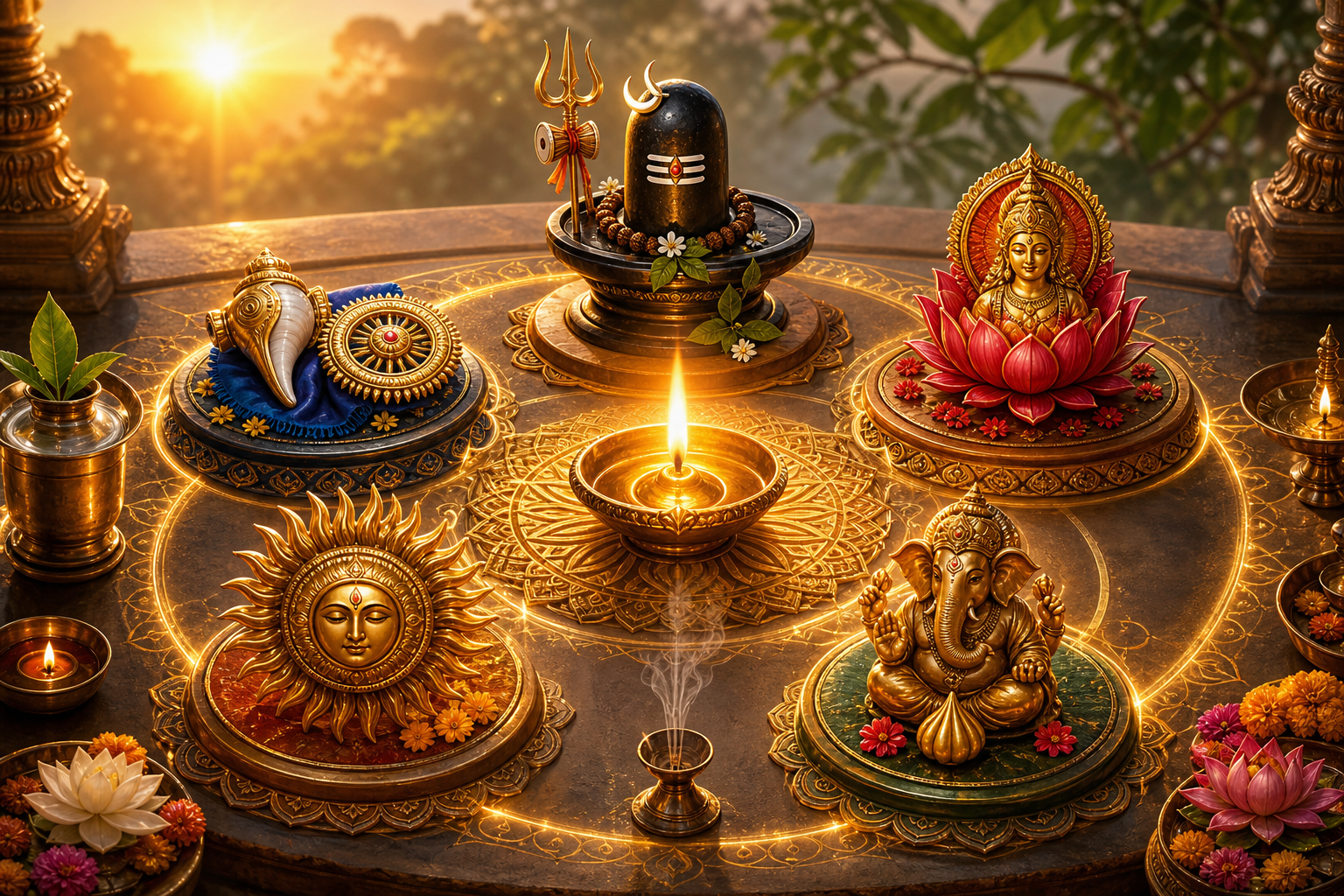
The Samakanda Shivling is a mānuṣa liṅga crafted so that the Brahmā, Viṣṇu, and Rudra sections are exactly equal in height. This sacred geometry embodies the Trimūrti’s harmony, turning complex theology into an accessible visual and ritual language. Drawing on Śilpa-Śāstra and Śaiva Āgama guidance, it balances square, octagonal, and circular principles across the vertical…
-
Transcend Forms, Find Clarity: Hindu Wisdom for Locating the Cause Behind All Phenomena

This article examines a central teaching of Hindu philosophy: look past nāma-rūpa (names and forms) to the abiding kāraṇa (cause). Drawing on the Upaniṣads and Bhagavad Gītā, it explains how Vedānta distinguishes empirical from ultimate reality and why māyā is a principle of appearing rather than mere illusion. It shows how forms function as upāya—means…
-
Beyond Sectarianism: Dharmic Wisdom for an Inclusive, Boundless Vision of the Divine

This essay examines the insight that a sectarian mind yields a defective image of the Divine, drawing on Hindu philosophy and the wider Dharmic traditions. It traces Vedic and Upanishadic roots of pluralism, explains the Bhagavad Gita’s inclusivism, and shows how Ishta, Advaita, Vishishtadvaita, and Dvaita approach the One-and-many problem without mutual negation. It integrates…
-
Bhagavan and Ishvara, One Truth: Why Vishnu and Shiva Bear These Timeless Honorifics

The titles Bhagavan and Ishvara carry precise theological weight in Hindu philosophy without enforcing hierarchy. Bhagavan highlights the plenary, relational fullness of the Divine, while Ishvara emphasizes sovereign lordship and cosmic governance. Scriptures apply both titles across deities—Vishnu is called Ishvara, and Shiva is addressed as Bhagavan—signaling complementarity rather than exclusivity. Vedantic schools, Shaiva traditions,…
-
Ripples on the Cosmic Ocean: Turn Life’s Fleeting Moments into Dharma, Wisdom, Oneness

Hinduism likens each life to a ripple on a boundless ocean, a metaphor that dignifies impermanence and intensifies responsibility. Read how Advaita Vedānta, Sāṅkhya-Yoga, and the Bhagavad Gita converge on ethical action, contemplation, and realization of unity. Discover parallel insights in Buddhism’s anicca and dependent arising, Jainism’s anekāntavāda, and Sikhism’s Ik Onkār—diverse paths that affirm…
-
Nyaya Darshana Unveiled: How Indian Logic and Epistemology Power Clear Thinking

Nyaya Darshana presents a powerful, time-tested framework for clear thinking through its four pramanas—perception, inference, comparison, and testimony—and a celebrated ethics of debate. By detailing the five-part syllogism, fallacies (hetvabhasa), and rigorous tests for reliable evidence (vyapti and upadhi), it equips readers to evaluate claims and avoid common reasoning errors. Its dialogical history with Buddhism,…
-
Nyayamrita of Vyasatirtha: A Dvaita Masterpiece of Logic, Metaphysics, and Pluralist Dialogue

Nyayamrita by Vyasatirtha is a landmark of Dvaita Vedanta that combines rigorous logic, careful scriptural exegesis, and a living devotional ethos. Composed in the Vijayanagara milieu, it clarifies Madhvacharya’s realism—affirming the fivefold difference and the integrity of bhakti—while engaging Advaita Vedanta with analytical precision. The work challenges the anirvachaniya status of the world, probes the…
-
Unity in Diversity: Harmonizing Distinct Personalities in Dharmic Service and Devotion

This article presents an academic yet accessible exploration of unity in diversity across Dharmic traditions. It clarifies Srila Prabhupada’s insight—”Variety is the mother of enjoyment”—and shows how distinct talents become seva that strengthens cohesion. Drawing on Srila Rupa Goswami’s Bhaktirasamrita- sindhu, it highlights Krishna’s identities as dhirodatta and dhiralalita to validate diverse human temperaments in…
-
Vedanta’s Three Kinds of Difference: A Clear, Unifying Guide to Vijātiya, Sajātiya, and Svagata

Vedanta distinguishes three kinds of difference—Vijātiya, Sajātiya, and Svagata—to clarify how unity and plurality coexist in scripture, philosophy, and practice. Understanding these categories resolves common confusions about whether Brahman can have peers, attributes, or internal parts. Advaita denies all three in Brahman at the ultimate level while allowing difference provisionally in experience. Vishishtadvaita affirms one…
-
Unmasking Avidya: Adi Shankaracharya’s Advaita roadmap to the wonders within the Self

This article presents an academically grounded overview of how Adi Shankaracharya diagnoses human suffering as avidya and prescribes Advaita Vedanta as a precise remedy. It explains adhyāsa, the superimposition error, and shows how Upanishadic mahāvākyas remove ignorance rather than create divinity. Readers learn the graded reality framework, the role of śruti as pramāṇa, and the…
-
Ego’s Illusion of Difference: Dharmic Wisdom on Avidya, Unity in Diversity, and Healing

This essay examines why humans manufacture differences where none ultimately exist, using a dharmic framework drawn from the Upanishads, the Bhagavad Gita, Yoga Sutra, Anekantavada, Buddhist anatta, and Sikh teachings on Ik Onkar. It explains how avidya and ahankara harden provisional distinctions into identity, and how sama-darshana resists that process. It integrates classical Indian logic…
-
Abolishing Ignorance: How Knowledge of Brahman Ends Suffering across Dharmic Paths

This article explains, in clear Vedantic terms, why only knowledge of Brahman removes avidya—the root of suffering—and how this claim aligns with the Upanishadic distinction between para vidya and apara vidya. It outlines the practical pathway of shravana–manana–nididhyasana, showing how ethics, devotion, and meditation prepare the mind for liberating insight. It compares Advaita, Vishishtadvaita, and…
-
Ego (Ahamkara), Conflict, and Liberation: A Dharmic Synthesis with Practical Tools for Peace

This article examines why ego (ahamkara) is repeatedly identified by Hinduism, Buddhism, Jainism, and Sikhism as a root driver of conflict, and how each tradition prescribes precise methods to transform it. It clarifies the mechanism from avidya to anger found in the Bhagavad Gita and Yoga philosophy, then correlates those insights with Buddhist anatta, Jain…
-
Advaita Unveiled: Realizing Oneness with the Supreme for Freedom from Fear and Sorrow

This article examines the Advaita Vedanta insight that true wisdom is to see the Self (Atman) as not different from the Supreme Being (Brahman), and shows how that vision resonates across Hinduism, Buddhism, Jainism, and Sikhism. It outlines Advaita’s precise metaphysics (maya, avidya, adhyasa) and its methods (sravana–manana–nididhyasana, neti neti, drg-drishya-viveka, panchakosha-viveka). Readers gain a…
-
Jara’s Arrow and Krishna’s Departure: Time, Dharma, and the Eternal Law of Transformation

The narrative of Jara’s arrow and Krishna’s departure, preserved in the Mahabharata and Bhagavata Purana, encodes a rigorous meditation on time, dharma, and karmic causality. By exploring the Sanskrit semantics of jarā (old age) and the story’s careful framing within prophetic and ethical horizons, the episode becomes a study of impermanence and intentional closure. It…
-
Bliss in Cosmic Harmony: Align Individual Life with the Universal Rhythm in Hindu Thought

Hindu philosophy teaches that genuine bliss arises when individual life resonates with the universal rhythm, a harmony expressed in the Upanishadic vision of atman and Brahman. This essay grounds the idea in scriptural sources, including tat tvam asi, sarvam khalvidam brahma, and the Gita’s view of the yogin who perceives unity in diversity. It clarifies…
-
Unlocking Truth: Six Pramāṇas in Hindu Philosophy and How They Strengthen Modern Thinking

This long-form guide explains the six pramāṇas of Hindu philosophy—pratyakṣa, anumāna, upamāna, arthāpatti, anupalabdhi, and śabda—and shows how they collaborate to produce reliable knowledge. It clarifies acceptance across Nyāya, Mīmāṃsā, Vedānta, Sāṃkhya-Yoga, Carvāka, and connects these insights with Buddhist, Jain, and Sikh approaches. Readers learn concrete criteria for perceptual reliability, how to build and test…
-
Healthy Jiva Seminar Insights: Harnessing Vedic Wisdom for Body–Mind–Atma Harmony and Resilience

The “Healthy Jiva” seminar by HH Bhanu Swami (Fri 06 Mar 2026) distilled a Vedic, evidence-aligned model of health that integrates the gross body, the subtle body, and the atma. It explained how imbalances propagate across layers, clarifying why mind-body practices such as asana, pranayama, meditation, and bhakti stabilize well-being. Drawing on tri-sharira, pancha-kosha, and…
-
Seeing the Banyan in a Seed: Profound Hindu Wisdom on Infinite Potential and Dharmic Unity

Hindu wisdom describes spiritual vision as the ability to perceive wholeness within the smallest fragment of reality, symbolized by seeing a vast banyan in a tiny seed. Drawing on the Chandogya and Mundaka Upanishads, the discussion clarifies how potentiality unfolds lawfully into form and how this insight aligns with Vedanta, Sankhya-Yoga, and systems science. Convergences…
-
Two Yet One: Advaita Vedanta’s Science of Oneness and a Dharmic Bridge across Traditions

The teaching ‘you and I are two persons; yet we are one’ expresses Advaita Vedanta’s core insight: empirical plurality and ultimate unity coexist without contradiction. This long-form exploration clarifies Brahman, Atman, and the roles of maya and avidya, situating ethics and devotion within a rigorous non-dual framework. Drawing on the Upanishads and the Bhagavad Gita,…