
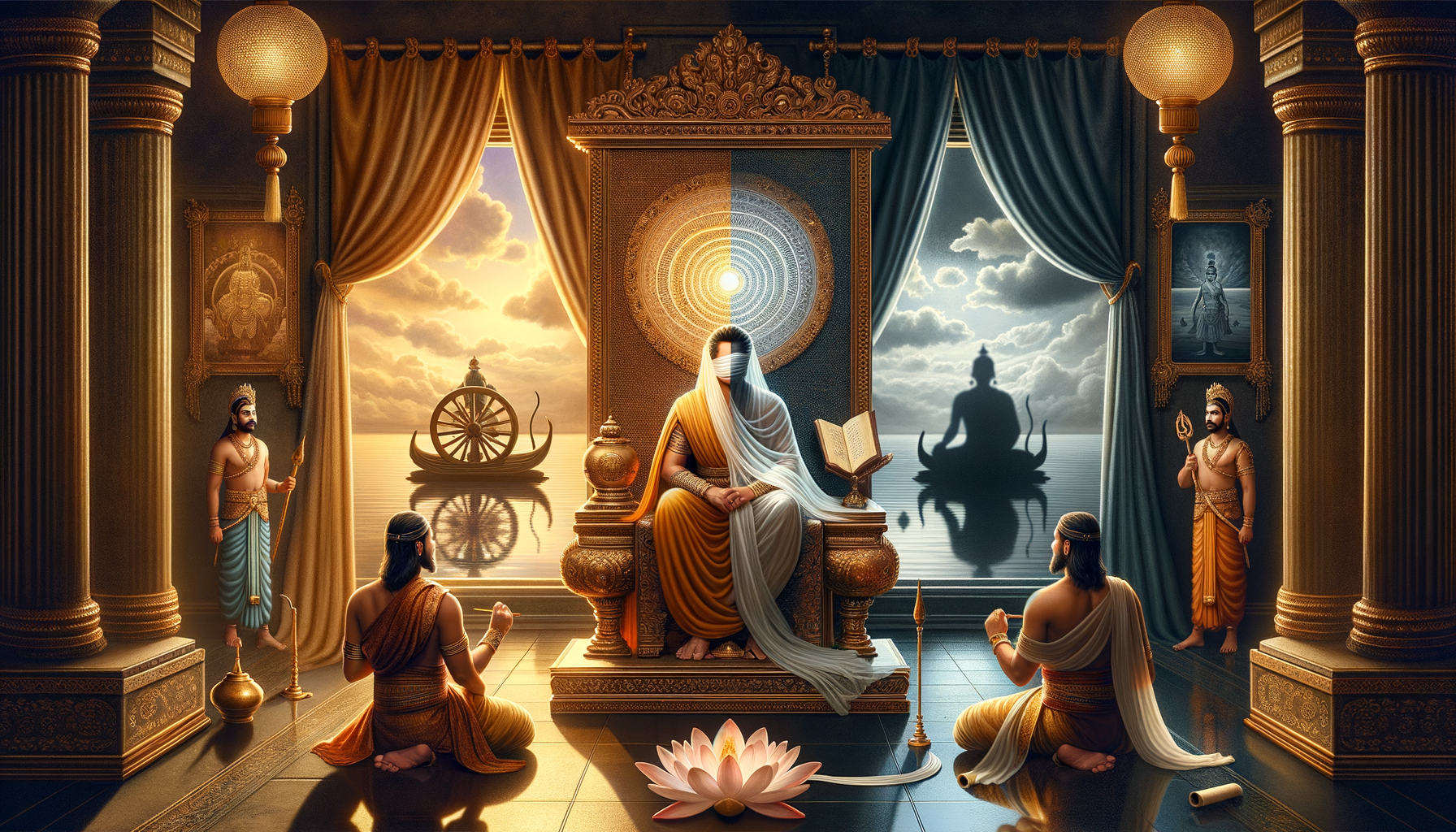
In the Mahabharata, Dhritarashtra’s birth as a blind king functions as a profound allegory for inner blindnessan inability to discern dharma from adharma when attachment and fear veil the mind. Rather than stigmatizing disability, the epic uses symbolism to illuminate a universal human condition: when craving, partiality, and insecurity dominate, moral vision dims, and judgment falters. This reading, grounded in Hindu philosophy, invites a reflective engagement with the text as a living guide to ethical clarity.
Dhritarashtra’s predicament is not merely physiological; it is psychological and ethical. His moha (attachment) to his sons and throne undermines viveka (discernment), making him susceptible to motivated reasoning and confirmation bias. Even as the Kurukshetra War approaches, and the Bhagavad Gita unfolds through Sanjaya’s narration, the king oscillates between yearning for truth and clinging to preference. The Mahabharata thus frames moral blindness as a state of the mind that resists uncomfortable truths, even when wise counsel is available.
Vidura’s counsel in Vidura-niti and Sanjaya’s steady narration offer the archetypes of conscience and clarity: calm, precise, and rooted in dharma. Their words exemplify the role of sattvalucidity and balancein restoring vision to the mind. Yet Dhritarashtra repeatedly defers to attachment, allowing Duryodhana’s ambition to override justice. The result is not only a royal failure but a cautionary tale about everyday decision-making: when affection, fear, or pride dictate choices, moral responsibility erodes.
The epic’s ethical psychology remains contemporary. In public life, echo chambers and partisan narratives mimic the king’s selective hearing; in families and workplaces, silence in the face of wrongdoing mirrors his abdication of responsibility. The Mahabharata’s lesson is clear: vision is not granted by sight alone but cultivated through disciplined attention to truth, even when truth demands courage. This is the enduring relevance of Dhritarashtra’s character among Mahabharata charactersan inward mirror urging the cultivation of moral clarity.
Dharmic traditions across Hinduism, Buddhism, Jainism, and Sikhism converge on practical methods to “see” rightly. Hindu dhyana and japa nurture steadiness and self-awareness; Buddhist sati and vipassanā train the mind to notice bias without clinging; Jain samayik and pratikraman refine inner accountability and aparigraha (non-attachment); Sikh simran and seva align intention with truthful action. Together they offer a unified path to restore viveka, demonstrating unity in spiritual diversity within the broader fabric of Sanatana Dharma.
Applied concretely, the teaching suggests three disciplines. First, pause before judgment (a practice akin to pratyahara) to separate fact from impulse. Second, seek counsel from those embodying Vidura-like sobriety rather than Duryodhana-like urgency. Third, examine personal attachments that skew perception, using daily reflection practices found across dharmic lineages. Such habits transform seeing into insight and knowledge into responsibility.
Read in this light, Dhritarashtra does not merely symbolize failure; he represents a threshold. The mind stands between blindness and wisdom, between adharma sustained by preference and dharma upheld by discernment. By embracing the Mahabharata’s symbolism and integrating the shared tools of the dharmic traditions, readers can cultivate moral clarity in uncertain times and embody the compassion, truthfulness, and courage that the epic ultimately esteems.
Inspired by this post on Hindu Blog.
