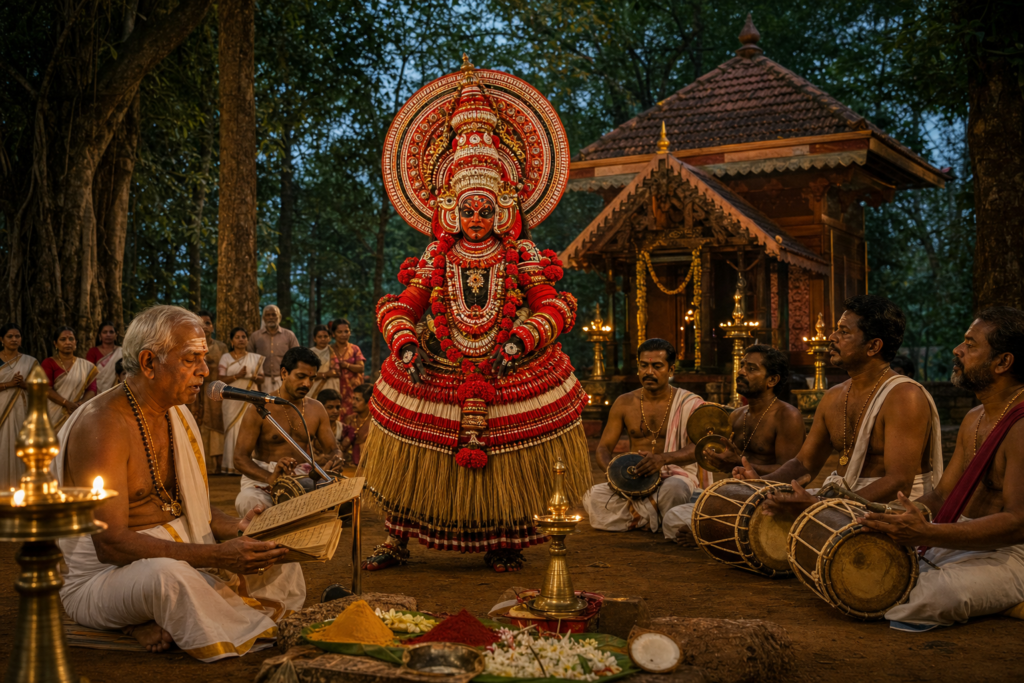
Bhudharatmajaya Bhairava illuminates Bhairava as the atma, the inner soul, of BhudharaEarth and mountains as living supports of existenceand as the Adhara, the unmoving ground beneath charachar prakriti, the entirety of moving and unmoving life. In this vision, Earth is not inert matter but a sentient matrix in which consciousness and form continuously co-arise, held by a steadfast substratum that Hindu traditions name Shiva in his fierce, alert modality as Bhairava.
Philologically, bhudhara denotes the mountain as the bearer of the earth, a stabilizing axis in sacred geography. Atma points to interiority and essence, while adhara signifies support, base, and unshakeable ground. Read together, Bhudharatmajaya Bhairava expresses a rigorous metaphysical claim: the world’s stability and the possibility of all movement rest in a witnessing, conscious core that is immovable yet ever-present in every locus of becoming.
This immovable core appears in the name Sthanu for Shiva, the pillar-like, enduring ground of being. As Bhairava, the ground is not passive; it is vigilant, protective, and precise, the kshetrapala or guardian that marks thresholds and holds the integrity of sacred space. The Earth, mountains, boundary shrines, and cremation grounds become loci where the unshakable base of reality is directly intuited.
Kalika stands as the kinetic counterpart to this ground. In Tantric insight, Shakti as Kalika is the inexhaustible dynamism of manifestation, while Bhairava is the luminous base that allows that dynamism to be intelligible and relational. The iconography of Kali poised upon Shiva evokes this dialectic without subordination: movement requires stillness, and stillness becomes knowable through movement.
Within Hindu cosmology, this relationship is mapped through the panchabhuta, the five great elements, and further refined in Shaiva systems that articulate thirty-six tattvas from the pure lights of consciousness to the densest forms. Prithvi tattva, the Earth principle, is the final consolidation of form; Bhairava as Bhudhara Atma is the conscious support in which prithvi becomes stable and habitable, and through which kalika, the power of transformation and time, can dance without collapse into chaos.
In Kashmir Shaivism, Bhairava denotes the supreme, unbounded awareness that self-recognizes as Aham, an all-pervading I-ness prior to subject–object division. From this undivided awareness, spanda, a subtle throb of creative freedom, arises as Shakti. Bhairava as adhara is that awareness, and Kalika as spanda is its pulse; Earth appears as the crystallized cadence of that pulse, the most intimate witnessable form of support.
As Kala-Bhairava, the fierce guardian of Kashi and master of time, the same metaphysics is re-specified. Time requires order, measure, and a constant from which change is reckoned; that constant is the unmoving support. Kalika embodies the transformative momentum within time. Thus, the Eternal Support of Kalika and the Worlds is not a metaphoric flourish but a subtle cosmological assertion about how change and constancy interpenetrate.
Purana and Agama literature knit these insights into sacred narrative and rite. Vedic hymns praise Earth as bhumi and dharini, the bearer; Puranas such as the Skanda Purana and Kalika Purana situate fierce guardianship, elemental stability, and Shakti’s sovereign play within sanctified landscapes. Temple manuals and Tantric instructions then translate these ontologies into ritual forms that make the ground experientially available to communities.
Temple architecture encodes adhara in stone. The garbhagriha sits upon foundations aligned to the directions, the dhvaja-stambha anchors the vertical axis, and Bhairava, often as kshetrapala, guards thresholds and perimeters. Ashta-Bhairavas ring many landscapes, eight stabilizing sentinels marking the compass and teaching that sacred geography is both map and method.
Ritually, Earth is touched first and last. The devotee bows and touches the ground, honoring the adhara before invoking the deities. Bali-pitha offerings acknowledge the elemental hosts. In the Kalabhairava tradition, stepping into a kshetra entails meeting the guardian who assures that time, space, and action remain in alignment with dharma.
Contemplative disciplines reflect the same grammar. Hatha Yoga texts describe prithvi-dharana and the cultivation of steadiness through the muladhara, literally the base. The seed sound lam stabilizes breath and attention. Bhairavi Mudra turns the senses inward, rooting awareness in the witnessing base; this interior adhara confers the steadiness from which insight arises without reactivity.
Ethically, Bhudharatmajaya Bhairava implies reverence, restraint, and responsibility toward Mother Earth. If Earth is a conscious support, stewardship is an expression of dharma, not an optional sentiment. Practices of ahimsa and aparigraha become modes of honoring the adhara, ensuring that Kalika’s transformative current remains creative rather than extractive.
Unity across dharmic traditions further corroborates this vision. In Buddhism, the Buddha’s bhumisparsha gesture calls Earth as witness to awakening, affirming the ground of truth. In Jain cosmology, Jambudvipa and Mount Meru structure a living, ordered world sustained by moral law. Sikh scripture sings Pavan Guru Pani Pita, Mata Dharat Mahat, venerating Earth’s greatness as mother. The shared ethic of reverence for Earth and the recognition of a moral–cosmic support converge powerfully in the dharmic family.
These convergences extend beyond symbolism into lived experience. Pilgrims at Kashi’s Kala Bhairava or Ujjain’s Kal Bhairav often report a somatic stillness that quiets the mind even amid bustle. The sensation is not of withdrawal but of grounding clarity, as if the ground itself participates in spiritual assurance. Such testimony aligns with the proposition that the adhara is not conceptual but palpable.
In sacred geography, mountains as bhudhara function as initiatory thresholds. Kailasa, Arunachala, and the Himalaya are approached as sentient teachers, their silence mirroring the immovability of the ground. The Earth-bearing mountain and Bhairava’s fierce awareness converge in these sites, guiding seekers from dispersion to centeredness.
From a philosophical lens, the unmoving core is not opposed to action; it conditions meaningful action. Just as a dancer requires a stable stage, Kalika’s creativity requires Bhairava’s ground. This complementarity dissolves false dualisms of ascetic withdrawal versus worldly engagement, proposing instead a discipline of steady presence that empowers compassionate, skillful participation in the world.
The doctrine also clarifies time and responsibility. Because Kala-Bhairava measures time from the standpoint of the unmoving support, discernment matures as the capacity to choose rhythms that accord with dharma. Periodic fasting, seasonal rites, and temple calendars synchronize communities with the deeper cadence of the adhara, tempering haste and excess while amplifying care and clarity.
For practice, three modalities translate the doctrine into daily life. First, a brief prithvi awareness each morning by placing both hands upon the floor and acknowledging Mother Earth as adhara cultivates gratitude and restraint. Second, a steady lam recitation with even exhalations anchors attention in the muladhara. Third, a weekly circumambulation at a local kshetrapala or Bhairava shrine, if available, trains the body to sense thresholds and responsibilities.
In textual study, the Skanda Purana’s theologies of guardianship, the Kalika Purana’s Shakti cosmologies, and Shaiva Agamas’ temple prescriptions form a coherent archive for exploring Bhairava as Bhudhara Atma. Read alongside Upanishadic reflections on atman as inner light, they reveal a consistent metaphysics in which consciousness grounds matter without denying matter’s sanctity.
The ecological consequences are timely. Seeing Earth as living support transforms policy and habit. Water is received as sacred, forests as sentient communities, and soil as a repository of lineage and life. Such vision does not romanticize nature; it re-educates desire, orienting well-being to right relationship with the adhara rather than to mere consumption.
Pluralism is native to this grammar. charachar prakriti is upheld through many forms of worship, idioms, and disciplines. Hindu, Buddhist, Jain, and Sikh streams affirm Earth’s sanctity and moral order in diverse ways, reflecting Vasudhaiva Kutumbakam while allowing each path its integrity. The unity sought is not uniformity but resonancedistinct voices tuned to a shared ground.
In sum, Bhudharatmajaya Bhairava is a precise key to a perennial insight. Bhairava names the luminous, alert, and fearless ground; Bhudhara names the Earth and mountains as its immediate expression; Kalika names the power of becoming that dances upon and within that ground. When embodied through ritual, ethics, and contemplation, this key opens toward steadiness in the midst of change, clarity in the press of time, and reverence in the embrace of Earth.
To stand with this doctrine is to learn equilibrium without indifference, power without domination, and devotion without credulity. The result is a life that moves with Kalika’s creativity while never losing Bhairava’s centera life attuned to the Eternal Support of Kalika and the Worlds.
Inspired by this post on Hindu Blog.