Ananda Tandava, the blissful dance of Lord Shiva, is a luminous synthesis of art, metaphysics, and devotion. Far more than an iconographic motif, it functions as a comprehensive map of reality in Hindu philosophy, revealing how consciousness, energy, and time unfold as a harmonious rhythm. In this form, Shiva Nataraja embodies ananda (supreme bliss) and choreographs the cosmos through a dynamic grammar of creation, preservation, transformation, concealment, and grace. The image is simultaneously devotional, philosophical, and practicalan invitation to experience the world as a living dance rather than a static design.
Etymologically, “ānanda” denotes unconditioned joy, while “tāṇḍava” names the vigorous divine dance that sets reality in motion. Tradition distinguishes the ecstatic Ananda Tandava from more ferocious modes such as Rudra Tandava, placing emphasis here on compassionate grace and the liberating play (līlā) of consciousness. In classical Shaiva thought, the bliss at the heart of Shiva’s movement is not psychological mood but ontological fullnessbliss as the very texture of being.
Across the history of Hinduism, and in dialogue with living practices in Shaiva Siddhanta, Kashmir Shaivism, and Advaita Vedanta, Ananda Tandava serves as a shared philosophical touchstone. Its insights also resonate deeply with the wider dharmic familyBuddhist, Jain, and Sikh traditionswhere the rhythmic nature of reality, the ethics of compassion, and the primacy of inner realization are celebrated in complementary ways. The dance thus becomes a bridge of unity among dharmic paths, honoring diversity while illuminating a common quest for wisdom.
The canonical key to understanding the dance is the doctrine of pañcakṛtya, the five cosmic acts attributed to Shiva: sṛṣṭi (creation), sthiti (maintenance), saṁhāra (dissolution or transformation), tirobhāva (veiling or concealment), and anugraha (revelation or grace). In Nataraja’s form, these acts are not abstract notions; they are made visible in gesture, posture, and attribute, allowing devotees, philosophers, and artists to contemplate metaphysics through a living image.
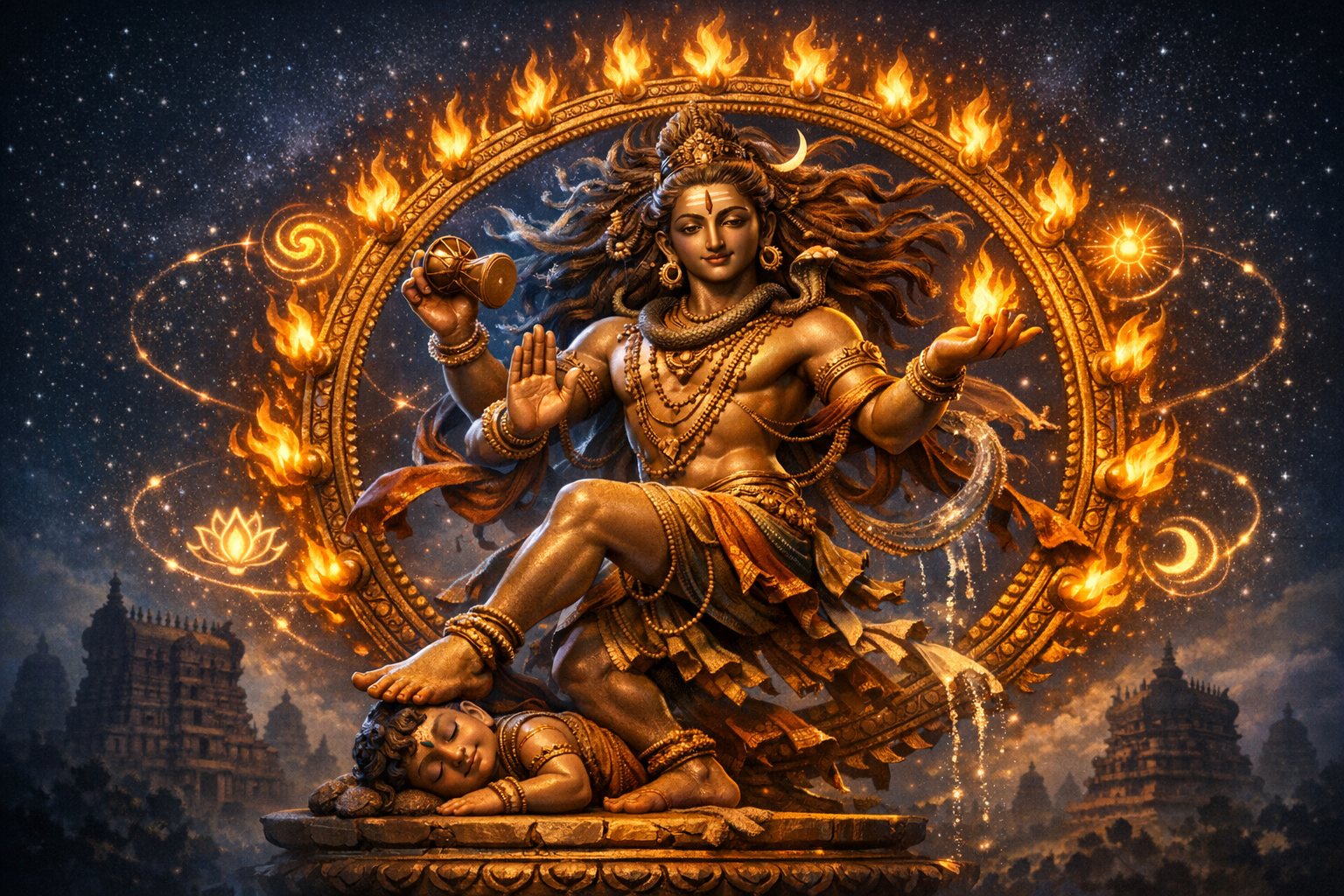
Classical iconography of Shiva Nataraja, perfected in the Chola bronzes, encodes this vision with meticulous symbolism. The ring of flames (prabhāmaṇḍala) signifies the pulsing perimeter of the cosmos, time (kāla), and the ceaseless energy (śakti) within which all phenomena arise and dissolve. The right upper hand holds the ḍamaru, the drum whose primordial beat births space, time, and sound (nāda), while the left upper hand cradles agni, the transformative fire that renews and resolves forms.
The lower right hand displays abhayaassurance of fearlessness and protectionexpressing Shiva’s sustaining compassion (sthiti). The lower left arm sweeps across the torso in gajahasta, gracefully indicating the raised left foot, the refuge of grace (anugraha) that liberates the devotee. Nataraja’s right foot subdues Apasmara (called Muyalakan in Tamil), the dwarf-demon of forgetfulness and spiritual nescience, symbolizing the conquest of inertia and ignorance through awakened awareness.
Every detail contributes: the streaming jaṭā (matted locks) that release Gaṅgā and hold the crescent moon suggest the integration of cosmic cycles and mind; serpentine ornaments affirm life-force and protection; the tribhaṅga posture captures poised dynamism rather than static balance. The entire figure visualizes Advaita’s sat–cit–ānanda (being–consciousness–bliss) through embodied rhythm.
Textual lineages for the Ananda Tandava converge from the Śaiva Āgamas (such as Kāmikāgama and Suprabhedāgama), the Śiva Purāṇa and Liṅga Purāṇa, Bhakti hymns of the Tamil Nāyaṉmār saints (Tēvāram), and philosophical treatises including Tirumūlar’s Tirumantiram. While the term Nataraja crystallized in the Tamil region, its metaphysical grammar coheres with pan-Indic sources. The Nāṭyaśāstra of Bharata Muni, foundational for classical dance, distinguishes tāṇḍava and lāsya, and preserves the 108 karaṇasmovements often mirrored in Nataraja bronzes and temple friezes.
The Chidambaram Nataraja Temple stands at the heart of this tradition as the ākāśa (space) chapter of the Pañcha Bhūta Sthalas. Within its Citsabhā, the famed Chidambara Rahasya reveals a paradox: a sanctified curtain opens to a revelation of “emptiness,” not as absence, but as the plenitude of formless consciousness. The icon and the empty space together proclaim that ultimate reality transcends form even as it compassionately manifests through forman insight that Ananda Tandava enacts.
Shaiva lore celebrates five dance halls (Pañcha Sabhas) where Shiva’s artistry unfolds: Chidambaram’s Kanaka Sabha (Golden Hall), Madurai’s Rajata Sabha (Silver Hall), Thiruvalangadu’s Ratna Sabha (Ruby Hall), Tirunelveli’s Tamra Sabha (Copper Hall), and Kutralam’s Chitra Sabha (Hall of Paintings). Thiruvalangadu, associated with Ūrdhva Tāṇḍava, memorializes Shiva’s supremely challenging movement, a legend interwoven with Kali’s own dance mastery, emphasizing that the divine arts transcend rivalry and culminate in shared radiance.
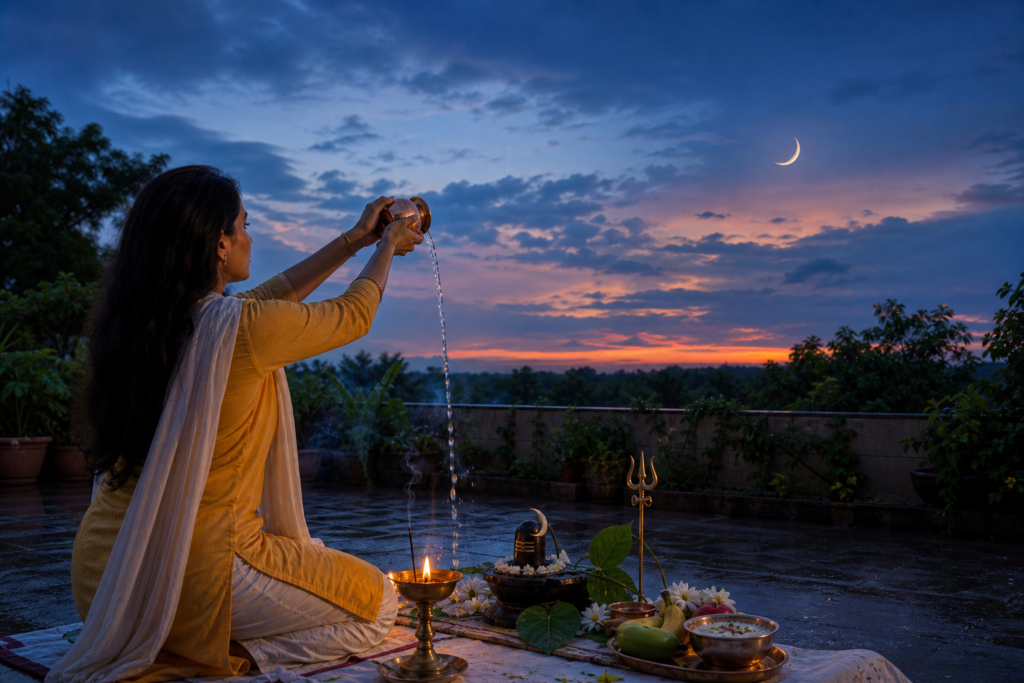
Arudra Darshan (Thiruvathirai), observed in the Tamil month of Mārgaḻi (Dhanur), is the liturgical zenith of Nataraja worship. Pilgrims describe a hush before dawn abhiṣeka, when the fragrance of vibhūti and bilva mingles with recited Tēvāram hymns, and the sanctum’s bronze effulgence becomes palpable. Devotees often recount a felt recognition that the “cosmic dance” is not distant myth but the very heartbeat of breath, memory, and meaning.
Shaiva Siddhanta interprets Ananda Tandava through the triad of Pati (the Lord), paśu (the bound soul), and pāśa (the bonds). Shiva’s five acts guide the soul from instinct and limitation toward jñāna and kaivalya. Tirobhāva (veiling) accounts for the obscurations of karma and mala, while anugraha (grace) is the liberating uplift of the raised footan emphatic theological assurance that compassionate emancipation is integral to the cosmic order.
Advaita Vedanta hears in the ḍamaru the pulse of nāda–bindu and reads the dance as līlā of Brahman. The bliss (ānanda) is not an effect of the dance but its very source: Brahman expresses as Śiva–Śakti, as awareness and its power to appear as the world. Thus, Ananda Tandava allegorizes the play of one non-dual reality that is ever-full, manifesting multiplicity without diminution.
Kashmir Shaivism renders the image through the lens of spanda (vibrational throb), prakāśa (self-luminous awareness), and vimarśa (self-reflection). The five acts are spontaneous effulgences of Paramaśiva’s freedom (svātantrya). Apasmara underfoot illustrates how limited cognition yields before expanded recognition (pratyabhijñā): reality is not a static substance but an ever-awakening continuity of consciousness, blissfully self-knowing.
In practice, the image is a guide to sādhanā. Many practitioners align breath with an inner “drum-beat,” reciting the pañcākṣarī mantra “Om Namaḥ Śivāya” to stabilize attention. Visualization of the prabhāmaṇḍala as the mind’s field of experience, Apasmara as constricting habits, and the raised foot as refuge helps cultivate fearlessness (abhaya) and clarity. This meditative grammar communicates Hindu philosophy not as abstraction but as embodied wisdom.
Bharatanatyam and other classical idioms translate Nataraja’s metaphysics into movement. Dancers often speak of a quiet moment backstage when the first syllables of the ḍamaru seem to sound inwardly; on stage, the karanas sculpt time into meaning. Training refines posture and breath until physical technique opens to rasa, and joy begins to feel less performed and more revealedan experiential echo of Ananda Tandava’s core promise.
The dance also models a dharmic ethos of pluralism. Within Hindu traditions, Ishta-devata freedom allows each seeker to approach the divine through the form and discipline that resonate most deeplydevotional song, temple ritual, philosophical inquiry, meditative practice, or aesthetic immersion. This openness naturally extends to dharmic kinships: Buddhism’s insight into impermanence (anicca) and dependent origination, Jainism’s celebration of non-violence and interdependence (parasparopagraho jīvanām), and Sikhism’s primacy of the Śabad/Naam all underscore a rhythm of reality that invites compassion, self-discipline, and liberation.
For historians, the Chola period Nataraja bronzes are masterworks of design engineering and theological sophistication. Their balanced center of mass, flowing jaṭā engineered into dynamic arcs, and precise mudras demonstrate knowledge that conjoined metallurgical excellence with scriptural fidelity. Temple architectureespecially at Chidambaramfurther anchors theology in space, making sacred geography a living textbook of Hindu civilization and cultural heritage.
Philosophically, Ananda Tandava rejects a rigid binary between creation and destruction. Saṁhāra here is not annihilation but transformation; the fire in Nataraja’s hand clears space for renewal, much like seasonal cycles in nature. This insight fosters ecological humility and ethical balance: preservation without stagnation, change without violence, a middle path that harmonizes continuity with creativity.
Contemporary seekers often note how the dance resonates with modern intuitions about a rhythmic universeoscillation, resonance, and patterned emergence. Responsible scholarship avoids facile one-to-one equations with physics; yet, as a contemplative metaphor, the icon refines intuition: reality is dynamic, relational, and intelligible through disciplined attention. In this way, Ananda Tandava nurtures an integrative intelligence that honors both spiritual insight and empirical curiosity.
The image’s ethical register is equally clear. Abhaya mudrā promises refuge to minds unsettled by uncertainty; Apasmara underfoot reminds that ignorance is conquered not by domination but by awakening; the raised foot extends grace without precondition. Together, these signs teach that knowledge married to compassion is the essence of right actiona principle that can guide families, communities, and institutions toward harmony.
Pilgrim testimonies from Chidambaram frequently emphasize a shared, wordless understanding that arises in communal worship: when the curtain parts and the sanctum’s light glints off the bronze, silence settles into a tangible presence. In that stillness, many feel seen, steadied, and invited to participate in the cosmic dance through humble daily virtuestruthfulness, non-injury, self-restraint, and reverence for all life.
As a living synthesis of Scriptures, temple architecture, classical arts, and philosophy, Ananda Tandava exemplifies the Hindu way of life at its most integrative. It offers a luminous vocabulary for unity across dharmic traditions: differences are not obstacles but ornaments in the larger choreography of truth. By returning again and again to Nataraja’s gestures, seekers learn to recognize bliss not as an escape from the world, but as freedom within it.
In sum, the Ananda Tandava of Shiva Nataraja is a masterpiece of spiritual engineeringequally at home in the sanctum, the dance hall, the study circle, and the silent seat of meditation. It encodes the pañcakṛtya as ethical poise, contemplative method, artistic discipline, and communal joy. To contemplate this icon is to rehearse an enlightened way of seeing: awareness steady, compassion active, and bliss unmistakably present.
Inspired by this post on Hindu Blog.