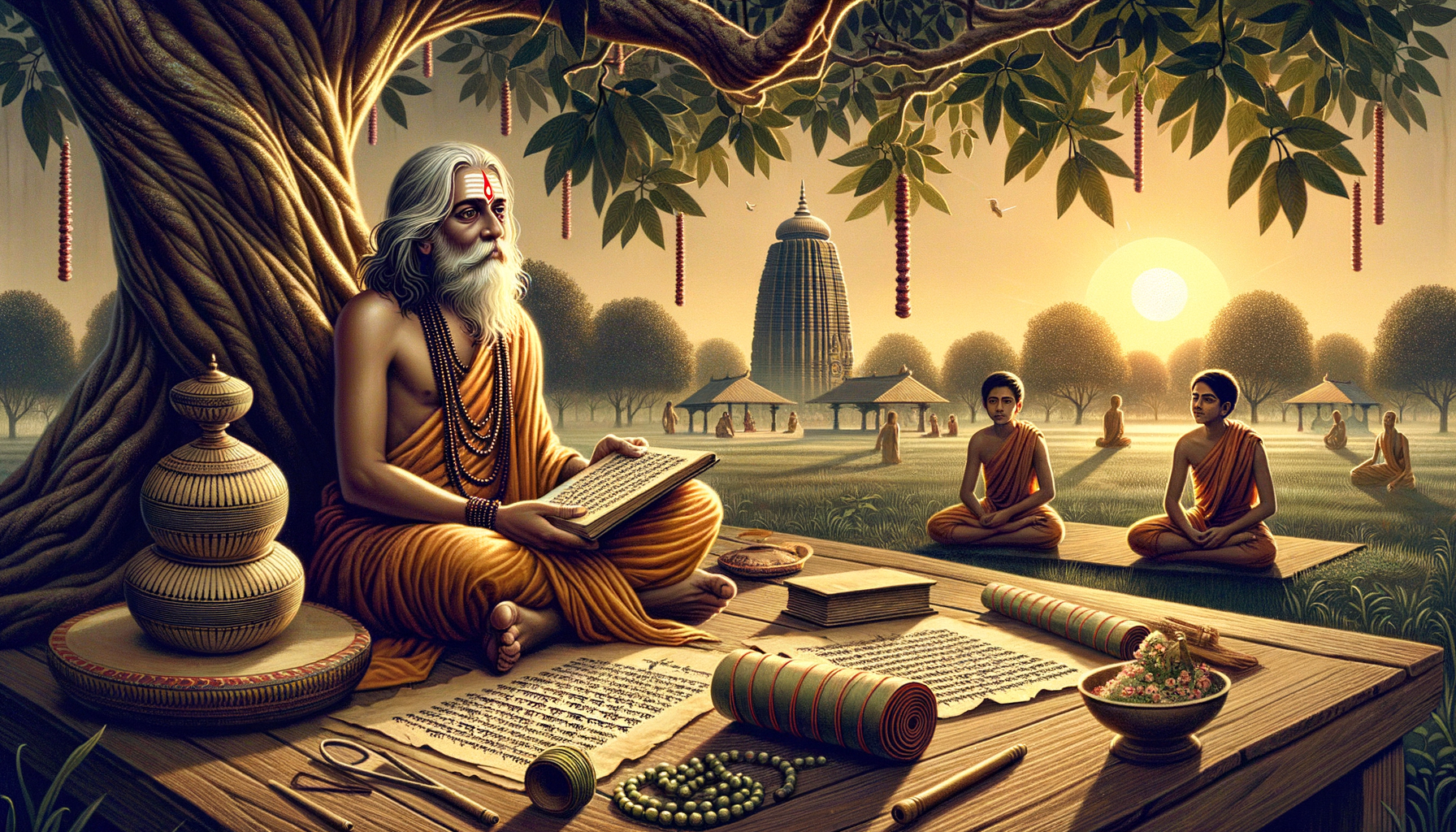
Baladeva Vidyabhushana, also known as Govinda Dasa or Govinda Muni, stands out as a late eighteenth-century figure in the Gaudiya Vaishnava tradition. Born into a Khandayata Vaishya family in a village near Remuna in the Balasore district of Odisha, his life reflects the continuity of scholarship and devotion that characterizes Hindu Dharma.
His formative training is linked to the disciplic lineage of Vairagi Pitambara Dasa and Radhadamodara Dasa, the author of Vedanta Syamantaka. This intellectual inheritance situates Baladeva within a stream of Vedanta reasoning and Bhakti Tradition, where scriptural rigor and devotional practice reinforce each other rather than compete.
As a writer on Gaudiya Vaishnava themes, Baladeva articulated a vision in which bhakti and Vedanta are harmonized through careful interpretation of scriptures and a disciplined Sanskrit idiom. His work exemplifies how philosophical inquiry and spiritual practice can cohere into a lucid and living traditionone that prizes clarity, fidelity to sources, and the ethical cultivation of the seeker.
The transmission of his learning continued through disciples, with sources noting two studentsone explicitly named as Nanda Mishra, and a second not specified in the surviving excerpt. This teacher–student continuity underscores the resilience of the Guru–Shishya Tradition, where knowledge is preserved through instruction, dialogue, and practice.
The cultural landscape of Odisha near Remuna offers a meaningful backdrop to his life and learning. For many readers and pilgrims, this region evokes a lived continuity of devotion and study, allowing contemporary audiences to connect emotionally and intellectually with a past that still informs present practice.
Baladeva’s synthesis offers a model for unity across dharmic traditions. Its emphasis on disciplined study, ethical conduct, and inner transformation resonates with shared values across Hinduism, Buddhism, Jainism, and Sikhism. Such affinities encourage mutual respect and dialogue, affirming that diverse methodsdevotional, contemplative, and philosophicalcan enrich a common pursuit of truth without erasing distinct identities.
For students of Indian history and philosophy, his legacy encourages rigorous, evidence-aware inquiry anchored in compassion and humility. For practitioners, it demonstrates that devotion need not abandon critical thought, and that Vedanta can be lived as much as it is studiedan insight as relevant to modern readers as it was to his own community.
Inspired by this post on Hindu Blog.