
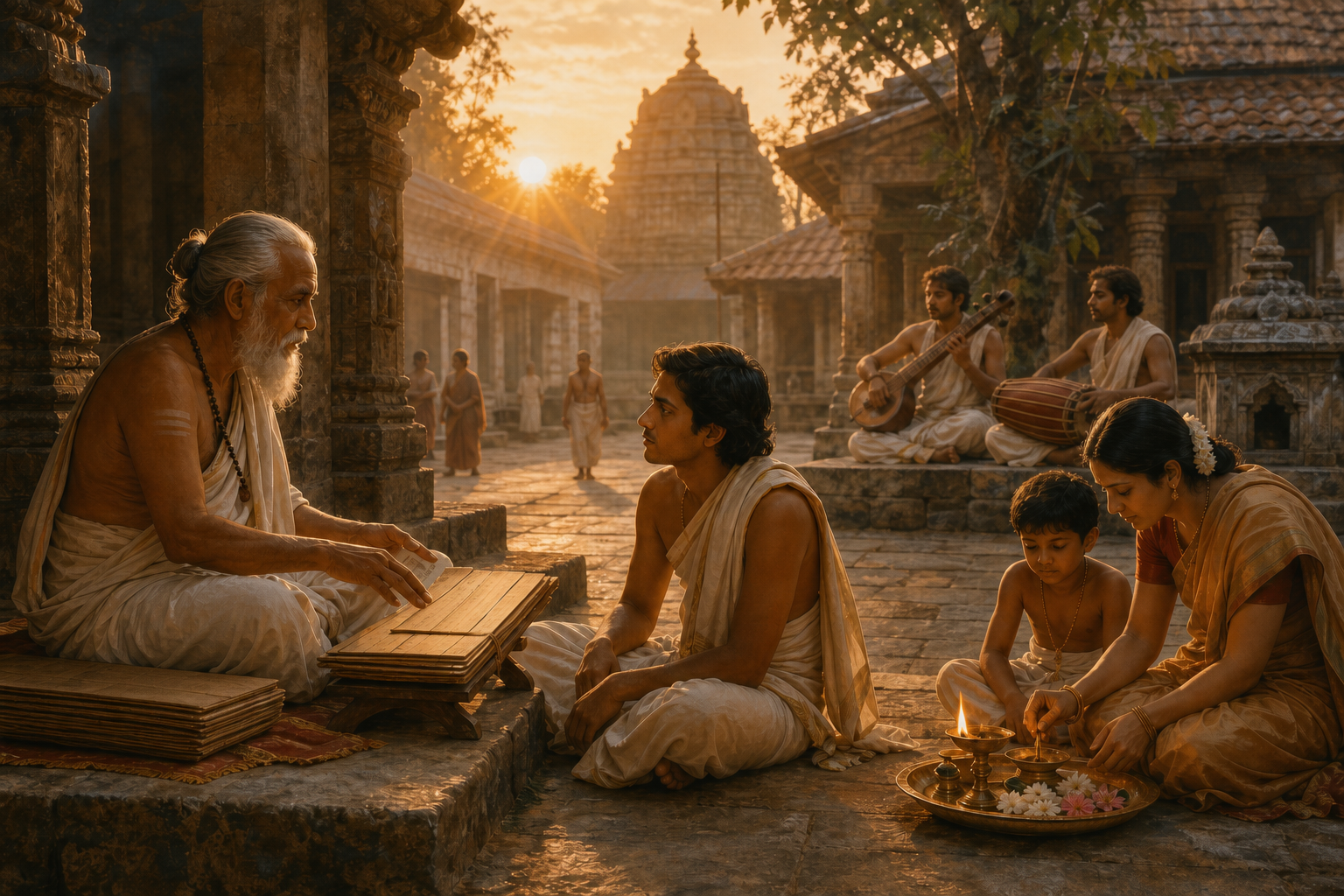
Dharma remains living when inherited knowledge becomes intelligible, practicable, and worth transmitting again. Across the source articles, continuity depends neither on texts alone nor on unexamined custom. It arises from an ecosystem of teachers, students, families, institutions, artists, rituals, stories, and communities.
Read together, the sources suggest four tests for successful transmission: fidelity to the knowledge received, accessibility across different levels of learning, embodiment in recurring practices, and meaningful adoption by a new generation. This framework helps explain both the resilience of Dharmic traditions and the vulnerabilities they face.
A living tradition must preserve more than information
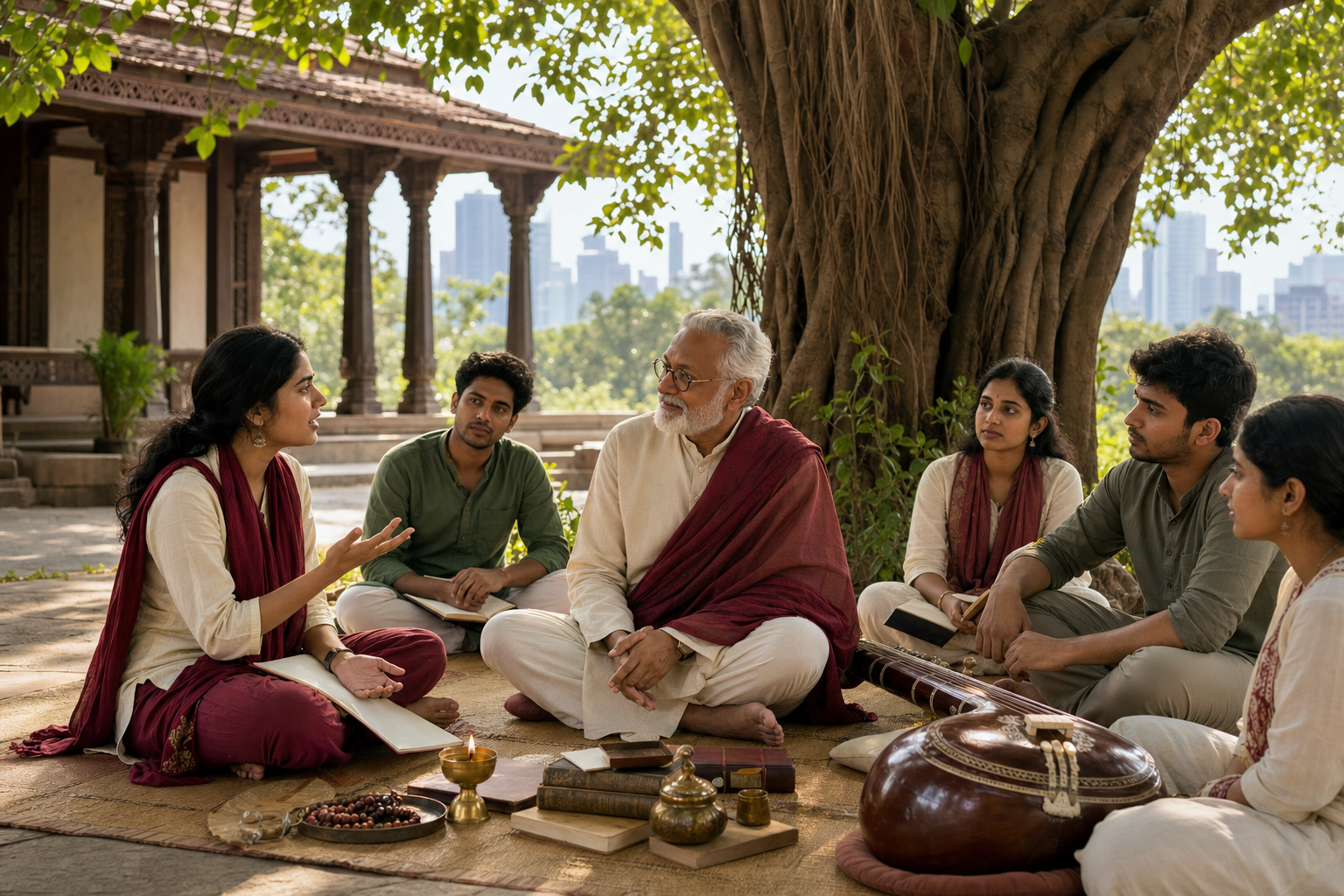
The source articles approach transmission from different starting points. The review of Ami Ganatra’s guide to Hindu Shastras begins with a vast textual inheritance: Vedas, Upanishads, Itihasas, Puranas, Darshanas, Dharmashastras, Vedangas, Upavedas, and regional traditions. The Dharma Civilization Foundation essay begins instead with the channels through which knowledge moves: recitation, commentary, Yoga, meditation, storytelling, ritual, art, pilgrimage, family, temple, and Sampradaya. Their shared conclusion is that a collection of texts becomes a tradition only when people learn how to receive, interpret, practice, and pass it onward.
This distinction separates an archive from a lineage. An archive can preserve words, objects, and recordings. A lineage also preserves pronunciation, interpretive context, standards of judgment, habits of attention, and the relationship between knowledge and conduct. The Dharma Civilization Foundation article accordingly presents Sampradaya as more than a denominational label. It is a continuity of understanding and method in which learning is received, examined, internalized, and responsibly taught.
The treatment of Shruti makes the point especially clearly. The transmission essay describes Vedic oral learning as a sophisticated discipline involving memory, breath, accent, rhythm, repetition, and patterned checks. The Ganatra review likewise emphasizes recitation, correction, mnemonic technique, and the guru-shishya relationship. These accounts agree that the human practitioner was not merely a carrier for content. The trained body, voice, memory, and attention formed part of the preservation system.
Yet fidelity does not mean freezing every expression of Dharma in one historical form. The Ganatra review presents Hindu textual culture as cumulative: later formulations can develop upon inherited foundations while retaining continuity of meaning. The transmission essay similarly describes multiple entrances suited to different dispositions, including philosophy, Bhakti, Yoga, ritual, story, and art. Variation can therefore support continuity when the new form remains connected to disciplined sources, ethical purpose, and transformative practice.
The result is a distributed model of preservation. No single family, monastery, temple, school, book, or artistic form is expected to carry the whole inheritance. Each preserves a different dimension, while relationships among them keep specialized learning from becoming isolated and popular practice from becoming unintelligible.
Fidelity and accessibility reinforce each other
A recurring transmission problem is the distance between specialized knowledge and everyday participation. If a tradition protects only its most technical forms, access narrows. If it offers only simplified forms, depth and precision may disappear. The strongest examples in the sources solve this problem by creating connected levels of entry.
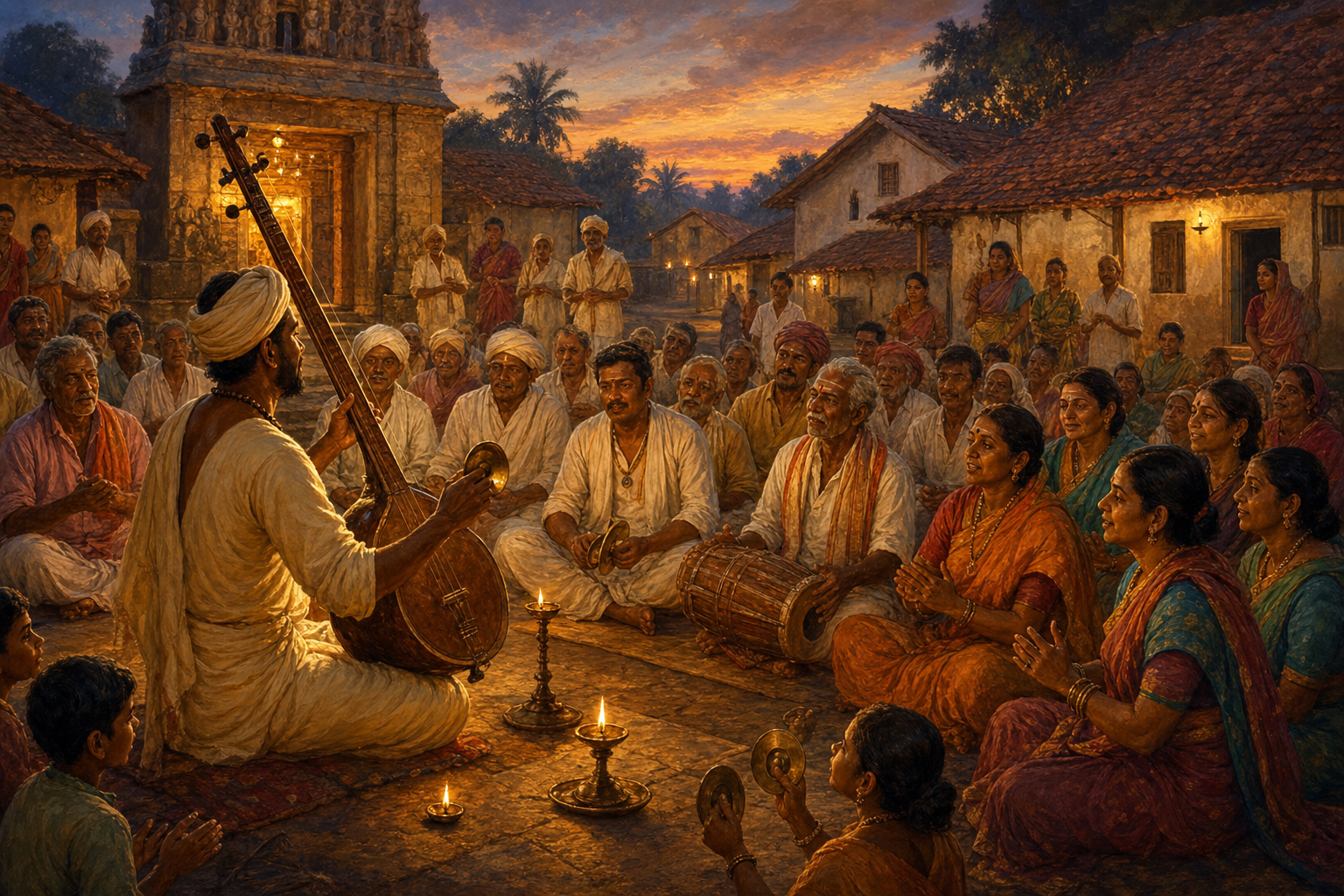
The Haridasa study supplies the most concrete historical case. It reports that the Madhva tradition possessed a developed Sanskrit philosophical literature while much household devotion operated through Kannada. Sri Sripadaraja’s Kannada devaranamas are presented as a way of carrying Dvaita ideas into memorable devotional forms without displacing Sanskrit scholarship. Sri Vyasatirtha contributed both rigorous philosophical works and Kannada compositions, while mathas furnished institutional support for teaching, preservation, and devotional networks.
Purandaradasa’s continuing musical presence shows how these layers could reinforce one another. The Haridasa article places his compositions in the first half of the sixteenth century and reports that they continued through homes, mathas, temples, concerts, and teaching lineages even after Hampi was devastated in 1565. The article interprets this survival not as the persistence of an isolated masterpiece, but as the outcome of an educational and devotional system joining philosophy, vernacular poetry, musical training, institutional shelter, and household practice.
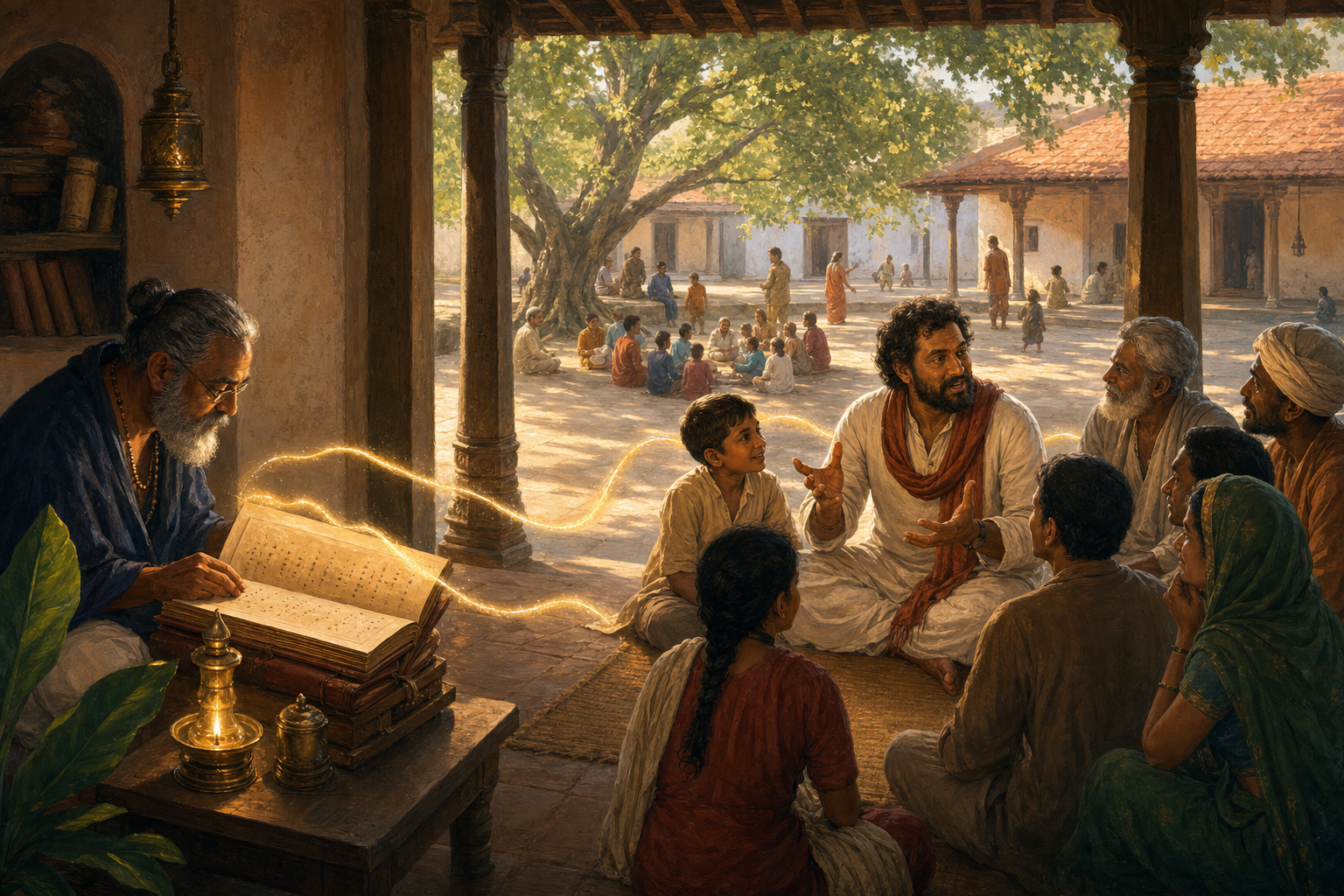
The Ganatra review and the Dharma transmission essay describe a comparable relationship between Shastra and narrative. Commentaries and philosophical systems train readers in precise reasoning, while the Ramayana, Mahabharata, Puranas, and Katha traditions place Dharma inside difficult human situations. Narrative does not merely make doctrine entertaining. It lets listeners revisit a dilemma at different stages of life, moving from plot to ethics, from ethics to philosophical inquiry, and from inquiry to self-examination.
Accessibility, then, need not require doctrinal dilution. It can mean offering related forms of different depth: accurate recitation for the trained student, commentary for sustained study, song for devotional memory, story for moral reflection, ritual for embodied participation, and explanation for the questioning learner. The forms are not interchangeable, but they can lead toward one another.
This model also guards against a false choice between inherited authority and inquiry. The sources portray the Darshanas and commentary traditions as cultures of argument, interpretation, and disciplined disagreement. A living transmission therefore teaches not only conclusions but also how questions are framed, evidence is assessed, rival positions are encountered, and insight is tested in life.
Practice turns inherited meaning into shared memory
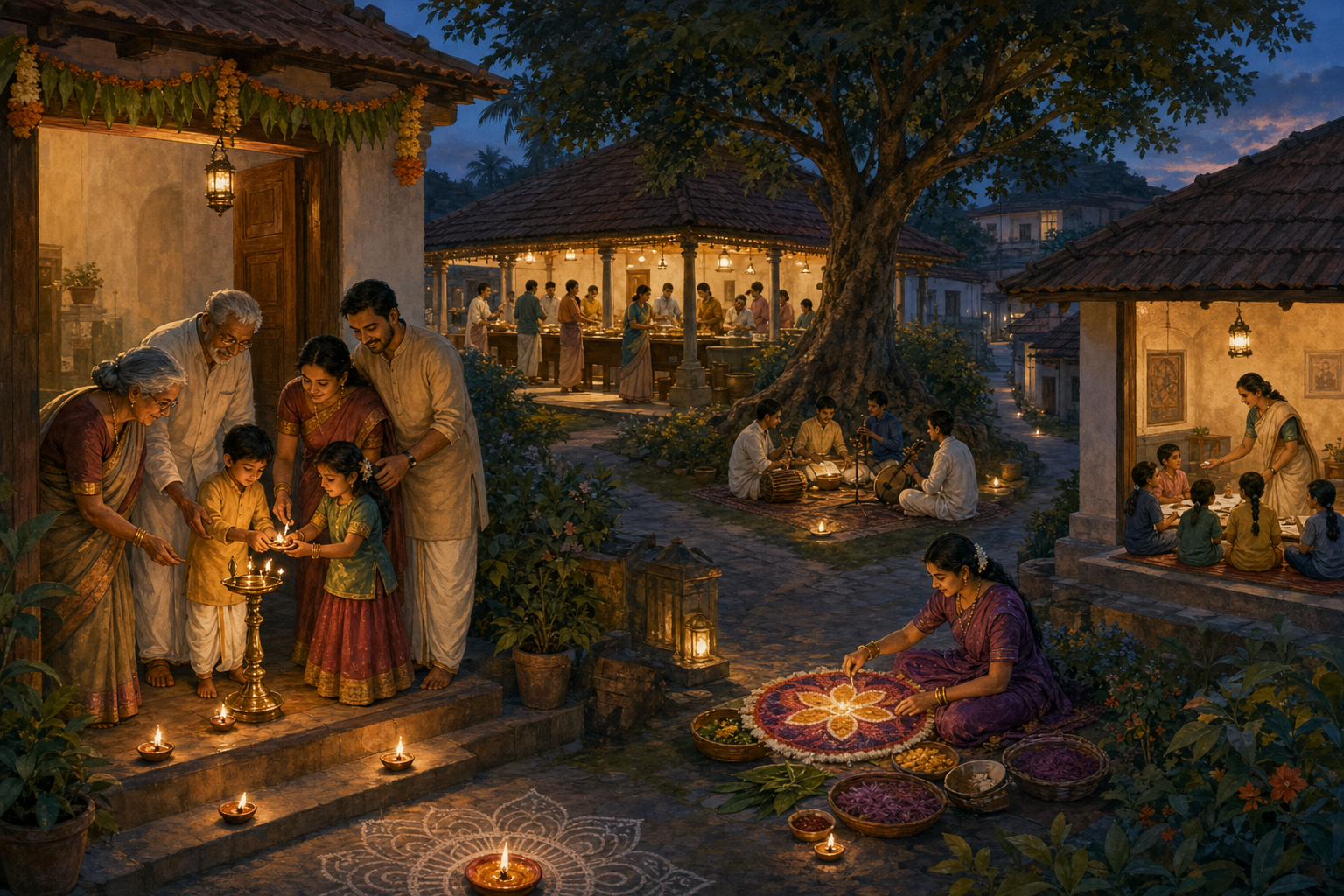
Texts and explanations become durable when they enter time, place, gesture, and relationship. The reflection on O Dharmaputri! argues that Hindu continuity can be heard and seen in home rituals, temple worship, Sanskrit and regional languages, festivals, music, dance, Yoga, Ayurveda, storytelling, and pilgrimage. Its concern is pedagogical: a sacred practice may appear empty to a child when its meaning is never explained, but an explanation also remains thin if it is never accompanied by experience.
The Pragyata essay on Navratri Kanjak reveals the social dimension of that experience. Recalling a Delhi neighborhood from the 1970s into the early 2000s, it describes girls visiting known households with steel plates, receiving halwa, poori, channa, small gifts, coins, and blessings. Adults honored the girls as forms of Devi, while children learned hospitality, recognition, trust, and sacred regard through participation. The theological teaching was carried by the conduct of neighbors as much as by verbal instruction.
This case expands the meaning of religious education. The child did not encounter Dharma only during a designated lesson. Dharma appeared in the route through the neighborhood, the preparation of food, the accessibility of familiar homes, the humility of adults, and the expectation that people beyond the immediate family shared responsibility for communal life. Repetition turned an idea into emotional and social memory.
The same essay contrasts that remembered neighborhood with a later environment of higher walls, denser buildings, parked cars, rental floors, and residents who may remain unknown to one another. This is an autobiographical comparison rather than a universal survey, but it identifies a genuine transmission question: what happens when a ritual remains on the calendar while the relationships that once sustained it weaken?
The sources collectively indicate that the isolated household cannot carry every burden of continuity. Families provide affection, early habits, language, and example, but they need teachers who can answer difficult questions, institutions that sustain advanced learning, artists who make memory beautiful, and communities in which service and reciprocity can be practiced. Conversely, institutions cannot compensate for a home in which Dharma is only discussed abstractly and never enacted.
Several sources extend this observation across the wider Dharmic family while preserving the distinctness of its traditions. They point to Hindu prasad and puja, Sikh langar and sangat, Buddhist dana and sangha, Jain disciplines of restraint and compassion, and shared respect for teachers, ethical formation, self-mastery, and liberation. The comparison does not make the traditions identical. It shows how spiritual teaching commonly requires social forms through which generosity, humility, discipline, and responsibility become habitual.
Diaspora changes inheritance from an assumption into a question
The American context places the four tests of transmission under particular pressure. The Dharma Civilization Foundation article on the changing religious landscape, drawing on Pew Research Center findings, reports that religiously unaffiliated Americans accounted for about 29 percent of adults in the 2023-24 Religious Landscape Study. It also notes that non-affiliation does not necessarily amount to hostility toward spiritual questions. The challenge for Hindu communities is therefore not simply competition with another organized religion. It may be the prospect of inherited identity becoming optional, private, or irrelevant.
The same article cites 2014 Pew figures reporting that 77 percent of Hindu adults in the United States were college graduates and that 36 percent of Hindu households had annual incomes above $100,000. The article uses these reported figures to frame a paradox rather than a triumph: educational and professional success cannot by itself transmit an account of selfhood, suffering, duty, consciousness, or liberation.
The O Dharmaputri! reflection reaches a similar conclusion from the perspective of parents and young people. It suggests that contemporary youth may resist unexplained obligations and shallow answers more than they resist depth itself. The Purusharthas, Itihasas, Yoga, Ayurveda, and Vedanta become relevant when they illuminate recognizable questions about ambition, relationships, desire, anxiety, responsibility, happiness, and freedom. Cultural affection can open the door, but sustained belonging requires intellectual honesty and practical consequence.
Diaspora transmission also requires distinguishing Dharma from ethnicity without severing it from Bharat, sacred geography, language, or historical memory. The American-landscape article argues that later-generation Hindu Americans may be deeply American in civic identity. For them, Dharma cannot remain solely a preserved memory of immigrant life. It must also function as a knowledge tradition capable of addressing human problems in their present surroundings.
This changes the role of explanation. A practice cannot rely indefinitely on the answer that it is performed because the family has always performed it. Teachers and parents need to clarify what a practice trains, which text or lineage informs it, how interpretations differ, and where a beginner can go deeper. Questions should become part of transmission rather than evidence that transmission has failed.
At the same time, explanation alone should not reduce Dharma to a set of agreeable ideas. The sources repeatedly present knowledge as transformative: it disciplines attention, action, desire, speech, relationship, and service. A new generation receives a living tradition when it is given both reasons to enter and practices through which understanding can mature.
Key takeaways
- Preserve fidelity through qualified teaching, careful study, accurate recitation, and accountable interpretation.
- Create connected levels of access through regional language, story, music, ritual, philosophy, and age-appropriate explanation.
- Pair concepts with recurring practices so that Dharma shapes attention, conduct, memory, and relationships.
- Build communities around hospitality, service, celebration, learning, and shared responsibility rather than leaving transmission to individual households.
- Treat sincere questions as invitations to deeper inquiry, while ensuring that inquiry leads toward practice rather than cultural information alone.
These principles suggest a practical standard for families and institutions: each point of entry should lead somewhere. A festival can lead to its story and symbolism; a song can lead to language and philosophy; a Yoga practice can lead to ethics and self-study; a children’s class can lead to advanced learning, service, and eventual responsibility for teaching others.
Digital media can extend access, but the model presented across the sources remains relational. Recordings cannot fully replace correction, information cannot replace formation, and visibility cannot replace community. The next phase of Dharmic continuity will depend on using new channels while renewing the human bonds through which knowledge acquires integrity and life.
The decisive measure will be whether receivers become responsible transmitters. When learners can understand what they inherit, practice it with discernment, and adapt its expression without severing its foundations, Dharma remains more than a memory of the past: it becomes a resource for lives not yet formed.
References
- Indica Today — Ami Ganatra’s Powerful Guide to Hindu Shastras and Living Knowledge Systems
- Indica Today — O Dharmaputri Review: Powerful Dharma Lessons for Raising Rooted Gen-H
- Indica Today — How the Haridasas Built a Powerful Five-Century System of Devotion and Learning
- Pragyata — Reviving Navratri Kanjak: The Powerful Community Ritual Modern India Needs
- Dharma Civilization Foundation — How Dharma Survives: Powerful Oral Traditions That Preserve Living Wisdom
- Dharma Civilization Foundation — Why Hindu Dharma Can Inspire America’s Spiritually Unaffiliated Generation