
A familiar teaching story describes an old synagogue in Eastern Europe where, during a prayer, half the congregation stood while the other half remained seated. Those sitting demanded that the standing congregants sit down; those standing demanded that the seated congregants rise. The rabbi, though learned in law and commentary, could not settle the quarrel. Hoping to recover the authentic custom, he visited a 98-year-old founder of the congregation with representatives from both sides.
The first representative asked whether the tradition was to stand during the prayer. The elder answered that it was not. The second asked whether the tradition was to sit. Again, the elder answered that it was not. When the rabbi explained that the congregation fought constantly over whether to sit or stand, the elder finally recognized the living continuity of the community: the argument itself had become the tradition.
The story is humorous, but its philosophical significance is serious. Civilizations often preserve themselves not only through settled doctrines but also through debate, memory, friction, improvisation, and repeated acts of interpretation. India, especially when approached through Hinduism and the wider Dharmic traditions, cannot be adequately understood as a fixed ritual system, a single creed, or a linear historical project. It is better approached as a civilizational field in which continuity and argument, reverence and revision, memory and intuition have existed together for millennia.
India is not reducible to geography, political history, ritual practice, or national identity. It can be mapped, governed, excavated, and catalogued, but those activities do not exhaust what India has meant to those formed by its spiritual and cultural inheritance. India has been experienced as Bharata, as sacred geography, as a network of pilgrimage routes, as a landscape of rivers and temples, as a home of philosophical inquiry, and as a living matrix of Hindu, Buddhist, Jain, Sikh, and other traditions that have shaped one another through proximity, dialogue, contestation, and shared ethical concerns.
This is why attempts to define India by a single adjective usually fail. India is ancient and modern, disciplined and improvisational, metaphysical and practical, austere and festive, local and universal. It is not a concept that yields easily to one interpretive framework. Like love, it is most fully known through experience, participation, attention, and inward recognition. Analytical categories are necessary, but they become misleading when they pretend to contain the whole.
In academic study, the question is not whether history matters. It certainly does. Inscriptions, textual transmission, temple patronage, philosophical schools, social institutions, political change, and patterns of cultural exchange all matter. The more precise question is whether the modern Western sense of history, centered on chronology, documentary evidence, institutional causality, and linear development, is sufficient for understanding a civilization that often placed equal or greater emphasis on inner knowledge, symbolic truth, sacred time, and experiential realization.
Indian civilization did produce historical memory, but it often organized that memory differently. The Itihasa-Purana tradition, genealogies, temple records, royal inscriptions, oral epics, regional sthala-puranas, and philosophical commentaries preserve the past in ways that combine narrative, ethics, cosmology, metaphysics, and social instruction. This does not mean that India lacked history. It means that the Indian understanding of meaningful memory was not limited to dates and events. It asked what a remembered event reveals about dharma, human conduct, cosmic order, liberation, and the consequences of action.
Modern historiography therefore performs an important service when it clarifies evidence, corrects romantic exaggeration, and distinguishes verifiable fact from inherited assumption. Yet it becomes inadequate when it treats symbolic language as mere ornament, ritual as irrational habit, or spiritual experience as secondary to political explanation. India’s civilizational archive includes both external record and inner realization. The technical challenge is to study both without collapsing one into the other.
Osho’s reflection, cited in the source essay from the Dharma Civilization Foundation, captures this dimension by describing India as more than geography or history, as a metaphor and a poetic presence. That formulation is not a substitute for scholarship, but it indicates something scholarship must account for: India has often understood truth not only as an object to be described but as a reality to be realized. The language of yoga, Vedanta, bhakti, tantra, Jain tapas, Buddhist awakening, and Sikh devotion all points toward disciplined transformation rather than mere intellectual classification.
Hinduism, in particular, resists the expectation that a religion must possess one founder, one book, one church, one universally mandated prayer, or one exclusive path of salvation. The word Hinduism itself is a later umbrella term for a vast family of traditions, practices, philosophies, communities, and lineages. Sanatana Dharma, Vaidika traditions, Shaiva, Vaishnava, Shakta, Smarta, folk, temple, yogic, and philosophical streams have all contributed to the larger Hindu way of life. Their differences are not incidental; they are part of the structure of the tradition.
This plurality is visible in the classical darshanas. Nyaya developed rigorous methods of logic and epistemology. Vaisheshika examined categories of reality. Samkhya analyzed purusha and prakriti. Yoga offered disciplined methods for mental stillness and liberation. Mimamsa interpreted ritual action and Vedic authority. Vedanta explored Brahman, atman, consciousness, and liberation through multiple schools such as Advaita, Vishishtadvaita, and Dvaita. These systems did not always agree, but their coexistence shows that Hindu philosophy developed through disciplined debate rather than enforced uniformity.
The same pattern appears in practice. One person may approach the Divine through Vishnu, another through Shiva, another through Devi, another through Surya, Ganesha, Skanda, a village deity, a guru, a mantra, a formless Absolute, or the quiet discipline of meditation. The idea of ishta, the chosen or beloved form of worship, acknowledges that spiritual temperament differs from person to person. This is not merely tolerance as a modern political virtue; it is a theological and psychological recognition that human beings do not all awaken through the same doorway.
Such freedom can appear disorderly to observers expecting centralized authority. Hinduism has no single ecclesiastical hierarchy comparable to a church structure with universal doctrinal enforcement. It has mathas, akharas, sampradayas, acharyas, gurus, temple traditions, monastic lineages, household practices, regional customs, and scriptural authorities, but these do not form one centralized command system. This decentralization has allowed remarkable cultural resilience. It has also produced ambiguity, internal disagreement, and uneven social practice. Both realities must be acknowledged honestly.
Pluralism is not the same as confusion, though it can become confusing when its internal grammar is ignored. Hindu traditions often operate through layered authority: shruti, smriti, achara, anubhava, guru-parampara, regional custom, and personal sadhana. A practice may be local yet meaningful, symbolic yet disciplined, inherited yet adaptive. To understand such a system, one must ask not only whether a practice is uniform across India, but what role it plays in a particular community, lineage, temple, household, or spiritual discipline.
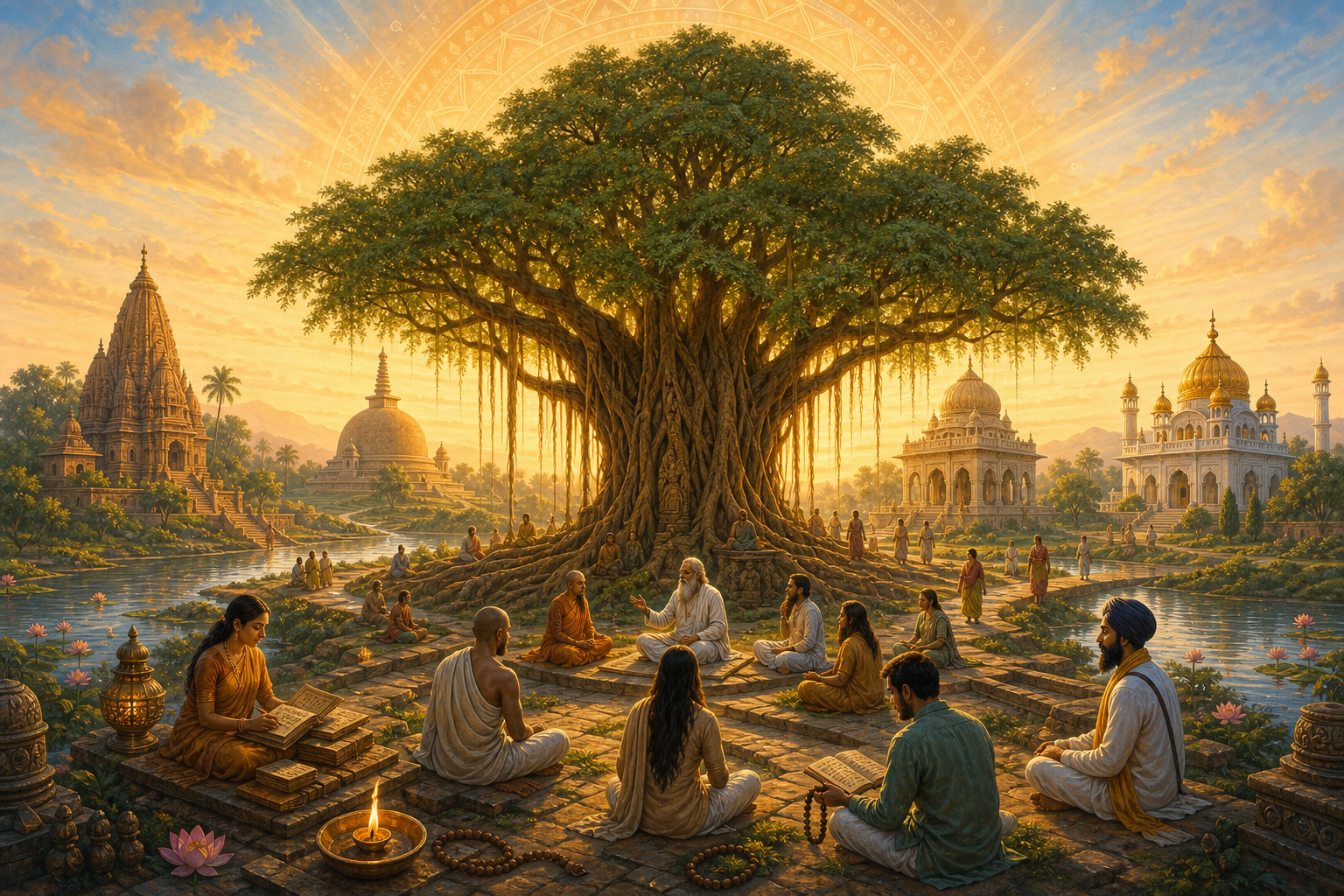
The image of the banyan tree is especially useful. A banyan does not grow like a single straight trunk; it sends down aerial roots that become new supports while remaining connected to the original organism. Hinduism has grown similarly. New devotional movements, philosophical commentaries, regional practices, temple cultures, reform movements, and household rituals have emerged across time without necessarily severing themselves from older roots. The result is neither a rigid monument nor a shapeless mass, but a living organism with many centers of nourishment.
This also helps explain India’s relationship with other Dharmic traditions. Buddhism, Jainism, and Sikhism developed distinctive doctrines, institutions, and disciplines, yet they arose within the broader Indic civilizational environment shaped by karma, rebirth, liberation, renunciation, ethical self-cultivation, meditation, non-violence, guru-disciple learning, and the search for truth beyond mere material success. Their differences should not be erased, but their shared civilizational vocabulary matters. Unity among Dharmic traditions is strongest when it respects both distinctiveness and kinship.
Buddhism challenged ritual formalism and analyzed suffering with extraordinary psychological precision. Jainism elevated ahimsa, aparigraha, and disciplined self-restraint into a demanding ethical path. Sikhism placed devotion, courage, service, equality, and remembrance of the Divine at the center of community life. Hindu traditions, in their many forms, explored metaphysics, ritual, devotion, yoga, aesthetics, and social duty. Together, these traditions show that India’s spiritual inheritance is not a single voice but a profound conversation about consciousness, ethics, liberation, and human responsibility.
The emotional power of India lies partly in this simultaneity. A pilgrim may encounter crowded streets, temple bells, philosophical debate, devotional singing, economic struggle, ritual precision, social contradiction, and deep hospitality in the same day. A purely logical account may see only disorder. A purely romantic account may overlook suffering and complexity. A mature account must hold both. India can be bewildering because it refuses to separate the sacred from the ordinary, the metaphysical from the domestic, or the eternal from the daily.
This is why brief exposure often produces confident generalization, while longer experience produces humility. A visitor may spend a week in India and believe a complete book can be written. After a month, an article may seem more appropriate. After a year or more, even a paragraph may feel difficult. The longer one studies India, the more visible its layers become: language, caste, region, sect, scripture, cuisine, music, temple, memory, politics, ecology, family, guru, and pilgrimage all intersect in ways that resist simplistic explanation.
For scholarship on Hinduism, this complexity requires methodological humility. Textual study is indispensable, but texts live within performance, commentary, recitation, ritual, and embodied practice. Temple studies are indispensable, but temples are not merely architectural objects; they are centers of economy, art, memory, devotion, food distribution, music, and collective identity. Philosophy is indispensable, but Indian philosophy often assumes that knowledge must transform the knower. Social critique is indispensable, but critique must avoid flattening a civilization into its failures alone.
The most fruitful approach therefore combines historical rigor with civilizational empathy. It examines evidence carefully, yet remains attentive to categories native to the tradition: dharma, moksha, karma, atman, Brahman, shakti, bhakti, seva, sadhana, guru, darshana, and anubhava. These terms should not be reduced too quickly into Western equivalents. Dharma is not merely religion, law, ethics, or duty, though it touches all of them. Moksha is not simply salvation in an Abrahamic sense. Darshana is not only philosophy; it also means a way of seeing.
This attention to native categories also guards against an overly narrow reading of “alternative history.” Alternative perspectives can be valuable when they recover neglected voices, correct colonial assumptions, or question inherited academic habits. Yet an alternative history of Hinduism becomes incomplete if it studies only power, conflict, and social construction while neglecting spiritual aspiration, philosophical sophistication, ritual meaning, and lived devotion. India’s alternatives are not merely political alternatives; they include alternative ways of knowing, remembering, worshipping, and becoming human.
Hinduism’s enduring contribution is not that it resolves every contradiction into a neat system. Its contribution is that it has preserved many legitimate routes of inquiry under a broad civilizational canopy. It can accommodate the ritualist and the renunciate, the temple devotee and the philosopher, the poet-saint and the logician, the householder and the monk, the image-worshipper and the seeker of the formless Absolute. This does not mean every practice is beyond critique. It means critique must understand the breadth of the tradition before judging its parts.
Such breadth has practical consequences for contemporary society. In a world strained by ideological absolutism, religious competition, identity anxiety, and cultural fragmentation, the Dharmic principle of many paths offers a disciplined alternative. It does not require that all doctrines be declared identical. It asks that diverse seekers be allowed to pursue truth according to temperament, training, lineage, and conscience, while remaining bound by ethical responsibility and mutual respect. This is the deeper meaning of unity in diversity.
At the same time, freedom without responsibility can decline into fragmentation. A decentralized tradition requires education, self-discipline, and serious transmission. Without knowledge of scriptures, languages, practices, and philosophical frameworks, pluralism can be mistaken for mere personal preference. The challenge for modern Hinduism and the broader Dharmic world is to preserve spiritual freedom while strengthening intellectual clarity, ethical accountability, and inter-traditional solidarity.
This solidarity is especially important for Hindu, Buddhist, Jain, and Sikh communities today. Each tradition has its own history and integrity, yet all can contribute to a shared civilizational renewal grounded in truthfulness, non-violence, compassion, courage, self-mastery, service, learning, and reverence for life. Academic study should help illuminate these resources rather than turn living traditions into inert museum objects or ideological caricatures.
India’s gift, then, is not a single doctrine to be exported, nor a nostalgic image to be preserved without examination. Its gift is a vast repertoire of human possibilities: disciplined inquiry, sacred art, philosophical debate, devotional intensity, symbolic imagination, ritual continuity, social experimentation, and spiritual interiority. It teaches that truth may be approached through reason, meditation, love, duty, beauty, renunciation, service, and direct experience.
The original reflection concludes with Osho’s image of sudden illumination, where intuition reveals the whole at once rather than piece by piece. Whether one accepts that image literally or poetically, it expresses an important civilizational intuition: reality is not always grasped by analysis alone. There are moments when experience gathers scattered fragments into a total perception. Indian spirituality has long valued that flash of recognition, not as irrationality, but as a deeper mode of knowing disciplined by practice.
Asato Ma Sadgamaya remains a fitting closing reminder. The movement from the unreal to the real, from darkness to light, and from limitation toward liberation is not the property of one sect alone. It belongs to the shared aspiration of the Dharmic traditions and to all who seek truth with humility. India and Hinduism are best studied, therefore, not as closed systems, but as living pathways into pluralism, inquiry, devotion, and inner transformation.
Source consulted for this rewrite: Dharma Civilization Foundation, “Reflections on studying Hinduism and what India has to offer”.
Inspired by this post on Dharma Civilization Foundation.


Leave a Reply
You must be logged in to post a comment.