The musalaclassically rendered in Sanskrit as mūṣala and widely remembered across South India as the ulakkaioccupies a distinctive place in Hindu iconography as the sacred pestle associated with Balarama. More than a weapon, it symbolizes the deep agrarian imagination of the subcontinent: a household implement for pounding grain elevated into a sign of divine protection, social stability, and the ethical force of kṣatra (protective valor). Within Vaishnava traditions, Balarama is frequently praised as Hala-muṣala-dhara, the bearer of the plough (hala) and the pestle (mūṣala), a pairing that fuses cultivation and guardianship into one integrated ideal.
In form, the musala is long, straight, and cylindrical, retaining near-uniform thickness along most of its length, with a gently rounded or slightly flared striking end. This geometry distinguishes it from the gadā (mace), whose bulbous head concentrates mass at the tip for percussive impact. The musala’s mass is distributed along the shaft, producing a different moment of inertia and a smoother, more controllable arc when swung. In domestic contexts, this same profile optimizes repetitive pounding of grain within a mortar, an everyday movement that ancient Indian viewers would instantly recognize. The continuity between household utility and sacred symbolism is deliberate: the very tool that feeds a community also protects it.
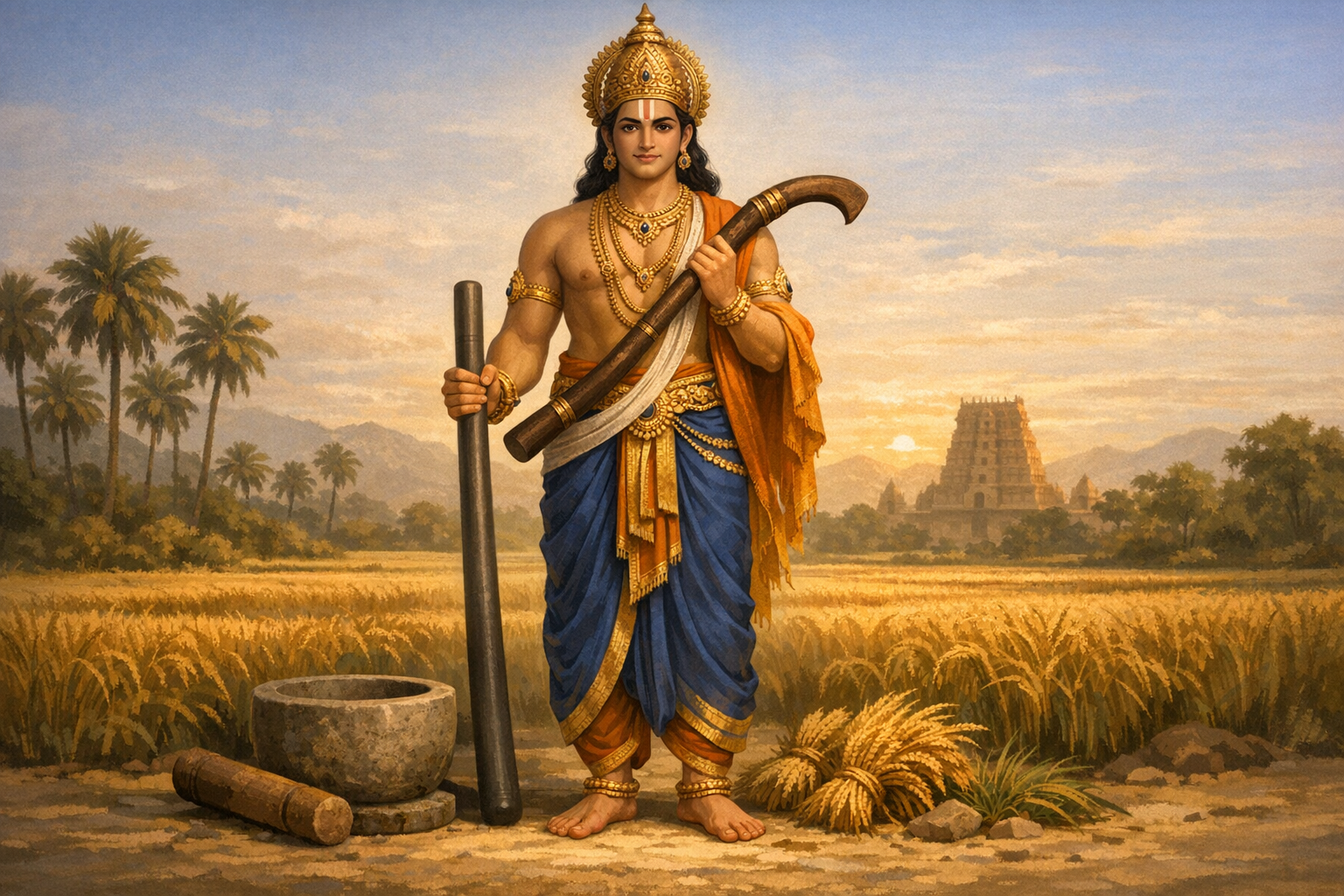
Classical Sanskrit lexicons and Puranic literature use mūṣala to denote a pestle or club, often in juxtaposition with ulūkhala (mortar). As a weapon, the musala could be fashioned from dense hardwood or forged iron, yielding variants suited to ritual display, close-quarters defense, or ceremonial iconography. Iconographers typically render it as a straight staff held vertically or diagonally, sometimes with a subtly expanded striking end; its measured simplicity is a hallmark that aids identification in sculpture, painting, and temple bronzes.
Textual references anchor the musala in the narrative world of the Mahabharata corpus and allied Vaishnava texts. The Mausala Parva of the Mahabharata recounts the tragic dissolution of the Yadavas, in which an iron bolt, cursed into being, is ground to powder and cast into the sea; the filings reappear as eraka grass that becomes the instrument of internecine strife. A remnant hard fragment contributes to the chain of events culminating in the departure of Krishna from the mortal realm. This episode frames the musala not only as a physical implement but also as a profound moral device that reflects law (dharma), consequence (karma), and the cycle of rise and decline within time (kāla).
Complementing this later narrative, the Bhagavata Purana and Harivamsa celebrate Balarama’s consistent association with the hala (plough) and mūṣala (pestle). The plough opens the earth to life, and the pestle transforms harvest into nourishmenttogether evoking prosperity, self-reliance, and disciplined strength. The symbolism is agrarian yet universal: sustenance and protection must co-operate for society to thrive. Read this way, Balarama’s musala is the ethical counterpart to his plough, channeling protective might without lapsing into aggression, and reminding guardians of society to remain rooted in the very communities they serve.
From a technical perspective, the musala’s distributed mass supports a training logic different from the gadā. The continuous cylinder encourages whole-body mechanicship rotation, shoulder stability, and grip endurancewhereas the heavy-headed mace emphasizes explosive tip-speed and targeted impact. Ancient kṣatra disciplines likely recognized these complementary qualities, and the iconographic pairing of plough and pestle subtly advertises a complete pedagogy: cultivate with patience, protect with restraint, and, when necessary, neutralize threats with proportionate force.
Art-historically, Balarama images across regions sustain these cues with notable consistency. In South Indian bronzes from medieval Tamil country, Balarama often stands in samabhanga, adorned with kīrīṭa-makuṭa (conical crown), yajnopavīta (sacred thread), and abundant ornaments, holding the hala in one hand and the musala in the other. The musala is typically modeled as a plain staff, its simplicity contrasting with the ornate jewelry to emphasize function over display. North Indian stone sculpture and painted traditions likewise retain the straight, unsegmented form, making the musala one of the easier attributes to distinguish amid crowded narrative panels.
Coins and early reliefs occasionally enrich this profile with agrarian motifsgarlands, floral patterns, or attendants bearing produceframing Balarama’s attributes within the seasonal rhythm of sowing, harvest, and communal feasting. Even where such motifs are absent, the visual grammar remains legible: the plough’s curved blade signals cultivation; the pestle’s straight line signals transformation and disciplined power.
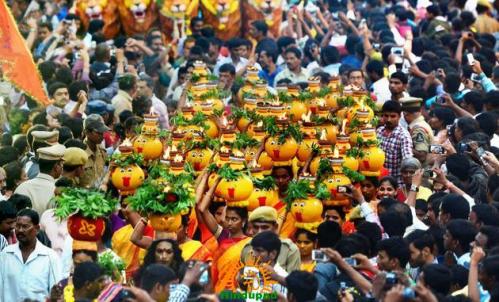
Temple practice further sustains the musala’s memory. Festivals honoring Balarama (observed in different regions on Shravana Purnima or in alternative local calendars) may emphasize his role as elder, guide, and stabilizer in the Krishna cycle of narratives. In alankara (ritual adornment), priests sometimes accentuate the contrast between the curving plough and the rectilinear musala, reinforcing the conceptual dyad of nourishment and protection. While ritual specifics vary by sampradaya and geography, the broader sign remains constant: sacred power remains accountable to the welfare of the fields, herds, and households it safeguards.
Semiotically, the musala communicates three nested messages. First, it upholds a civilizational ethic that refuses to sever protection from production; might does not float free of economic and ecological responsibility. Second, it transforms a domestic tool into a sign of sacred agency, dissolving the boundary between the everyday and the divinea signature move in Hindu symbolism. Third, it warns against hubris: the very instrument that forges cohesion can, when misdirected, precipitate decline, as the Mausala Parva poignantly narrates.
The musala’s quiet power resonates with shared ideals across dharmic traditions. Agricultural self-reliance, ethical labor, and communal responsibility form a common ground cherished in Hinduism, Buddhism, Jainism, and Sikhism. Jain and Buddhist ethics elevate restraint and non-harm as the measure of true power; Sikh teachings honor kirat karo (earn by honest labor), honoring work that sustains families and communities; Hindu narratives insist that guardianship flows from, and remains answerable to, the life of the soil. Read together, these perspectives affirm a plural yet unified ethos: strength serves life.
Everyday experience reinforces this symbolism. In many homes, the ulakkai’s steady rhythm accompanies the preparation of food, echoing an older cadence of care and continuity. For generations who grew up watching grain being pounded at dawn or dusk, the straight, unadorned pestle evokes more than utility; it recalls the dignity of labor, the warmth of kitchens, and the intergenerational knowledge that binds families. The icon of Balarama holding the same implement bridges household memory and temple vision, illuminating how culture turns the ordinary luminous.
The philology of mūṣala strengthens this link between household and sanctum. In Sanskrit usage, mūṣala denotes a pestle used with an ulūkhala (mortar), while allied terms for pounding and sifting populate Vedic and post-Vedic ritual vocabularies. Such linguistic continuity explains why ancient viewers would never have misunderstood the object in Balarama’s hand. Where a gadā might require a label to be certain, the musala’s plain cylinder practically names itself across languages and regions.
Comparative weapon studies further clarify the musala’s identity. A mace’s prominent head is optimized for crushing armor and bone on impact, whereas the musala’s uniform shaft produces a different strike profileless spiky in force delivery but consistent, controllable, and adaptable in crowded or enclosed spaces. This difference matters in both practical and symbolic registers: the musala stands for stamina, discipline, and calibrated strength rather than theatrical shock.
In iconographic fieldwork, several cues help distinguish the musala quickly. A straight, featureless cylinder with a rounded or marginally flared end strongly suggests mūṣala, especially when paired with a clearly curved plough. Held vertically beside the body or diagonally across the torso, it lacks the mace’s globular mass and the trident’s prongs; nor does it taper like a spear. Its stark sobriety is intentional, reminding viewers that reliable, everyday power often appears unadorned.
The ethical teaching that flows from this object is unusually compact. The musala teaches that authority must remain yoked to nourishment, that strength without service corrodes, and that homespun tools may carry the highest sacral charge. The arc from mortar to sanctum, from ulakkai to mūṣala, does not inflate the ordinary; it reveals how culture perceives the extraordinary in the ordinary and then asks guardians to be worthy of that trust.
Read within the wider Vaishnava frame, Balarama’s persona harmonizes earthbound grit with cosmic assurance. As an embodiment related to Śeṣathe cosmic serpent who supports the worldsBalarama anchors expansive theology in tactile reality. The plough scrapes soil; the pestle pounds grain; the deity who wields them lends divinity to the labors that keep society alive. The message scales effortlessly from kitchen courtyards to temple courtyards: cultivate, transform, and protectrepeat.
For students of Hindu sculptures and symbols, the musala offers methodological advantages as well. Its stable form across centuries simplifies identification; its narrative anchors in the Mahabharata, Harivamsa, and Bhagavata Purana facilitate cross-referencing; and its agrarian resonance enables interdisciplinary study linking art history, philology, religious studies, and agrarian anthropology. This integrative potential reflects the object’s own integrative meaning.
Contemporary relevance remains clear. In an age that often divorces power from responsibility, the musala’s ethic of protective, service-oriented strength speaks with fresh urgency. It encourages communities to value the unglamorous labor that sustains life, to invest in institutions that guard without dominating, and to remember that culture thrives where dignity and duty are shared.
Ultimately, the sacred pestle of Balarama clarifies a civilizational truth: the most enduring forms of power do not shout. They steady the hand, provision the meal, guide the field, and defend the peace. When the musala appears in sculpture or scripture, it invites a disciplined imaginationone that joins divine strength to agrarian power, iconographic clarity to ethical depth, and plural dharmic wisdom to a unified commitment to human flourishing.
A practical takeaway completes the picture. To recognize the musala in art or ritual, look for a straight, uniform cylinder with a subtly rounded or gently flared end, commonly paired with the curved blade of a plough in the other hand of Balarama. Note the absence of a mace-head, trident prongs, or spear-tip. When these cues align with Vaishnava adornments and the epithet Hala-muṣala-dhara in captions or liturgy, identification can be made with high confidence.
In its quiet way, the musala keeps a promise at the heart of the Hindu way of life: strength exists for the sake of care. By turning a household implement into a sacred sign, the tradition ensures that the arts of livinggrowing, pounding, cooking, sharingremain inseparable from the arts of protecting. That indivisibility is the essence of agrarian power and the soul of divine strength.
Inspired by this post on Hindu Blog.