
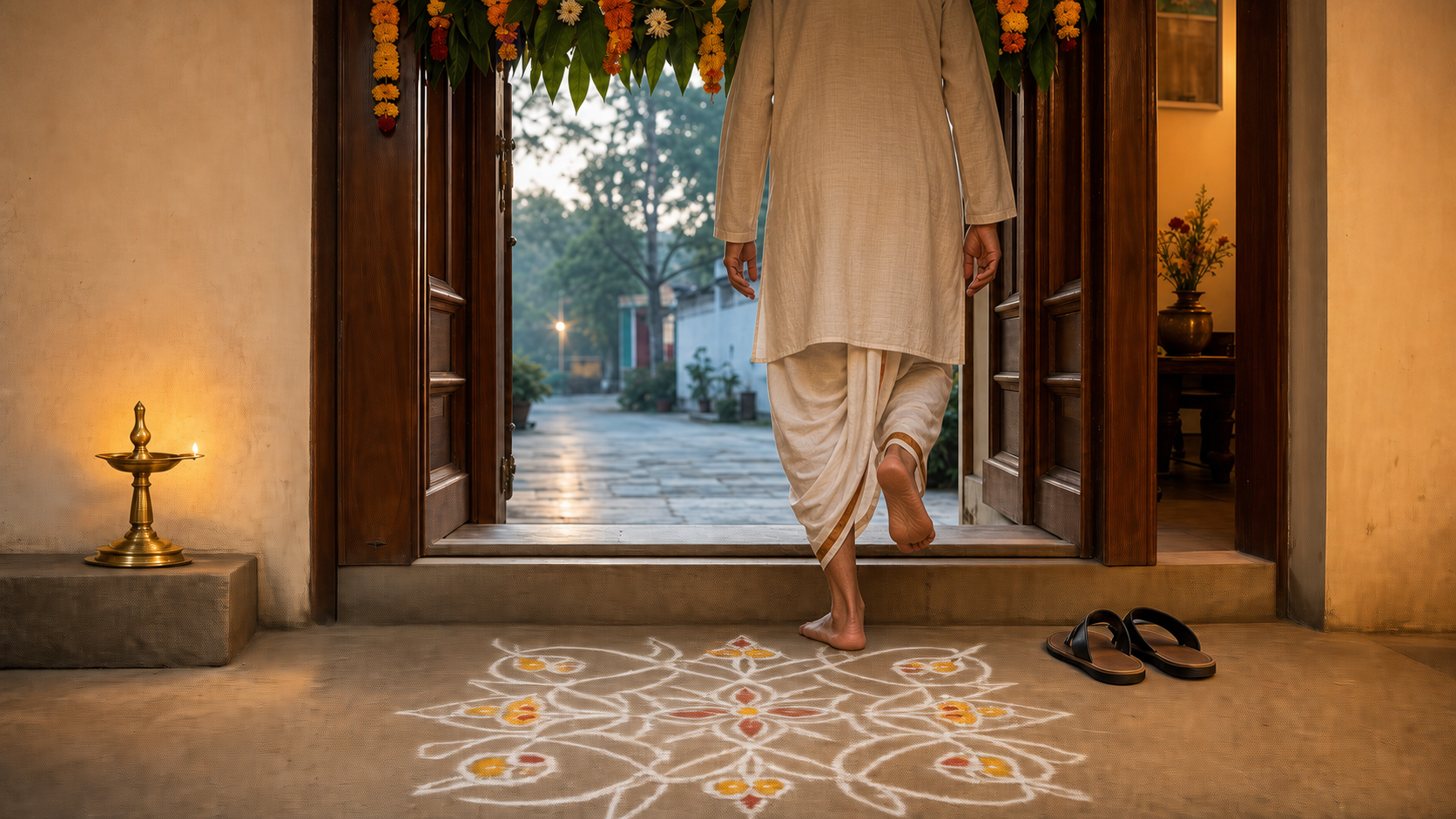
The doorway that changes the meaning of space. At the entrance to a Hindu home, an ordinary movement can acquire unusual depth. A person comes in from a public road, removes dust-bearing footwear, notices a rangoli or kolam, steps across a carefully maintained sill, and enters a place shaped by family memory, worship, food, rest, and responsibility. The movement lasts only a moment, yet it joins architecture, ritual, emotion, and ethics. This is why the threshold can feel more significant than its modest physical form suggests.
Known in the source tradition as the dehalee or dehali, the threshold is the lower boundary of a doorway and, symbolically, the meeting place of two spatial conditions. On one side lies the relatively ordered and protected life of the household; on the other lies a mobile social world of neighbors, travelers, work, trade, weather, uncertainty, and opportunity. The threshold does not merely separate these worlds. It regulates their relationship, allowing people, goods, obligations, blessings, and ideas to pass between them.
The sacred threshold in Hinduism should not be reduced to a rigid opposition between a pure interior and an impure exterior. Streets, forests, rivers, fields, pilgrimage routes, and public gathering places can themselves be sacred. Nor is every event inside a house automatically dharmic. The more accurate interpretation is relational: the threshold marks a change in responsibility. Crossing inward may call for cleanliness, attentiveness, and respect for household order; crossing outward may begin a journey into wider social duties. Its meaning comes from transition rather than from a simplistic division between good and evil.
Dehali, dvāra, and gṛha. Sanskrit and regional architectural vocabularies distinguish the threshold from the doorway as a whole. The dehali is the sill or crossing line, while dvāra commonly refers to the door or opening. Gṛha denotes the house or household, and gṛhapraveśa means entering a dwelling, especially in the context of a new-home rite. Terms, pronunciations, and ritual associations differ across languages, periods, craft traditions, and communities. Consequently, no single word should be treated as proof of one uniform practice throughout Hindu history.
Physically, a traditional threshold may be formed from stone, timber, brick, or another durable material. It can stabilize the door frame, reduce the entry of rainwater and dust, discourage pests, and mark the point at which exterior paving gives way to an interior floor. These practical functions matter. Sacred symbolism frequently develops around places that are repeatedly touched, crossed, cleaned, and repaired. The threshold becomes ritually important partly because it is already an architecturally vulnerable and heavily used junction.
The doorway should therefore be understood as an ensemble. Its sill lies below, jambs define the sides, a lintel spans the top, and doors control access through the opening. A toraṇa may hang above, religious signs may appear on the frame, lamps may be placed nearby, and geometric designs may extend across the ground in front. Popular speech often calls this entire ritualized area the threshold, even when a particular object is attached to the lintel or drawn on the forecourt rather than placed on the sill itself.
A place of liminality. Modern anthropology uses the term liminality for an intermediate condition in which a person is no longer wholly in one state but has not fully entered another. This analytical concept, associated with studies of rites of passage, helps explain the emotional force of a threshold. It is not itself an ancient Hindu technical definition of dehali, but it provides a useful comparative vocabulary. A doorway is simultaneously an ending, a beginning, and a moment of potential transformation.
That liminal character is felt in everyday experience. Someone returning after a long absence may recognize home at the doorstep before seeing the interior. A bride entering a new household, a family moving into a new residence, a pilgrim departing before dawn, or a guest waiting to be welcomed occupies an in-between state at the door. Ritual gives visible form to the mixture of uncertainty, hope, vulnerability, and belonging contained in such moments.
What the textual record actually supports. Hindu practices concerning homes arise from several kinds of authority: Vedic hymns, Gṛhya Sūtras and later domestic ritual manuals, Dharma literature, Vāstu and Śilpa texts, Purāṇic and devotional traditions, regional custom, family inheritance, and contemporary adaptation. These sources do not always address the same question or prescribe identical conduct. An academically sound explanation must distinguish a broad theology of sacred dwelling from specific regional customs performed at a modern front door.
Rigveda 7.54 and 7.55 invoke Vāstoṣpati, the guardian or lord of the dwelling, with requests for recognition, well-being, and freedom from harm. Atharvaveda 3.12 contains a benediction associated with the establishment of a house and imagines the dwelling as firm, abundant, and protective. These hymns demonstrate that a residence could be ritually addressed and integrated into a sacred order. They do not, however, supply a complete manual for every threshold custom now practiced in India or the diaspora.
The Gṛhya Sūtras deal with domestic rites performed by householders, including acts associated with establishing and entering a dwelling. Later paddhatis, or procedural manuals, develop such practices according to region and lineage. A rite may include purification, worship of Gaṇeśa, propitiation connected with Vāstu, a sacred fire, offerings, blessings, or the preparation of the first food in the house. The particular role assigned to the entrance varies, but the act of crossing commonly marks the practical completion of ritual preparation.
Vāstu literature approaches the dwelling through site selection, orientation, measurement, proportional systems, spatial division, drainage, circulation, and the positioning of openings. Works such as the Mayamata, Mānasāra, and architectural sections of the Bṛhat Saṃhitā preserve influential but not identical systems. Door location can be significant within these systems, yet popular claims that every house must possess one universally auspicious entrance direction flatten a far more complex textual history. Climate, plot shape, building type, local craft knowledge, and the specific textual school all affect interpretation.
Vedic references, architectural treatises, and living customs should therefore be connected with care. An ancient hymn to a dwelling does not automatically establish the antiquity of a particular acrylic rangoli pattern, televised wedding custom, or contemporary Vāstu remedy. At the same time, a recent material form can express an older principle of welcome, protection, or auspicious beginning. Continuity in meaning does not require every visible detail to remain unchanged.
The household as an ordered world. The Hindu house is not only a shelter. It is the principal setting of the gṛhastha, or householder, stage of life, within which food is prepared, children and elders are cared for, guests are received, ancestors are remembered, knowledge is transmitted, livelihoods are supported, and daily worship may occur. The threshold stands at the point where these inward responsibilities meet obligations to the wider community.
Vāstu traditions often treat a built site as an organized whole whose parts are related to direction, movement, function, and a larger cosmic order. This does not mean that every historic residence was built from one standardized Vāstu Puruṣa Maṇḍala or that the threshold contains a measurable supernatural force. Rather, architecture can be understood as a disciplined transformation of open land into habitable order. The entrance is especially important because it interrupts the enclosure and makes exchange possible.
The threshold gathers several paired ideas without permanently separating them: stability and movement, kin and guest, privacy and hospitality, cultivated space and open environment, familiarity and uncertainty, protection and exchange. Each pair remains necessary. A house sealed against every outsider would fail in hospitality, while a house without meaningful boundaries would fail in care and security. The threshold symbolizes a balanced permeability rather than absolute closure.
This balance gives the threshold a cosmic dimension. The household becomes a small field in which order must be renewed through conduct. Sweeping the entrance, lighting a lamp, greeting a guest, repairing a damaged sill, or refusing to humiliate someone at the door can all help establish that order. Sacredness is not produced by the material threshold alone; it is sustained by the quality of the relationships that pass across it.
The illuminating logic of dehalī-dīpa-nyāya. Sanskrit intellectual traditions preserve a memorable maxim called dehalī-dīpa-nyāya, the principle of the lamp placed on a threshold. Such a lamp casts light toward both the interior and exterior. In grammatical, legal, and interpretive reasoning, the image can explain how a centrally placed word, qualification, or rule may illuminate material on both sides of it. The maxim offers one of the clearest technical expressions of the threshold’s relational nature.
The threshold lamp is significant because it belongs fully to neither side while serving both. Its position transforms separation into intelligibility. Applied to domestic symbolism, the image suggests that wisdom at a boundary should clarify relations rather than deepen fear. Household values must illuminate conduct in public life, while experience gained outside must be examined and integrated within the home. The dehali is therefore not only a defensive line; it can also be a site of discernment.
Protection without superstition. Entrances are vulnerable points in nearly every architectural culture, so they attract protective devices and symbols. In Hindu homes these may include an image or sign of Gaṇeśa, invocations of Lakṣmī, sectarian emblems, a sacred syllable, a swastika, turmeric and kumkum marks, protective threads, leaves, flowers, or motifs associated with a family deity. Scholars describe signs intended to avert harm as apotropaic. Their forms and theological explanations vary substantially.
Gaṇeśa is frequently associated with beginnings and the removal of obstacles, making his presence at an entrance intelligible. Lakṣmī is associated with auspiciousness, well-being, beauty, and abundance, and stylized footprints may depict her movement into a clean and welcoming home. Hanumān, a kula devatā, a village guardian, or another revered form may receive emphasis in particular families. These practices should not be merged into a fictional universal doorway pantheon.
The Hindu swastika, when used at an entrance, is an ancient auspicious sign whose Indian history long predates its twentieth-century appropriation by Nazism. Its arms, orientation, dots, and associated meanings can differ among Hindu, Buddhist, and Jain traditions. Presenting it responsibly requires historical explanation, especially outside South Asia. Treating the symbol as mere decoration ignores both its sacred setting and the modern trauma created by the Nazi emblem.
Temple architecture magnifies the same concern with passage. Monumental doorways may include dvārapālas, auspicious vegetation, divine figures, river goddesses, decorated jambs, and carefully proportioned thresholds. Entering a sanctum is not equivalent to entering a private residence, however. Temple āgamas, local rules, and architectural conventions have their own ritual logic. Household customs may echo the temple’s concern with protected transition without reproducing its complete iconographic program.
Ritual protection should not displace ordinary responsibility. A sacred mark is not a substitute for a sound lock, safe wiring, adequate lighting, weatherproof construction, or respectful attention to children and elders. Hindu architectural symbolism is strongest when practical care and ritual intention reinforce each other. The repaired threshold protects bodies; the honored threshold reminds residents how bodies and relationships ought to be treated.
Daily renewal through cleaning. In many households, the entrance is swept or washed before a fresh design is made. This is a concrete act of removing dirt and a symbolic restoration of order. The practice may be performed at dawn, before worship, on a festival day, or when guests are expected. Its meaning should not be exaggerated into a claim that every unswept doorway drives away a goddess. Cleanliness functions as hospitality, discipline, and sensory preparation rather than as a mechanical bargain with the divine.
Regional floor arts make the entrance visually alive. Names include rangoli, kolam, muggu, alpana, aripana, mandana, and other local terms. Some designs are drawn from grids of dots; others use flowing lines, flowers, footprints, geometric diagrams, or images connected with a festival. Materials may include rice flour, powdered stone, chalk, turmeric, vermilion, flower petals, or modern pigments. No single design vocabulary represents all Hindu homes.
The temporary nature of these designs is central to their meaning. Footsteps, rain, wind, animals, and routine cleaning gradually erase them. Their value lies not in permanent possession but in attentive renewal. This rhythm offers a domestic lesson in impermanence: order is lovingly created even though it cannot be frozen. The person who redraws a pattern participates in continuity through repeated action rather than through the preservation of an untouched object.
Claims that every traditional kolam is made of edible rice flour specifically to feed insects should be treated cautiously. Rice-based materials are indeed used in some communities, and generosity toward small beings is a meaningful interpretation, but mineral and synthetic powders are also common. Local ecology, food safety, pest management, weather, and household circumstances matter. A responsible practice can honor ahiṃsā while avoiding substances that endanger animals, contaminate water, or create a slippery surface.
The doorway above the threshold. A toraṇa or bandhanvār may be suspended from the upper frame during festivals, marriages, and new-home rites. Mango leaves, other locally available foliage, marigolds, textiles, beads, or reusable craft materials may be used. The hanging marks the doorway as prepared for an auspicious occasion and makes welcome visible before anyone crosses the sill. Its symbolism belongs to the vertical doorway as a whole, not solely to the lower threshold.
A lamp near the entrance introduces fire and light into this visual grammar. At twilight or during a festival, the lamp may signal welcome, vigilance, and the removal of obscurity. It also recalls the logic of dehalī-dīpa-nyāya by illuminating both directions. The lamp must be placed on a stable, nonflammable surface away from fabric, children, animals, and walking paths. In buildings where open flames are prohibited, a safely enclosed or flameless light can preserve the intention without creating danger.
Feet, footwear, and the act of crossing. Removing outdoor shoes before entering many Hindu homes has both practical and ritual dimensions. Footwear carries street dust and may be inappropriate near a household shrine, kitchen, or floor used for sitting. Washing the feet after travel serves a similar purpose in some settings. These customs express śauca, or disciplined cleanliness, but their exact application depends on climate, architecture, occupation, health, and family practice.
Many people avoid placing a foot directly on a raised threshold, particularly at a temple or ritualized doorway. Some touch the sill respectfully; others simply step over it; still others follow no special rule in a domestic setting. A practical explanation is that standing on a sill damages it, obstructs traffic, and places the body awkwardly between spaces. Symbolically, stepping over acknowledges the boundary without crushing or occupying it. Local instructions should take precedence over generalized internet rules.
Related customs may discourage sitting on the threshold, exchanging objects across it, lingering in the doorway, or conducting an argument while one person stands inside and another outside. Such rules are often forms of loka-ācāra, or local and customary conduct, rather than universal scriptural commandments. They can nevertheless preserve a coherent social insight: a passage should remain open, and significant exchanges deserve a clear relationship rather than an ambiguous standoff.
Diwali and the welcome of Lakṣmī. During Diwali, entrances in many regions are cleaned, illuminated, and decorated with rangoli, flowers, auspicious signs, or small footprints. The imagery presents the household as ready to receive Lakṣmī and the qualities she embodies. The rite concerns more than monetary gain. Classical and devotional understandings of śrī include radiance, fertility, dignity, beauty, good fortune, and flourishing. Ethical prosperity requires care, generosity, and right livelihood as well as material resources.
Regional New Year and harvest observances also renew the entrance. Kolam or muggu may become especially elaborate around Pongal and Makara Sankranti; mango-leaf decorations may appear during Ugadi or Gudi Padwa; alpana may mark Lakṣmī worship in eastern India; and floral arrangements may welcome participants during Kerala festivals. These examples reveal a shared grammar of renewal without implying a single pan-Indian calendar or design.
Gṛha Praveśa and the first crossing. A new house is physically complete when construction ends, but a Griha Pravesh housewarming ritual marks its transition into an inhabited moral and sacred space. The entrance may be cleaned, ornamented, and opened at a selected time. Depending on the tradition, a priest or family may conduct Gaṇeśa Pūjā, Vāstu-related rites, a homa, kalasha worship, recitation, cooking, or distribution of prasāda. The threshold concentrates the decisive moment when preparation becomes residence.
Entering with the right foot first is a widespread auspicious custom, but it should not be advertised as an invariant Vedic law. Some households carry a kalasha, a sacred image, grain, milk, or another sign of sustenance. Boiling milk until it rises is common in parts of southern India, while other regions emphasize a fire ritual or the first shared meal. The rite gains authenticity through an appropriate sampradāya and family context, not by collecting every custom into one performance.
House-entry rituals also reveal that sacredness is cultivated rather than purchased. An expensive building is not automatically a harmonious gṛha, and a modest apartment is not spiritually deficient. The ceremony establishes an intention that subsequent conduct must fulfill. Regular care, honest livelihood, mutual respect, study, worship, hospitality, and responsible use of resources continually complete the house after the formal ritual has ended.
The bride at the household entrance. In several regional wedding traditions, a bride is welcomed at the doorway with a lamp, water, ārati, colored footprints, grain, or another sign of prosperity. Popular North Indian ceremonies may include gently moving a vessel of rice before entering. These customs differ widely and should not be projected onto every Hindu marriage. The threshold dramatizes a change in relationship and residence, which explains its prominence in the ceremony.
A contemporary ethical interpretation should avoid presenting the bride as property transferred into a household or as the sole bearer of its honor and prosperity. Marriage establishes reciprocal duties, and welcome should recognize dignity, consent, and belonging. Where a couple forms a new home together, both partners cross a threshold into altered responsibilities. Ritual remains meaningful when its symbolism supports mutual care rather than unequal expectations.
Departures can be as significant as arrivals. A traveler may receive tilaka, ārati, food, or a blessing near the door; a pilgrim may bow before leaving; and a returning family member may be welcomed at the entrance. Practices connected with birth, illness, and death sometimes engage the doorway as a transition point, but these are especially sensitive to regional custom. They should never be generalized without reliable local evidence.
The threshold as a test of hospitality. The Taittirīya Upaniṣad 1.11 includes the well-known injunction atithidevo bhava, instructing the student to regard the guest as worthy of divine honor. Although this passage is not a manual for threshold decoration, it supplies an ethical framework for the doorway. The sacred entrance is where an abstract commitment to hospitality becomes a decision: whether to acknowledge, welcome, assist, feed, direct, or respectfully decline the person who has arrived.
Hospitality does not eliminate privacy or consent. A household has legitimate duties of protection, and no visitor acquires an unrestricted right to enter. The threshold allows welcome to be deliberate. It creates a place for greeting before admission and a point at which safety, circumstance, and the needs of vulnerable residents can be considered. Dharmic hospitality is therefore neither hostility nor naïve openness; it is responsible discernment expressed with dignity.
Some domestic ritual traditions include bali, small offerings distributed at designated points for deities, guardians, ancestors, animals, or other beings. The doorway may be one such point in certain procedures. These practices place the household within a community larger than its human residents. Modern observance should use nontoxic materials, prevent harm to animals, and comply with sanitation rules. Symbolic generosity loses its purpose if it creates injury or waste.
Purity as disciplined care, not human hierarchy. At a household entrance, purity often concerns dirt, ritual readiness, food preparation, bodily hygiene, and the transition from public activity to domestic worship. It need not imply that the world outside is spiritually worthless or that a person has lesser human value. Confusing ritual classification with moral worth has produced damaging interpretations that obscure the threshold’s hospitable possibilities.
Historical homes and religious institutions have also used entrances to enforce distinctions of caste, gender, occupation, wealth, and status. An academic account cannot romanticize every inherited restriction as timeless dharma. Hindu teachings on the presence of ātman, ahiṃsā, seva, compassion, and hospitality provide resources for rejecting humiliation and untouchability. A sacred threshold in contemporary life should protect dignity while preserving reasonable privacy and the distinctive discipline of a worship space.
The ethical question is therefore not only what symbol appears above a door, but how people are treated at it. A brilliant rangoli cannot compensate for cruelty toward a worker, neighbor, relative, animal, or stranger. Conversely, a physically plain entrance can express profound dharma when it is clean, safe, accessible, and associated with kindness. Ritual beauty and ethical conduct are most persuasive when they confirm each other.
Regional diversity is part of the tradition. A Tamil household with a daily kolam, a Telugu household with muggu, a Bengali home with alpana, a Rajasthani home with mandana, and a diaspora apartment with a removable rangoli sticker may all ritualize the entrance differently. Climate, building material, language, caste and community history, sectarian affiliation, urban regulation, and family memory influence the result. Diversity is evidence of living transmission, not necessarily corruption of an imagined single original form.
Differences also appear among Śaiva, Vaiṣṇava, Śākta, Smārta, folk, and other Hindu traditions. A household may privilege a form of Gaṇeśa, Lakṣmī, Nārāyaṇa, Śiva, Devī, Hanumān, a grāma devatā, or a kula devatā. Another may use only a lamp and geometric design. The threshold does not require every symbol at once. Restraint can preserve theological coherence and prevent a carefully inherited practice from becoming a collage assembled for display.
A useful interpretive hierarchy distinguishes śāstra, sampradāya, ācāra, loka-ācāra, and personal choice. Śāstra refers broadly to authoritative textual disciplines; sampradāya identifies a transmitted lineage or tradition; ācāra concerns accepted conduct; loka-ācāra denotes community custom; and personal practice adapts these inheritances to circumstances. A rule grounded mainly in one family’s custom should be described that way rather than promoted as a universal command of Hinduism.
Philosophical readings of the boundary. The threshold can support several contemplative interpretations, although these should not be mistaken for mandatory doctrines. A bhakti-oriented household may imagine the doorway as the place where the divine guest is welcomed. A Śākta setting may emphasize Lakṣmī or a protective goddess. A Vāstu interpretation may stress spatial order. A Vedāntic reflection may use inside and outside to question the limits imposed by ordinary perception.
From a nondual perspective, the boundary remains practically necessary while lacking absolute metaphysical independence. Walls organize daily life, but consciousness is not literally confined by masonry. From a devotional perspective, the distinction between resident and divine visitor creates intimacy and service. From a ritual perspective, the crossing changes status because intention, mantra, and action frame it. These readings can coexist because they address different levels of experience.
The threshold also illustrates how Hindu thought often joins the gross and subtle. Stone, pigment, flowers, water, flame, scent, gesture, memory, and mantra act together. The physical structure remains material, yet it trains attention and carries inherited meanings. There is no need to deny architecture in order to affirm spirituality. The symbol works precisely because a tangible object becomes a reliable focus for intangible responsibilities.
Dharmic parallels without erasing differences. Jain, Buddhist, and Sikh communities also cultivate forms of respectful entry, cleanliness, auspicious imagery, mindful conduct, or hospitality, but they do not all assign the same theology to a household threshold. Jain uses of the swastika possess distinctive cosmological meanings and are shaped by ahiṃsā. Buddhist temples may employ guardians and entry etiquette within their own ritual systems. Sikh practice emphasizes equality, service, cleanliness, and reverence in the presence of the Guru Granth Sahib rather than worship of a threshold as an object.
The constructive comparison lies in shared ethical concerns: attention at moments of transition, care for sacred and communal space, hospitality, non-harm, humility, and responsible belonging. Unity among dharmic traditions does not require declaring their rituals identical. It grows through accurate description, mutual respect, and recognition that a boundary can protect a tradition without becoming a weapon against another community.
The Lakshmana Rekha is not a threshold doctrine. Popular discussions sometimes connect every domestic boundary with the Lakshmana Rekha from the Rāmāyaṇa. The familiar line episode is prominent in later retellings and popular culture, but it does not occur in the critical text of Vālmīki’s Rāmāyaṇa in the form commonly narrated today. It may serve as a later metaphor for protection and transgression, yet it should not be presented as the scriptural origin of Hindu threshold ritual.
Not every crossing predicts fortune. Accidentally touching a sill, entering with a different foot, or failing to draw a design does not establish an inevitable chain of supernatural punishment. Ritual conventions help train memory and attention, but fear-driven claims can turn meaningful practice into anxiety. Illness, conflict, and financial difficulty have complex causes. Responsible spiritual guidance does not blame a family’s suffering on a minor doorway mistake.
Vāstu should likewise not be used fatalistically. Orientation, daylight, ventilation, circulation, drainage, privacy, and structural soundness can materially affect well-being. Symbolic systems may help residents think holistically about space. They cannot justify dangerous renovations, predatory remedies, or guarantees of wealth. Where textual prescriptions conflict with building codes, engineering requirements, accessibility, or safety, qualified professional judgment is essential.
The threshold in an apartment or diaspora home. A sacred entrance does not require a large courtyard, raised stone sill, or ownership of the building. In a rental apartment, the doorway can be kept clean and unobstructed, a small symbol can be placed on a removable surface, and a compact design can be made without damaging common property. Building regulations, neighbors, weather, and fire rules should be treated as part of responsible dharma rather than as obstacles to it.
Accessibility deserves particular attention. A high sill can create a fall hazard or block a wheelchair, walker, or stroller. Altering or removing such a barrier does not destroy the threshold’s sacred meaning. A contrasting floor strip, side-mounted symbol, overhead toraṇa, wall lamp, or clear transition in material can mark the entrance without impeding movement. A boundary dedicated to well-being should not exclude people through preventable design.
Sustainable practice favors durable, repairable, and locally appropriate materials. Reusable decorations may be preferable to disposable plastic; nontoxic colors protect children, animals, and waterways; and flowers or leaves should be sourced without unnecessary waste. Traditional materials are not automatically safe in every modern setting, just as manufactured materials are not automatically disrespectful. The relevant principles are care, proportion, truthfulness, and avoidance of harm.
A grounded way to honor the entrance. A household can begin with four simple priorities: keep the passage structurally safe, maintain reasonable cleanliness, select one symbol or practice meaningful to its tradition, and connect that practice with hospitality. A short prayer, a lamp used safely, a small kolam, or a respectful pause before entering may be sufficient. The aim is disciplined awareness, not an exhausting catalogue of compulsory remedies.
Before adopting a custom, residents can ask where it comes from, who transmitted it, what it means locally, whether it belongs to a particular festival, and whether it is safe in the present building. Family elders, knowledgeable practitioners, priests, craftspeople, textual specialists, and regional histories may supply different parts of the answer. Where accounts disagree, the disagreement should be documented rather than concealed beneath a claim of universal antiquity.
Recording family threshold traditions can itself preserve cultural heritage. A photograph of an inherited pattern is useful, but so are the name of the design, its language, its maker, its materials, the occasion on which it appears, and the explanation remembered by elders. Such documentation reveals change as well as continuity. It allows later generations to adapt a practice knowingly instead of reproducing an image stripped of context.
Textual and scholarly orientation. The broad sacredness of dwelling is illuminated by Rigveda 7.54–7.55 and Atharvaveda 3.12; domestic ritual is explored through the Gṛhya Sūtras and later procedural traditions; hospitality is ethically framed by Taittirīya Upaniṣad 1.11; and architectural principles appear in works including the Mayamata, Mānasāra, and Bṛhat Saṃhitā. The dehalī-dīpa-nyāya belongs to the wider Sanskrit tradition of interpretive maxims. Translations and textual schools differ, so primary texts should be read alongside regional evidence and modern scholarship on Indian architecture and domestic religion.
A boundary made sacred by what crosses it. The enduring power of the Hindu house threshold lies in its ability to hold several truths at once. It protects without demanding isolation, welcomes without abolishing discernment, preserves memory while permitting adaptation, and joins practical architecture with spiritual attention. Its deepest lesson is not that holiness can be trapped behind a door. It is that every passage between home and world can become more conscious, ethical, and compassionate.
Inspired by this post on Hindu Blog.










Leave a Reply
You must be logged in to post a comment.