-
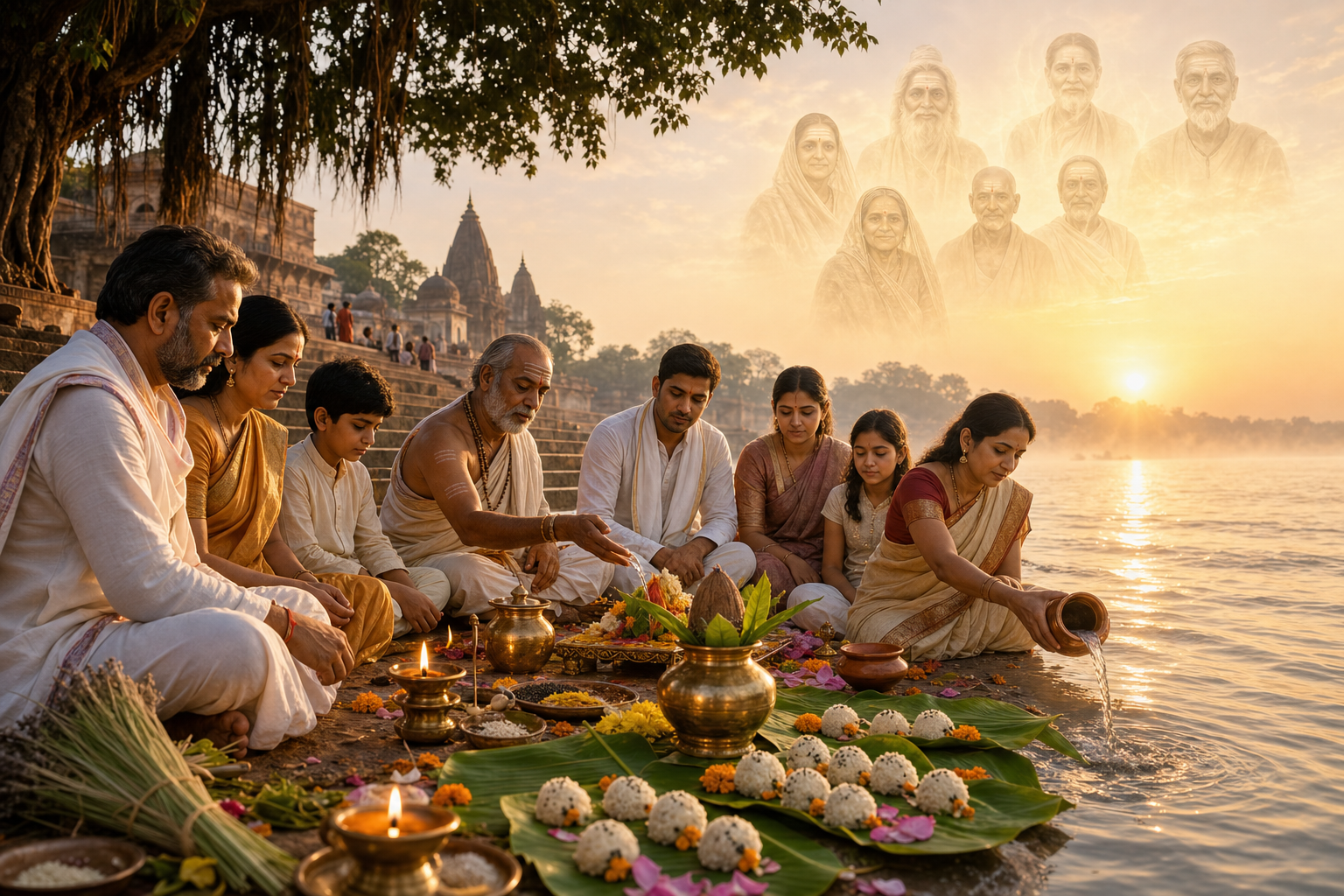
Sanghata Shraddha Explained: A Sacred Collective Rite for Healing Ancestral Grief

Sanghata Shraddha is the Hindu rite of collective remembrance performed when many departed beings are honored together. Rooted in Pitru Rina, Shraddha, tarpana, pindadana, and dharmic responsibility, it transforms grief into disciplined reverence. The rite is especially meaningful after collective tragedy, disaster, epidemic, war, or family loss involving several departed persons. It affirms that no…
-
Parvati Marries Shiva: Transforming the Primordial Yogi into the Ideal Householder (Grihastha)

Shiva’s marriage to Parvati is not a departure from yogic austerity but its civilizational fulfillment. Drawing from the Shiva Purana, Skanda Purana, and Kalidasa’s Kumarasambhava, the narrative shows how Parvati’s tapas leads the primordial yogi into grihastha ashrama without diluting spiritual intensity. Shaiva–Shakta symbolismArdhanarishvara and the linga within the yonirenders the complementarity of awareness and…
-
Madhyandina Shakha of the Shukla Yajurveda: Yajnavalkya’s timeless legacy, texts, rituals, and reach

Madhyandina Shakha is a principal recension of the Shukla Yajurveda, tracing its lineage to Yajnavalkya and preserving a carefully ordered ritual and philosophical corpus. Its core textsthe Vājasaneyi Madhyandina Saṁhitā and the Śatapatha Brāhmaṇa (Madhyandina)transmit the Isha and Brihadaranyaka Upanishads, uniting precise liturgy with deep inquiry into the Self. Auxiliary works such as the Kātyāyana…
-
Samavartana Unveiled: The Transformative Rite of Return and the Making of a Householder

SamavartanaHindu Dharma’s rite of returnformally completes Brahmacharya and inaugurates the ethical agency required for Grihastha. Grounded in the Grihya Sutras, Dharmasutras, and the Taittirīya Upaniṣad’s convocation counsel, it transforms private learning into public responsibility through guru-dakṣiṇā, ritual bathing, and vows of truth, duty, and lifelong study. The rite prepares the Snātaka for pañca-mahāyajñasdaily disciplines that…
-
Dashashanti: Ten Timeless Vedic Shanti Mantras for Protection, Harmony, and Inner Calm

Dashashanti designates a cycle of ten Vedic Śānti Mantras recited to sanctify study, rituals, and community life. Drawn from the Rigveda, Yajurveda, and early Upanishads, these hymns seek protection, clarity, and universal welfare. The cycle typically includes Bhadraṁ karṇebhiḥ, Śaṁ no mitraḥ, Saha nāvavatu, Pūrṇam adaḥ, Asato mā, Āpyāyantu mamāṅgāni, Āpyāyasva sametu te, Svasti na…
-
Time, Intention, and Destiny: Deep Insights on S.B. 3.14.40 at ISKCON Chowpatty (10 May 2026)

On 10 May 2026 at ISKCON Chowpatty, Mumbai, H.G. Gauranga Prabhu examined Srimad-Bhagavatam 3.14.40, highlighting how time (kāla), intention (saṅkalpa), and ethical regulation (vrata-niyama) shape outcomes. The discourse situated Diti and Kaśyapa’s dusk encounter within a theology of guṇas and auspicious timing, while showing how divine grace through Lord Vishnu restores balance. Practical guidance emphasized…
-
Dakshinagni Unveiled: The Southern Vedic Fire of Ancestors, Ritual Mastery, and Dharma

Dakshinagni is the southern member of the Vedic triad of fires, maintained by an ahitagni and widely identified with the anvāhāryapacana, the hearth used for ritual cooking. Placed to the south within the sacrificial area, it complements garhapatya (west) and āhavanīya (east) to complete a precise ritual ecology. Its role is both pragmaticpreparing ritual foods…
-
Why Hindus Wear Janeyu (Yagnopaveetham): Vedic Origins, Ritual Science, and Sacred Duty

Janeyu (Yagnopaveetham) is a Vedic discipline rather than a mere ornament. Grounded in the Grihya Sutras and Dharmasastra, it centres on Upanayanathe ethical and contemplative initiation into study (brahmacharya). The sacred thread’s three strands map to classical Vedic ideas such as the three debts, the three gunas, sacred rivers, or the puruṣārthas, and its orientations…
-
Janeyu (Yagnopaveetham) Decoded: Sacred Thread Meaning, Ritual Science, and Daily Dharma Practice

This comprehensive guide decodes Janeyu (Yagnopaveetham) as a living samskaraits Vedic foundations, ritual science, and daily discipline. Drawing on Gṛhya Sūtras and Dharmaśāstra, it explains construction, symbolism, and the functional grammar of wearing styles (upavīti, prācīnāvīti, nivīti). Readers learn how the sacred thread supports sandhyā, svādhyāya, and ethical vows, and how annual upākarma renews study.…
-
Decoding Pratigara: The Sacred Response that Powers Dialogue in Vedic Yajña Rites

This article unpacks pratigarathe sacred response or assentin Vedic yajña as a precise, timed, and theologically charged reply that authorizes ritual action. It situates pratigara within the fourfold priestly system (hotṛ, adhvaryu, udgātṛ, brāhmaṇ) and explains how call-and-response exchanges keep the rite synchronized with ṛta. Readers gain a clear sense of how oṃ or astu…
-
Porcupine Quills in Hindu Samskaras: Forgotten Symbolism, Gentle Power, and Ethical Revival

This article explores the little-known place of porcupine quills within Hindu samskaras, situating the implement in the broader material culture of Ancient India. It clarifies that explicit scriptural references are scarce, while regional and oral recollections describe occasional, optional use for delicate ritual contact. The analysis offers a technical reading of the quill’s symbolic grammarprotection,…
-
Decoding Khila in Vedic Sutras: Hidden Supplements That Shaped Ancient Hindu Wisdom

Khila, the Vedic category for recognized supplements, reveals how ancient Indian literature balanced canonical integrity with lived adaptability. This in-depth exploration maps khila across the Rigveda Khilāni and sūtra traditions, showing how supplementary hymns and pariśiṣṭas extend ritual capacity without unsettling core śruti. Readers learn why texts like the Śrīsūkta, though technically ancillary in many…
-
Guarding Lakshmi at the Door: Why Hindu Dharma Discourages Charity on the Threshold

Why do many Hindu households discourage giving charity at the doorway? This article unpacks the threshold as a sacred, liminal space in Hinduism and explains how Vastu Shastra, the Grihya Sutras, and Dharmaśāstra converge on a single ethic: dāna should occur in a clean, clearly defined place with dignifying courtesies. It shows how “deśa–kāla–pātra–śraddhā” guide…
-
Unveiling Keshanta (Godana): The Sacred Rite of First Shaving in Hindu Samskaras

Keshanta (often called godana) is a Hindu samskara that marks the first formal shaving and the transition from adolescence to disciplined study. Rooted in the Grihya Sutras and Dharmashastras, it is performed variously as the first shaving of beard and moustache, and in some traditions includes head and limited body hair. The rite affirms values…
-
Kathaka Grhya Sutras: Unveiling Vedic Household Rites, Samskaras, and Living Dharma

The Kathaka Grhya Sutras, aligned with the Katha school of the Krishna Yajurveda, present a concise and authoritative guide to Vedic household rites and samskaras. As part of the Kalpa (Kalpasutra) literature within the Vedanga, the text distills domestic ritual wisdom into memorable aphorisms that balance mantra and action. Readers gain a clear view of…