
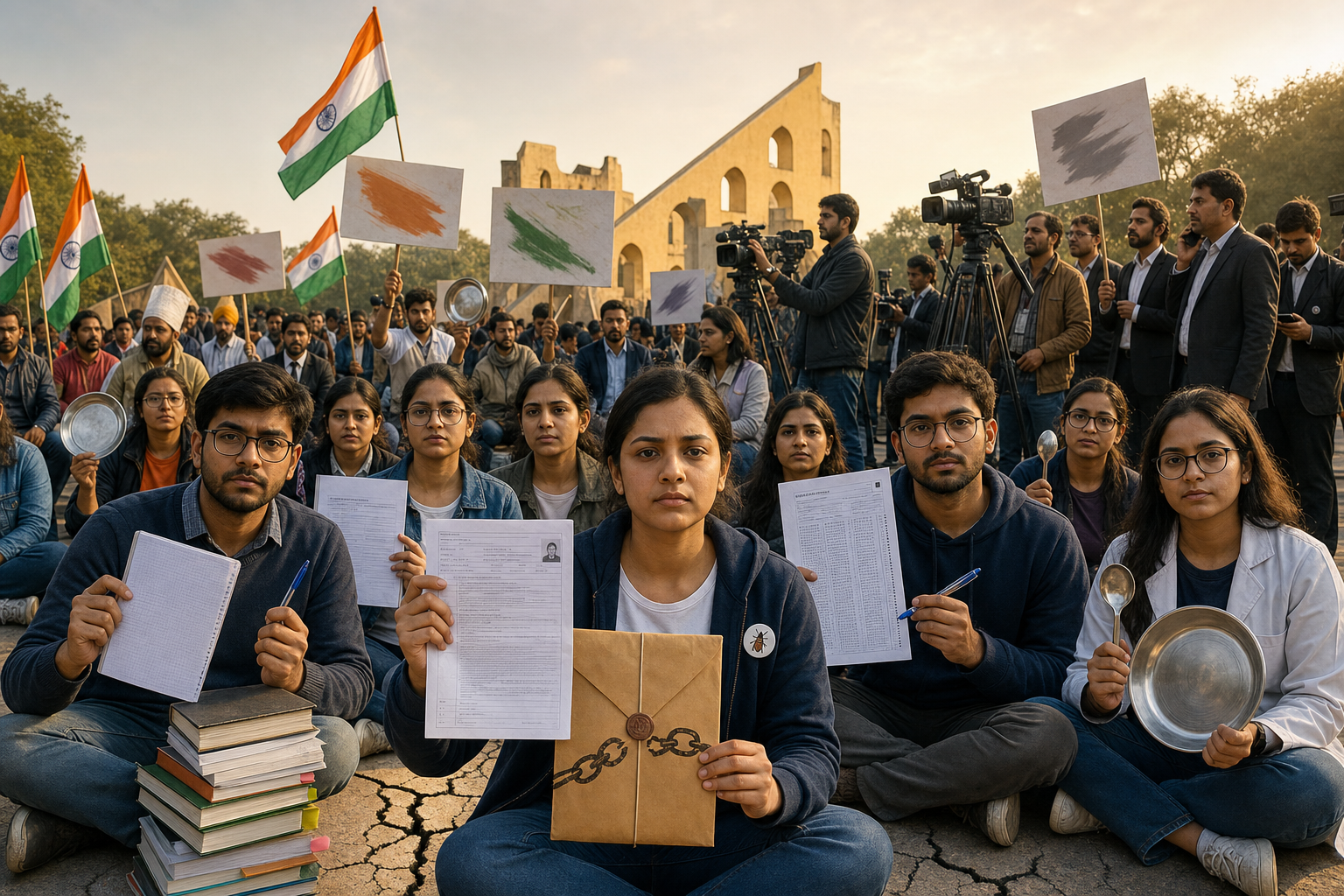
A protest enters a new phase. By July 8, 2026, the Cockroach Janta Party protest at Delhi’s Jantar Mantar had become far more than a confrontation over one examination. Television personality Raghu Ram arrived at the site, met CJP founder Abhijeet Dipke and hunger striker Sonam Wangchuk, and became the latest public figure to associate with the agitation. His appearance supplied another highly shareable moment, but it also raised the central analytical question surrounding the movement: had a youth-led demand for examination accountability gained a useful national coalition, or had its original purpose become vulnerable to broader political and ideological agendas?
Scope and evidentiary standard. This chronology covers developments through July 8, the nineteenth day of the continuous demonstration that began on June 20. It distinguishes four different kinds of information that political commentary often merges: a documented visit to the protest, a visitor’s stated position, an allegation made by an opponent, and a judicial or administrative finding. Those categories are not interchangeable. Attendance at a demonstration proves presence and, at most, expressed solidarity with its stated cause; it does not automatically prove agreement with every participant, every slogan or every position previously taken by the organisers. The same standard must apply across ideological lines if the account is to remain academic, factual and fair.
The examination crisis behind the agitation. The immediate background was the NEET-UG 2026 examination conducted on May 3. After law-enforcement inputs raised concerns about the integrity of the process, the National Testing Agency cancelled that sitting, arranged refunds and scheduled a nationwide re-examination for June 21. The Central Bureau of Investigation registered a case on May 12 following a complaint from the Department of Higher Education and subsequently announced arrests in the alleged paper-leak investigation. These developments were not merely matters of political perception: the cancellation, re-examination and investigation were documented through official NTA notices and a Press Information Bureau release.
The scale explains the intensity of the reaction. According to the NTA, more than 20 lakh candidates took the June 21 re-examination at 5,440 centres in India and 14 centres abroad, with approximately seven lakh officials mobilised across examination administration, policing, observation and related functions. For each candidate, however, those large numbers concealed an intimate burden: years of preparation, coaching expenses, travel, family savings and the psychological weight of a medical career compressed into a single high-stakes paper. A leak therefore harms more than an answer key. It undermines equality of opportunity, creates uncertainty about merit and forces honest candidates to bear the cost of failures they did not cause.
Why examination integrity is technically difficult. A national paper-based test depends on a long chain of custody: question creation, moderation, translation, typesetting, printing, packaging, transport, secure storage, centre-level opening, identity verification, answer-sheet handling, scanning and result processing. Compromise at any node can contaminate confidence in the entire system. A re-examination may restore a competitive baseline, but it cannot by itself answer how the breach occurred, who benefited, which control failed or whether the same vulnerability remains. That distinction between restoring an examination and repairing an institution became fundamental to the protest’s persistence.
From online satire to street politics. The CJP emerged in May as a satirical, youth-oriented political movement that adopted the cockroach as a symbol of endurance after controversial judicial remarks about young critics and unemployed people. News reports described it as an online parody rather than a conventional electoral party, but its memes and self-deprecating language connected with wider frustration over education, employment and political access. By converting a term of disparagement into a shared identity, the movement used a familiar technique of political communication: symbolic reversal. The humour lowered the threshold for participation, while the underlying grievances gave that humour institutional targets.
The movement’s first major street demonstration took place at Jantar Mantar on June 6. Participants were encouraged to carry books and the national flag, remain peaceful, avoid confrontations and report disruptive conduct. The book symbolised education and equal opportunity; the flag framed accountability as a national rather than sectarian demand. The immediate call was for Union Education Minister Dharmendra Pradhan to resign over alleged examination failures. CJP founder Abhijeet Dipke issued an ultimatum and warned that the campaign would expand if no action followed.
The indefinite demonstration begins. CJP returned to Jantar Mantar on June 20 after receiving permission for a scheduled protest. Hundreds of young participants reportedly banged steel plates with spoons, adapting a familiar public symbol into a critique of government responsiveness. When demonstrators remained after the permitted hours and continued into the following day, Delhi Police stated that the continuation breached the original conditions. Protesters nevertheless described the action as indefinite. Their principal demands were the resignation of the education minister, the scrapping or fundamental restructuring of the NTA, and enforceable accountability for repeated failures in examinations and recruitment tests.
Those demands operated at different levels. A ministerial resignation is a claim about political responsibility: it asks who should bear public consequences for a failure under a ministry’s watch. Abolishing the NTA is a structural claim: it asks whether the testing agency’s organisational model is capable of delivering secure examinations. Criminal investigation addresses a third level by identifying individual offences and evidence. These remedies can overlap, but none automatically substitutes for the others. Removing an office-holder does not repair a weak custody system, while technical reform does not eliminate the democratic question of responsibility.
Sonam Wangchuk changes the movement’s visibility. On June 28, climate activist and education reform advocate Sonam Wangchuk began an indefinite hunger strike at Jantar Mantar. He had given the government until June 27 to respond to at least one of two sets of concerns: accountability for the NEET controversy and environmental, cultural and constitutional demands relating to Ladakh. Six members of the All India Students’ Association were also reported to be fasting on a separate stage. Wangchuk’s arrival brought a nationally recognised figure, the moral symbolism of a fast and an additional regional cause into the same protest space.
Health reports soon became part of the mobilisation narrative. On July 2, The New Indian Express reported that Wangchuk’s blood glucose had fallen to 60 and that his blood pressure remained low. Reports issued at different times on July 6 and July 8 placed his weight loss between approximately six and more than seven kilograms. Much of this information originated with organisers or doctors present at the site rather than a publicly released clinical record, so the figures should be attributed and time-stamped rather than treated as perfectly comparable measurements. The health risk, however, was plainly serious and required continuous independent medical supervision.
Wangchuk’s earlier Ladakh activism shaped political reactions to his presence. A September 2025 statehood agitation in Leh ended in violent clashes in which four people died and dozens were injured. The Union government blamed provocative speeches for contributing to the breakdown in public order, while Wangchuk appealed for calm, described his movement as peaceful and ended that hunger strike after the violence. He was detained under the National Security Act on September 26. The Ministry of Home Affairs revoked his detention on March 14, 2026. These are material facts, but the occurrence of violence at an agitation he supported does not, without a legal finding, establish his personal criminal responsibility for every act committed by members of a crowd.
July 1: the coalition becomes unmistakably political. On the twelfth day of the demonstration, social activist and political analyst Yogendra Yadav, transparency campaigner Anjali Bhardwaj and Trinamool Congress Rajya Sabha MP Sagarika Ghose visited the site. Contemporary reporting documented all three expressions of solidarity. Their arrival expanded the visible coalition from students and online supporters to established civil-society and parliamentary figures. It also increased the likelihood that audiences would interpret the protest through their pre-existing attitudes toward those personalities.
The treatment of Yogendra Yadav illustrates why legal precision matters. Commentary surrounding the CJP protest asserted that Delhi Police had named him in a supplementary chargesheet as an instigator of the 2020 Delhi riots. His name did appear in material associated with cases arising from the riots, including an accused person’s disclosure statement, but Delhi Police expressly clarified that he had not been arraigned as an accused in the supplementary chargesheet. A person being mentioned in a document is not equivalent to being charged, tried or convicted. Omitting that distinction converts a contested allegation into a misleading statement of guilt.
Anjali Bhardwaj’s work on the Right to Information and institutional transparency made her support substantively relevant to a protest demanding accountability. Critics have objected to some of her positions concerning constitutional bodies, including the Election Commission, but criticism of an institution is not evidence of hostility to the constitutional order. Sagarika Ghose similarly framed her visit as a duty to young people who had endured repeated examination failures and severe distress. Her statement included a claimed number of student deaths, but such figures require a defined period, verified cases and careful causal assessment. Separate disputes about her social-media posts may affect public perceptions of credibility; they do not, by themselves, determine whether the examination grievance is valid.
July 2: legal advocacy joins the platform. Supreme Court advocate Prashant Bhushan visited the demonstration and expressed solidarity with Wangchuk and the protesters. Some ideological commentary connected Bhushan to figures accused in the 2020 Delhi-riots conspiracy case by citing meetings allegedly held at premises associated with his office. Even if a meeting location is accurately identified, the location alone does not establish that its owner attended, approved its contents or participated in a conspiracy. Criminal responsibility requires evidence of knowledge, intention and conduct. Bhushan’s public record has attracted sharp opposition, including from Hindu organisations, but describing that record with political labels cannot replace an examination of specific statements and legally established facts.
July 3: Mahua Moitra supplies the protest’s most forceful parliamentary rhetoric. TMC Lok Sabha MP Mahua Moitra addressed the crowd and accused the government of neglecting students. Her most widely circulated formulation was: “His birthday cake can’t be baked with the blood of our children.” She also urged demonstrators to reject political labels, retain only the identity “Hindustani” and remain non-violent. The imagery was emotionally powerful, although its moral accusation was rhetorical rather than a literal causal finding against the minister.
Moitra’s presence also revived debate about her earlier political interventions, including her 2022 remarks concerning Goddess Kali, which prompted complaints and anger among Hindu organisations. Religious hurt should not be dismissed, particularly when a sacred figure is discussed in a manner devotees experience as disrespectful. At the same time, complaints and public outrage must be reported as complaints and public outrage unless a court has reached a further conclusion. Her participation in an education protest neither erases that controversy nor converts every student at Jantar Mantar into an endorser of her theological or political views.
July 4: support broadens across opposition parties. AAP Rajya Sabha MP Sanjay Singh and CPI(M) Rajya Sabha MP John Brittas joined the agitation as it entered its fifteenth day. PTI reporting documented their support while also noting the deteriorating health of a fasting AISA student. Singh expressed solidarity with the students and Wangchuk; Brittas added the institutional presence of the parliamentary Left. Opponents cited Singh’s earlier “Ram Ke Naam” remarks and Brittas’s legislative positions as grounds for suspicion. Those disputes explain political reception, but a defensible causal argument would still have to demonstrate how the earlier positions altered the CJP’s charter, leadership or conduct.
July 5: farmer organisations connect examination accountability to a wider struggle. The Samyukta Kisan Morcha announced that a delegation would visit Jantar Mantar to support the protesting students and CJP. The organisation accused the central government of renewing attacks on the farmers’ movement through references contained in the NewsClick FIR. This alliance was politically significant because SKM carried the organisational experience and contested legacy of the 2020–2021 farm agitation, including memories of the violence and disruption associated with the Republic Day tractor rally. Yet responsibility cannot be transferred by association: the conduct of particular people during an earlier rally is not proof that a later education protest shares the same intentions or methods.
Author and activist Arundhati Roy also visited the site on July 5. Her support inevitably drew attention because of her longstanding positions on Kashmir, the Indian state and major development projects. In 2024, Delhi’s lieutenant governor granted sanction for her prosecution under the Unlawful Activities (Prevention) Act in relation to an allegedly provocative speech delivered at a 2010 event. A sanction to prosecute permits legal proceedings; it is not a conviction. Her appearance therefore carried substantial symbolic and reputational weight, but its meaning should be described as political solidarity, not as proof that CJP adopted every position attributed to her.
July 8: Raghu Ram brings celebrity amplification. Raghu Ram’s visit was less programmatic than those of the MPs and activists. According to ABP Live, he told Dipke that the movement had moved him, said he had come to be part of it and expressed hope that the matter would end soon. He also met Wangchuk, and photographs circulated rapidly online. His combative television persona and past remarks about women have attracted criticism, but those controversies were not shown to have changed the protest’s formal demands. His most demonstrable effect was amplification: celebrity attendance created a new media cycle and brought the agitation before audiences that might not follow education policy.
What the count of eleven actually represents. The selected chronology contains eleven major participation episodes or supporters: Wangchuk, Yadav, Bhardwaj, Ghose, Bhushan, Moitra, Singh, Brittas, the SKM delegation, Roy and Raghu Ram. It should not be mistaken for a complete census. Reporting from the period also identified visitors such as M. A. Baby, Brinda Karat, D. Raja and Annie Raja, while other leaders were scheduled to attend. The selection of eleven figures therefore reflects an editorial focus on personalities considered controversial, not the full social composition of the protest. That methodological limitation matters because a curated list can create a stronger impression of ideological uniformity than the total participant record would support.
There was nevertheless genuine issue expansion. The protest began with examination irregularities, the minister’s resignation and the future of the NTA. Wangchuk connected those concerns to Ladakh’s environmental and constitutional demands. SKM connected them to the treatment of the farmers’ movement. By July 2, Dipke was also discussing other accountability questions, including the Special Intensive Revision of electoral rolls. These additions constitute observable frame expansion. They do not necessarily prove that students had lost control of the platform, but they do show that NEET was no longer its only subject.
How protest coalitions work. Social-movement research distinguishes a grievance from the network that mobilises around it. A grievance supplies the moral claim; organisations supply people, communication channels, legal knowledge, money, logistics and political access. Public personalities act as brokers between otherwise separate audiences. CJP’s digital following attracted young people, Wangchuk supplied moral authority associated with a hunger strike, transparency activists contributed an accountability vocabulary, opposition MPs supplied parliamentary visibility, and SKM brought experience in sustained mobilisation. This architecture explains why a relatively new satirical movement could acquire national attention so quickly.
Coalitions offer clear benefits. They reduce the risk that a student grievance will disappear after one news cycle. Lawyers can translate frustration into justiciable questions; legislators can demand documents and debates; experienced movements can provide organisational memory; celebrities can expand reach. For an aspirant who feels invisible before a national bureaucracy, such attention may provide a rare sense that personal sacrifice has entered public consciousness. That emotional recognition is politically consequential even when it does not immediately produce a resignation or statutory reform.
The same coalition creates equally clear risks. New supporters may shift media attention from students to themselves. Additional causes can dilute a precise demand, while ideologically charged speakers may make potential allies reluctant to participate. Opponents can practise reputational transfer, treating the most controversial visitor as representative of everyone present. Organisers may then spend more time defending personalities than explaining examination reform. A movement that began with measurable questions about a paper leak can become trapped in an argument about who is sufficiently patriotic, religiously acceptable or politically pure to raise those questions.
“Controversial” is not a self-explanatory category. An academic assessment must specify whether controversy arises from a verified statement, a pending prosecution, a criminal conviction, an institutional disagreement, partisan criticism or public offence. These categories carry different evidentiary weight. A quotation can establish what someone said, but not every interpretation of the quotation. A chargesheet records the prosecution’s case, not a final determination of guilt. A complaint establishes that an objection was filed, not that the objection was legally sustained. Without these distinctions, political biography becomes a catalogue of insinuations rather than analysis.
The label “anti-national” demands particular restraint. In a 2021 parliamentary answer, the Ministry of Home Affairs stated that the word had not been defined in national statutes, while noting that specific laws address unlawful and subversive conduct harmful to sovereignty and integrity. Consequently, “anti-national” in ordinary political debate is an evaluative label, not a substitute for naming a statutory offence or judicial finding. Criticism of a government, minister, testing agency or constitutional institution does not automatically amount to hostility toward Bharat. Where conduct is alleged to cross a legal boundary, the relevant act, evidence and procedural status should be stated precisely.
Religious disagreement must not fracture civil society. References to Goddess Kali, Prabhu Ram or other sacred symbols can evoke profound and legitimate concern among devotees. Public figures should engage such traditions with knowledge and respect. Yet political disagreement should not be converted into collective hostility toward Hindus, Buddhists, Jains, Sikhs or any other community, nor should one participant’s words be imputed to everyone sharing a stage. The dharmic principles of ahimsa, disciplined dialogue, truthfulness and respect for diverse paths offer a constructive standard: objection may be firm, but it should remain evidence-based, non-violent and directed at the specific conduct in dispute.
The state’s response must also be included in the record. The cancellation and nationwide re-examination represented significant remedial action. In May, the NTA announced institutional strengthening measures based on recommendations of a high-level expert committee. These included four senior government postings, proposed recruitment of a chief technology officer, chief financial officer and general manager for human resources, and reforms concerning question-paper logistics, cyber-security, biometric authentication, anomaly analytics, audit and grievance redressal. The measures demonstrate that the administration recognised weaknesses and public concern. They do not, by themselves, establish that every vulnerability was removed or settle the question of ministerial responsibility.
The proposed technology programme is substantial. The NTA described AI-assisted integrity controls, face and biometric authentication, secure infrastructure and coordination with NIC, C-DAC, CERT-In and the Ministry of Electronics and Information Technology. Such controls can reduce impersonation and detect anomalies, but technology is not a cure for compromised governance. Biometric systems require exception procedures, privacy safeguards and false-match review. AI models require validated error rates, human oversight and protection against biased or opaque decisions. Cyber-security cannot compensate for an insider who retains excessive access to a printable question paper.
A credible examination-security architecture. Question banks should be compartmentalised so that no single employee or contractor can access a complete paper before the authorised stage. High-risk actions should require multi-person approval and generate immutable audit logs. Printing and distribution should use tamper-evident packaging, serialised custody records, route monitoring and documented handovers. Vendors should face independent security audits and meaningful contractual penalties. Examination centres need controlled opening protocols, CCTV retention rules, real-time incident escalation and secure answer-sheet reconciliation. Sensitive access should follow least-privilege principles and be revoked automatically when a role ends.
Transparency after an incident is equally important. The responsible authority should publish a verified timeline, the number of candidates and centres potentially affected, the basis for cancelling or retaining results, the status of fee refunds, the schedule for re-examination and the measures taken to preserve evidence. After the investigation permits disclosure, an independent root-cause report should identify the failed controls without revealing information that would facilitate another breach. Useful performance indicators include detection time, candidate-notification time, grievance-resolution time, custody exceptions, centre-level compliance rates and completion of corrective actions.
Scrapping the NTA requires more than a slogan. If the agency were abolished, another institution would still have to perform its functions, inherit data, manage vendors and administer examinations at enormous scale. Reform proposals should therefore specify the successor model: a redesigned national agency, multiple specialised boards, state-based administration under common standards or an independent statutory examination authority. Each model involves trade-offs between uniformity, local capacity, economies of scale and concentration of risk. The decisive question is not the name on the letterhead but whether authority, expertise, auditability and accountability are properly distributed.
Political and technical accountability should reinforce one another. A resignation may communicate that failure has consequences, but it does not reveal the root cause. A CBI prosecution may punish offenders, but it does not automatically correct procurement, staffing or security design. A successful re-examination can restore admissions, but it cannot reimburse every candidate for lost time and emotional distress. A comprehensive remedy therefore needs criminal investigation, institutional reform, transparent reporting, candidate support and a clearly reasoned decision about political responsibility.
Student deaths require exceptional care in public rhetoric. Speakers at Jantar Mantar cited different numbers of deaths or suicides allegedly connected with examination failures. Every such death is a human tragedy, but responsible reporting should not assign a single cause without verified family accounts, clinical context or investigative findings. Aggregated figures should define the period, inclusion criteria and source. Emotional advocacy can bring attention to student distress, yet unsupported causal claims risk instrumentalising bereaved families and weakening the credibility of a legitimate demand for mental-health safeguards.
Digital reach is not the same as organisational control. CJP’s rapid online growth helped it summon attention, but follower totals, viral photographs and trending posts do not reliably measure ground participation or support for a policy demand. Algorithms reward outrage, novelty and recognisable faces. A celebrity visit may generate more views than a technical proposal even when the proposal matters more. Reliable assessment requires triangulating organiser statements with police records, independent reporting, official notices, court documents and direct quotations. Images can confirm that a meeting occurred; they cannot establish the full content of a conversation or a participant’s entire ideology.
Peaceful protest requires operational discipline. The CJP’s early instructions to avoid hinsa, carry books and flags, cooperate with police and identify disruptive conduct were important. A long occupation nevertheless creates additional responsibilities: compliance with lawful time and space restrictions, sanitation, drinking water, safe shelter, emergency access and independent medical care for hunger strikers. Organisers should publish incident logs and clarify who is authorised to negotiate. Police should use proportionate, documented measures and facilitate peaceful expression. Non-violence is not merely an ethical slogan; it is a set of procedures that must be maintained under heat, fatigue, provocation and political pressure.
A common minimum charter could protect the movement from ideological drift. Such a document would list the exact examination demands, identify the evidence supporting each demand, specify the authorised spokespersons and explain how additional causes may be adopted. Visiting figures could endorse the charter without being granted control over the platform. Rules against sectarian rhetoric, personal abuse and incitement would preserve space for participants from different political and dharmic traditions. Regularly published minutes, finances and decisions would make the movement practise the transparency it demands from public institutions.
Assessment through July 8. The CJP agitation undeniably expanded beyond its original student-centred frame. Its supporter network included climate and transparency activists, opposition MPs, Left leaders, farmer representatives, lawyers, authors and media personalities. That diversity brought visibility and ideological baggage in equal measure. The evidence supports describing the protest as a widening coalition and a site of political contestation. It does not, without further proof, support treating every attendee as part of one conspiracy or concluding that students endorsed every visitor’s past statement.
The strongest criticism of the coalition is therefore not guilt by association but governance risk. If organisers cannot keep examination accountability measurable and primary, the platform may become vulnerable to capture, reputational polarisation and issue dilution. The strongest defence is equally concrete: citizens do not surrender the right to demand a secure examination because people with contentious political histories support the same demand. The appropriate test is whether the protest remains peaceful, transparent, student-led and connected to verifiable institutional reforms.
The lasting significance. Jantar Mantar offered a concentrated view of contemporary Bharat’s political fault lines: mistrust of high-stakes institutions, youth anxiety, the conversion of internet satire into mobilisation, opposition efforts to occupy an accountability vacuum and the ease with which labels can eclipse evidence. The movement’s value will ultimately be measured neither by its most famous visitor nor by its loudest allegation. It will be measured by whether candidates receive a fair process, investigators establish responsibility, testing systems become demonstrably safer and political disagreement proceeds without violence or religious hostility. Those outcomes would convert a moment of anger into durable democratic reform.
Sources and further reading: 11 Incidents: Controversial Personalities Participating in CJP Protest (June 2026–July 2026); National Testing Agency notice archive; Associated Press report on CJP’s first street protest; The Indian Express report on Wangchuk’s fast; and the linked reports accompanying the dated entries above.
Inspired by this post on Hindu Post.









Leave a Reply
You must be logged in to post a comment.