
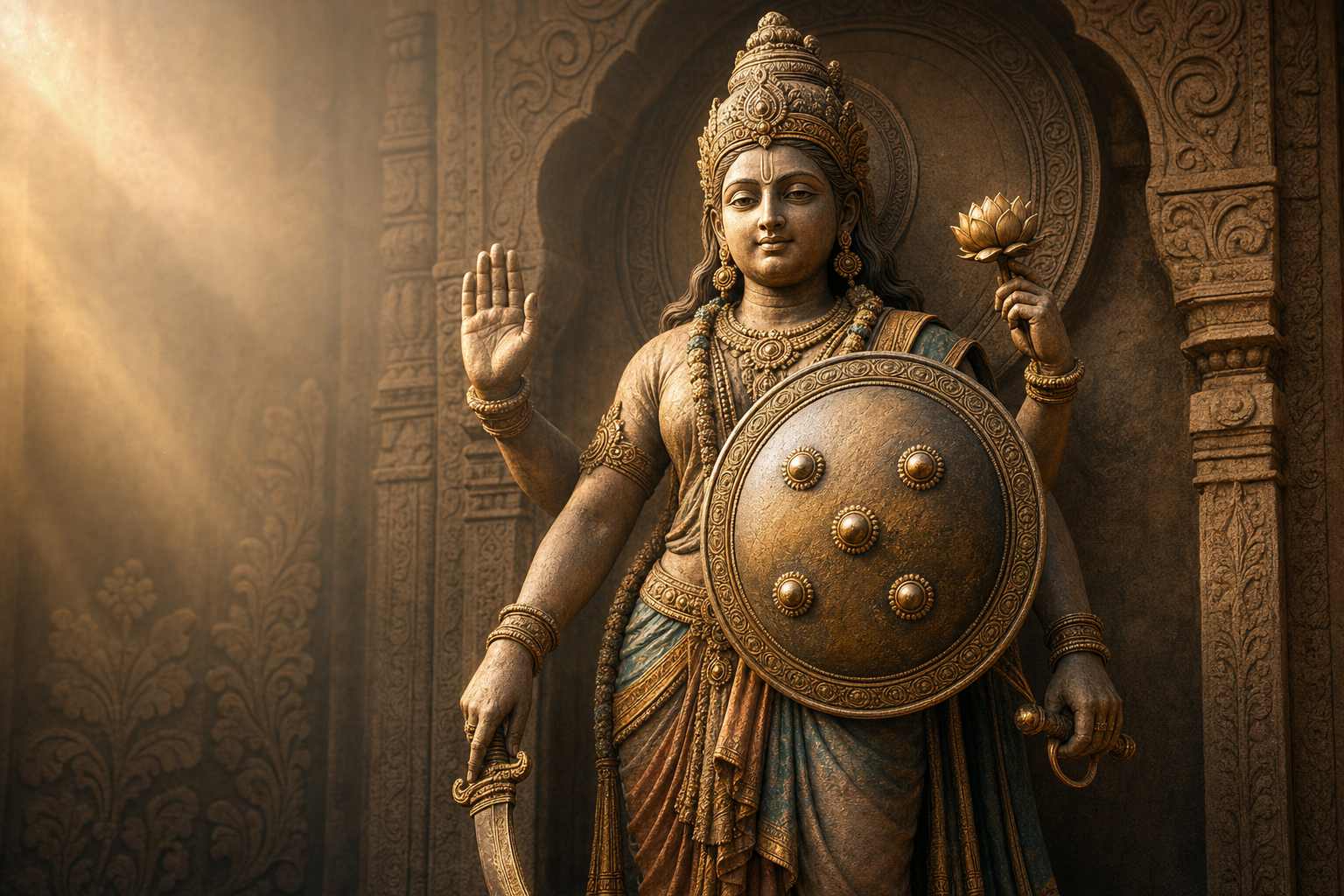
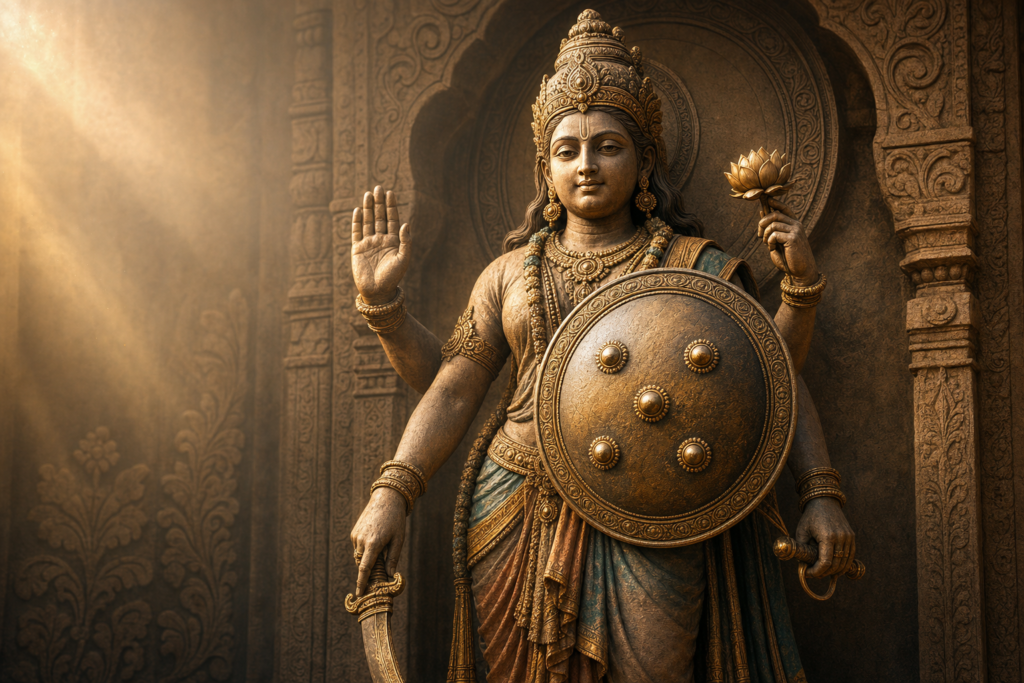
The khetaka, or kheṭaka, is the shield carried by deities, guardians, and divine attendants in Indian sacred art. It can appear so modest beside a flashing sword, trident, discus, or bow that an observer may initially treat it as secondary equipment. Yet its apparent simplicity is precisely what makes it revealing. A weapon projects force outward; a shield receives, contains, and redirects force. Within Hindu iconography, the khetaka consequently contributes to a visual language of protection, disciplined power, readiness, and the preservation of sacred order.
The shield should not, however, be reduced to a single universal meaning. Hindu sculptures were produced across many centuries, regions, dynasties, sectarian traditions, and workshops. Their attributes were shaped by textual prescriptions, local conventions, ritual requirements, narrative episodes, and artistic judgment. In one image the khetaka helps identify a warrior manifestation; in another it completes a sword-and-shield pair; elsewhere it emphasizes the protective office of a goddess or attendant. Its meaning emerges from the entire iconographic composition rather than from the object in isolation.
What the word khetaka means
The Sanskrit term kheṭaka is conventionally translated as shield. English-language catalogues and studies also use the spelling khetaka, while kheta may occur as a shortened form. It belongs to the technical vocabulary used to identify the āyudha, or implement and attribute, placed in a divine hand. An illustrated Government of India reference on Indian art lists Khetaka (खेटक) directly as Shield alongside such implements as khaḍga, paraśu, pāśa, śakti, triśūla, and vajra. This classification is useful because an āyudha in sacred art is rarely just military hardware; it is also an identifying sign embedded in a larger system of form, gesture, posture, vehicle, ornament, and narrative.
The word requires contextual care because Sanskrit terms can possess several meanings, and similar-looking words may belong to different semantic histories. In an iconographic description such as khaḍga-kheṭaka, however, the martial pairing makes the sense unambiguous: khaḍga denotes a sword and kheṭaka a shield. The compound is therefore not merely a list of objects. It describes a coordinated visual unit in which attack and defense, intervention and preservation, are held together.
Scripture, tradition, and the limits of simple claims
The theological environment behind the khetaka has deep roots, but its history should be stated precisely. Vedic literature supplies foundational ideas about protection, armor, divine assistance, kingship, and victory over disorder. It does not function as a straightforward sculptor’s manual prescribing every later form of the khetaka. The detailed visual programs familiar from temple sculpture developed through the epics, Purāṇas, Āgamas, Tantras, and the broad body of Śilpaśāstra literature. Thus, the shield participates in a Vedic and epic ethos of divinely ordered protection, while its specific placement in images is more directly associated with later iconographic systems.
Texts concerned with image making prescribe a deity’s number of arms, bodily proportions, gestures, ornaments, weapons, facial expression, posture, and vehicle. Such directions allowed artists and ritual specialists to distinguish one manifestation from another. The Agni Purāṇa, for example, describes an eight-armed form of Viṣṇu whose attributes include martial implements, with the khetaka placed among the objects held in the left hands. The Viṣṇudharmottara Purāṇa likewise belongs to the important textual tradition that discusses the visual arts and the representation of divine forms. Śaiva and Śākta Āgamic traditions provide additional configurations in which a shield accompanies a sword, bow, trident, axe, noose, or other attribute.
These textual prescriptions are not identical across all recensions and regions. Nor did every sculptor reproduce a textual list mechanically. Attributes could be omitted because of scale, substituted according to local practice, damaged over time, or rearranged to create a balanced composition. A surviving image may also represent a regional form whose authoritative description circulated through a workshop tradition rather than through a single text now available to scholars. Responsible interpretation therefore compares scripture, sculpture, inscriptions, temple context, and regional style instead of forcing every figure into one rigid formula.
The shield as a theology of protection
At its most accessible level, the khetaka signifies protection. This protection is not necessarily passive. A shield requires alertness, correct positioning, endurance, and a willingness to stand between danger and what must be preserved. In sacred imagery, those qualities resonate with the defense of dharma: the maintenance of moral, cosmic, social, and ritual order against forces represented as chaotic, violent, or obstructive.
That interpretation is compelling, but it remains an interpretive principle rather than a universal caption attached to every ancient image. The shield’s precise significance changes according to its bearer. In the hand of Durgā, it belongs to her capacity to confront forces that the ordinary world cannot overcome. In the hand of Vīrabhadra, it strengthens an image of formidable Śaiva authority. In a multi-armed form of Viṣṇu, it contributes to the deity’s complete sovereign equipment. When carried by an attendant, guardian, Yakṣa, or śāsanadevī, it identifies a protective office rather than supreme divinity itself.
The khetaka also expresses restraint. Divine power in Hindu sculpture is often shown as immense but ordered. A deity may possess numerous weapons without appearing overwhelmed by them. Every hand remains purposeful, and the body frequently retains a centered axis even amid violent action. The shield participates in this composure. It suggests that sacred strength includes the ability to absorb aggression without surrendering balance.
For many viewers, this is the shield’s most emotionally immediate dimension. The object evokes a recognizable human need for safety, yet it does not promise a life without conflict. It instead visualizes a disciplined response to conflict. Protection becomes an active ethical responsibility: vulnerability is acknowledged, boundaries are maintained, and force is placed in the service of something greater than personal anger.
Why the sword and shield appear together
The khetaka is frequently paired with the khaḍga, or sword. On the practical level, this reflects a familiar martial combination: one hand strikes while the other guards the body. In iconography, the pairing creates a richer conceptual field. The sword can indicate decisive action, the destruction of obstruction, or the cutting of ignorance; the shield can indicate preservation, resistance, and the safeguarding of dharma. Together they make divine action both forceful and controlled.
It would be too schematic to declare that every sword always means knowledge and every shield always means dharma. Sacred attributes are multivalent, and narrative context matters. Nevertheless, the visual opposition between a cutting edge and a containing surface is unmistakable. The pairing permits an image to communicate two complementary truths at once: some conditions must be confronted, while some realities must be protected.
The conventional placement of a sword in a right hand and shield in a left hand often follows the practical logic of combat, although artists could vary the arrangement. In a multi-armed sculpture, the pair may occupy corresponding positions so that the composition remains legible. Their diagonals can enliven the silhouette, frame the torso, or direct attention toward an adversary. Iconography and sculptural design therefore reinforce one another.
Durgā, Devī, and the khetaka
The shield is especially meaningful in images of Devī’s martial forms. Durgā and Mahiṣāsuramardinī embody divine power mobilized against a destructive threat that has exceeded the capacity of ordinary resistance. Their many arms display the coordinated energies and weapons associated with the gods. The khetaka does not diminish the goddess’s offensive power; it shows that she is fully equipped, sovereign, and invulnerable in the fulfillment of her protective task.
A small stone image in the British Museum, probably made in Bihar in the ninth century, shows a four-armed female deity identified provisionally as Durgā because she sits upon a lion. Her upper right hand carries a sword, while her upper left holds a buckler. The identification is appropriately cautious, but the sword-and-shield pairing, lion vehicle, and martial bearing form a coherent ensemble. Even at only 10.6 centimetres high, the sculpture compresses a complete statement of beneficent authority into a portable scale.
A seventeenth-century Kerala bronze identified as Bhadra Kālī offers another configuration. Its eight arms carry a flail, sword, trident, cup, noose, and shield, while two hands display abhaya and varada mudrās. The juxtaposition is theologically important. Weapons declare the capacity to overcome danger; abhaya promises freedom from fear; varada communicates the granting of favor. Protection is therefore expressed through both martial attributes and compassionate gestures.
A circa-1790 Pahari painting of Devī from Guler extends the same vocabulary into another medium. The Great Goddess is enthroned and carries a conch, goad, lotus, discus, shield, mace, banner, and sword. Here the khetaka belongs not to a chaotic battle scene but to a majestic courtly vision. The shift demonstrates that a shield can signify latent sovereignty and preparedness even when no enemy is shown.
Śaiva forms: Vīrabhadra and other warrior manifestations
Śaiva iconography provides some of the clearest surviving examples of the khetaka. Vīrabhadra, the formidable being generated through Śiva’s wrath in the Dakṣa narrative, is commonly represented as an armed warrior. A large seventeenth-century granite sculpture associated with the Deccan and possibly Hampi shows him standing with sword, shield, bow, and arrows. A small goat-headed Dakṣa beside him anchors the figure in its narrative context. The shield alone would not establish the identification, but it strengthens the total iconographic argument.
A seventeenth-century South Indian bronze in the British Museum similarly represents Vīrabhadra with sword, spear, shield, and bow. The repetition of the martial ensemble across stone and bronze illustrates continuity without implying exact uniformity. Granite encourages broad, durable masses; lost-wax bronze permits extended limbs, finer edges, and a more fluid relationship between body and attributes. The theological identity remains recognizable even as material alters visual effect.
The khetaka also occurs in prescribed forms of fierce or warrior-like Śaiva deities. The Indira Gandhi National Centre for the Arts documents an image at the Bṛhadīśvara Temple in which a four-armed deity carries paraśu and mṛga in the rear hands and sword and shield in the front hands. Such combinations demonstrate why attributes must be read relationally. The axe and deer connect the figure to Śaiva visual language, while the sword and shield emphasize an active, protective manifestation.
An unusual eighteenth-century ceremonial shield, probably from Karnataka, carries a hammered metal plaque of Vīrabhadra with Dakṣa and Satī on a wooden backing. The object reverses the normal relationship between symbol and support: instead of a sculpted deity holding a shield, an actual ceremonial shield becomes the surface upon which the deity is represented. Sacred narrative, ritual display, and the material culture of arms converge in a single artifact.
Vaiṣṇava and other divine contexts
The khetaka is less immediately associated with Viṣṇu than the conch, discus, mace, and lotus, but it appears in expanded multi-armed forms. Puranic iconographic descriptions can equip Viṣṇu with a wider royal and martial arsenal, including sword, bow, arrow, and shield. These additional attributes express total sovereignty and the capacity to restore order in every mode required by a cosmic crisis.
This distinction is crucial for identification. A four-armed Viṣṇu is normally recognized through the familiar śaṅkha, cakra, gadā, and padma ensemble, subject to regional and chronological variation. A shield is more likely to occur when the image expands the deity’s arms and powers or presents a special manifestation. Its presence should prompt investigation rather than an automatic conclusion.
The shield can also belong to divine attendants. An eleventh-century sandstone image of Sūrya in the British Museum includes Daṇḍī as a small attendant carrying sword and shield. The main deity holds lotuses, while the subordinate warrior bears the martial pair. This hierarchy of attributes helps distribute functions throughout the composition: Sūrya remains the radiant center, and Daṇḍī contributes protective readiness at the base.
Forms of Gaṇeśa, Skanda, Bhairava, Cāmuṇḍā, Nirṛti, and other deities or guardians may also carry a khetaka in particular textual and regional traditions. Such occurrences confirm the shield’s wide circulation but also warn against treating it as the exclusive emblem of any one deity. Identification depends upon the full constellation of head type, number of faces and arms, posture, vehicle, companions, gestures, and remaining attributes.
Form, material, and the sculptor’s problem
Iconographic manuals and modern reference works recognize shields in circular, oval, oblong, or quadrangular forms. Surviving historical shields show that wood and hide were important materials, with metal, lacquer, textile, and ornament sometimes added. A North Indian dhāl at the Metropolitan Museum of Art, dated to the early nineteenth century, is made from thick hide formed into a shallow dome and embellished with gilt bronze, enamel, lacquer, jewels, and velvet. Although much later than many temple sculptures, it demonstrates the material richness that a carved or painted shield could evoke through abbreviated signs.
A sculptor working in stone had to translate a relatively thin object into a stable form. A fully detached circular shield would be vulnerable to breakage, especially at the wrist or rim. Artists therefore joined it to the body, back slab, garment, or adjacent attribute. They might thicken its edge, reduce its projection, or show only part of its face. What appears to be an oversized or unusually solid shield may reflect structural intelligence rather than ignorance of real weapons.
Bosses, rims, central projections, straps, and surface patterns can assist identification, but weathering often removes these details. In some images only a rounded mass beside a hand survives. The researcher must then determine whether it was a shield, lotus, bowl, fruit, drum, or another implement. Old photographs, comparable sculptures, textual descriptions, and traces of the hand’s grip can become decisive evidence.
Bronze creates different possibilities. Through lost-wax casting, a shield can be modeled with a distinct curvature, thin rim, ornamental bosses, and visible relationship to the forearm. Paint adds another layer: color, gold, shading, and patterned decoration can make the shield luxurious or visually separate it from other attributes. The khetaka is therefore not one immutable shape but a concept translated through the capacities of stone, metal, wood, and pigment.
Multiple arms and simultaneous power
The khetaka becomes especially expressive in a multi-armed image. Multiple arms should not be read as an attempt to portray ordinary anatomy. They are a visual method for presenting simultaneous capacities that a two-armed body could reveal only sequentially. A goddess may attack, defend, reassure, and grant blessings at the same moment. The shield is one component of this theological compression.
Each arm also contributes to rhythm. Weapons radiate around the divine body, but the torso often remains calm and frontal. A shield may anchor one side of the composition, counterbalance a raised sword, or close an otherwise open contour. The eye first encounters movement and multiplicity, then discovers an ordered center. That progression from turbulence to stability is itself compatible with the protective meaning of the image.
Reading a damaged sculpture
A careful examination begins with the hand rather than the object’s presumed identity. The position of the fingers may reveal whether the figure grasped a handle, supported a bowl, or held a stem. The next question concerns placement: a shield generally occupies a defensive side of the body or balances a sword, although exceptions occur. Its outline, curvature, bosses, and rim should then be compared with regional examples.
The wider composition must follow. A lion may suggest Durgā; a goat-headed Dakṣa may confirm Vīrabhadra; a serpent canopy and miniature Tīrthaṁkara may identify the Jaina goddess Padmāvatī. A single attribute rarely provides a secure identification because sacred art uses a shared repertoire. The strongest conclusion is the one supported by several independent features.
Absence is equally important. Many images have lost projecting hands and weapons through impact, weathering, ritual handling, theft, or later alteration. A museum label that describes an object as unidentified may therefore reflect responsible caution rather than a lack of expertise. Certainty should be proportional to the evidence, particularly when an image has been removed from its architectural setting and no inscription survives.
A shared Dharmic visual vocabulary
The khetaka also illuminates connections among the Dharmic traditions without erasing their differences. Hindu, Buddhist, and Jaina artists worked within overlapping regional environments, employed related materials and workshops, and drew from a broad Indian vocabulary of deities, guardians, gestures, weapons, lotuses, serpent canopies, and protective beings. A form could therefore cross religious boundaries while receiving a distinct doctrinal identity in each tradition.
An eleventh- or twelfth-century sandstone Padmāvatī from the Deccan provides a particularly clear Jaina comparison. The British Museum identifies her as a śāsanadevī, or protective goddess, associated with Pārśvanātha. She stands beneath a serpent canopy and holds a shield, serpent, lotus tendril, and sword, although two attributes are now broken. The khetaka serves her Jaina protective office; it does not transform her into a Hindu deity merely because the same implement appears in Hindu art.
This example encourages a mature understanding of unity. Shared forms reveal dialogue, proximity, and a common artistic inheritance, while differences in theology and ritual remain meaningful. Buddhist traditions likewise developed extensive iconographies of guardians and protective deities, and Sikh history gave ethical depth to disciplined defense and the protection of others. The traditions need not be collapsed into one system for their convergences to be appreciated. Respectful comparison recognizes kinship without denying particularity.
From battlefield equipment to sacred symbol
The transformation of an ordinary shield into a divine attribute does not require the rejection of its practical function. Sacred art often works by intensifying familiar objects. A human shield protects one body for a limited time; a divine khetaka visualizes protection on a cosmic and ethical scale. Its physical purpose remains legible, enabling theological meaning to arise from lived experience.
This continuity helps explain the object’s emotional power. A lotus may require knowledge of purity symbolism, and a complex mudrā may require technical study, but the basic action of a shield is immediately understandable. It stands between vulnerability and danger. The deeper iconographic lesson emerges when that simple action is placed within a sacred composition: protection is represented not as fearfulness but as courageous, measured responsibility.
The shield also complicates modern assumptions that spirituality and martial imagery are opposites. Hindu sacred art does not necessarily glorify violence by placing weapons in divine hands. It frequently distinguishes force governed by dharma from aggression driven by ego, domination, or disorder. The khetaka reinforces that distinction because its primary action is defensive. It asks what deserves protection, under what authority, and with what degree of restraint.
Regional continuity and historical change
Examples from Bihar, Odisha, the Deccan, Karnataka, Kerala, and the Pahari region demonstrate that the khetaka was not confined to one school. It appears in compact stone icons, monumental granite figures, portable bronzes, paintings, and ceremonial arms. This distribution reflects a widely intelligible iconographic vocabulary adapted to local artistic languages.
Chronology nevertheless changes its appearance. Early medieval stone carvers may render the shield as a compact disk or buckler integrated into a dense figure. Later South Indian bronzes can display it more openly as part of an extended martial silhouette. Pahari painters can cover it with color and ornament, while ceremonial metalworkers can turn the shield itself into a carrier of sacred narrative. Continuity lies in function and association, not in an unchanging design.
Historical collections must also be read critically. Many Indian sculptures now in European or North American museums were acquired during colonial rule, often with incomplete documentation. Museum catalogues can provide valuable measurements, dates, materials, and iconographic observations, but provenance may remain uncertain. A comprehensive study of the khetaka therefore includes not only what an image represents but also where it was made, how it was worshipped, when it was removed, and what information was lost during that movement.
Conservation and documentation
Small attributes are among the first parts of a sculpture to break. Shields may survive more frequently than thin swords because their broad surfaces can be joined to the body, but their rims, handles, and decorative bosses remain vulnerable. Corrosion can obscure details in metal images, while repeated cleaning can soften modeled surfaces. Stone examples face salt damage, water erosion, biological growth, and structural fractures.
Good documentation should record the object from several angles, including the relationship between shield, hand, wrist, and back support. Raking light can reveal shallow bosses or incised borders. Three-dimensional imaging may preserve details that are difficult to see under ordinary museum lighting, while technical analysis can identify metal composition, casting repairs, pigments, or later additions. These methods do not replace textual study; they provide another body of evidence with which textual claims can be tested.
How to recognize and interpret the khetaka
A practical reading can proceed through five linked questions. First, does the object have the outline, rim, bosses, curvature, or grip expected of a shield? Second, is it paired with a sword or another martial implement? Third, which hand holds it, and how does it balance the pose? Fourth, what do the vehicle, companions, crown, faces, gestures, and remaining attributes indicate? Fifth, does a relevant Purāṇic, Āgamic, Śilpaśāstra, inscriptional, or regional source support the proposed identification?
The method guards against two opposite errors. One is to dismiss the shield as decorative equipment and miss its iconographic role. The other is to impose an elaborate symbolic explanation unsupported by the image or its tradition. A sound interpretation begins with description, moves to comparison, and reaches symbolism only after the material evidence has been respected.
The enduring significance of the shield
The khetaka embodies one of sacred art’s most durable insights: power is incomplete without protection. A sword can defeat an immediate threat, but a shield represents the capacity to endure, preserve, and remain responsible under pressure. When both appear in the hands of a deity, destructive and conserving powers are placed within a single ordered intelligence.
Its significance is therefore theological, artistic, historical, and deeply human. Theologically, it participates in images of divine guardianship and the defense of dharma. Artistically, it balances silhouettes, stabilizes multi-armed compositions, and helps identify particular forms. Historically, it connects textual prescriptions with regional workshops and the material culture of Indian arms. Humanly, it gives visible form to the desire that courage should protect rather than dominate.
Once recognized, the khetaka changes the way a sculpture is seen. What seemed like a minor disk becomes a carefully positioned statement about boundaries, responsibility, and controlled strength. It reminds the observer that Hindu iconography communicates through relationships: shield and sword, fearlessness and favor, motion and stillness, destruction and preservation. In that balanced visual grammar, the khetaka is not merely carried by the deity. It helps reveal what divine power is for.
Selected research resources
Useful comparative evidence includes the Indira Gandhi National Centre for the Arts documentation of Bṛhadīśvara Temple iconography; the British Museum records for the ninth-century Durgā image, Kerala Bhadra Kālī bronze, Deccan Vīrabhadra sculpture, Jaina Padmāvatī sculpture, and ceremonial Vīrabhadra shield; and the Metropolitan Museum of Art record for a North Indian hide shield. These sources document distinct objects and should be used comparatively rather than treated as proof of one fixed meaning for every khetaka.
Inspired by this post on Hindu Blog.







Leave a Reply
You must be logged in to post a comment.