
When a Registration Dispute Becomes a Constitutional Test
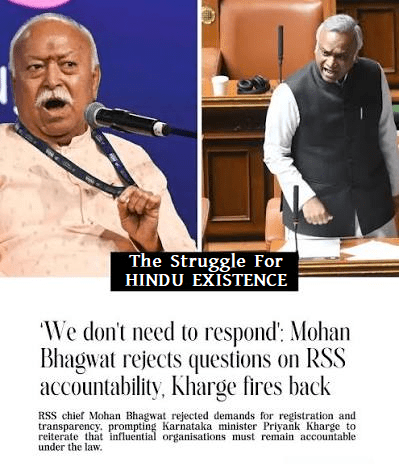
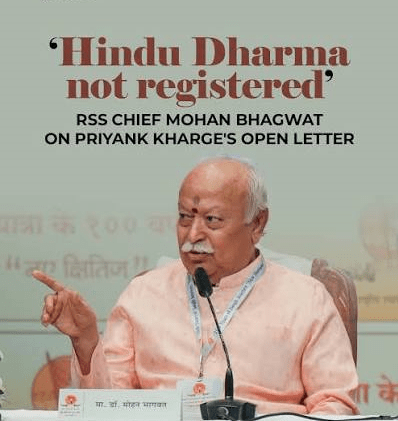
The controversy over whether the Rashtriya Swayamsevak Sangh (RSS) should be formally registered is larger than a dispute between Karnataka Home Minister Priyank Kharge and RSS Sarsanghchalak Mohan Bhagwat. It presents a difficult constitutional question: how should India reconcile freedom of association with demands for institutional transparency, financial accountability and equal application of the law? The answer cannot be reduced to either an assertion that a large organisation must register because it is influential or a claim that voluntary status places an organisation beyond all regulatory scrutiny.
The public exchange began with questions about the RSS’s legal status, organisational structure, office-bearers, sources of income, expenditure, tax compliance and permissions for public programmes. Kharge argued that an organisation with a substantial presence in Indian public life should meet high standards of constitutional accountability. The counterargument was equally direct: before demanding registration, the government must identify the statute that makes registration compulsory for an association of this kind.
This distinction is decisive. A political demand for registration is not automatically a legal obligation, just as the absence of a universal registration requirement does not eliminate obligations arising under tax, criminal, property, foreign-contribution or public-order laws. Constitutional analysis therefore requires several questions to be separated instead of being compressed into one emotionally charged controversy.
The First Question: Is Every Voluntary Association Required to Register?
Indian law does not begin with a general rule that every group of citizens must obtain government recognition before associating. Article 19(1)(c) of the Constitution guarantees citizens the right “to form associations or unions or co-operative societies.” This freedom allows individuals to gather around social, cultural, religious, educational, charitable, ideological or civic purposes without treating state permission as the source of their collective existence.
Article 19(4), however, permits reasonable restrictions imposed by law in the interests of the sovereignty and integrity of India, public order or morality. Freedom of association is therefore substantial but not absolute. The state may regulate unlawful conduct, financing, public assemblies and other activities falling within valid legislation. What the state ordinarily cannot do is replace a statutory rule with an improvised political command.
Registration is one legal mechanism through which an association may acquire a defined institutional form. A society may register under an applicable societies law; a charitable body may operate through a public trust; a non-profit enterprise may use a company structure; and an organisation contesting elections may be governed by the Representation of the People Act. These frameworks serve different purposes. They are not interchangeable, and the availability of a registration framework does not necessarily mean that every informal association is compelled to enter it.
The Societies Registration Act, 1860, historically enabled groups formed for literary, scientific, charitable and related purposes to register as societies. Its language and the state-level legal variations built upon it must be examined carefully before drawing universal conclusions. The relevant inquiry is not simply whether registration is possible, but whether a particular central or state law makes it mandatory for a body with the RSS’s legal characteristics and activities.
Consequently, a minister seeking compulsory registration carries an important legal burden: the demand should identify the competent legislature, the applicable statutory category, the provision allegedly violated and the consequences prescribed for non-compliance. Without those elements, the demand remains a proposal for public policy or political accountability rather than an established finding of illegality.
Freedom of Association Is Not the Same as Corporate Personality
A group can exist as an association of individuals without being incorporated as a separate juristic person. This is the core of the RSS response. Yet constitutional freedom to associate and statutory recognition as an independent legal entity are different concepts. The former protects collective action by citizens; the latter determines how an institution may hold property, enter contracts, maintain accounts, employ personnel, receive regulated benefits or sue and be sued in its own name.
Registration can therefore offer practical advantages even where it is not compulsory. It can clarify who is authorised to act, who owns institutional assets, how leadership transitions occur, which rules govern internal administration and where legal responsibility rests. For an ordinary volunteer or donor, these matters are not theoretical. They influence whether a contribution can be traced, whether a grievance has a defined recipient and whether a promise made in the organisation’s name can be enforced.
An unregistered association may still be recognised for particular legal purposes. Indian statutes sometimes define a “person” broadly enough to include an association or body of persons, whether incorporated or not. Tax law, criminal law and procedural law may therefore recognise a collective body without granting it every attribute of a registered society or corporation. Recognition for one legal purpose does not automatically create comprehensive exemption from other laws.
This is why the question “Does the RSS legally exist?” is too imprecise. Its public existence, identifiable leadership and organised activities are not seriously in doubt. The more precise questions concern the legal capacity in which particular assets are held, donations are received, contracts are executed, workers are engaged and programmes are conducted. Different RSS-linked or associated institutions may also possess their own registered structures, accounts and statutory obligations. Their compliance cannot automatically prove or disprove the legal position of the central voluntary body.
What the Supreme Court’s Association Cases Actually Establish
In State of Madras v. V.G. Row, the Supreme Court examined restrictions affecting an association and emphasised that constitutional reasonableness must be assessed judicially rather than accepted merely because the executive considers a body undesirable. The decision remains important because it places legal limits on state interference with associational freedom. It does not, by itself, answer every modern question about registration, taxation or financial disclosure.
In Damyanti Naranga v. Union of India, the Supreme Court held that the right to form an association includes a meaningful right to preserve its voluntarily chosen composition. The state could not fundamentally alter an association by imposing members whom its existing members had not chosen. The case supports organisational autonomy, but it should not be transformed into a claim that every activity undertaken by an association is immune from regulation. The Court’s broader jurisprudence distinguishes the right to form and continue an association from an unrestricted right to achieve every institutional objective by any chosen method.
These precedents strengthen a limited but important proposition: executive suspicion cannot substitute for law. If registration is to be compelled, the state must rely on constitutionally valid legislation rather than an ad hoc direction. At the same time, a generally applicable law governing taxation, foreign contributions, employment, property, public gatherings or criminal conduct is not invalid merely because it affects an association exercising rights under Article 19(1)(c).
The Madhya Pradesh High Court Decision Requires Careful Reading
The 2024 decision in Shri Purushottam Gupta v. Union of India is frequently invoked in this debate. The case concerned Office Memorandums issued in 1966, 1970 and 1980 that restricted Central Government employees from joining or participating in RSS activities. During the proceedings, the Union Government produced an Office Memorandum dated 9 July 2024 removing the RSS from the earlier instructions.
The Madhya Pradesh High Court observed that restrictions affecting fundamental rights should not depend on the changing preferences of the government of the day. It also discussed the social, educational, health, rural-development and humanitarian work undertaken by volunteers and associated organisations, cautioning against treating every activity connected with the RSS as political. The court directed public dissemination of the government’s 2024 memorandum.
The judgment is relevant to freedom of association and the limits of executive instructions, but it did not adjudicate a comprehensive statutory claim that the RSS must register. Its subject was the participation of government employees and the legal adequacy of executive restrictions. It would therefore be inaccurate either to ignore the judgment or to present it as a final ruling on every question concerning the RSS’s organisational and financial status.
The Bengaluru Defamation Order Adds Another Layer
A Bengaluru special court subsequently addressed whether an RSS volunteer could maintain a criminal defamation complaint concerning statements directed at the RSS and its swayamsevaks. Kharge contended, among other things, that the absence of formal registration and documentary membership records weakened the complainant’s legal standing. The court rejected the proposition that registration was a prerequisite for recognising an identifiable body of persons in that context.
Referring to Section 2(26) of the Bharatiya Nyaya Sanhita, 2023, and earlier defamation jurisprudence, the court treated the RSS as a sufficiently definite and identifiable body for the preliminary purpose of the complaint. It reasoned that an association need not be incorporated before a claimed member can attempt to establish that a defamatory imputation against the group caused legally cognisable injury.
That order should also be interpreted within its procedural limits. The court was deciding whether the complaint could proceed at a preliminary stage, not delivering a final judgment on guilt, membership or the complete regulatory status of the RSS. Recognition as an identifiable group for defamation law does not settle whether particular financial transactions, assets or public activities comply with every applicable statute.
Financial Accountability Does Not Depend on a Single Registration Certificate
The strongest public concern raised by the controversy relates to money. Questions about donations, expenditure, assets and taxation are legitimate whenever an institution exercises significant social influence or handles substantial resources. Yet those questions must be investigated through evidence and the correct statutory channels. An allegation of tax evasion, unlawful foreign funding or money laundering cannot be established merely by pointing to the absence of society registration.
Indian tax law can recognise an association of persons even when it is not incorporated. Tax liability depends on legally relevant income, receipts, exemptions and the identity of the person or body receiving them. Charitable tax exemptions and donor benefits generally require compliance with specified registration, reporting and use-of-funds conditions. If a body claims such benefits, the relevant authorities may examine whether it has satisfied those conditions.
Foreign contributions present another distinct field. The Foreign Contribution (Regulation) Act governs the acceptance and use of foreign contributions by covered persons and associations. A body cannot avoid an applicable foreign-contribution requirement merely by describing itself as informal. Conversely, no allegation of foreign funding should be treated as fact without records identifying the recipient, transaction and violated provision.
Property and banking questions require the same precision. If assets used for organisational purposes are legally owned by separate trusts or societies, those entities possess their own duties. If funds are received or spent through identifiable persons or institutions, the relevant accounts and statutory filings may be examined under the laws applicable to them. The existence of multiple affiliated entities may complicate oversight, but complexity is not proof of illegality.
Transparency nevertheless has an ethical dimension beyond minimum legal compliance. A major public institution may voluntarily publish governance rules, audited summaries, conflict-of-interest safeguards and explanations of how funds are administered. Such disclosure can strengthen public confidence without conceding that political opponents possess unlimited power to dictate its internal structure. Legal compulsion and voluntary good governance should not be confused, but neither should they be treated as enemies.
Public Events Are Regulated Separately
Registration of an organisation is also distinct from permission for a route march, procession, assembly or event on public property. Police and civic authorities may regulate time, place, route, crowd safety, traffic, noise and public order under applicable laws. A registered organisation does not acquire an unconditional right to occupy a road, and an unregistered association does not automatically lose the constitutional protection available to peaceful assembly.
Authorities must apply these rules consistently. Comparable events should be assessed through neutral criteria rather than the religious, cultural or political identity of their organisers. Selective permission, selective prohibition or selective enforcement corrodes trust and invites claims under Article 14’s guarantee of equality before the law. Public safety is a legitimate concern; partisan discrimination is not.
Influence Does Not Automatically Convert a Cultural Body into a Political Party
A further argument holds that the RSS’s influence on Indian politics should subject it to the legal regime governing political parties. The organisation describes itself as a social and cultural body and does not contest elections in its own name. Critics, however, point to ideological, organisational and personnel relationships between the RSS and the Bharatiya Janata Party.
Political influence and legal classification must be distinguished. Civil-society organisations, trade unions, religious bodies, business associations, advocacy groups and intellectual movements may all shape elections and public policy without becoming registered political parties. The decisive legal question is whether a body performs activities that trigger the statutory definition and obligations of a political party, not whether its views influence politicians.
This does not prevent legitimate scrutiny of coordination, campaign expenditure or electoral activity. If resources are contributed to election campaigns, candidates or parties, election and finance laws may apply to the relevant transactions. The correct response is transaction-specific enforcement based on evidence, not an assumption that ideological proximity automatically merges legally separate institutions.
Could a New Registration Law Be Enacted?
A legislature may consider creating a general registration and disclosure framework for large voluntary associations that handle significant funds or conduct extensive public operations. Such a proposal is a policy question and should be debated openly. It would need clear definitions, objective thresholds, procedural safeguards, reasonable reporting duties and a principled allocation of responsibility between the Union and the states.
Any new law would also face constitutional review. It would need to satisfy Article 14 by avoiding arbitrary classification and discriminatory enforcement. Any restriction on associational freedom would have to fall within Article 19(4), remain proportionate to a legitimate purpose and provide fair procedures for registration, inspection, penalties and appeal. Disclosure demands should respect privacy and should not expose ordinary members of lawful associations to harassment.
A law drafted to capture one named organisation while leaving similarly situated bodies untouched would raise serious equality and political-retaliation concerns. A neutral framework, by contrast, could apply consistently to large cultural, religious, charitable and ideological associations across communities. The constitutional legitimacy of regulation depends greatly on whether it establishes a fair rule or merely supplies a legal-looking instrument for selective control.
A Principle Relevant to Every Dharmic Tradition
The broader constitutional principle has consequences for Hindu, Buddhist, Jain and Sikh institutions as well as for organisations representing every other faith and philosophy. Monastic orders, temple networks, gurudwaras, educational societies, charitable trusts, cultural forums and informal devotional communities frequently use different organisational forms. A rule that allows the state to compel registration solely because a movement is influential could eventually threaten many peaceful traditions.
At the same time, Dharmic service is strengthened when institutions demonstrate stewardship, integrity and responsibility. Donors who contribute in good faith deserve confidence that resources are used for declared purposes. Volunteers deserve clarity about decision-making. Beneficiaries deserve protection against misuse. Transparency, when designed fairly, can express dharma through accountable conduct rather than function as an attack on religious or cultural autonomy.
This shared standard can encourage unity across Dharmic traditions. Hindu, Buddhist, Jain and Sikh organisations need not agree on theology or institutional design to support freedom of association, equal treatment, non-violence, due process and responsible management. Constitutional pluralism protects their distinctive paths while accountability preserves the public trust on which community service depends.
The Difference Between a Legal Question and a Political Accusation
The registration controversy has generated claims from opposing political camps that extend well beyond the evidence necessary to answer the legal question. One side portrays the absence of registration as proof that the RSS is above the law. The other treats any request for disclosure as an unconstitutional attack. Both positions are too absolute.
An unregistered association is not inherently unlawful, and registration is not the source of the constitutional right to associate. Yet unregistered status does not create immunity from tax, criminal, property, labour, foreign-contribution or public-order law. The state must identify specific obligations and investigate specific conduct. The organisation, for its part, can distinguish a legally unsupported demand from reasonable questions concerning governance and financial integrity.
The rule of law requires symmetry. Political influence cannot excuse legal violations, but political hostility cannot manufacture them. If authorities possess evidence of an offence, they should initiate proceedings under the applicable statute and provide due process. If no mandatory registration provision applies, they should candidly frame compulsory registration as proposed legislation rather than present it as an already established duty.
A Constructive Path Forward
A responsible resolution would begin with a publicly accessible legal memorandum from the government identifying the statutory provisions it considers applicable. That document should distinguish registration, taxation, foreign funding, property ownership, public-event permissions and electoral activity. Each field should be analysed separately, with evidence replacing broad accusation.
The RSS could respond through an equally precise institutional statement explaining the legal form in which its central and associated activities operate, the mechanisms used to receive and administer funds, and the compliance systems governing registered affiliates. Voluntary disclosure of an independently audited financial overview, where legally and practically possible, could reduce suspicion without surrendering constitutional autonomy.
Parliament and state legislatures could then consider whether India’s existing framework for large unincorporated associations contains genuine gaps. Any reform should emerge from consultation with constitutional scholars, tax specialists, civil-society organisations and representatives of diverse religious and cultural traditions. The result should protect citizens from opaque financial practices while also protecting lawful associations from partisan surveillance.
Conclusion: Accountability Must Be Constitutional
The RSS registration debate ultimately tests the maturity of Indian constitutional politics. Freedom of association protects citizens from being required to seek executive approval merely to organise around lawful purposes. Accountability ensures that influence, money and institutional complexity do not become shelters for unlawful conduct. Neither principle should be sacrificed to preserve the other.
On the presently articulated issue, the decisive challenge for advocates of compulsory registration is to identify a specific law that requires the RSS, in its claimed form as a voluntary body of individuals, to register. Until such a provision is established, non-registration alone cannot responsibly be treated as proof of illegality. At the same time, every identifiable transaction and activity remains subject to the laws that independently govern it.
The most durable conclusion is therefore neither institutional exemption nor politically directed compulsion. It is equal accountability under clear, prospective and constitutionally valid law. That standard protects the RSS, its critics, India’s diverse Dharmic communities and every citizen who depends on the Constitution to keep both private power and state power within legitimate limits.
Inspired by this post on Struggle for Hindu Existence.









Leave a Reply
You must be logged in to post a comment.