
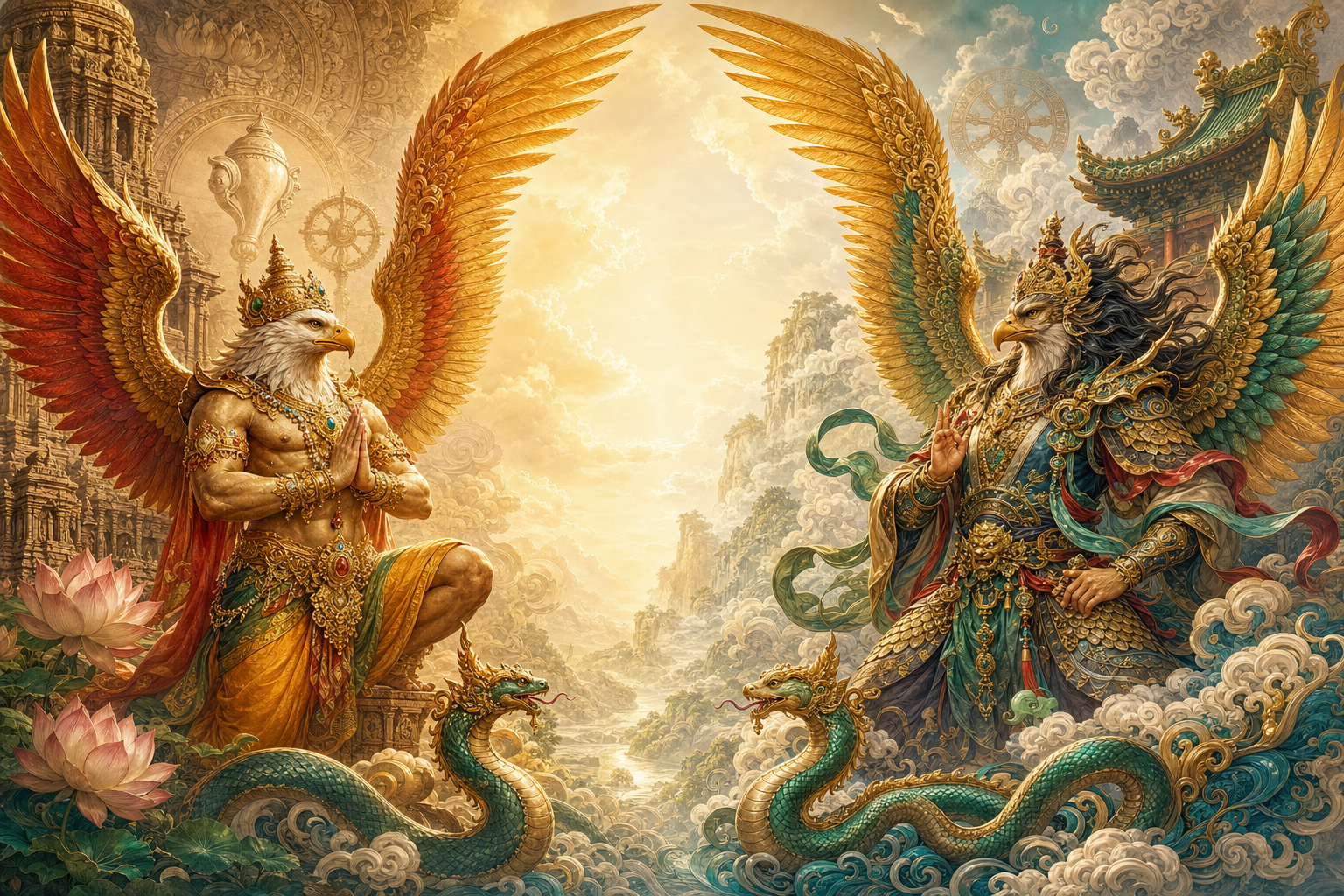
The golden-winged guardian across Asia
Across the religious landscapes of Asia, few sacred beings possess the visual force of the immense golden-winged bird. Its wings can obscure the sky, its speed exceeds that of ordinary creatures, and its presence announces both danger and protection. In Hindu traditions, this figure is Garuda, the mighty son of Vinata and the vahana, or divine mount, of Bhagavan Vishnu. In Buddhist traditions, garuḍas became a class of powerful non-human beings associated with the protection of the Dharma. In China, this inherited image interacted with the indigenous idea of the colossal Peng bird and eventually contributed to the richly layered figure known as Dapeng Jinchi Mingwang, the Golden-Winged Great Peng King of Illumination.
The resemblance between Garuda and Dapeng Jinchi Mingwang is unmistakable, but the two should not be treated as perfectly interchangeable names for a single, unchanging deity. Garuda developed within Sanskrit epic, Puranic, Vaishnava, and Buddhist traditions over many centuries. Dapeng Jinchi Mingwang emerged through the translation and adaptation of Indian Buddhist ideas in China, where Buddhist cosmology, Chinese bird symbolism, esoteric ritual, temple iconography, and popular literature influenced one another. Their relationship is therefore best understood as one of transmission and creative transformation rather than simple duplication.
This distinction makes the comparison more meaningful. It reveals how a sacred image can travel without losing every connection to its place of origin, yet still acquire new names, genealogies, moral roles, and visual forms. The golden-winged bird became a shared cultural vocabulary through which Hindu and Buddhist communities explored liberation, disciplined power, protection, sovereignty, and the transformation of dangerous forces into guardians of sacred order.
Garuda’s birth in the Sanskrit epic tradition
The most influential account of Garuda’s birth appears in the Ādi Parva of the Mahabharata. Garuda is born to the sage Kashyapa and Vinata, while the nāgas, or serpent beings, are born to Kashyapa and Vinata’s sister Kadru. The conflict between bird and serpent is consequently presented as a family conflict rather than a battle between unrelated species. This kinship is important because it prevents the narrative from collapsing into a simplistic opposition between absolute good and absolute evil.
Vinata becomes enslaved after losing a wager to Kadru through deception. Garuda’s defining quest is therefore motivated not by conquest for its own sake but by the desire to free his mother. The nāgas demand amṛta, the nectar of immortality, as the price of Vinata’s release. Garuda accepts the perilous task and overcomes extraordinary obstacles to reach the closely guarded nectar.
The episode establishes several enduring features of Garuda’s character. He possesses immense physical strength, but his power is governed by filial devotion and a clear purpose. He seeks amṛta without intending to drink it himself. His self-restraint distinguishes him from beings who pursue immortality solely for personal advantage. The story consequently presents strength as spiritually meaningful when it serves freedom, loyalty, and dharma.
Garuda eventually arranges for the nectar to be placed before the nāgas so that Vinata can be released. Indra recovers it before the serpents can consume it. When the nāgas lick the kuśa grass on which the vessel had rested, their tongues are split. This epic explanation connects a visible feature of snakes with the cosmic story of amṛta, while also completing Garuda’s liberation of his mother.
Garuda’s encounter with Vishnu gives the bird his most recognizable theological identity. Impressed by Garuda’s strength and selflessness, Vishnu grants him a boon. Garuda, in turn, asks to stand above Vishnu and becomes associated with the deity’s banner; he also agrees to serve as Vishnu’s vehicle. The apparent paradox is deliberate: Garuda can occupy an exalted position while voluntarily carrying the divine. Service does not diminish his dignity. It reveals that freely chosen devotion can be a form of sovereignty rather than submission.
More than an eagle: Garuda’s theological identity
Garuda is often described as an eagle, but this familiar label is only an approximation. Sanskrit sources also associate him with Suparṇa, a name conveying the idea of beautiful, excellent, or powerful wings. His form combines avian, human, solar, royal, and supernatural qualities. Depending on the region and period, he may appear as a gigantic bird, a humanlike figure with wings and a beak, or an anthropomorphic attendant whose hands are joined in reverence.
His connection with the sky is matched by an association with radiance. The description “golden-winged” does not merely specify a decorative color. Gold can signify luminosity, incorruptibility, majesty, and the brilliance of awakened or divinely ordered power. Garuda’s ability to rise rapidly above the earth also lends itself to interpretations involving transcendence, spiritual vision, and freedom from restriction.
Within Vaishnava practice, Garuda is not simply a convenient means of divine transportation. He is an exemplary devotee, a guardian, and an intimate servant of Vishnu. Garuda images frequently face a Vishnu shrine, much as Nandi faces Shiva in many Shaiva temples. A kneeling Garuda with folded hands communicates disciplined devotion, while a flying Garuda carrying Vishnu communicates swift divine intervention.
The relationship is vividly expressed in images of Gajendramoksha, the liberation of the elephant Gajendra. When Gajendra calls upon the divine while trapped by a powerful aquatic adversary, Vishnu rushes to assist him on Garuda. The bird’s speed becomes an expression of divine responsiveness: suffering is heard, help is mobilized, and devotion bridges the distance between the vulnerable being and the transcendent protector.
Garuda also became a symbol of royal authority. Gupta rulers used Garuda imagery as a dynastic emblem, connecting political sovereignty with Vaishnava legitimacy. A British Museum guide to ancient Indian traditions notes that Garuda appears above the names of Gupta rulers on the Bhitri seal and explains that the Vaishnava Gupta kings adopted him as an emblem. This political use did not erase his sacred identity; it demonstrates how religious symbols could operate simultaneously in devotional, artistic, and royal settings.
Garuda and the nāgas: rivalry without crude dualism
Garuda’s hostility toward nāgas is among his most consistent attributes. Temple images may show him gripping serpents, subduing them, or holding them away from his body. Such scenes recall the enslavement of Vinata and Garuda’s conflict with Kadru’s children. They also support his protective association with overcoming venom, constriction, hidden danger, and illness.
Yet nāgas are not uniformly demonic in either Hinduism or Buddhism. Ananta or Shesha serves as Vishnu’s cosmic couch, and numerous nāgas protect water, fertility, treasure, sacred sites, and religious teachings. Buddhist narratives similarly portray nāgas as beings capable of devotion, generosity, anger, danger, or spiritual progress. Garuda and nāga imagery therefore represents the regulation of competing powers more accurately than an eternal war between goodness and evil.
This nuance matters for interreligious understanding. Sacred narratives often preserve tension without demanding the annihilation of one side. Serpent power can be threatening when uncontrolled and protective when aligned with dharma. Garuda’s appetite and force can likewise become destructive unless disciplined. Both traditions repeatedly ask how great natural or supernatural energies may be brought into a morally ordered universe.
Garuda enters the Buddhist cosmos
Buddhism did not merely borrow a finished Hindu deity and place him unchanged beside the Buddha. Buddhist texts reinterpreted garuḍas within their own cosmology. Garuḍas, sometimes rendered in Pāli as garuḷas and associated with the name supaṇṇa, appear as a race of enormous, intelligent bird beings. They are commonly included among the eight classes of non-human beings who hear or protect Buddhist teaching.
In this setting, the term may refer to a category of beings rather than exclusively to the individual son of Vinata who serves Vishnu. This is one of the most important differences between many Hindu and Buddhist uses of the name. Hindu narratives frequently foreground a singular divine personality with a particular genealogy, whereas Buddhist cosmology often speaks of garuḍas collectively, even when a king or named representative of the class is present.
The ancient rivalry with nāgas remains visible. Buddhist accounts describe garuḍas preying on nāgas, but the Buddhist ethical framework can redirect this conflict. Narratives of refuge, precepts, reconciliation, and the Buddha’s authority place predation within a larger moral order. A being is not revered merely because it is powerful. Its power becomes worthy of protection or veneration when it is restrained, converted, or placed in service to the Dharma.
Garuda imagery also entered Buddhist ritual technologies concerned with poison, snakebite, disease, hostile forces, and protection. In esoteric contexts, mantras, visualizations, and prescribed images could invoke the bird’s mastery over serpents. A Tang-period text known as the Scripture of the Garuda and Various Celestial Mantras describes a hybrid form with the upper body of a celestial king, an eagle-like beak, ornaments, flowing hair, and a bird body below the waist. Such instructions show that Garuda was not merely a literary memory; he belonged to a carefully organized ritual and visual system.
From Garuḍa to 迦樓羅 and the golden-winged bird
As Buddhist texts moved through Central Asia and into China, translators faced a recurring choice: preserve the sound of a Sanskrit term, translate its meaning, or combine both strategies. Garuḍa was transliterated in forms such as 迦樓羅, commonly romanized as Jiālóuluó. Chinese Buddhist vocabulary also rendered the being descriptively as a golden-winged bird or great golden-winged bird.
Translation was an act of interpretation. A transliteration retained the being’s connection to Indian Buddhist cosmology, while a descriptive name made its appearance and power immediately intelligible to Chinese readers. “Golden-winged” emphasized radiance and supernatural rank. “Great bird” connected naturally with a Chinese literary imagination already familiar with gigantic birds that exceeded ordinary measures of size and motion.
Material evidence confirms that the garuḍa-nāga pairing became part of Chinese Buddhist visual culture. A fifteenth-century revolving scripture cabinet at Zhihua Temple in Beijing includes Garuda and Nāga imagery within a complex centered on Vairocana Buddha. Such objects demonstrate that the Indian bird and serpent relationship was translated into Chinese sacred space rather than surviving only in written stories.
The Chinese Peng and a meeting of mythic languages
China possessed its own celebrated image of an immeasurable bird long before the Ming novel Journey to the West. The opening of the Zhuangzi describes the transformation of the enormous fish Kun into the vast bird Peng. The Peng rises on immense winds and travels toward the southern darkness, while smaller creatures fail to comprehend its scale. In that philosophical setting, the bird helps explore differences in perspective, freedom, knowledge, and the limitations of ordinary judgment.
The Peng of the Zhuangzi is not originally Garuda, nor is it originally a Buddhist guardian. Their eventual proximity arose because both images represented colossal flight, extraordinary distance, and a vantage point beyond ordinary life. When the Indian golden-winged bird entered Chinese language and culture, the native Peng provided a powerful framework through which its immensity could be imagined.
Dapeng, meaning “Great Peng,” and titles involving the golden-winged king consequently reflect cultural layering. Indian Buddhist Garuda imagery supplied the serpent-eating celestial bird and Dharma-protecting associations. The Chinese Peng supplied an indigenous vocabulary of unimaginable size and transcendent movement. Esoteric Buddhist language contributed the honorific Mingwang, often translated as “King of Illumination,” “Wisdom King,” or “Knowledge King.” Popular religion and literature then expanded the figure’s biography.
Mingwang derives from the Buddhist category vidyārāja. Such figures embody forceful, protective, or transformative dimensions of awakened wisdom. The title should not be interpreted as a license for uncontrolled violence. In Buddhist symbolism, fierce appearance is ideally subordinated to insight and compassionate purpose. Wrathful energy is legitimate only insofar as it confronts ignorance, obstruction, poison, or harmful conduct.
Dapeng Jinchi Mingwang and the claim that he is “Buddha’s uncle”
The description of Dapeng Jinchi Mingwang as “Buddha’s uncle” is one of the most memorable features of his popular Chinese identity. It is also one of the claims most in need of historical qualification. It should not be read as a biological statement about the historical Siddhartha Gautama or as a doctrine shared uniformly by all Buddhist schools.
The relationship is especially prominent in the narrative world associated with Journey to the West. In that literary genealogy, a primordial bird gives rise to the peacock and the Golden-Winged Great Peng. The peacock consumes the Buddha, who escapes and subsequently grants the peacock the exalted status associated with the Buddha Mother Great Peacock, or Mahāmāyūrī. Because the Great Peng is treated as the peacock’s sibling, he becomes the Buddha’s classificatory or spiritual uncle.
Mahāmāyūrī has a substantial Buddhist history as a peacock-associated protective figure connected with rites against poison and danger. The specific sibling relationship and resulting “uncle” title, however, belong to a later Chinese narrative synthesis. The distinction between canonical traditions, ritual texts, commentaries, oral legends, and novels is essential. All may influence religious culture, but they do not possess the same historical origin or doctrinal authority.
The kinship title nevertheless performs an important literary function. It explains why the Great Peng possesses extraordinary status and access to the Buddhist cosmos. It also creates moral tension: privileged proximity to the sacred does not guarantee ethical conduct. A powerful relative of a holy figure can still misuse freedom and require correction.
The Golden-Winged Great Peng in Journey to the West
The Ming-period Journey to the West presents the Golden-Winged Great Peng as a formidable adversary rather than a consistently obedient guardian. He joins the Azure Lion and Yellow-Tusked Elephant in threatening Tang Sanzang and his companions. His flight, weapons, cunning, supernatural container, and family connection to the Buddha make him difficult even for Sun Wukong to overcome.
This depiction does not simply reverse a benevolent deity into an evil monster. Journey to the West repeatedly portrays celestial animals, attendants, and spiritually connected beings as dangerous when discipline fails. The novel’s religious universe is filled with unstable boundaries between demon and guardian, appetite and austerity, rebellion and service. Dapeng embodies the frightening possibility that sacred status can coexist with predatory conduct.
The Buddha’s eventual subjugation of the Great Peng illustrates the transformation of force rather than its erasure. Dapeng’s speed and strength are not denied; they are placed under a higher ethical and spiritual authority. The story echoes a broader Buddhist pattern in which yakṣas, nāgas, fierce gods, and other potentially dangerous beings become protectors after encountering the Dharma.
For a modern reader, the episode offers a recognizable insight into power. Ability alone does not establish moral legitimacy. Intelligence, ancestry, charisma, and institutional access can magnify harm when appetite remains undisciplined. The guardian becomes trustworthy only when strength is joined to responsibility.
Dapeng, Yue Fei, and Chinese popular memory
Dapeng acquired another influential identity in stories surrounding the celebrated Song general Yue Fei. The later novel commonly known as The Story of Yue Fei portrays Yue Fei as an incarnation of the Great Peng. The association was reinforced by Yue Fei’s courtesy name, Pengju, which evokes the flight or rising of the Peng.
In this setting, the celestial bird’s power is redirected toward loyalty, courage, and the defense of the realm. The transformation demonstrates the versatility of the Dapeng image. Within one narrative he may represent appetite and rebellious force; within another he can symbolize patriotic virtue and martial protection. Chinese popular religion did not require every version to be reduced to a single, perfectly consistent biography.
Iconography: how the two guardians can be recognized
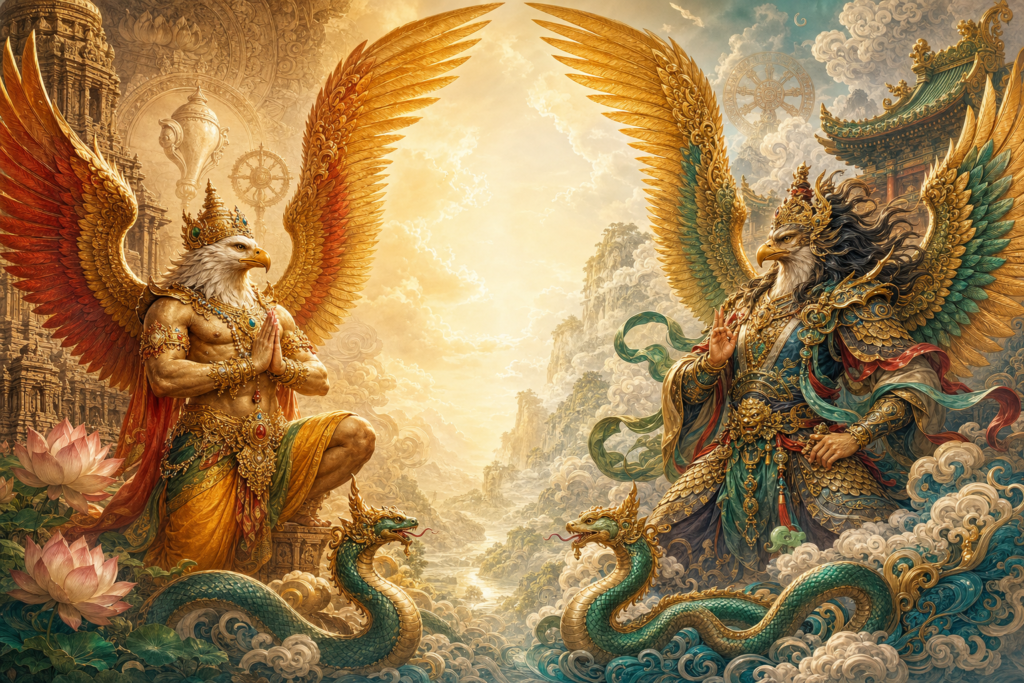
Garuda’s iconography varies widely across South Asia, the Himalayas, Southeast Asia, and East Asia. Common features include wings, a powerful bird body, talons, an eagle-like beak or nose, a crown, divine ornaments, and a human torso. He may carry Vishnu, kneel before him, hold his hands in añjali, spread his wings behind a shrine, or subdue nāgas.
In Hindu temple settings, context often identifies him more reliably than anatomy. A winged figure facing Vishnu, positioned before a Vaishnava sanctum, or carrying Vishnu and Lakshmi is likely Garuda. Garuda shrines and Garuda Seva processions emphasize the relationship between the deity and his devoted vehicle. The imagery unites movement and reverence: Garuda is capable of crossing cosmic distances, yet he remains attentively oriented toward Vishnu.
Chinese depictions may preserve the hybrid body described in Buddhist ritual texts or present a more fully avian, anthropomorphic, armored, or demonlike form. Dapeng can be shown with elaborate weapons and the commanding presence of a celestial general. Literary illustrations may emphasize his role as an adversary in Journey to the West, while temple settings may foreground protection and submission to Buddhist order.
The serpent remains an especially useful identifying attribute, but it must be interpreted carefully. Garuda holding a nāga may signify victory over poison, the inherited bird-serpent rivalry, protection from dangerous forces, or the containment of disorder. It need not communicate hostility toward every nāga or every serpent-associated sacred tradition.
Garuda and Dapeng compared directly
Garuda’s central Hindu identity is that of Vinata’s son, liberator of his mother, enemy of predatory nāgas, and devoted vahana of Vishnu. Buddhist garuḍas retain the bird-serpent rivalry but commonly form a class of powerful beings integrated into Buddhist cosmology. Dapeng Jinchi Mingwang represents a Chinese development in which this Buddhist inheritance interacts with the indigenous Peng, esoteric titles, temple traditions, and vernacular storytelling.
Garuda’s best-known ethical themes are filial devotion, freedom from bondage, self-restraint, courage, and service to Vishnu. Dapeng’s Chinese narratives more frequently explore the conversion of dangerous power, the ambiguity of sacred privilege, cosmic guardianship, and the need to discipline appetite. These themes overlap, but their emphasis differs because each figure developed within a distinct literary and religious environment.
The designation “golden-winged” provides a bridge between them. Both can embody radiance, speed, heavenly authority, and protection. Their association with serpents supplies another clear line of continuity. The title “Buddha’s uncle,” by contrast, belongs to a particular Chinese narrative genealogy and should not be projected backward onto the Sanskrit epic Garuda or treated as a universal Buddhist belief.
Neither figure is adequately understood as merely a monster, eagle, or decorative emblem. Each operates inside a moral cosmos. Flight signifies more than motion; it offers a perspective beyond ordinary limitation. Serpent conquest signifies more than predation; it can express mastery over poison and constricting danger. Service signifies more than obedience; it shows power voluntarily aligned with a sacred purpose.
A shared Dharmic lesson about transforming power
The comparison supports unity among Dharmic traditions precisely because it does not erase their differences. Hinduism contributes the deeply personal account of Garuda’s birth, his mother’s enslavement, his quest for amṛta, and his devotion to Vishnu. Buddhism develops garuḍas within a community of non-human beings capable of hearing, serving, or being transformed by the Dharma. Chinese Buddhism and literature then give the golden-winged bird new philosophical, ritual, and narrative dimensions.
These transformations illustrate a historical pattern of cultural exchange rather than religious theft or doctrinal confusion. Buddhist communities inherited many cosmological beings from the wider Indian environment and reinterpreted them according to Buddhist ethics. Chinese translators and artists received those Buddhist forms and expressed them through local language and imagery. Each stage preserved recognizable features while creating meanings suited to a new community.
A devotee standing before a kneeling Garuda may be moved by his complete orientation toward Vishnu. A reader encountering Dapeng in Journey to the West may instead feel the unease produced by immense talent without moral restraint. The emotional responses differ, yet both lead toward a related question: what makes power worthy of trust?
The answer supplied across these traditions is not strength alone. Garuda becomes exemplary because he uses strength to free his mother, refuses to consume the nectar he acquires, and accepts service to Vishnu. The Great Peng becomes spiritually intelligible when his predatory force is restrained and redirected. Power reaches its highest form when governed by devotion, wisdom, compassion, and responsibility.
Why the golden-winged guardian still matters
Garuda remains a living religious symbol rather than a relic of ancient mythology. His images continue to appear in temples, processions, dance, state emblems, architecture, protective art, and popular culture across Asia. In Thailand, for example, Garuda functions as both a sacred protective figure and an emblem associated with royal and governmental authority. In Indonesia, Garuda became a powerful national symbol within a modern, religiously diverse society.
Dapeng likewise continues to move between Buddhist devotion, Chinese folklore, martial symbolism, literature, television, games, and new visual media. Modern adaptations often emphasize spectacular combat or speed, but the historical background offers something deeper. The figure carries traces of Sanskrit epic, Buddhist cosmology, Chinese philosophy, esoteric ritual, Ming fiction, and popular memory.
Recognizing those layers protects the traditions from careless simplification. Garuda is not merely “the Hindu Dapeng,” and Dapeng is not simply “the Chinese Garuda.” They are related sacred figures shaped by translation, reinterpretation, and local creativity. Their shared golden wings reveal continuity, while their different stories preserve the intellectual and devotional distinctiveness of Hindu and Buddhist traditions.
The most enduring image is therefore not simply that of a bird defeating serpents or carrying a deity through the sky. It is the image of tremendous energy being given direction. Whether Garuda is freeing Vinata, carrying Vishnu, protecting a temple, confronting nāgas, or reappearing as the complex Dapeng Jinchi Mingwang, the golden-winged guardian asks the same profound question: will freedom serve appetite, or will it serve dharma?
Selected research references
Material and iconographic evidence can be explored through the British Museum’s accounts of Garuda’s rivalry with the nāgas, its guide to Garuda as a Gupta and Vaishnava emblem, and Smarthistory’s discussions of Garuda’s liberation of Vinata and the Gajendramoksha relief at Deogarh.
For the Chinese Buddhist visual and ritual context, useful evidence includes the University of Chicago’s record of the Garuda and Nāga imagery at Zhihua Temple and the academic study of Garuda iconography in the Scripture of the Garuda and Various Celestial Mantras. These sources support a historically layered comparison while also showing how much regional variation exists within both Hindu and Buddhist art.
Inspired by this post on Hindu Blog.









Leave a Reply
You must be logged in to post a comment.