
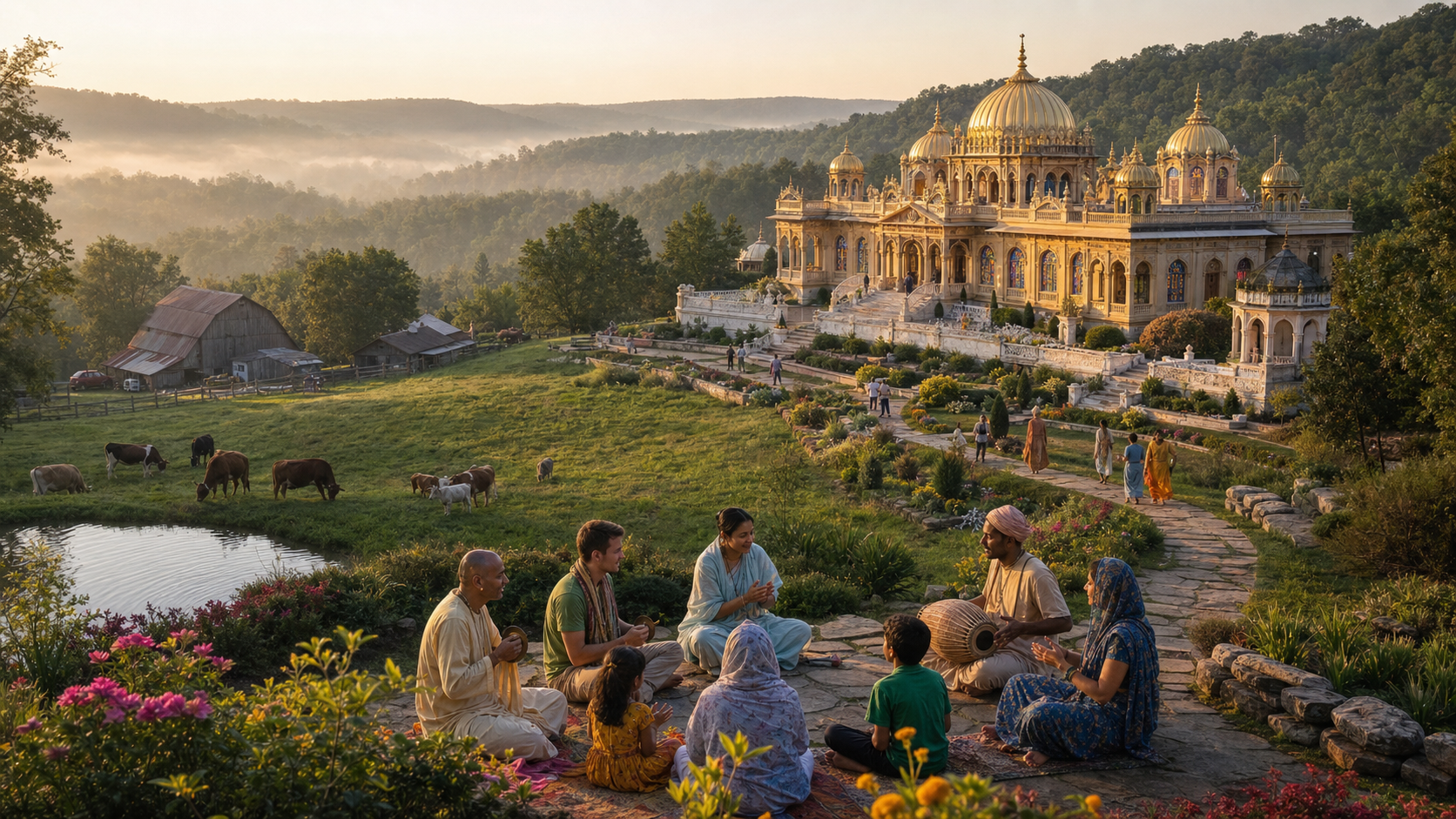

In the wooded hills of Marshall County, West Virginia, a striking experiment in Hindu devotional life took root during the social upheavals of the late 1960s. New Vrindaban was conceived as more than a temple, retreat, or rural commune. It was intended to become a living environment in which bhakti—loving devotion to the Divine—could shape worship, work, food, music, relationships, agriculture, and the human treatment of animals. Its history consequently offers an unusually rich case study of Gaudiya Vaishnavism, the Hare Krishna movement, Hindu sacred geography, intentional community building, and the adaptation of an Indian spiritual tradition to North America.
The word bhakti is often translated simply as “devotion,” but that definition can conceal its depth. Within the Gaudiya Vaishnava tradition represented by the International Society for Krishna Consciousness, or ISKCON, bhakti is a disciplined way of directing thought, emotion, speech, and action toward Krishna. It is not limited to private belief. Chanting, temple worship, scriptural study, preparing and sharing sanctified food, serving other beings, maintaining sacred spaces, and cultivating humility can all function as forms of devotional practice.
This understanding helps explain why New Vrindaban cannot be adequately interpreted as an exotic architectural attraction hidden in Appalachia. Its buildings are significant, but they belong to a larger spiritual ecology. The sound of congregational chanting, the rhythm of daily worship, the care of cows, the preparation of prasadam, and the physical labor required to sustain a rural settlement are interconnected expressions of Krishna consciousness. The settlement’s central proposition is that spiritual life can organize an entire pattern of living rather than occupy only a few ceremonial hours each week.
From Bengal’s bhakti tradition to the American hills
New Vrindaban belongs to the Gaudiya Vaishnava lineage associated with Sri Chaitanya Mahaprabhu, whose devotional movement developed in Bengal during the sixteenth century. The tradition places particular emphasis on Krishna as the Supreme Person and on Radha as the highest embodiment of loving devotion. It teaches that the Divine can be approached through loving service and that the names of Krishna are spiritually potent rather than merely symbolic references.
The best-known practice of the modern Hare Krishna movement is the repetition of the maha-mantra: “Hare Krishna, Hare Krishna, Krishna Krishna, Hare Hare / Hare Rama, Hare Rama, Rama Rama, Hare Hare.” In individual japa, the mantra is repeated meditatively, traditionally with prayer beads. In kirtan or sankirtana, it becomes a participatory form of call-and-response chanting. Voices, hand cymbals, drums, and movement create a shared devotional field in which no distinction is required between performer and audience. Everyone may participate through sound, attention, or respectful presence.
Bhakti therefore combines theology with embodied practice. Chanting regulates breath and attention; ritual establishes a disciplined relationship with time; pilgrimage connects memory to place; and seva transforms ordinary work into service. These practices do not erase personality. Gaudiya Vaishnava theology instead understands spiritual individuality as fulfilled through a loving relationship with Krishna. Emotion is not rejected as an obstacle to knowledge but cultivated, clarified, and directed toward a sacred object.
The global transmission of this tradition is closely associated with A. C. Bhaktivedanta Swami Prabhupada. He arrived in New York in 1965 and established ISKCON there in 1966. His teaching attracted young Americans who were searching for alternatives to consumerism, social alienation, and inherited religious conventions. The movement presented a demanding spiritual discipline—daily chanting, ethical commitments, scriptural learning, communal worship, and regulated living—while also offering music, shared meals, fellowship, and a compelling sense of purpose.
The founding vision of New Vrindaban
New Vrindaban began in 1968 as ISKCON’s first rural farm community. Its name refers to Vrindavan in northern India, the sacred region associated with Krishna’s childhood pastimes. Naming the West Virginia settlement after Vrindavan expressed a theological aspiration rather than a claim that the two places possessed identical histories. The founders sought to cultivate a devotional atmosphere in which remembrance of Krishna could become part of the landscape itself.
The setting was initially austere. According to the West Virginia Encyclopedia, the early property had no electricity, no running water, difficult access, and only a deteriorated building. These conditions made the project a practical test of conviction. Devotional ideals had to survive cold weather, mud, limited resources, physical exhaustion, and the technical demands of shelter, food production, sanitation, and transportation.
The hardship is important because it prevents the community’s history from being reduced to the later splendor of its temples and palace. New Vrindaban was built through ordinary labor performed under extraordinary constraints. Roads had to be negotiated, fields cultivated, buildings raised, meals prepared, animals cared for, and worship maintained. The early community’s emotional intensity emerged partly from this union of spiritual aspiration and shared material difficulty.
Prabhupada visited the developing settlement for the first time in 1969 and subsequently returned on several occasions. His rural vision was frequently summarized as “simple living and high thinking.” The phrase did not imply intellectual withdrawal or nostalgia for poverty. It proposed that human intelligence should be directed toward self-knowledge, ethical responsibility, and realization of the Divine rather than consumed entirely by production and acquisition.
In this model, land and animals were not merely economic inputs. Agriculture could reduce dependence on industrial systems, cow protection could embody nonviolence and gratitude, and communal worship could place moral limits on consumption. The model remained difficult to implement consistently, but its conceptual structure was clear: economic activity should sustain spiritual and ecological life rather than dominate it.
Sacred geography recreated through memory
New Vrindaban illustrates how sacred geography can travel without becoming detached from its source. Vrindavan in India remains a historically and theologically unique pilgrimage region. The West Virginia community sought to remember that sacred landscape by naming hills, ponds, pathways, and places of worship after locations connected with Krishna’s pastimes. This practice turned the Appalachian terrain into a mnemonic map: physical features could prompt theological recollection and devotional contemplation.
Such place-making is more sophisticated than architectural imitation. A sacred environment is produced through repeated practices—walking, chanting, hearing narratives, celebrating festivals, honoring food, and associating particular sites with spiritual memory. Over time, these practices create a layered landscape in which geography, story, and community identity reinforce one another.
The transplantation also required adaptation. West Virginia’s seasons, vegetation, building regulations, labor conditions, and surrounding culture differed profoundly from those of northern India. The community therefore had to translate a devotional imagination rather than reproduce India literally. Its most successful features emerged where fidelity to Gaudiya Vaishnava principles was joined to practical knowledge of the Appalachian environment.
The temple as a system of disciplined service
Temple worship at New Vrindaban is centered on Radha and Krishna, especially Sri Sri Radha Vrindaban Chandra. In Vaishnava practice, the consecrated form of the deity is approached as a focus of real divine presence, not as an ordinary object or a substitute for an absent God. This theological distinction is essential to understanding the precision of arcana, or formal worship.
Arcana is technically demanding. It involves standards of cleanliness, scheduled offerings, carefully prepared food, clothing and ornamentation of the deities, lamps, incense, flowers, music, prayers, and ceremonial gestures. Each element disciplines the senses. Sight is directed toward darshan, sound toward mantra and kirtan, smell toward flowers and incense, taste toward prasadam, and touch toward the materials of service. Rather than suppressing sensory life, bhakti reorganizes it around sacred relationship.
The daily schedule also gives religious meaning to time. Morning and evening worship, scriptural recitation, individual chanting, and communal meals interrupt the modern assumption that time is valuable only when it produces measurable economic output. Temple time is repetitive, but the repetition is purposeful. It trains attention and allows devotion to mature beyond temporary enthusiasm.
Prasadam provides another example of theology becoming material practice. Vegetarian food is prepared with care, offered to Krishna, and then received as grace. The process links agriculture, cooking, ritual, hospitality, and ethical consumption. A shared plate of prasadam may appear socially simple, yet it carries a dense network of meanings: dependence on nature, gratitude for nourishment, restraint from unnecessary harm, equality among participants, and the sanctification of daily life.
Kirtan as devotion, social practice, and cultural memory
Kirtan is among the most accessible dimensions of New Vrindaban’s spiritual culture. Its call-and-response form lowers the barrier between religious specialist and visitor. A participant does not need advanced philosophical training to listen or repeat the mantra. The experience can therefore create immediate emotional connection while remaining rooted in a defined Vaishnava theology.
From an analytical perspective, kirtan works on several levels simultaneously. Repetition stabilizes attention; melody supports memory; rhythm coordinates bodies; shared vocalization reduces social distance; and sacred language locates the experience within a lineage. Its emotional force does not make it intellectually empty. The practice carries teachings about divine personality, dependence, longing, service, and the possibility of transforming consciousness through disciplined sound.
Visitors may first encounter kirtan aesthetically, through the resonance of drums and voices in a temple hall. Continued exposure can reveal its deeper function. The music is not primarily presented as entertainment or virtuoso performance. Its purpose is remembrance of Krishna and the cultivation of devotional attention. This distinction explains why participation, humility, and intention matter as much as musical skill.
Kirtan also provides a respectful point of connection across dharmic traditions. Sikh practice gives a central place to sung sacred teaching; many Hindu sampradayas preserve their own forms of bhajan and nama-sankirtana; Buddhist traditions use chanting to sustain mindfulness, refuge, and communal memory; and Jain traditions employ recitation and devotional song within a distinct non-theistic and ethical framework. These practices should not be collapsed into one doctrine, yet their shared appreciation for disciplined sound, community, remembrance, and ethical transformation can support meaningful dialogue.
Cow protection, agriculture, and ecological responsibility
Cow protection has been part of New Vrindaban’s identity since its formative years. Within Krishna bhakti, the cow carries theological, ethical, and cultural significance. Krishna is remembered as Govinda and Gopala, names associated with his pastoral life and care for cows. Go-seva therefore connects scriptural memory with practical responsibilities such as feeding, shelter, veterinary attention, pasture management, and lifelong care.
The practice should not be romanticized as effortless rural symbolism. Responsible animal care requires land, water, stored feed, trained personnel, medical planning, safe facilities, and long-term financing. Aging or nonproductive animals continue to require care. In this respect, cow protection tests whether reverence can be translated into durable institutional responsibility.
Agriculture was similarly tied to the ambition of local self-sufficiency. Early residents cultivated food and explored animal-powered farming as alternatives to complete dependence on industrial supply chains. The ecological ideal was to create reciprocal relationships among soil, plants, animals, and people. In practice, terrain, climate, expertise, labor availability, and changing community demographics limited the degree of self-sufficiency that could be achieved.
These limitations do not make the experiment irrelevant. They make it instructive. Modern conversations about sustainable agriculture often confront the same questions: how much land is needed, how fertility is maintained, which technologies reduce labor without increasing ecological harm, and how communities retain skilled workers. New Vrindaban demonstrates that spiritual ecology requires operational knowledge as well as inspiring principles.
Prabhupada’s Palace of Gold and devotional craftsmanship
The best-known structure at New Vrindaban is Prabhupada’s Palace of Gold. Initially connected with the intention to create a residence for Prabhupada, the project developed into an elaborate memorial after his death in 1977. Devotees with limited formal training acquired specialized skills as construction proceeded. The resulting complex combined marble, carved ornament, stained glass, decorative metalwork, gardens, and an architectural vocabulary designed to communicate reverence.
The palace is significant not merely because it appears visually unexpected in rural West Virginia. It records the transformation of devotion into craftsmanship. Materials were shaped through sustained labor, and technical learning became a form of seva. The building thus represents an important principle of bhakti aesthetics: beauty can be offered rather than possessed, and artistic excellence can become a disciplined expression of gratitude.
At the same time, monumental architecture creates continuing obligations. Water intrusion, freeze-thaw cycles, aging materials, drainage, structural movement, and the conservation of decorative surfaces all require specialized maintenance. The palace’s restoration history shows that sacred monuments cannot survive on emotion alone. Heritage preservation depends on documentation, engineering, skilled trades, institutional continuity, and realistic long-term planning.
The contrast between ornate devotional architecture and the surrounding Appalachian landscape produces a memorable emotional response. Yet the deeper encounter lies in recognizing that both landscape and structure have been integrated into a religious narrative. The hills communicate seclusion and natural scale; the palace communicates aspiration and human dedication. Together they make New Vrindaban one of the most distinctive sites in the history of Hinduism in the United States.
Community growth and institutional complexity
New Vrindaban expanded rapidly during the 1970s and 1980s. The community’s official historical account states that by 1988 its holdings had grown to more than 2,500 acres and its resident population to approximately 600 devotees. Temples, educational initiatives, guest facilities, agricultural projects, dining facilities, and commercial activities developed alongside the Palace of Gold. West Virginia eventually recognized New Vrindaban as an unincorporated town and placed it on the state map.
This growth reveals the organizational scale of the experiment. A devotional settlement must still address governance, property management, education, public safety, food systems, finances, child welfare, conflict resolution, and relationships with neighboring communities. Spiritual ideals may guide these functions, but they do not eliminate the need for transparent procedures, professional competence, and accountable leadership.
New Vrindaban also became a cultural bridge for Hindu families in North America. For immigrants separated from the sacred places and extended religious networks of India, the community offered deity worship, festivals, vegetarian food, familiar devotional music, and a landscape explicitly shaped by Krishna traditions. For converts and spiritual seekers, it provided immersion in a lineage that might otherwise have been encountered mainly through books or urban temple programs.
The encounter was reciprocal. Indian religious practice influenced the cultural life of West Virginia, while the Appalachian setting influenced the forms that community life could take. New Vrindaban therefore belongs both to Hindu diaspora history and to the religious history of Appalachia. It challenges any assumption that either region possesses a single, culturally uniform identity.
Crisis, accountability, and institutional restoration
A comprehensive account must address New Vrindaban’s period of serious institutional crisis. During the late twentieth century, the community experienced authoritarian leadership, departures from ISKCON standards, internal harm, criminal allegations involving former leaders, and a profound loss of trust. A former leader was expelled from ISKCON, and New Vrindaban itself remained separated from the wider institution for several years.
These events should be neither sensationalized nor concealed. Religious commitment does not make an institution immune to concentrated power, inadequate oversight, financial opacity, or abuse. On the contrary, spiritual language can intensify vulnerability when authority is treated as beyond examination. Mature religious life therefore requires mechanisms through which concerns can be reported, leaders can be reviewed, children and vulnerable adults can be protected, records can be examined, and misconduct can be addressed without retaliation.
New Vrindaban was formally readmitted to ISKCON in 2000 after a prolonged period of separation and reform. Restoration involved more than repairing buildings or reviving festivals. It required rebuilding relationships, reestablishing standards of worship and governance, acknowledging painful history, and creating conditions in which service could be separated from unquestioning obedience to individuals.
The history offers a broader lesson for all spiritual communities. Unity is durable only when joined to truth, justice, and accountability. Silence about harm does not protect dharma; it weakens the ethical credibility of religious institutions. Honest institutional memory can be painful, but it allows later generations to inherit wisdom rather than merely inherit unresolved problems.
Renewal and the contemporary pilgrimage landscape
In the decades following readmission, New Vrindaban entered a period of renewal. Temple life was strengthened, heritage structures received renewed attention, festivals and retreats attracted visitors, and agricultural and cow-care programs continued to express the original rural vision. The community celebrated its fiftieth anniversary in 2018, marking both the endurance of its founding aspiration and the need to remember its complicated institutional history.
The West Virginia Encyclopedia reports that more than 35,000 pilgrims and visitors came to New Vrindaban in 2022, with approximately 12,000 additional stays recorded in its lodge or cabins. These dated figures should not be treated as a permanent annual total, but they demonstrate the site’s continuing significance as both a religious destination and a West Virginia cultural landmark.
Contemporary visitors may arrive for different reasons. Some come for darshan, kirtan, festivals, study, or association with devotees. Others are drawn by architecture, gardens, vegetarian food, rural scenery, or curiosity about the history of American religious communities. The site’s public significance lies partly in its capacity to hold these motivations together without reducing itself to either a closed devotional enclave or a purely commercial attraction.
A thoughtful visit benefits from several interpretive distinctions. The Palace of Gold is not the whole community; visual beauty is not the whole of bhakti; the failures of former leaders are not the whole of the tradition; and devotional enthusiasm is not a substitute for historical analysis. Holding these truths together produces a fuller and more humane understanding of New Vrindaban.
Bhakti, dharmic unity, and respectful difference
New Vrindaban is rooted in a specific Hindu sampradaya, and respecting that specificity is essential. Gaudiya Vaishnavism has its own theology of Krishna, scriptural authorities, ritual standards, lineage, and devotional vocabulary. Dharmic unity does not require these distinctions to disappear. It requires communities to engage one another without hostility, caricature, or coercion.
Hinduism, Buddhism, Jainism, and Sikhism articulate different understandings of ultimate reality, selfhood, liberation, revelation, and religious authority. They nevertheless share civilizational conversations about disciplined conduct, compassion, non-attachment, service, meditation, moral causation, and the transformation of consciousness. New Vrindaban’s emphasis on chanting, hospitality, vegetarian food, service, and care for living beings can contribute constructively to those conversations while remaining authentically Vaishnava.
The community’s history also warns against forms of unity based on personality cults or the suppression of criticism. Dharmic solidarity becomes meaningful when it protects freedom of conscience, encourages responsible scholarship, honors legitimate differences, and places the dignity of living beings above institutional reputation. Such unity is principled rather than merely rhetorical.
Why New Vrindaban still matters
New Vrindaban matters because it brings philosophical questions into material form. Can a community organize economic life around restraint rather than endless consumption? Can music function as contemplative discipline rather than entertainment alone? Can agriculture become an expression of reverence? Can sacred traditions cross oceans without becoming museum pieces? Can a religious institution acknowledge grave failures and still undertake credible reform?
No single community can provide final answers to questions of this scale. New Vrindaban instead offers evidence: inspiring achievements, costly mistakes, resilient practices, unresolved tensions, and repeated efforts at renewal. Its most valuable lesson may be that bhakti is tested not only in moments of elevated emotion but also in governance meetings, maintenance work, animal care, hospitality, education, conflict resolution, and the willingness to confront truth.
The West Virginia hills gave this devotional experiment a landscape of unusual beauty, but the enduring power of the place does not depend on scenery alone. It arises from the continuing attempt to make love of Krishna visible in sound, food, architecture, work, ethical discipline, and community. New Vrindaban remains compelling precisely because its history contains both aspiration and accountability—the radiance of bhakti alongside the demanding human work required to embody it responsibly.
This first exploration establishes the intellectual and historical foundation for understanding New Vrindaban. It reveals a community that is neither a simple utopia nor merely a cautionary tale. It is a living chapter in the history of Gaudiya Vaishnavism, ISKCON, the Hindu diaspora, American intentional communities, and the ongoing encounter between dharmic tradition and modern life.
Inspired by this post on Dandavats.









Leave a Reply
You must be logged in to post a comment.