
The extraordinary image of Shiva as a student
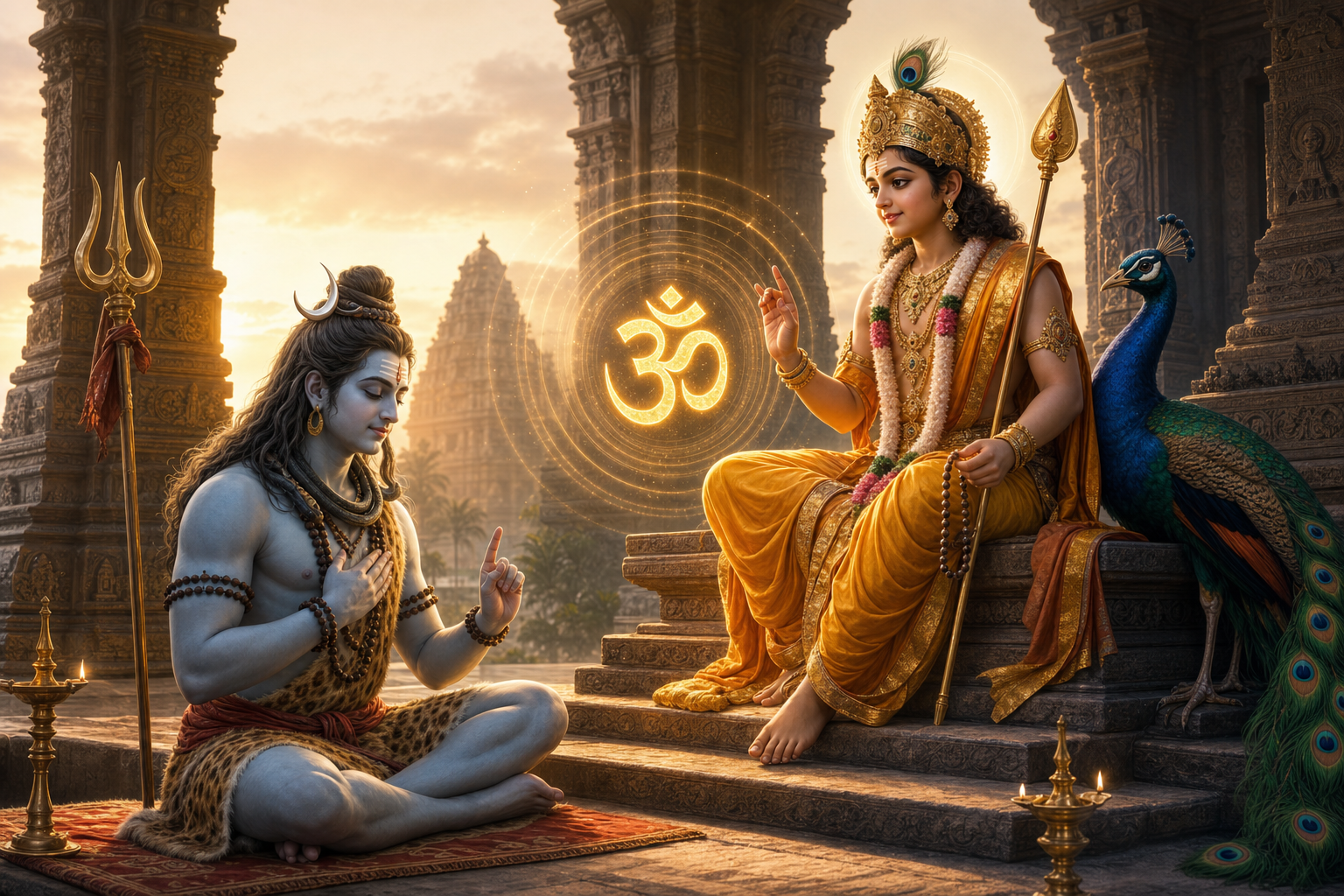
Among the many forms preserved in Shaiva iconography, Shishyabhava Murti is one of the most philosophically arresting. It presents Shiva—the Mahayogi of Kailasha, the conqueror of Tripura, and the divine teacher celebrated as Dakshinamurti—assuming the disciplined disposition of a student before his son Skanda. The apparent reversal is deliberate. The deity conventionally represented as the source of sacred knowledge bows to receive an explanation of the Pranava, the primordial syllable Om. In a single scene, divine authority becomes inseparable from intellectual humility.
The Sanskrit expression shishya-bhava combines shishya, a disciple or pupil, with bhava, a state, disposition, attitude, or mode of being. Shishyabhava Murti therefore means more than “Shiva depicted as a student.” It signifies Shiva manifesting the inward condition required for learning: attention, restraint, reverence, and freedom from the presumption that status guarantees understanding. The icon does not diminish Shiva. It reveals that genuine greatness includes the capacity to listen.
This theological image carries unusual emotional force because it touches a familiar human difficulty. Seniority, reputation, institutional rank, and parental authority can make it painful to admit that another person understands something more clearly. Shishyabhava Murti turns that discomfort into a sacred opportunity. Shiva’s greatness is demonstrated not by defending his position but by becoming fully receptive when wisdom appears through an unexpected teacher.
Skanda, the child who questioned Brahma
The narrative associated with this form survives in related but varying Puranic, Tamil, temple, and oral traditions. Skanda—also known as Kartikeya, Subrahmanya, Muruga, Kumara, Guha, Shanmukha, and Saravanabhava—encounters Brahma and asks him to explain the meaning of the Pranava. Brahma can recite Om and is associated with the transmission of Vedic knowledge, yet in the story he cannot give an explanation that satisfies the young questioner. Skanda treats this failure as serious because creation without knowledge of its first principle would be authority without understanding.
Some retellings say that Skanda confines Brahma and temporarily assumes responsibility for creation. The episode should not be reduced to a quarrel between deities or interpreted as a literal institutional contest. Its narrative purpose is pedagogical: memorized language is not identical to realized knowledge, and the performance of a sacred office does not automatically confer insight into the reality that office represents. Skanda’s uncompromising question exposes the difference between repeating a formula and understanding its significance.
When the disruption reaches Shiva, he approaches Skanda and asks that Brahma be released. Skanda complies, but the conversation then turns toward the question at the center of the story. Shiva asks whether Skanda himself knows the meaning of Om. Skanda answers that the knowledge can be communicated only within the proper relationship between guru and disciple. If Shiva wishes to hear it, he must receive it with the discipline and reverence of a shishya.
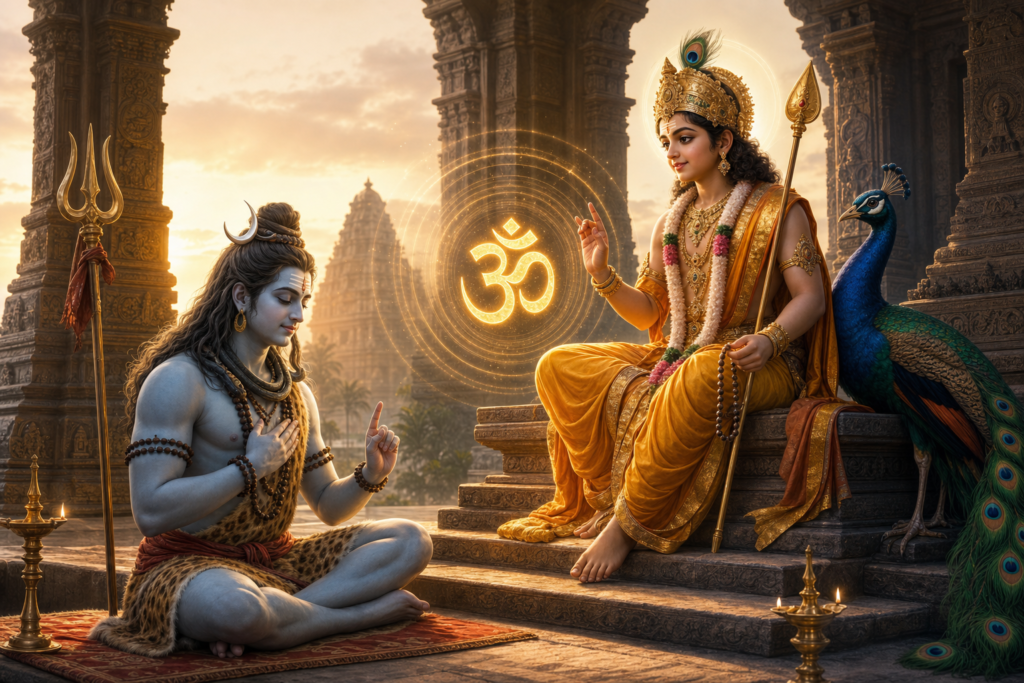
Shiva accepts. Depending on the regional or textual retelling, he sits below Skanda, kneels with folded hands, bends his head, receives the teaching privately into his ear, or lifts the child to a position from which the instruction can be whispered. These variations should not be forced into a single rigid account. Each preserves the same theological center: the father becomes the disciple, the son becomes the guru, and knowledge—not age, power, or genealogy—determines the teaching role.
Skanda consequently receives the name Swaminatha, commonly understood in this context as the teacher or lord of his own Lord. He is also praised as Shivagurunatha, the guru of Shiva. The title is intentionally paradoxical. Skanda is born from Shiva’s divine power, yet he becomes the channel through which Shiva receives the mystery of Shiva’s own sonic form. The guru is thus “born” from the disciple even as the disciple is the source of the guru.
What the Pranava signifies
Pranava is a traditional designation for Om or Aum, the sacred syllable placed at the beginning of numerous recitations, mantras, and acts of worship. It functions as sound, symbol, contemplative support, and compact theological statement. No single explanation exhausts it. Vedic, Upanishadic, Vedantic, Yogic, Shaiva, Vaishnava, and Shakta traditions interpret its structure through their own doctrinal vocabularies while recognizing its exceptional sacred importance.
The Mandukya Upanishad offers one of the most influential philosophical analyses of Om. It relates A, U, and M to waking, dreaming, and deep sleep, while the unconditioned fourth, often discussed as turiya, is neither merely another ordinary state nor an object captured by language. It is described through the cessation of differentiation, tranquility, non-duality, and the identity of Atman with the ultimate ground of reality. Om therefore maps not only a sequence of sounds but the whole field of experience and that which transcends temporal and conceptual division.
Shaiva sources interpret this sacred syllable through the identity of Shiva and the Pranava. In the Shiva Purana, Om is treated as the seed of sacred knowledge, an extremely subtle expression containing immense meaning, and a sonic form through which Shiva may be contemplated. Such passages illuminate the depth of the Skanda narrative: the child is not giving his father a dictionary definition. He is disclosing the relation between sound, consciousness, cosmos, and the reality symbolized by Shiva.
It would nevertheless be misleading to claim that the narrative supplies one universally fixed verbal explanation of Om. Its secrecy is structurally important. The teaching is frequently whispered rather than proclaimed, indicating that sacred knowledge involves preparation, initiation, contemplation, and transformation. The story directs attention away from possessing a clever formula and toward becoming capable of receiving what the formula signifies.
The private instruction also marks a distinction between information and realization. Information can be repeated without changing the person who speaks it. Realized knowledge reorganizes perception, conduct, and identity. Brahma’s difficulty in the story represents the insufficiency of formal command without inner assimilation, while Shiva’s posture represents the receptivity through which knowledge becomes transformative.
The technical iconography of Shishyabhava Murti
The form is not merely a modern moral illustration. It belongs to the technical vocabulary of Hindu image-making. T. A. Gopinatha Rao’s classic study Elements of Hindu Iconography, drawing upon the Manasara, identifies Shiva in the aspect of a disciple as Sishya-bhava-murti and discusses the corresponding teaching form of Subrahmanya. This textual evidence establishes Shishyabhava Murti as a formally conceived iconographic type rather than only a general devotional idea.
In the description transmitted through that study, Shiva sits cross-legged before Subrahmanya. One right hand is associated with restraint or closure of the mouth, an eloquent sign that speech has yielded to listening, while another is placed near the chest in a knowledge-related gesture. Other hands carry attributes including the deer and an implement conventionally identified as a tanka. Shiva is described with a serene, moonlike face and a white complexion. These features convert the discipline of discipleship into visible form.
The corresponding teacher is described as Desika-Subrahmanya—Subrahmanya as preceptor. He may be represented seated upon the peacock, with one face and six arms, bearing such attributes as the shakti or spear and an akshamala, while other hands display gestures of instruction, protection, or blessing. The precise reading of individual attributes can vary across editions, translations, and realized images. Iconographic prescriptions should therefore guide interpretation without erasing the diversity of regional sculpture and worship.
The most important visual relationship is positional and gestural. Skanda occupies the teacher’s place; Shiva assumes the composed posture of the receiver. The reversal becomes immediately intelligible even when the viewer does not know every attribute. Scale, elevation, hand gestures, direction of attention, and bodily restraint work together as a visual philosophy of learning.
This form gains additional significance when placed beside Dakshinamurti. As Dakshinamurti, Shiva is the primordial guru whose silence instructs sages. As Shishyabhava Murti, the same Shiva embodies the ideal disciple. The two forms are complementary rather than contradictory. Together they suggest that the authority to teach is inseparable from the ability to learn and that sacred knowledge remains alive only when teaching and receptivity circulate.
Swamimalai and the sacred geography of the teaching
The legend is closely associated with Swamimalai in Tamil Nadu, revered as one of the six major abodes of Muruga known as the Arupadai Veedu. The presiding deity, Swaminathaswamy, embodies Skanda as the teacher of Shiva. Temple tradition gives spatial form to the theological reversal: the son is encountered in the elevated position of the guru, and the devotee’s ascent becomes a physical enactment of approaching knowledge.
Swamimalai also demonstrates how theology is preserved through more than books. Architecture, processions, hymns, names, ritual gestures, sculpture, and oral narration operate together as a living archive. A visitor may first meet the story as an emotionally compelling account of father and son, then recognize its teaching on humility, and finally encounter its deeper reflection on Om and consciousness. Temple culture allows these levels of meaning to coexist.
The strong place of this narrative in Tamil Muruga devotion also cautions against treating Hindu tradition as a single uniform textual system. The Sanskrit Skanda Purana has a complex history, and popular statements that assign every version of the Swaminatha narrative to one precise Puranic passage may overlook the roles of Tamil literary retellings, regional sthala-purana traditions, and oral transmission. A historically responsible interpretation acknowledges both the authority of living devotion and the plurality of its textual forms.
Why Shiva’s submission is not a sign of ignorance
A literal reading might ask why Shiva, identified in Shaiva theology with supreme consciousness and with Om itself, would need another being to explain Om. Traditional theology resolves the tension through the idea of divine play, or lila. Shiva does not become deficient so that Skanda can become superior. Instead, the divine relationship dramatizes a truth that abstract propositions alone cannot express: no social identity should obstruct the reception of wisdom.
At another level, the scene represents knowledge recognizing itself. Shiva is the reality symbolized by Om; Skanda arises from Shiva and reveals that reality; Shiva receives the revelation in the form of a disciple. Teacher, teaching, and taught remain distinguishable within the narrative while belonging to a deeper unity. This pattern is compatible with the non-dual insight that consciousness can become the subject, object, and means of its own recognition without being divided in essence.
The narrative also protects the guru principle from becoming a cult of personality. Skanda is not guru merely because he demands obedience, and Shiva is not disciple merely because he occupies a lower seat. Skanda functions as guru because he is capable of transmitting insight; Shiva functions as disciple because he becomes prepared to receive it. The legitimacy of the relationship rests upon knowledge, discipline, and transformation.
Humility as a rigorous intellectual practice
Humility in Shishyabhava Murti is not self-abasement, timidity, or the denial of competence. It is an accurate recognition of the limits of one’s present understanding. Such humility is intellectually demanding because it requires a person to separate identity from opinion. A mistaken claim can then be corrected without treating correction as personal annihilation.
The form is therefore relevant far beyond explicitly religious instruction. A senior scholar may learn from a student who has mastered a new method. A parent may receive moral clarity from a child. A spiritual teacher may be corrected by lived experience, textual evidence, or another lineage. A leader may discover that listening preserves authority more effectively than defensiveness. In each case, shishya-bhava makes learning possible without erasing legitimate responsibility.
Several practical disciplines are implicit in Shiva’s posture. The first is suspension of premature speech: the learner does not prepare a rebuttal while the teaching is still unfolding. The second is focused attention: knowledge is approached as worthy of effort rather than consumed casually. The third is reverence without credulity: respect opens the mind, while inquiry protects it from confusion. The fourth is integration: the lesson must be contemplated until it shapes conduct.
The story also offers a disciplined model of questioning. Skanda’s challenge to Brahma is not presented as contempt for learning but as insistence that inherited language be understood. Shiva’s response then prevents inquiry from becoming arrogance. Questioning and reverence are not enemies; they become mutually corrective. Questioning without humility can become performance, while reverence without inquiry can become mechanical repetition.
Guru and disciple beyond age and hierarchy
The reversal between father and son destabilizes the assumption that knowledge always travels downward from elder to younger. Hindu traditions generally honor age, lineage, and established teachers, but Shishyabhava Murti shows that these forms of respect do not imprison wisdom within a biological hierarchy. The person who possesses insight in a particular moment may become the teacher, while the socially senior person may properly become the learner.
This does not abolish the guru-shishya tradition; it clarifies its purpose. Parampara is not the preservation of rank for its own sake. It is the disciplined transmission of knowledge across generations. A lineage remains vital when its custodians preserve the capacity to listen, interpret, test, contemplate, and renew understanding without severing continuity.
The father-son relationship adds tenderness to the philosophical claim. Shiva does not compete with Skanda or treat the child’s knowledge as a threat. He creates room for the son to teach. Skanda, in turn, does not cease to be a son when he becomes guru. Their relationship expands rather than breaks. Familial affection and spiritual authority become capable of changing direction without losing mutual reverence.
A bridge across Dharmic traditions
Although Shishyabhava Murti belongs specifically to Shaiva and Skanda-centered traditions, its central discipline resonates across the broader Dharmic family. Hindu, Buddhist, Jain, and Sikh traditions differ substantially in theology, scripture, ritual, and philosophical method; those differences should not be blurred. Yet each preserves, in distinctive forms, respect for disciplined learning, self-examination, ethical restraint, and guidance received through a teacher, community, or lineage.
Within Buddhist contexts, receptivity to instruction and the examination of attachment challenge the conceit of fixed self-importance. Jain traditions give profound importance to humility, careful knowledge, and the recognition that ordinary judgments are partial. Sikh tradition places transformative wisdom, disciplined listening, and the Guru at the center of spiritual life. These are not interchangeable doctrines, but their ethical convergence can encourage respectful dialogue without demanding sameness.
Shishyabhava Murti contributes to that dialogue by presenting humility as strength. It does not ask one tradition to surrender its identity to another. It invites every community to distinguish fidelity from rigidity and confidence from pride. Unity among Dharmic traditions is most durable when it grows from informed respect, honest study, and the willingness to learn across boundaries while preserving philosophical precision.
The enduring lesson of Shishyabhava Murti
The deepest power of this form lies in its reversal of expectations. Shiva can destroy the three cities, subdue cosmic disorder, teach sages, and remain absorbed in perfect yogic stillness. Yet in the presence of a teaching, he also becomes silent. His lowered posture is not a loss of divinity but one of its most refined expressions.
Skanda’s role is equally profound. He is not only the youthful commander of the divine hosts or the bearer of the Vel. As Swaminatha, he becomes the revealer of the Pranava and the embodiment of knowledge unconstrained by age. His youth makes the lesson sharper: truth does not become less true because it arrives in an unfamiliar voice.
For devotees, the image may inspire reverence for Shiva and Muruga; for students of iconography, it preserves a sophisticated visual theology; for philosophers, it explores the relation between consciousness and its own recognition; and for ordinary life, it offers a demanding but practical discipline. Before wisdom can be possessed, the desire to appear already wise must be relinquished.
Shishyabhava Murti ultimately teaches that the highest seat is not permanently owned by a person. It belongs to knowledge. Shiva honors that principle by becoming the ideal disciple, and Skanda honors it by becoming a worthy guru. Their sacred exchange transforms humility from a social courtesy into a path of realization—and turns the mystery of Om into a living lesson on how truth is received.
Inspired by this post on Hindu Blog.






Leave a Reply
You must be logged in to post a comment.