

Lines That Promise Order
The Ramayana traditions and the Rishyasringa narrative preserved in the Mahabharata present two memorable attempts to protect a vulnerable person from a dangerous world. In the first, Lakshmana draws the boundary popularly called the Lakshmana Rekha before leaving Sita at the forest dwelling. In the second, the sage Vibhandaka raises his son Rishyasringa in extreme seclusion, keeping him beyond ordinary society and its temptations. One boundary is imagined as a line of protection; the other is better understood as a metaphorical wall built through isolation, restricted knowledge, and paternal authority. Their apparent similarity conceals a decisive ethical difference.
Both narratives begin with a recognizably human desire: the wish to keep someone safe. Yet both also reveal the limits of safety imposed from outside. A line cannot interpret a disguise, and a wall cannot permanently eliminate curiosity. Protection remains incomplete when the protected person lacks sufficient knowledge, participation, and freedom to recognize danger independently. These stories therefore speak not only about ancient forests, ascetics, kings, or divine events, but also about parenting, education, institutions, relationships, and the boundaries people negotiate in everyday life.
A Necessary Textual Clarification
The familiar Lakshmana Rekha should not be described uncritically as an episode found in every Ramayana. In Valmiki’s Ramayana, Aranya Kanda 45 concludes with Lakshmana respectfully taking leave of Sita and repeatedly looking back as he goes toward Rama; it does not describe him drawing a protective line. The episode belongs to the evolving Ramayana tradition and became prominent through later Sanskrit, regional, oral, theatrical, and visual retellings. This distinction does not make the Lakshmana Rekha culturally insignificant. It demonstrates instead how a living sacred narrative can acquire new symbols as communities repeatedly interpret it.
Research into the motif traces versions of the boundary to later works such as the Mahanataka and to regional traditions including the Ranganatha Ramayana, in which multiple lines appear. The episode is also absent in its familiar narrative form from Tulsidas’s Ramcharitmanas, although the expression is invoked elsewhere in that work. Over time, Lakshmana Rekha became larger than any single textual scene. It entered Indian languages as a metaphor for an ethical, constitutional, social, or personal limit that should not be violated.
This history matters because Hindu sacred literature is not a single uniform book with one fixed mode of transmission. It includes shruti, smriti, itihasa, Puranic narration, philosophical commentary, temple performance, vernacular poetry, folk memory, drama, and devotional retelling. Textual variation is therefore not necessarily evidence of corruption or confusion. It often records the creative continuity of a civilization in which inherited narratives are preserved while their moral possibilities continue to unfold.
The Crisis at Panchavati
The setting of the Lakshmana Rekha tradition is the crisis at Panchavati. Maricha assumes the form of a captivating golden deer, drawing Rama away from the dwelling. After Rama strikes him, Maricha imitates Rama’s voice and cries out in apparent distress. Sita, hearing what sounds like her husband’s call, urgently asks Lakshmana to help him. Lakshmana understands Rama’s strength and suspects deception, but Sita’s fear becomes overwhelming. Her words grow severe, and Lakshmana is forced into a painful conflict between Rama’s instruction to protect her and her insistence that he leave.
Later retellings give visible form to this conflict by having Lakshmana draw a line before departing. The line signifies vigilance, duty, and an attempt to preserve safety after direct protection is no longer possible. It is not drawn to expand Lakshmana’s power or to isolate Sita for his benefit. It arises from responsibility under conditions in which every available choice carries risk. Its moral force comes from protective intent rather than ownership.
Ravana nevertheless succeeds because the attack is not frontal. Disguised as a mendicant, he exploits the sacred obligations of hospitality and generosity. Sita does not knowingly choose danger; she confronts a carefully engineered deception in which the outward appearance of religious life conceals predatory intent. The central failure is therefore Ravana’s abuse of trust. The episode must never be reduced to the claim that Sita caused her own abduction by crossing a line.
This point is ethically indispensable. A protective boundary may warn of danger, but violating or misunderstanding it does not transfer guilt from an aggressor to a victim. Ravana plans the deception, assumes a false identity, manipulates hospitality, and commits the abduction. Any interpretation that concentrates blame on Sita while minimizing Ravana’s agency reverses the moral structure of the narrative. Dharma demands accountability from the person who deliberately causes harm.
Maryada as an Ethical Boundary
The Lakshmana Rekha is often associated with maryada, a term that can indicate a limit, norm, propriety, or ethical restraint. Maryada is not merely a prohibition imposed on a weaker person. At its highest level, it binds the powerful as well. A ruler must not exceed legitimate authority, a teacher must not exploit trust, a householder must not neglect obligations, and an ascetic must not turn spiritual discipline into arrogance. A society in which only the vulnerable are told to remain within limits has misunderstood the reciprocal character of dharma.
A dharmic boundary should protect life, dignity, trust, and right relationship. It should identify genuine danger without treating the outside world as inherently impure. It should also remain proportionate to its purpose. When the emergency ends or circumstances change, the boundary must be capable of reconsideration. This flexibility distinguishes moral discipline from stubborn control.
The image is especially relevant to modern institutions. Constitutional limits restrain governments; professional ethics restrain experts; consent establishes limits within relationships; and privacy rules protect personal dignity. Such boundaries are not expressions of weakness. They make cooperation possible because they clarify what power may and may not do. The strongest Lakshmana Rekha is therefore one that the powerful recognize around another person’s rights, not merely one that authority draws around another person’s conduct.
Vibhandaka’s Invisible Wall
The Rishyasringa story approaches protection from another direction. In the Vana Parva of the Mahabharata, the sage Vibhandaka’s son grows up in a forest hermitage and has encountered no man other than his father. In the Bala Kanda of Valmiki’s Ramayana, Rishyasringa is likewise described as remaining at the hermitage and lacking experience of women, men, cities, and the ordinary attractions of settled society. His seclusion is not a literal stone fortification in these core accounts. Vibhandaka’s “wall” is the controlled environment produced by exclusion from ordinary human knowledge.
Vibhandaka’s purpose is connected with tapas, discipline, and the preservation of brahmacharya. These are honored ideals in Hindu traditions, and the narrative does not require contempt for ascetic life. The problem arises from confusing disciplined understanding with enforced ignorance. Rishyasringa possesses spiritual power and ritual training, yet he has not developed the practical discernment required to interpret unfamiliar people, sensations, foods, emotions, and social intentions.
The kingdom of Anga, ruled by Lomapada in the Mahabharata account, suffers a devastating drought after the king’s misconduct and estrangement from the Brahmanas. Advisers tell the king that the arrival of Rishyasringa will restore rain. Unable or unwilling to approach him openly, the court devises an ethically complicated plan. Courtesans are sent to win the inexperienced ascetic’s confidence and bring him into the kingdom.
The Mahabharata develops the encounter with striking psychological precision. A floating hermitage is constructed to resemble the world Rishyasringa already knows. The courtesan appears in a form he cannot classify, and he interprets unfamiliar dress, food, physical affection, and play through the only conceptual vocabulary available to him: ascetic practice and hospitality. His innocence is genuine, but it is also dangerous because it gives him no reliable means of distinguishing sincerity from strategy.
When Rishyasringa describes the visitor to his father, Vibhandaka responds by portraying the encounter as a demonic threat and forbidding further contact. He attempts to restore the old enclosure through fear. Yet the warning arrives after curiosity, affection, and longing have already entered the hermitage. Rishyasringa later leaves with the visitors, reaches Anga, and is associated with the return of rain. He marries Shanta, becomes integrated into social and ritual life, and ultimately demonstrates that purity need not depend upon permanent ignorance of the world.
The Folly Was Not Asceticism
Vibhandaka’s error should be defined carefully. It was not the practice of tapas, the transmission of sacred learning, or the cultivation of self-restraint. Nor was parental concern itself the problem. The folly lay in making one person’s control of the environment substitute for another person’s mature discernment. Rishyasringa had been taught how to remain pure when temptation was absent, but not how to make an informed choice when novelty appeared.
This distinction has immediate educational significance. A student protected from every difficult idea may appear secure while remaining intellectually fragile. A child who is commanded never to trust strangers but is not taught how manipulation works may lack the judgment required in an ambiguous situation. A spiritual practitioner who encounters no alternative perspective may confuse unfamiliarity with falsehood. Durable character is formed not by ignorance alone but through guided exposure, reflection, self-command, and the ability to recognize consequences.
The story also refuses a simplistic division between an evil father and a liberated son. Vibhandaka is a formidable sage with legitimate spiritual commitments. His anger after discovering Rishyasringa’s departure reflects fear, attachment, wounded authority, and concern. The king’s side is not morally uncomplicated either: Lomapada seeks relief for a suffering population, but his agents rely upon deception. The courtesans display intelligence and courage, yet they are acting within royal power and political necessity. The Mahabharata frequently teaches by presenting such mixed motives rather than offering morally effortless choices.
Vibhandaka eventually sees his son established with Shanta and accepts the transformed situation. This conclusion is significant. The father’s wall does not simply collapse into permanent hostility. It gives way, however reluctantly, to a wider order in which ascetic power, household life, royal responsibility, fertility, and social continuity can coexist. The transition suggests adaptation rather than the destruction of tradition.
Forest, Kingdom, Rain, and Fertility
The Rishyasringa narrative operates on more than a psychological level. It joins forest and kingdom, tapas and fertility, renunciation and social obligation. The forest preserves concentrated spiritual energy, while the drought-stricken kingdom needs that energy to re-enter public life. Rishyasringa’s arrival is followed by rain, and his marriage to Shanta links ascetic potency with household continuity. In the Ramayana, he later becomes central to the sacrificial setting associated with Dasharatha’s quest for heirs.
This movement reflects a broad Hindu insight: distinct paths need not exist in hostility. The renouncer, householder, ruler, teacher, and student perform different duties, yet each depends upon a larger moral ecology. The forest can correct the excesses of the court, while society gives ascetic knowledge a field of service. When either sphere declares itself wholly self-sufficient, imbalance follows.
The rain consequently carries symbolic and political meaning. Lomapada’s realm does not suffer merely because of a technical shortage. In the epic’s moral cosmology, the king’s failure disrupts right relationship among ruler, learned community, people, nature, and the sacred order. Restoring rain requires atonement, counsel, and the reconnection of separated worlds. The narrative treats ecological well-being, ethical governance, and spiritual responsibility as interdependent.
A Line and a Wall Are Not the Same
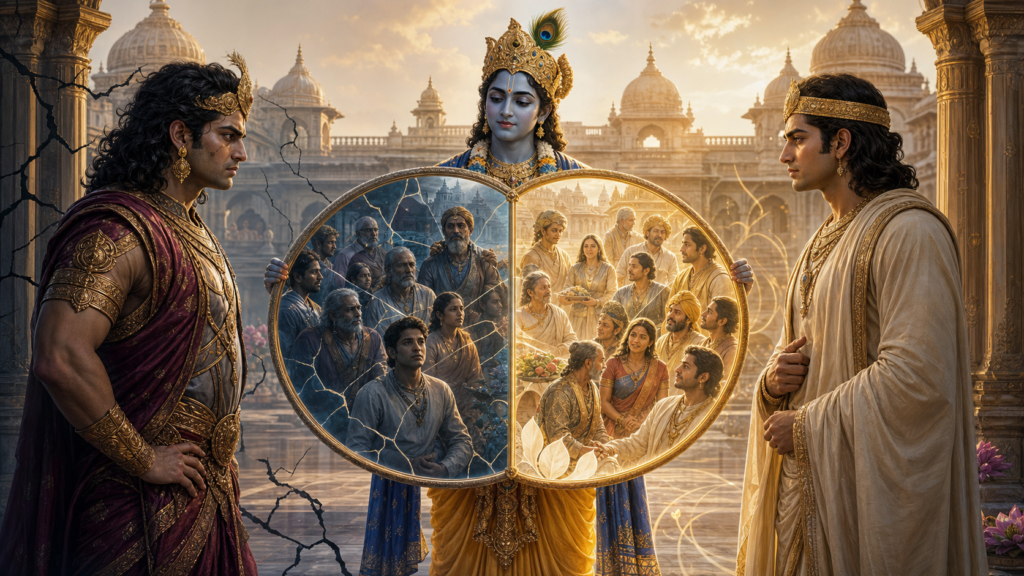
The difference between Lakshmana’s line and Vibhandaka’s wall may be expressed through purpose, scope, knowledge, and duration. The Lakshmana Rekha is drawn in an immediate emergency, directed against a specific danger, and intended to preserve Sita’s safety during a temporary absence. Vibhandaka’s enclosure shapes Rishyasringa’s entire world and limits the knowledge through which he might eventually govern himself. The first responds to a crisis; the second attempts to prevent life from presenting a crisis at all.
The difference is also relational. Lakshmana is caught between duties and acts while leaving a person he wishes he could continue to protect. Vibhandaka organizes his son’s environment so completely that the father’s presence becomes the principal source of interpretation. In one case, the boundary acknowledges that danger exists beyond the protector’s reach. In the other, the protector behaves as though controlling access can permanently control reality.
Yet the contrast must not be made absolute. Even a loving boundary can become oppressive if later interpreters use it to deny agency or blame victims. Even a strict enclosure may originate in genuine care. Moral evaluation therefore cannot rest on the visible form of a boundary alone. It must ask who created it, whom it protects, what threat it addresses, whether it is proportionate, whether those affected understand it, and whether it can be revised without violence or humiliation.
Protection Requires Knowledge
Both stories demonstrate that danger often arrives through imitation. Maricha imitates Rama’s cry. Ravana imitates a mendicant entitled to hospitality. The floating hermitage imitates an ascetic environment. The courtesan adopts signs that Rishyasringa interprets through his limited religious vocabulary. In each case, the threat succeeds by borrowing the appearance of something trusted.
This shared structure makes discernment the deepest lesson of the comparison. Rules are useful when reality is clear, but deception deliberately makes reality unclear. A person who knows only “stay inside” may not understand why the rule exists, how an aggressor might manipulate it, or what to do when two duties conflict. Ethical education must therefore provide principles and interpretive capacity, not commands alone.
Discernment also requires emotional literacy. Sita’s fear for Rama intensifies the pressure on Lakshmana. Rishyasringa’s wonder and longing make the unfamiliar visitor irresistible. Vibhandaka’s anger narrows his response, while Lomapada’s desperation encourages deception. None of these emotions automatically determines right action, but each changes how people perceive choices. Dharma is tested precisely when fear, affection, urgency, shame, and desire compete with calm judgment.
Lessons for Parenting and Education
Vibhandaka’s predicament is familiar to any parent or teacher who wishes to protect a young person from harmful influences. Complete exposure without guidance can be reckless, but complete isolation produces its own vulnerability. A sound middle path combines age-appropriate boundaries with explanation, gradually increasing responsibility, and opportunities to practice judgment. The goal is not perpetual dependence upon the guardian but the formation of a person capable of acting responsibly when the guardian is absent.
Such education should distinguish innocence from ignorance. Innocence can mean freedom from malice and commitment to what is good. Ignorance means lacking information needed to evaluate a situation. Rishyasringa possesses the first but is burdened by the second. His experience shows that goodness without practical knowledge can be exploited by those who understand appearances, incentives, and desire.
The same principle applies to digital life. Technical barriers, parental controls, institutional filters, and privacy settings function like modern protective lines. They are valuable, but no filter can identify every disguised solicitation, fraudulent message, manipulated image, or predatory relationship. Digital safety also requires an understanding of persuasion, verification, consent, privacy, and the right to seek trusted help without fear of punishment.
Lessons for Relationships and Institutions
In personal relationships, healthy boundaries preserve dignity while allowing connection. They clarify consent, responsibility, privacy, and acceptable conduct. Controlling walls operate differently: they monopolize information, discourage independent relationships, treat questions as betrayal, and make affection conditional upon obedience. The difference may not always be visible from outside, because care and control can use similar language. The decisive question is whether the relationship strengthens or weakens the other person’s capacity for responsible agency.
Institutions face the same test. A university needs academic standards, a monastery needs discipline, a state needs law, and a community needs shared norms. These limits remain dharmic when they serve a legitimate purpose and apply with fairness. They become walls when authority treats criticism as impurity, withholds knowledge to preserve dependence, or protects itself at the expense of those it claims to serve.
Traditions also require boundaries if they are to retain coherence, but coherence need not become hostility. Hinduism, Buddhism, Jainism, and Sikhism maintain distinct scriptures, practices, histories, and philosophical commitments. Unity among dharmic traditions does not require erasing those differences. It grows through truthful study, non-coercion, mutual respect, and recognition of shared concerns such as ethical discipline, compassion, self-knowledge, service, and freedom from destructive attachment.
From Control to Self-Governance
The highest purpose of an ethical boundary is to support self-governance. Early discipline may be external, but mature discipline must become internal. A child first follows a rule because a trusted elder gives it; later, the developing person should understand the value protected by that rule. Similarly, social law is most stable when citizens grasp its ethical basis rather than complying only from fear.
This transition resembles the movement from restraint to wisdom. Restraint interrupts harmful action, while wisdom recognizes why the action is harmful and chooses differently even when no guard is present. Vibhandaka’s method emphasizes restraint through environmental control. The Lakshmana Rekha emphasizes an external warning during a specific emergency. Neither device, by itself, can replace informed judgment.
Modern readers may recognize their own lives in this tension. Every family, community, and institution draws lines. Some preserve trust and make growth possible. Others are maintained long after their purpose has disappeared because uncertainty feels frightening. The stories invite a disciplined examination of inherited limits: which ones protect dignity, which ones conceal fear, and which ones should evolve as knowledge and responsibility increase?
The Most Enduring Lesson
Neither Lakshmana nor Vibhandaka can hold the world permanently in place. Ravana crosses moral limits even when confronted by a sacred boundary, and social life eventually reaches Rishyasringa despite his seclusion. This is not proof that boundaries are useless. It is proof that boundaries must be joined to knowledge, ethical accountability, resilience, and the capacity to respond when protection fails.
The Lakshmana Rekha remains powerful when it is understood as a limit placed upon aggression, deceit, and the misuse of power—not as a device for blaming Sita. Vibhandaka’s wall remains instructive when it is understood as a warning against confusing spiritual discipline with manufactured ignorance—not as an attack on asceticism. Read together, the narratives defend both protection and freedom while refusing to make either absolute.
The mature dharmic approach is therefore neither a world without lines nor a life enclosed by walls. It is the cultivation of wise boundaries: clear enough to defend what is sacred, humane enough to respect agency, flexible enough to meet changing circumstances, and transparent enough to be understood by those they affect. Such boundaries do not attempt to stop life. They teach people how to enter life without surrendering discernment, dignity, or dharma.
Textual References
The departure of Lakshmana without a described protective line can be consulted in Valmiki Ramayana, Aranya Kanda 45. Rishyasringa’s secluded upbringing appears in Valmiki Ramayana, Bala Kanda 10. The fuller Mahabharata account of the drought, Rishyasringa’s upbringing, the floating hermitage, his arrival in Anga, the rain, and his marriage to Shanta is preserved across Vana Parva 110, 111, 112, and 113. The later textual history and social meaning of the Lakshmana Rekha motif are examined in Danuta Stasik’s academic study, “A (Thin) Boundary Not to Be Crossed, or Lakshman-rekha”.
Inspired by this post on Hindu Blog.






Leave a Reply
You must be logged in to post a comment.