
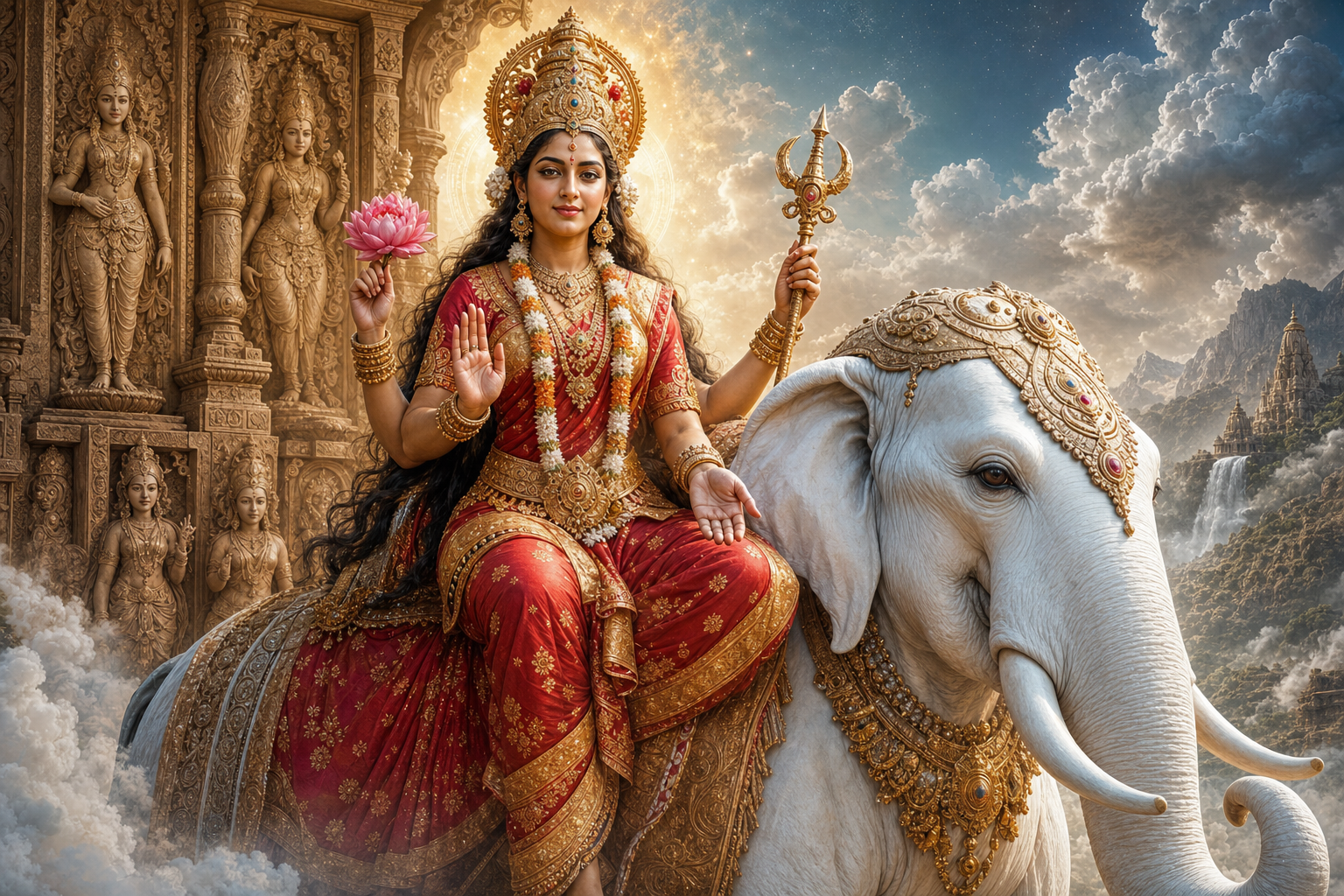
Indrani, also known as Shachi, Aindri, Mahendri, and Poulomi, occupies a luminous but often under-discussed place in Hindu sacred tradition. She is revered as the divine consort of Indra, the king of the Devas, yet her significance is not limited to marital association. In theological, ritual, and sculptural contexts, Indrani represents Shakti, the conscious and dynamic power through which divine authority becomes active, protective, and meaningful.
In Hindu thought, power is rarely treated as a merely political or physical quality. It must be animated by wisdom, order, beauty, protection, and moral responsibility. Indrani’s iconography expresses precisely this principle. Her image teaches that sovereignty without Shakti is incomplete, and that divine kingship must be balanced by auspicious feminine intelligence. This is why she is not simply a celestial queen but a theological symbol of disciplined power.
The name Shachi carries associations of grace, dignity, and strength, while Aindri identifies her as the feminine power of Indra. The name Poulomi is connected with her Puranic lineage as the daughter of the asura Puloman. This background is symbolically important because it shows how sacred narratives often transform conflict into integration. Indrani’s presence in the Deva world does not erase complexity; it reorders it into dharma, cosmic balance, and divine purpose.
Her relationship with Indra is best understood through the broader Hindu principle that every deity has a corresponding Shakti. Shiva is inseparable from Parvati, Vishnu from Lakshmi, Brahma from Saraswati, and Indra from Indrani. This is not merely a domestic pairing. It is a metaphysical structure in which consciousness and energy, authority and manifestation, principle and action, stand together. Indrani therefore becomes a key figure for understanding Hindu goddess iconography and the sacred feminine within Vedic and Puranic imagination.
In Vedic literature, Indrani appears as a powerful feminine presence within the celestial order. She is associated with status, self-possession, and the dignity of a queen. Later Puranic and Agamic traditions expand this identity into a more elaborate iconographic form. By the time temple sculpture and Tantric goddess traditions become more visibly systematized, Indrani is recognized not only as Indra’s consort but also as one of the Matrikas, the divine mother-goddesses who embody the energies of major gods.
As Aindri or Mahendri among the Saptamatrikas and Ashtamatrikas, Indrani stands beside Brahmani, Vaishnavi, Maheshvari, Kaumari, Varahi, Chamunda, and sometimes Narasimhi or additional forms depending on regional and textual traditions. This placement is crucial. The Matrikas are not decorative attendants. They are protective, martial, maternal, and cosmic powers. They guard sacred space, confront disorder, and represent the collective strength of Devi Shakti.
Indrani’s most recognizable emblem is the elephant, usually connected with Airavata, the royal elephant of Indra. The elephant in Hindu symbolism conveys majesty, memory, rain-bearing clouds, fertility, authority, and stabilizing strength. When Indrani is shown seated on or associated with an elephant, the image communicates more than royal privilege. It indicates mastery over the atmosphere, abundance, and the organized power required to sustain life.
The elephant also links Indrani to the monsoon imagination of ancient India. Indra is the wielder of the thunderbolt and the releaser of waters, while Indrani’s presence beside him evokes the nourishing dimension of that power. Rain is not merely a meteorological event in sacred culture; it is fertility, food, continuity, and social well-being. In this sense, Indrani’s iconography quietly connects heaven, agriculture, prosperity, and household life.
Her complexion is often described or represented in radiant tones such as golden, red, or bright celestial hues. These colors carry layered meanings. Gold suggests sovereignty, auspiciousness, and divine splendor. Red is associated with Shakti, vitality, passion, protection, and active energy. When viewed in a temple or museum setting, these visual codes help the devotee or observer recognize Indrani not as passive beauty but as charged divine presence.
Indrani is commonly depicted with a crown, rich ornaments, and royal bearing. The crown is not an incidental accessory. It signifies her participation in celestial sovereignty. Her ornaments represent auspicious fullness, while her composed posture suggests authority restrained by order. Hindu sculpture often communicates theology through posture, gesture, vehicle, ornament, and weapon; Indrani’s image is a refined example of this symbolic grammar.
The vajra, or thunderbolt, is one of her most significant attributes. Since the vajra is Indra’s principal weapon, its presence in Indrani’s hand marks her as the bearer of Indra’s active power. Symbolically, the vajra represents firmness, clarity, irresistible force, and the destruction of obstruction. In a dharmic reading, it is not violence for its own sake but the force that breaks ignorance, arrogance, drought, and disorder.
Other objects associated with Indrani may include the lotus, goad, noose, and gestures of blessing or protection. The lotus indicates purity, beauty, and spiritual emergence from the waters of existence. The goad suggests direction and disciplined control. The noose represents the capacity to restrain harmful tendencies. Abhaya mudra offers fearlessness, while varada mudra grants blessing. Together, these attributes reveal a goddess who protects, governs, nourishes, and guides.
Her arms may vary in number depending on the sculptural tradition, region, and textual source. Two-armed forms emphasize queenly dignity and accessibility, while four-armed or multi-armed forms highlight her divine capacity beyond ordinary human limitation. In Hindu iconography, multiple arms do not indicate fantasy in a simplistic sense. They represent simultaneous powers: protection, blessing, restraint, strength, and cosmic participation.
Indrani’s presence among the Matrikas also gives her a strong temple-architectural significance. Matrika panels are found in many parts of India, especially in Shaiva, Shakta, and early medieval temple contexts. These panels often appear near thresholds, outer walls, subsidiary shrines, or protective zones. Their placement reflects the belief that sacred space must be guarded by divine feminine forces who contain and redirect dangerous energies.
In sculptural sequences, Aindri can usually be identified through her elephant association, vajra, crown, and regal posture. Careful identification matters because Matrika figures can appear visually similar at first glance. The trained reading of Hindu sculptures requires attention to vahana, ayudha, mudra, hairstyle, ornaments, and position within the group. Indrani’s elephant and thunderbolt provide the strongest clues to her identity.
Her symbolism becomes especially meaningful when considered in relation to the wider dharmic respect for feminine divinity. Hinduism, Buddhism, Jainism, and Sikh traditions differ in theology and practice, yet all preserve deep reverence for discipline, wisdom, compassion, and liberation from ego. Indrani’s iconography can be appreciated within this broader dharmic landscape as a reminder that power must be ethically oriented and spiritually refined.
For many modern observers, the first encounter with Indrani may happen not through scripture but through sculpture: a weathered temple panel, a museum label, a photograph of a Matrika group, or a quiet shrine image. Such encounters can feel unexpectedly intimate. A figure that initially appears as part of a larger iconographic set gradually reveals a complex theology of queenship, protection, rain, dignity, and sacred feminine power.
This emotional response is not separate from academic understanding. Hindu art was designed to be read, contemplated, and experienced. The sculpted form invites both intellectual study and devotional sensitivity. Indrani’s image asks the viewer to recognize that the universe is sustained not only by heroic force but also by relational power, maternal protection, and the subtle authority of Shakti.
Indrani’s mythology also reflects the challenges of status, jealousy, loyalty, and celestial responsibility. Like many figures in the Puranic world, she is not a flat abstraction. She participates in narratives that explore the vulnerabilities of divine households, the instability of power, and the need for dharma even among the Devas. This makes her more relatable, because sacred literature often uses divine stories to illuminate human psychology.
Her role as queen of Svarga also places her within the symbolic structure of cosmic society. Svarga is not merely a paradise of pleasure; it is an ordered celestial realm governed by merit, hierarchy, ritual power, and divine responsibility. Indrani’s queenly presence indicates the refinement of that order. She embodies auspicious sovereignty, reminding devotees that prosperity and leadership require grace as much as strength.
The feminine title of queen should therefore not be read as secondary. In Hindu tradition, the queenly goddess often mediates between abundance and authority. Lakshmi does this through prosperity, Saraswati through knowledge, Parvati through tapas and power, and Indrani through celestial majesty and protection. Each form of Devi Shakti reveals a distinct dimension of the sacred feminine.
Indrani’s connection with Indra also opens a broader discussion of Vedic deities in later Hindu practice. Indra’s prominence shifts over time as Vishnu, Shiva, Devi, and other deities become central in sectarian traditions. Yet Indra and Indrani continue to survive in ritual memory, iconography, literature, and temple art. Their persistence shows that Hindu tradition does not simply discard older layers; it absorbs, reinterprets, and re-situates them within expanding sacred frameworks.
This continuity is one of the most remarkable features of Sanatana Dharma. Vedic, Puranic, Agamic, folk, temple, and philosophical traditions do not always speak in a single voice, but they remain linked through shared symbols and ritual imagination. Indrani is an excellent example of this layered continuity. She belongs to Vedic memory, Puranic narrative, Shakta theology, and Hindu sculpture at the same time.
From an art-historical perspective, Indrani’s image also demonstrates how Hindu sculptors transformed theology into visible language. Stone does not speak in prose, yet it communicates through proportion, iconographic attributes, and placement. The elephant beneath her, the vajra in her hand, the crown on her head, and the calm force of her posture together form a complete symbolic sentence about divine sovereignty.
In temple worship, such imagery also functions as a map of inner life. The elephant can represent steadiness, the vajra unwavering resolve, the lotus purity, and the protective gesture courage. The devotee does not merely look at Indrani as an external goddess; the image becomes a mirror for qualities that must be cultivated within the self. Sacred art thus becomes a discipline of perception.
Indrani’s iconography is especially valuable today because it challenges simplified assumptions about Hindu goddesses. Not every goddess is defined only by motherhood, beauty, or benevolence, though these qualities may be present. Indrani combines sovereignty, protection, status, martial power, auspiciousness, and emotional complexity. Her image expands the understanding of Hindu Goddess traditions and shows the intellectual depth of Hindu religious symbols.
She also offers a model for thinking about power in human society. Leadership without wisdom becomes domination, and strength without compassion becomes fear. Indrani’s symbolic world suggests a more integrated model: power must nourish, protect, restrain, bless, and uphold order. This lesson remains relevant far beyond the ancient celestial court of Indra.
In the broader study of Hindu sculptures, Indrani deserves more sustained attention. Her figure helps interpret Matrika panels, temple programs, goddess theology, and the continuity between Vedic and Puranic traditions. She also helps recover the subtle ways in which Hindu art preserves female divinity as an active and indispensable force in the cosmos.
Indrani is therefore not merely the consort of Indra. She is Shachi, the dignified queen; Aindri, the power of the thunderbolt; Mahendri, the celestial sovereign feminine; and Poulomi, the transformed lineage that becomes part of dharma. Her sacred iconography unites beauty, authority, protection, and cosmic order. To study her is to understand how Hindu tradition sees power itself: incomplete unless illumined by Shakti.
Inspired by this post on Hindu Blog.



Leave a Reply
You must be logged in to post a comment.