
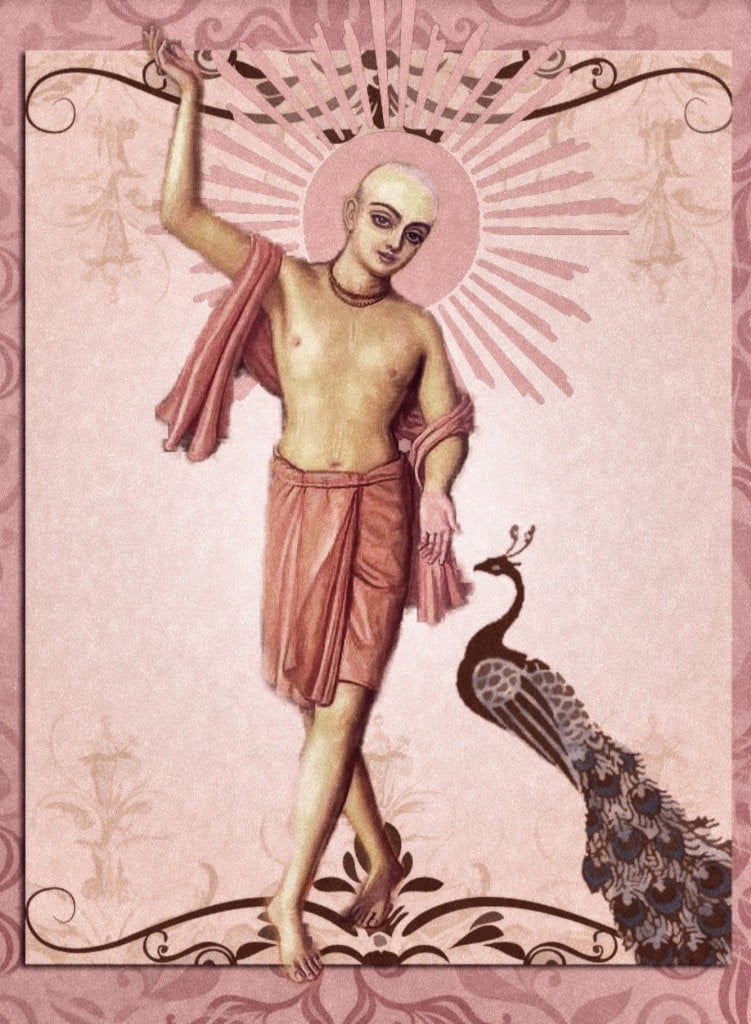
Srila Vakreśvara Paṇḍita occupies a distinctive place in the devotional history of Gaudiya Vaishnavism. Remembered as one of Sri Caitanya Mahāprabhu’s most beloved associates and as an extraordinary singer and dancer in His assembly, he represents a form of bhakti in which the body, voice, rhythm, memory, and theological conviction become one integrated act of worship. His life is not merely a record of devotional performance; it is a study in how Sankirtana transformed public religious life by making chanting, dancing, and shared spiritual emotion central to the practice of Krishna consciousness.
The well-known instruction of Śrīla Prabhupāda, spoken in Seattle on Oct. 2, 1968, captures this principle with striking simplicity: Dance and chant. This is best exercise. We allow them to dance very… Yes. High jump. Actually that is exercise, and at the same time ecstasy. If they dance and chant Hare Kṛṣṇa, it is automatically a very big exercise and spiritual advancement. This observation is not casual rhetoric. It reflects a long Vaishnava understanding that devotional movement, when joined with nāma-saṅkīrtana, is not entertainment but embodied remembrance of Lord Kṛṣṇa.
In ordinary devotional gatherings, the experience is familiar. A hall fills with devotees, the kirtaniya gradually increases the tempo, the Mrdanga and Kartal players respond with greater intensity, and the seated participants rise almost naturally into movement. The rhythm gathers force, the chanting becomes collective, and the boundary between individual effort and shared devotion begins to soften. Yet, in most cases, the body eventually tires and the dancing subsides. The tradition remembers Vakreśvara Paṇḍita precisely because his devotional absorption seemed to transcend this ordinary limit.
Born in the village of Guptipāra, near Triveṇi, Vakreśvara Paṇḍita became renowned as an important singer and dancer among the associates of Sri Caitanya Mahāprabhu. His devotional identity is inseparable from Sankirtana, the congregational chanting of the divine names. In Gaudiya Vaishnava theology, such chanting is not merely a ritual technique; it is understood as the primary spiritual discipline for the age, a path that gathers scholarship, humility, emotional refinement, and public devotion into one accessible practice.
The episode involving Devānanda Pandit at Kuliā is especially instructive. Devānanda Pandit was known as a learned speaker on Bhāgavatam, yet learning alone did not place him beyond the need for grace, humility, and Vaishnava association. When he heard that Vakreśvara Paṇḍita had come to Kuliā for congregational chanting, he was pleased and went to see him. Upon witnessing the symptoms of divine love manifest in Vakreśvara Paṇḍita, Devānanda became deeply moved.
As the crowd gathered, Devānanda Pandit took practical responsibility for preserving the sanctity of the devotional assembly. With a stick in hand, he kept order so that the crowd would not disturb Vakreśvara Paṇḍita’s ecstatic dancing. This detail is significant because it shows that service to a devotee is not always dramatic or philosophical. Sometimes it consists of making space, protecting concentration, and allowing sacred practice to unfold without interference.
Vakreśvara Paṇḍita is said to have danced continuously for six hours at Kuliā. When the dancing concluded, Devānanda Pandit offered obeisances at his lotus feet. Vakreśvara Paṇḍita then blessed him with the words, “May you attain devotion to Lord Kṛṣṇa”. The theological meaning of this moment is profound. Devotion is not presented as a product of intellectual mastery alone, but as a gift received through humility, service, and contact with those whose lives are already absorbed in divine love.
The tradition further explains that Devānanda Pandit had previously failed to receive the full mercy of Mahāprabhu because he had offended Śrīvāsa Ṭhākura, a Vaiṣṇava. When Mahāprabhu later visited Kuliā, He bestowed mercy upon Devānanda because Devānanda had served Vakreśvara Paṇḍita. This account underscores a central principle of bhakti: reverence for devotees is inseparable from reverence for the Lord. In this sense, Vaishnava conduct is not secondary ethics; it is part of the spiritual architecture of the tradition.
Mahāprabhu’s praise of Vakreśvara Paṇḍita is remembered in especially exalted terms: “Wherever one can get the association of Vakreśvara, that place is the sum total of all Holy places and is as good as Sri Vaikuntha.” This statement places devotional association at the center of sacred geography. A holy place is not defined only by terrain, architecture, or pilgrimage routes; it is also made manifest wherever pure devotion is present. Such a view harmonizes with the wider dharmic insight that sacredness is both locative and relational.
Vakreśvara Paṇḍita was not only a performer of ecstatic dance but also a close servant of Sri Caitanya Mahāprabhu. After Mahāprabhu accepted sannyāsa, Vakreśvara Paṇḍita accompanied Him to Jagannātha Purī, indicating both personal dedication and spiritual intimacy. Jagannātha Purī then became one of the most important centers of Mahāprabhu’s later pastimes, where devotional practice, theological discussion, temple culture, and public kirtan converged around Lord Jagannath.
In Purī, Mahāprabhu sometimes engaged Vakreśvara Paṇḍita and other devotees in congregational chanting three times a day in the courtyard of Guṇḍicātemple. Vakreśvara Paṇḍita would dance there in jubilation. The setting matters. The Guṇḍicā temple is central to the devotional imagination of Jagannath Puri, especially in relation to the Ratha Yatra tradition. Within that sacred environment, Vakreśvara Paṇḍita’s dance becomes more than personal ecstasy; it becomes a visible theology of longing, service, and celebration.
The Caitanya-caritāmṛta preserves his reputation as an especially expert dancer. One account states that he danced in the house of Srivas Thakur continuously for up to 72hours (~3days). Whether approached devotionally, historically, or phenomenologically, this description functions as a marker of extraordinary spiritual absorption. It communicates that his dancing was not based on display, athleticism, or social excitement, but on a state of consciousness shaped by deep devotional emotion.
This is why Vakreśvara Paṇḍita’s life remains relevant for contemporary practitioners and students of Hindu spirituality. Modern culture often separates the body from the sacred, treating physical movement as fitness, performance, or recreation. The bhakti tradition offers another model. In Sankirtana, the body becomes an instrument of remembrance; the feet, hands, breath, and voice participate in theology. Chanting Hare Kṛṣṇa while dancing is therefore not a distraction from spiritual seriousness. It is one of the ways devotion becomes fully embodied.
The example of Vakreśvara Paṇḍita also illuminates the relationship between discipline and ecstasy. Ecstatic devotion in the Gaudiya tradition is not treated as emotional disorder or sentimental excess. It is rooted in sambandha, the knowledge of one’s relationship with Lord Kṛṣṇa, and expressed through abhidheya, the practical process of devotional service. His dancing, therefore, is best understood within a disciplined theological world shaped by śāstra, guru, kirtan, humility, and service to Vaishnavas.
In Jagannātha Purī, Vakreśvara Paṇḍita lived in the house of Kāśī Miśra, who is remembered as King Prataparudra’s Guru. This association places him within the broader devotional network of Purī, where saints, royal patrons, temple servants, scholars, and renunciants interacted around the living worship of Lord Jagannath. The social world of bhakti was never merely private. It shaped institutions, pilgrimage circuits, sacred music, literature, public festivals, and models of community life.
Śrīla Kavi Karṇapūra, in the Gaura-gaṇoddeśa-dīpikā, identifies Vakreśvara Paṇḍita as an incarnation of Aniruddha, one of the quadruple expansions of Viṣṇu: Vāsudeva, Saṅkarṣaṇa, Aniruddha and Pradyumna. Dhyānacandra Gosvāmī, within the devotional mapping of Kṛṣṇa lila, identifies him with Tungavidya Sakhi. These identifications are not incidental labels. They express the Gaudiya Vaishnava conviction that Mahāprabhu’s associates participate in eternal devotional realities that appear within history for the upliftment of the world.
From an academic perspective, such theological identifications show how Gaudiya Vaishnava memory links historical devotion with sacred ontology. The tradition does not treat saints merely as moral examples. It understands them as bearers of divine relationship, whose visible actions reveal deeper spiritual identities. Vakreśvara Paṇḍita’s dancing, therefore, is interpreted not only as an act within sixteenth-century devotional culture, but as an expression of eternal service in relation to Lord Kṛṣṇa and Sri Caitanya Mahāprabhu.
His life also invites reflection on unity among dharmic traditions. Hinduism, Buddhism, Jainism, and Sikhism each preserve disciplined ways of transforming the human person through sound, memory, movement, restraint, compassion, and community. Vakreśvara Paṇḍita’s example belongs specifically to the Gaudiya Vaishnava lineage, yet its broader lesson is recognizable across dharmic civilization: spiritual practice becomes powerful when knowledge, humility, devotion, and embodied discipline reinforce one another.
For many devotees, the image of a packed hall, rising kirtan, rhythmic Mrdanga, ringing Kartal, and dancing bodies remains one of the most immediate ways to understand bhakti. Vakreśvara Paṇḍita gives that familiar experience a historical and theological depth. He shows that sacred dance is not an ornament added to devotion; when performed in the mood of surrender, it is devotion itself, made visible through movement.
The enduring legacy of Srila Vakreśvara Paṇḍita lies in this synthesis of beauty and rigor. He stands as Mahāprabhu’s dancer-in-chief not because he merely danced longer than others, but because his dance revealed the force of divine love. His life teaches that the chanting of Hare Kṛṣṇa, the honoring of Vaishnava saints, and the disciplined joy of Sankirtana remain central to spiritual advancement. In his example, ecstasy is not escape from the world; it is the world reoriented toward Lord Kṛṣṇa through sound, service, and sacred movement.
Inspired by this post on Dandavats.
