
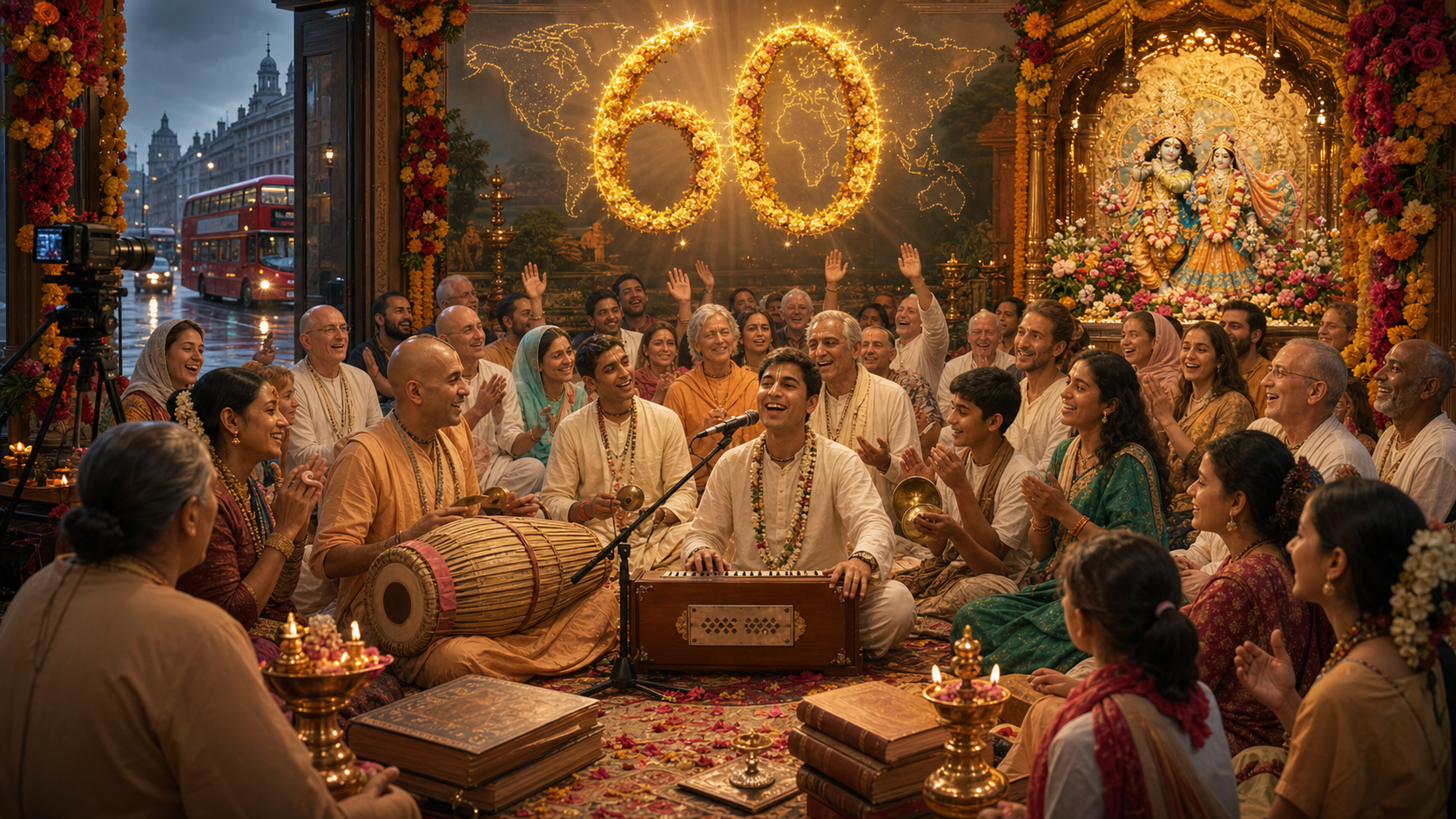
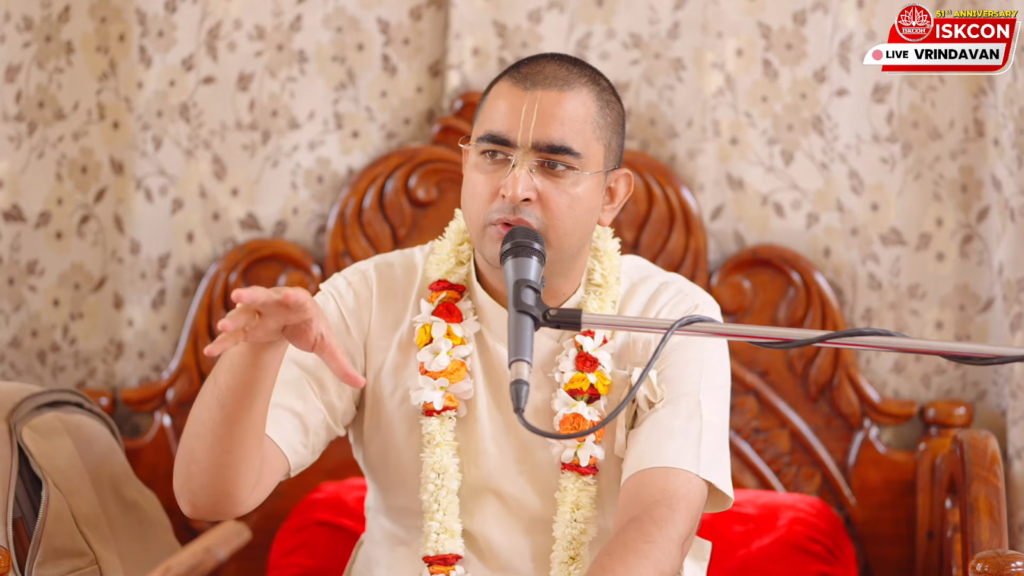
A global milestone observed in Soho. On 13 July 2026, the Radha-Krishna Temple in central London marks sixty years since the legal incorporation of the International Society for Krishna Consciousness, widely known as ISKCON or the Hare Krishna movement. The official ISKCON London calendar lists an “ISKCON 60th Anniversary Incorporation Festival” from 07:00 to 21:00. The supplied post centres on the live broadcast, allowing the observance at the Soho temple to be witnessed far beyond London. The occasion combines institutional memory, Gaudiya Vaishnava theology, sacred music, community participation and the modern infrastructure of digital religious life.
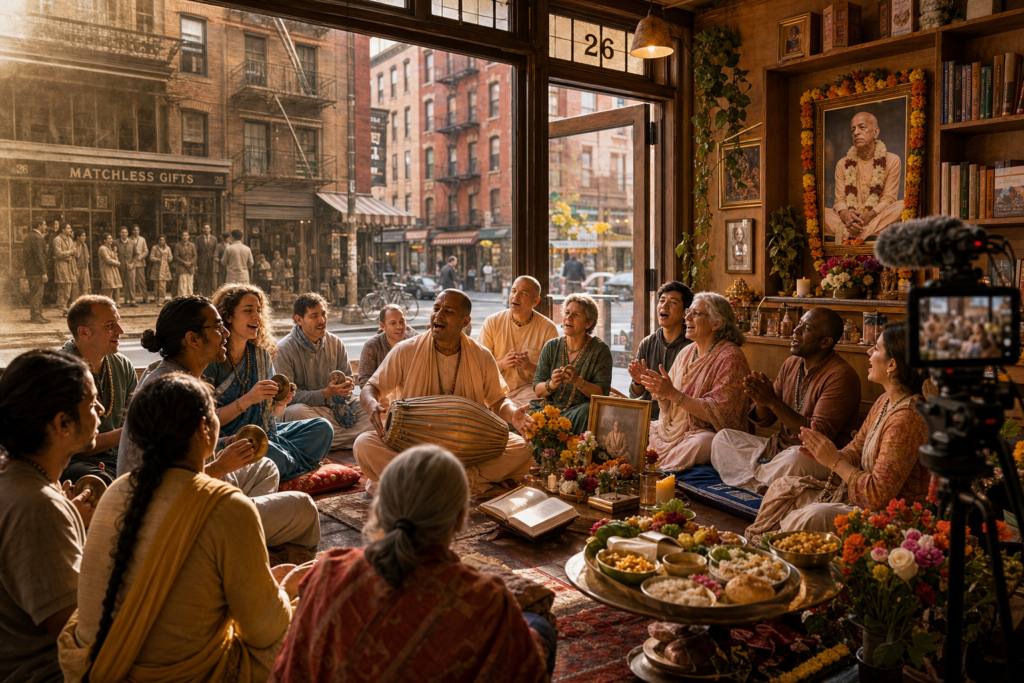
Official livestream. The anniversary broadcast is provided by the ISKCON London Radha-Krishna Temple YouTube channel. The original post also includes an event image associated with the livestream. Together, these resources preserve access to the celebration without requiring viewers to be physically present at 10 Soho Street. The stream should be understood as the primary record of the programme because the supplied source does not include a detailed running order.
What is actually turning sixty? The anniversary is calculated from ISKCON’s incorporation in New York on 13 July 1966. It is therefore the sixtieth anniversary of the international society, not the sixtieth anniversary of the London temple itself. ISKCON’s London mission began in 1968, and the first permanent Radha-Krishna Temple opened at Bury Place in December 1969. Making this distinction prevents two related histories from being collapsed into one: the global institution began in New York, while London subsequently became one of its most historically influential centres.
From the Jaladuta to a New York storefront. A. C. Bhaktivedanta Swami Prabhupada travelled from Kolkata to the United States aboard the cargo ship Jaladuta in 1965, when he was sixty-nine. After arriving in New York, he lectured, translated Sanskrit texts and gathered a small circle of interested listeners. In July 1966, while working from a modest storefront on the Lower East Side, he established the International Society for Krishna Consciousness. The official ISKCON history notes that he had not yet initiated any disciples at the moment of incorporation. The legal act therefore expressed an ambitious institutional vision before a large organisation existed to carry it forward.
The constitutional architecture of the movement. ISKCON’s original incorporation document set out seven purposes. They concerned the systematic communication of spiritual knowledge; the study of Krishna consciousness through the Bhagavad-gita and Srimad-Bhagavatam; the formation of a community centred on Krishna; the encouragement of congregational chanting, or sankirtana; the establishment of sacred places; the cultivation of a simpler and more natural way of life; and the publication and distribution of books and periodicals. These purposes, summarised on ISKCON’s official mission page, show that education, worship, community, publishing and public engagement were designed as interdependent parts of one project.
Why incorporation mattered. Incorporation gave a small devotional community a durable public structure. It created a legal identity through which property, publishing, worship and collective responsibilities could be organised beyond the lifespan or private ownership of any single participant. In sociological terms, it helped translate charismatic religious leadership into an institution capable of continuity. The sixtieth anniversary consequently commemorates more than the passage of time. It recalls the moment when a fragile initiative acquired a framework through which teachings, rituals and communities could be reproduced across generations and national borders.
Bhakti reaches London. In September 1968, three married couples travelled from San Francisco to establish a London centre at Prabhupada’s request: Gurudasa and Yamuna, Syamasundara and Malati with their daughter Sarasvati, and Mukunda and Janaki. Their early circumstances were materially uncertain, yet the group sought to make Krishna bhakti intelligible within the cultural environment of late-1960s Britain. Their work combined public chanting, personal conversations, musical collaboration and the search for a permanent temple. This small community would soon connect an Indian devotional lineage with some of the most influential institutions of British popular culture.
George Harrison and the movement of sacred sound. The London devotees met George Harrison in December 1968 after approaching Apple Records. Harrison already had a strong interest in Indian philosophy and devotional music. In July 1969, he produced and performed on the Radha-Krishna Temple’s recording of the Hare Krishna maha-mantra at Abbey Road Studios. Released by Apple Records the following month, the single reached number twelve on the United Kingdom singles chart, and the devotees performed it twice on the BBC programme Top of the Pops. The achievement did not create the mantra or change its theological origin; it changed its medium, scale of circulation and place within British public culture.
A temple takes institutional form. Prabhupada visited the emerging British community in September 1969. In December, the devotees moved into the new Radha-Krishna Temple at 7 Bury Place, close to Oxford Street. ISKCON London identifies Sri Sri Radha-Londonisvara as the first full-size Radha-Krishna deities installed within ISKCON. The temple gave the community a stable site for daily worship, teaching, hospitality and public contact. It also transformed a dispersed network of practitioners into a visible urban institution with an address, ritual calendar and regular congregation.
From Bury Place to Bhaktivedanta Manor and Soho Street. Harrison continued his association with the movement by producing The Radha Krishna Temple album in 1970 and financing the printing of Prabhupada’s book about Krishna. In 1973, he acquired a seventeen-acre Hertfordshire property that became Bhaktivedanta Manor and later developed into ISKCON’s principal United Kingdom centre. In 1978, Sri Sri Radha-Londonisvara and the London congregation moved from Bury Place to the present six-storey building at 10 Soho Street. This history connects rural retreat, metropolitan worship and public outreach within one British devotional network.
Why London occupies a distinctive place in ISKCON history. London was not merely another point on a map of institutional expansion. It became a meeting place between Gaudiya Vaishnavism, post-war migration, youth counterculture, recorded music and the international circulation of Indian religious ideas. Its proximity to Oxford Street placed worship next to one of Europe’s busiest commercial districts. The temple’s visibility allowed sacred sound, vegetarian food, books and devotional practice to enter everyday urban life. The contrast remains striking: a tradition rooted in Sanskrit and Bengali devotional texts operates from a compact temple amid the density, tourism and cultural plurality of modern Soho.
The theological foundation: bhakti-yoga. ISKCON belongs to the Gaudiya Vaishnava tradition of Hinduism, which draws particular inspiration from the teachings of the sixteenth-century saint Chaitanya Mahaprabhu. Bhakti-yoga is often translated as the path of devotion, but it involves more than spontaneous religious emotion. It is a disciplined orientation of attention, action, speech and relationship towards Krishna. Study, mantra meditation, congregational singing, worship, ethical conduct, food offering and service all become methods of cultivating devotion. Within Gaudiya theology, the individual self and Krishna are related through acintya-bhedābheda, the doctrine of an inconceivable simultaneous distinction and unity.
The maha-mantra at the centre of the soundscape. The best-known vocal practice associated with ISKCON is the sixteen-word sequence: Hare Krishna, Hare Krishna, Krishna Krishna, Hare Hare; Hare Rama, Hare Rama, Rama Rama, Hare Hare. It may be repeated quietly with prayer beads as japa or sung collectively as kirtan and sankirtana. In Gaudiya Vaishnava thought, the divine name is not treated as an ordinary label. Practitioners understand sacred sound as a mode of divine presence and relationship. Chanting is therefore simultaneously prayer, meditation, remembrance and communal participation.
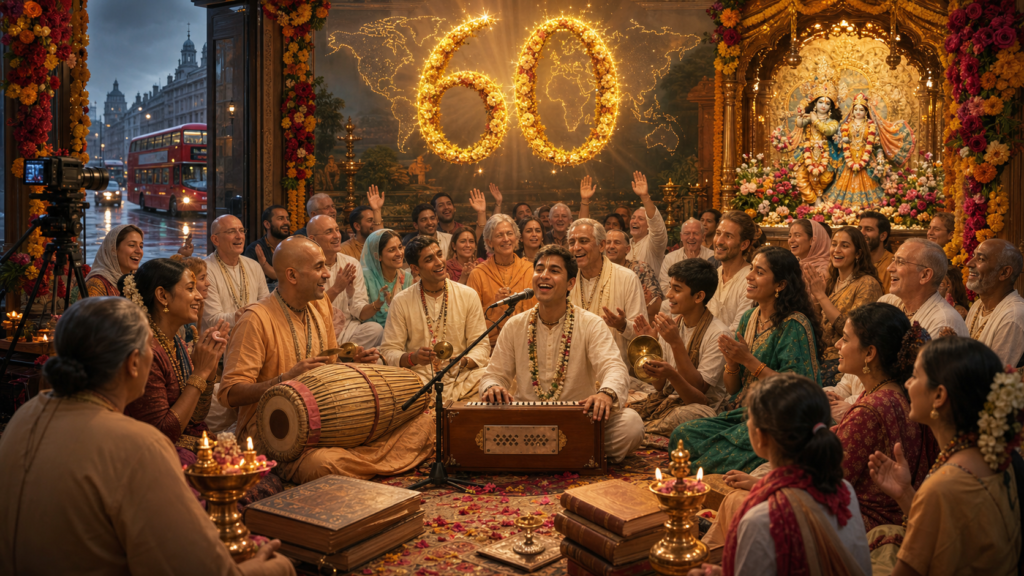
How kirtan works. A typical ISKCON kirtan uses a responsorial structure in which a leader sings a phrase and the assembly repeats it. The mridanga supplies a rhythmic foundation, while hand cymbals known as kartals mark the pulse and its subdivisions. Harmonium, additional percussion and other instruments may extend the texture, although the voice and mantra remain central. Tempo, melodic register and rhythmic intensity can develop gradually, encouraging collective singing and movement. Unlike a conventional concert, the boundary between performer and audience is deliberately porous: participation is a defining feature rather than an optional reaction.
Repetition as a contemplative technology. To a first-time listener, an extended kirtan may initially sound repetitive. Within the practice, repetition is not considered informational redundancy. A stable verbal sequence reduces the demand for new semantic processing, enabling attention to return repeatedly to pronunciation, rhythm, listening and devotional intention. The call-and-response form also distributes musical agency across the group. Its observable effects include synchronised vocalisation, coordinated movement and a heightened sense of shared participation. Claims about spiritual transformation belong to the theological and experiential testimony of practitioners, while the musical and social structure can be described independently.
Reading the visual language of temple worship. If the broadcast shows deity worship, several technical terms help explain what is taking place. The consecrated form is commonly called the arcā-vigraha; within Vaishnava theology, it is approached as a form through which the divine accepts reciprocal service, not merely as decorative sculpture. Darśana refers to sacred seeing and the experience of being seen in the divine presence. Ārati is a structured offering in which such elements as lamps, incense, water, cloth, flowers and a fan may be presented. Sevā means devotional service, encompassing both ritual duties and practical care for the community.
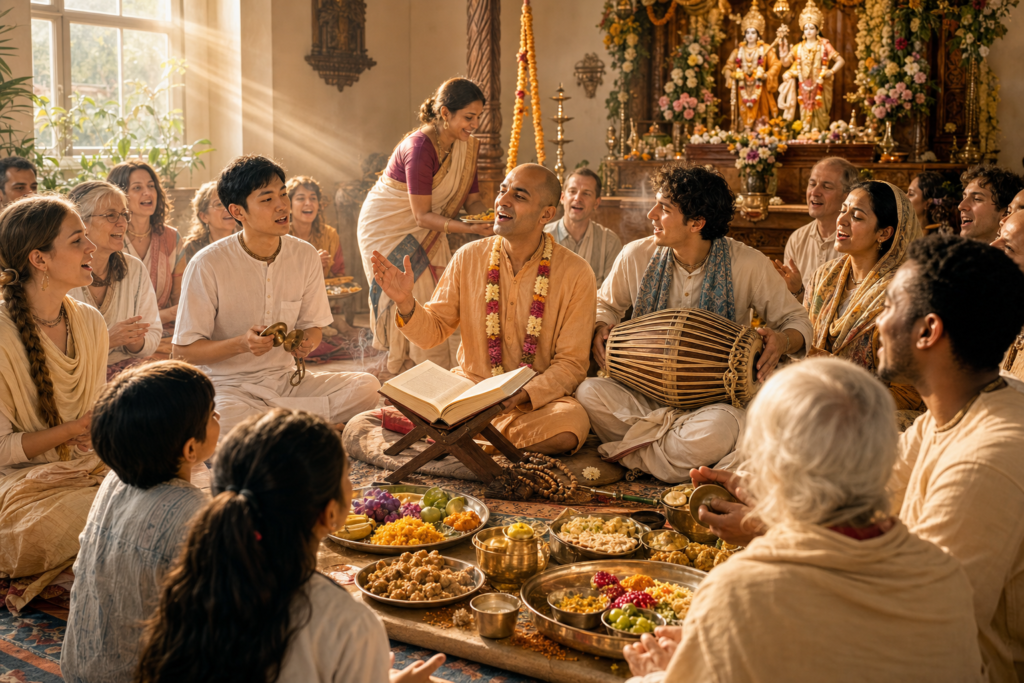
Prasādam and the social life of food. Food occupies an important place in Krishna bhakti. Vegetarian preparations are offered in worship and then received as prasādam, literally grace or favour. The movement’s shared meals connect theology with hospitality: preparation becomes service, offering becomes worship, and distribution becomes a form of community care. ISKCON London’s wider activities include congregational meals, a vegetarian restaurant and food-relief work. These practices show how devotion moves beyond private belief into kitchens, dining spaces and public service. The anniversary’s significance is therefore not exhausted by speeches or ceremony; it is also carried by ordinary systems of cooking, cleaning, serving and welcoming.
What the source confirms—and what it does not. The available source confirms the official livestream channel, while ISKCON London’s calendar confirms the festival title, date and listed duration. It does not provide a segment-by-segment programme. It would therefore be inaccurate to name particular speakers, describe unverified rituals or present common ISKCON practices as though each definitely occurred during this broadcast. The stream itself remains the evidence for what happened on camera. This distinction between verified event reporting and informed religious context is essential to an academically responsible account.
Livestreaming as mediated participation. A live religious broadcast does more than transmit pictures from one room to another. It reorganises participation across distance and time zones. Members of the Indian and wider Hindu diaspora, former London residents, people with disabilities, older viewers and those unable to travel can follow the observance from home. Comments and shared links may create a secondary digital congregation around the physical one. Yet remote viewing is not identical to being inside the temple: it cannot reproduce the room’s acoustics, the movement of the assembly, the fragrance of incense or the face-to-face exchange of hospitality.
The importance of hearing. The livestream is particularly suited to a tradition in which hearing sacred sound is central. Camera angles may be limited, but intelligible audio can carry recitation, kirtan and discourse beyond the building. This makes sound engineering part of religious accessibility. Balanced speech levels, controlled musical peaks, clear vocal pickup and dependable transmission affect whether distant viewers can meaningfully follow the programme. The shift from the 1969 Apple Records single to a 2026 digital stream illustrates a striking continuity: the distribution technology has changed radically, while vocal devotion remains the principal content being transmitted.
Digital preservation after the celebration. If retained, the broadcast can become a primary historical source for future research. Its long-term value increases when it is accompanied by accurate dates, venue information, participant names, a programme, captions, chapter markers and a transcript. Descriptive image text should identify the event rather than rely solely on a generic label such as “Live Stream.” Stable metadata allows later viewers to distinguish the 2026 global incorporation anniversary from anniversaries specific to the London temple. Responsible archiving should also consider permissions, the correct identification of speakers and musicians, and preservation outside a single commercial platform.
A commemoration extending beyond one day. London’s observance belongs to a wider anniversary year. The official temple website also presents events that reflect on Srila Prabhupada’s legacy and ISKCON’s future. The London Mellows Kirtan Weekend, established in 2016 during ISKCON’s fiftieth-anniversary year, reaches its own tenth anniversary on 12–13 September 2026. Its convergence with ISKCON’s sixtieth year demonstrates how annual local traditions can develop inside a longer global chronology. The result is not one isolated celebration but a sequence of devotional, educational and cultural acts distributed across the year.
Anniversary as cultural heritage. Religious heritage is not preserved only through buildings and objects. It also survives as repertoire, memory and embodied skill: how a melody is led, how kartals are played, how an altar is prepared, how food is offered, how guests are received and how scriptural concepts are explained to a new generation. The London temple holds material heritage in its deities, publications, photographs and historic locations, but it also carries intangible heritage through repeated practice. A livestream can document part of that living inheritance, particularly the interaction among elders, younger participants and a geographically dispersed congregation.
Anniversary as community memory. The emotional power of sixty years lies in continuity rather than scale alone. In 1966, the international society existed legally before it possessed a large initiated membership. In 1968, the London mission consisted of six adults and a child operating under materially difficult conditions. By 1969, their chanting had entered British popular media, and a permanent temple had opened. In 2026, the same broad devotional tradition can be broadcast globally from Soho. The movement from a precarious storefront and an improvised London base to an international digital audience gives the anniversary its human depth.
Service as a measure of institutional maturity. A religious organisation’s longevity can be measured by more than membership, property or public visibility. It can also be evaluated through the quality of education, pastoral care, safeguarding, hospitality, accessibility and service offered to the wider community. ISKCON’s incorporation purposes joined spiritual teaching to community formation, publishing and a simpler way of life. A serious sixtieth-anniversary reflection therefore asks how effectively those purposes are being interpreted under contemporary urban conditions. Celebration and evaluation need not be opposites; institutional gratitude becomes more credible when it is accompanied by transparent learning and responsible care.
Dharmic unity without erasing difference. The festival is specifically a Gaudiya Vaishnava celebration within the broad Hindu family of traditions. It should not be presented as though it speaks on behalf of Buddhism, Jainism or Sikhism. Nevertheless, constructive solidarity among Dharmic communities can arise through mutual respect for contemplative discipline, ethical responsibility, service, learning and the transmission of inherited wisdom. Vaishnava bhakti and seva, Jain emphasis on ahimsa, Buddhist cultivation of compassion and Sikh traditions of seva and kirtan possess meaningful resonances, but they are not interchangeable systems.
Unity requires theological literacy. Hindu, Buddhist, Jain and Sikh traditions differ in their understandings of the self, divinity, liberation, revelation and religious authority. Respectful unity becomes stronger when these differences are acknowledged rather than flattened into a vague universalism. ISKCON’s anniversary can contribute to that unity by presenting its own lineage accurately, receiving other traditions without hostility and locating shared civic work in areas such as food security, non-violence, education and compassionate service. Such an approach protects both solidarity and intellectual integrity.
A “house in which the whole world can live.” ISKCON London prominently associates its mission with Prabhupada’s inclusive image of a house spacious enough for the whole world. In a city shaped by migration and religious plurality, the phrase has particular force. Its practical meaning depends on hospitality, dignity and the ability to explain a strong devotional identity without treating cultural difference as a threat. The Soho temple’s public location creates daily encounters among practitioners, tourists, workers, shoppers and people with no prior knowledge of Krishna consciousness. Each encounter places theology into a lived civic setting.
The value of historical precision. Anniversaries often encourage compressed stories in which decades of development appear inevitable. The London record suggests the opposite. Progress depended on individual relationships, music-industry access, unpaid service, migration, legal structures, property decisions and the patient formation of a congregation. Separating the 1966 incorporation from the 1968 London mission and the 1969 Bury Place temple makes the history more compelling, not less. It reveals that institutions emerge through stages and that cultural influence is produced by people working under specific material conditions.
The next sixty years. A forward-looking commemoration must consider how inherited practices will be transmitted in a rapidly changing media environment. Reliable digital archives, accessible teaching, responsible governance, intergenerational leadership and serious scholarship will all affect the future of the movement. Environmental responsibility also gives renewed relevance to the incorporation purpose concerning a simpler and more natural way of life. The central challenge is not merely to preserve the outward form of activities, but to maintain their ethical and devotional purpose while responding intelligently to new social conditions.
How the livestream can be approached. A viewer unfamiliar with temple culture can treat the broadcast as a layered document rather than as spectacle alone. Attention can be given to the relation between leader and congregation, the changing musical dynamics of kirtan, the arrangement of sacred space, the movement between formal worship and informal service, and the ways different generations participate. Familiarity with terms such as bhakti, sankirtana, darśana, ārati, sevā and prasādam makes the visual record easier to interpret. Viewers should still allow the actual broadcast—not assumptions about a typical temple programme—to determine what occurred.
A legacy carried through sound, service and community. ISKCON London’s celebration of the international society at sixty links several histories: Prabhupada’s 1966 incorporation in New York, the arrival of devotees in London in 1968, the Apple Records collaboration of 1969, the Bury Place temple, Bhaktivedanta Manor, the move to Soho Street and the emergence of digital religious participation. The most enduring thread is the attempt to make bhakti a lived public practice through chanting, study, worship, hospitality and service. The anniversary is therefore both a remembrance of institutional origins and an invitation to examine how a devotional tradition sustains meaning across changing generations and media.
Research basis. Historical and event details were checked against the official ISKCON London website, its detailed account of ISKCON’s establishment in London, its history of the appearance of Sri Sri Radha-Londonisvara, and ISKCON’s official history and mission pages. No unverified programme details have been attributed to the livestream.
Inspired by this post on Dandavats.




Leave a Reply
You must be logged in to post a comment.