
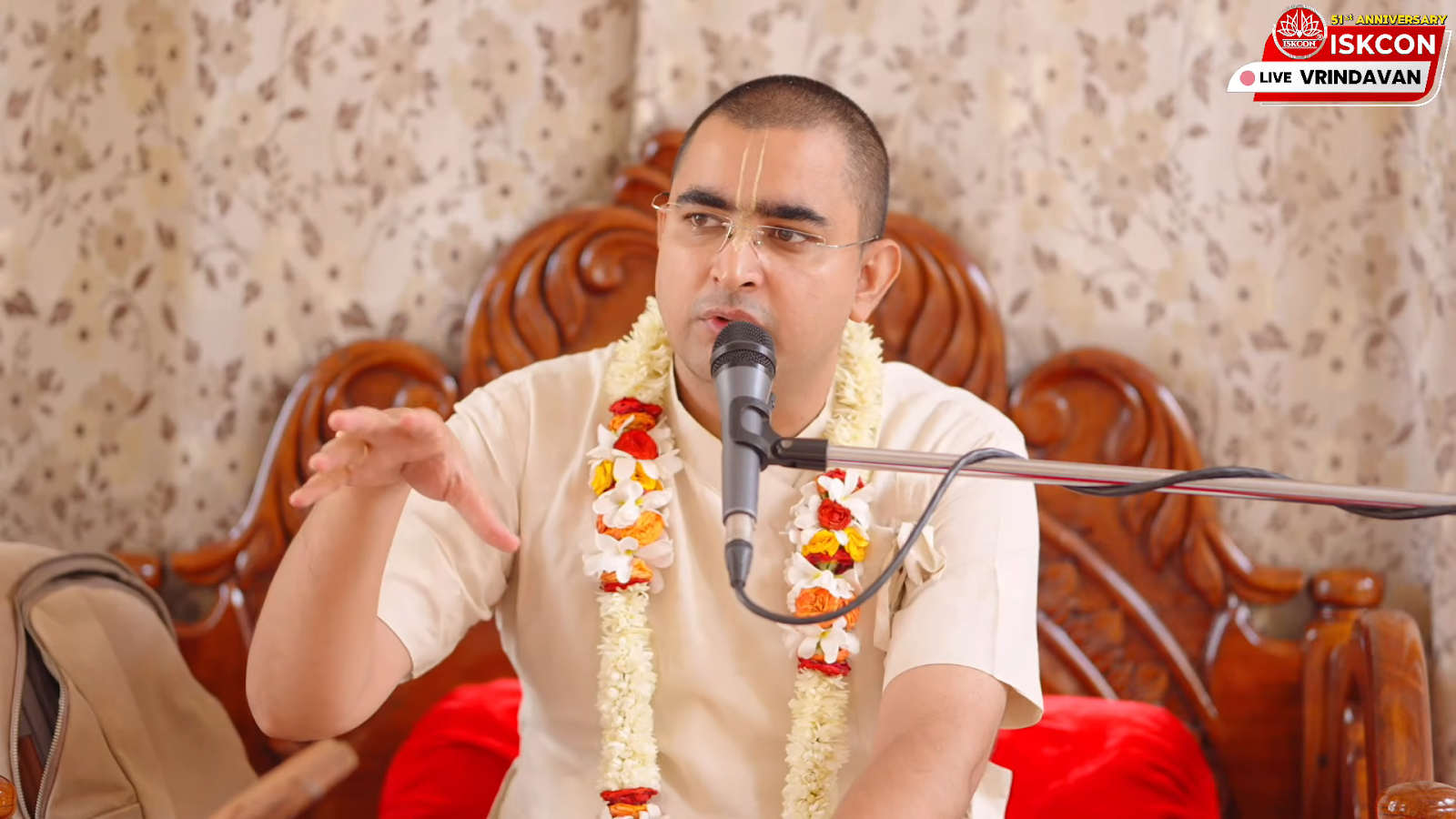
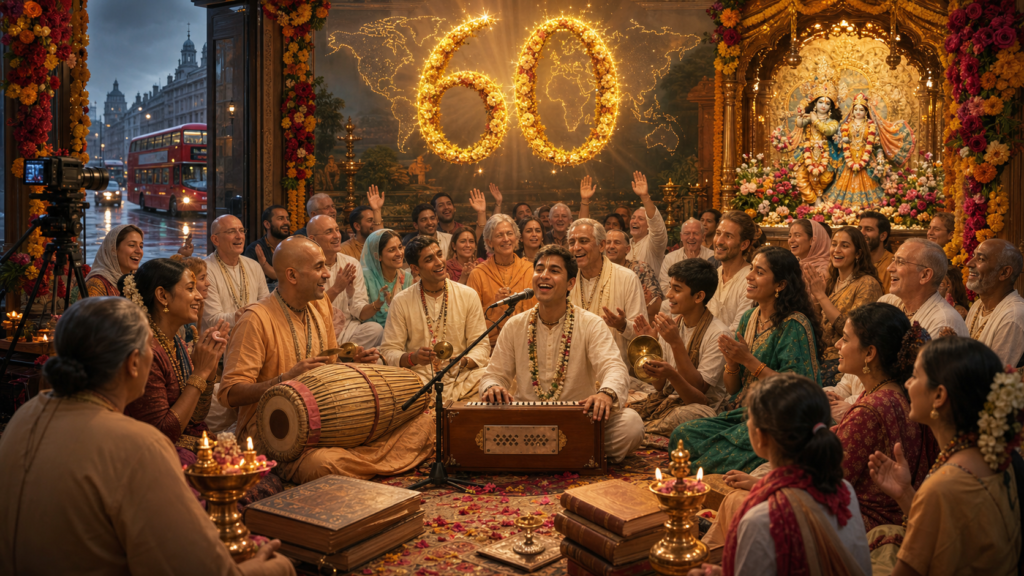
The supplied record identifies a teaching session titled His Grace Rupanuga Bhakta Prabhu || CC Ādi-līlā – 05.41 || 13-06-2026. At its center stands a compact verse with an unusually large theological reach. CC Ādi-līlā 5.41 names Vāsudeva, Saṅkarṣaṇa, Pradyumna, and Aniruddha as a second fourfold manifestation and immediately describes them as entirely beyond material contamination. Properly understood, the verse opens a technical discussion about divine personhood, spiritual plurality, transcendence, consciousness, and the position of Lord Nityānanda Balarāma within Gauḍīya Vaiṣṇava theology.
Editorial scope and source integrity. The supplied source contains a title, date, and still image, but it does not include a transcript, recording link, or substantive account of the discourse. Consequently, no undocumented statement is attributed here to His Grace Rupanuga Bhakta Prabhu. This article instead offers a researched exposition of CC Ādi-līlā 5.41, its immediate literary context, and the principal doctrinal questions raised by the verse. This distinction preserves both scholarly accuracy and respect for the named speaker.
The verse. vāsudeva-saṅkarṣaṇa-pradyumnāniruddha
‘dvitīya catur-vyūha’ ei — turīya, viśuddha
A concise translation. “Vāsudeva, Saṅkarṣaṇa, Pradyumna and Aniruddha constitute this second quadruple. They are purely transcendental.” This translation and the accompanying word analysis appear in the Bhaktivedanta Vedabase edition of CC Ādi-līlā 5.41. Although the statement is brief, each of its key expressions carries technical significance within Caitanya Caritamrita, Gauḍīya Vaiṣṇava philosophy, and the wider Pañcarātra tradition.
The grammatical movement. The first compound joins four divine names without pausing to narrate separate biographies. The expression dvitīya catur-vyūha identifies them collectively as the second ordered group of four. The final pair, turīya, viśuddha, governs how the entire statement is to be interpreted: these manifestations belong to the transcendent domain and are free from material impurity. The verse therefore names, classifies, and protects its subject from a materialistic reading in only two lines.
Placement within Chapter Five. The fifth chapter of Ādi-līlā is devoted to the glories and ontological identity of Lord Nityānanda Balarāma. Within the chapter’s Gauḍīya framework, Śrī Caitanya Mahāprabhu is identified with Kṛṣṇa and Lord Nityānanda with Balarāma, Kṛṣṇa’s first personal expansion. The chapter then traces a theological sequence from Kṛṣṇa and Balarāma through the catur-vyūha manifestations, Nārāyaṇa, Mahā-Saṅkarṣaṇa, and the puruṣa forms associated with cosmic creation. The complete chapter overview makes clear that verse 5.41 is one link in this carefully arranged argument rather than an isolated catalogue of names.
The primary quadruple. Earlier in the chapter, CC Ādi-līlā 5.23–24 describes Kṛṣṇa’s manifestations in Mathurā and Dvārakā and identifies Vāsudeva, Saṅkarṣaṇa, Pradyumna, and Aniruddha as the primary quadruple forms. Verse 5.24 already emphasizes that the four are purely transcendental. This first group supplies the conceptual basis for the later reference to a second group. Without that earlier passage, the word dvitīya, meaning “second,” would remain unexplained.
The second quadruple. CC Ādi-līlā 5.40 places a further manifestation of the four around Nārāyaṇa in the spiritual sky. Verse 5.41 then gives their names, while verses 5.42–48 concentrate especially on Mahā-Saṅkarṣaṇa. In that sequence, Mahā-Saṅkarṣaṇa is described as the shelter of the spiritual energy, the support of the jīvas, and the source or shelter of the puruṣa through whom the material cosmos is manifested and withdrawn. Verse 5.48 finally connects this Mahā-Saṅkarṣaṇa to Nityānanda Balarāma. The verse under study is therefore a bridge between the theology of Vaikuṇṭha and the chapter’s central glorification of Lord Nityānanda.
A relational map rather than a temporal timeline. The sequence may look like ordinary cause and effect when represented in a straight line: Kṛṣṇa, Balarāma, the primary catur-vyūha, Nārāyaṇa, the second catur-vyūha, Mahā-Saṅkarṣaṇa, and the puruṣa manifestations. Gauḍīya theology does not, however, treat these divine forms as products manufactured at successive moments. The language of manifestation describes relationships of source, form, function, and devotional intimacy. It is an ontological ordering, not a claim that an incomplete deity gradually produces other incomplete beings.
What catur-vyūha means. Catur means “four,” while vyūha can indicate an arrangement, ordered formation, or structured deployment. In this theological setting, catur-vyūha denotes an ordered fourfold manifestation of the one divine reality. Translating it merely as “four gods” would distort its purpose, because the tradition affirms both the distinct identity of each form and their full participation in divinity. Translating it as an abstract set of four principles would also be inadequate, because the forms remain personal and worshipful.
Why dvitīya matters. The adjective dvitīya does not imply that the second quadruple is spiritually inferior, less complete, or contaminated. It marks position within the chapter’s architecture. The first catur-vyūha is associated with Kṛṣṇa’s Dvārakā manifestations; the second appears in relation to Nārāyaṇa and Vaikuṇṭha. Difference of placement and function is therefore affirmed without introducing a difference in spiritual purity. This is precisely why the verse closes with turīya and viśuddha.
The technical force of turīya. The word turīya literally carries the sense of “the fourth” and is well known from Upaniṣadic discussions of the reality beyond waking, dream, and deep sleep. In CC Ādi-līlā 5.41, its immediate function is to designate transcendence beyond the material modes. The familiar Upaniṣadic resonance can illuminate the term, but it should not be used to erase the verse’s own Vaiṣṇava context. Here transcendence is not presented as featureless absence; it belongs to personal, spiritually complete forms.
The meaning of viśuddha. Viśuddha means thoroughly pure or wholly free from contamination. The following verses connect this purity with viśuddha-sattva, pure spiritual existence. Material sattva, or the mode of goodness, still operates within conditioned nature alongside passion and ignorance. Viśuddha-sattva is not simply an unusually calm psychological mood or a refined material condition. In this theological vocabulary, it refers to existence under the internal spiritual potency, untouched by the mixture and instability of the three material guṇas.
Four names, one coordinated theology. Vāsudeva, Saṅkarṣaṇa, Pradyumna, and Aniruddha also appear as personal names in Kṛṣṇa’s Dvārakā narratives. The catur-vyūha doctrine does not reduce them to a historical family tree. It reads those names at an ontological level, where each indicates a complete divine manifestation with a distinct relational or cosmic emphasis. The narrative and theological levels can coexist, but they should not be confused.
Vāsudeva and lucid consciousness. Vāsudeva occupies the central position in many presentations of the fourfold manifestation. In Śrīmad-Bhāgavatam 3.26.21 and its Gauḍīya commentary, the term is associated with clear consciousness and a state in which divine reality can be understood without the interference of passion or ignorance. This correspondence is devotional rather than merely cognitive. Clarity is valued because it makes recognition, remembrance, and service possible; it is not treated as an end detached from relationship with the divine.
Saṅkarṣaṇa and the power of integration. The name Saṅkarṣaṇa suggests drawing together or gathering. Scriptural and commentarial treatments associate this form with integration and withdrawal, the principle of identity, and the shelter of living beings. In CC Ādi-līlā Chapter Five, Mahā-Saṅkarṣaṇa receives particular emphasis because the chapter is tracing the expansions of Balarāma and, ultimately, Lord Nityānanda. Saṅkarṣaṇa is not equated with an ordinary jīva or material ego; rather, the tradition describes him as the divine ground or presiding reality related to those categories.
Pradyumna and intelligence. Several Vaiṣṇava commentarial systems correlate Pradyumna with intelligence, discernment, and the ordered capacity by which purposes become intelligible. This does not mean that Pradyumna is merely a poetic label for the human brain. The correspondence moves in the opposite direction: finite intelligence is understood as dependent upon a higher, personal source of order. For a practitioner, the association gives ethical weight to discernment, since intelligence is meant to clarify truth and guide responsible action rather than rationalize impulse.
Aniruddha and the mind. Aniruddha is frequently associated with mind, the senses, governance, and maintenance. Śrīmad-Bhāgavatam 3.26.28 connects Aniruddha with the mind and with mastery of the senses. Again, the language is not a reduction of a divine person to a psychological mechanism. It presents the mind as a dependent faculty that becomes stable when oriented toward its transcendent ground. The association gives contemplative discipline a relational and devotional structure.
Correspondence is not reduction. Texts and commentaries sometimes vary in the order of the four names or in their detailed correspondences with consciousness, identity, intelligence, mind, and cosmic functions. Those variations caution against constructing an overly rigid chart. The shared principle is more important: the psychological and cosmic domains are not independent of divine order, yet divine personhood cannot be exhausted by them. Vāsudeva is not simply consciousness, Saṅkarṣaṇa is not simply ego, Pradyumna is not simply intellect, and Aniruddha is not simply mind.
Unity without indistinction. One of the verse’s deepest questions concerns how four genuinely distinguishable persons can remain one in divine status. Gauḍīya Vaiṣṇava theology answers by distinguishing material division from spiritual manifestation. A material object divided into parts becomes smaller, and the original quantity is depleted. A divine manifestation, by contrast, is held to remain complete even when complete forms become manifest from it. Distinction therefore need not mean rivalry, fragmentation, or unequal divinity.
Neither arithmetic polytheism nor empty sameness. The catur-vyūha is not presented as a council of four independent supreme beings competing for sovereignty. Nor does the tradition regard the four names and forms as disposable appearances without enduring significance. Their unity is a unity of spiritual nature, potency, and purpose; their distinction allows relationship, service, and līlā. This structure is compatible with the wider Gauḍīya grammar often summarized as acintya-bhedābheda, inconceivable simultaneous difference and non-difference, although that formula is not explicitly stated in verse 5.41 itself.
Expansion does not mean manufacture. The English word “expansion” can misleadingly suggest spatial inflation, biological reproduction, or the construction of a later product. The Sanskrit theological vocabulary is more relational. Forms may be described as prakāśa, manifestation, or vilāsa, a form associated with divine play and relational differentiation. Such language permits priority of source without imposing material birth, decay, or loss upon the manifested form.
Spiritual qualities and divine personhood. The purport to CC Ādi-līlā 5.41 devotes substantial attention to whether transcendence must be devoid of qualities. Its Vaiṣṇava conclusion is that material limitation should be denied, but spiritual form and spiritual qualities should not. Knowledge, beauty, strength, compassion, and relational activity are not treated as defects imposed upon the Absolute. They are understood as intrinsic expressions of divine fullness when freed from material limitation.
The six opulences. The surrounding commentary discusses knowledge, wealth, strength, fame, beauty, and renunciation as the classical six opulences associated with Bhagavān. Verse 5.44 relates these spiritual attributes to Saṅkarṣaṇa’s opulence. Their coexistence is theologically significant: unlimited possession is balanced by complete renunciation, power by knowledge, and majesty by beauty. Divine fullness is therefore not raw power. It is a coordinated perfection in which no attribute becomes distorted through deficiency or selfishness.
Completeness without depletion. The purport invokes the traditional teaching that the complete whole remains complete even when complete manifestations proceed from it. This principle offers the conceptual key to the catur-vyūha. The relation is not comparable to clay losing a portion of itself when a pot is formed, nor to a parent producing a numerically separate child through a material body. The model claims a mode of spiritual causality in which manifestation reveals plenitude rather than consuming a finite resource.
Cross-textual foundations. The four names are not unique to Caitanya Caritamrita. Śrīmad-Bhāgavatam 1.5.37 places them together in a mantra of praise, while Śrīmad-Bhāgavatam 6.16.18–19 invokes them in a contemplative prayer associated with Nārada and Citraketu. These passages demonstrate that the catur-vyūha vocabulary belongs to a broader Vaiṣṇava scriptural network. Kṛṣṇadāsa Kavirāja Gosvāmī is organizing and interpreting inherited material within a specifically Gauḍīya account of Kṛṣṇa, Balarāma, Caitanya, and Nityānanda.
The Pañcarātra setting. The catur-vyūha is especially important in Pañcarātra, a major Vaiṣṇava ritual and theological tradition preserved through numerous saṁhitās. Pañcarātra integrates metaphysics with worship: divine manifestations are not speculative entries in a catalogue but personal forms approached through mantra, consecrated images, temple liturgy, meditation, and disciplined service. This practical setting explains why exact distinctions matter. Theology guides worship, while worship gives theology an embodied form.
An intra-Hindu debate. A.C. Bhaktivedanta Swami Prabhupāda’s purport discusses Śaṅkarācārya’s interpretation of Brahma-sūtra 2.2.42–45 and defends the Pañcarātra understanding of the quadruple forms. It draws particularly upon Śrīla Rūpa Gosvāmī’s Laghu-bhāgavatāmṛta and also cites Rāmānuja’s Śrī-bhāṣya. The central issue is whether the language of manifestation implies temporal production, inequality, or contradiction, and whether divine qualities compromise transcendence. The Vaiṣṇava response is that these forms are eternal, equally spiritual, and related through inconceivable divine potency rather than material causation.
Reading disagreement responsibly. The purport employs the strong polemical language characteristic of premodern and confessional debate. An academic presentation should accurately report that voice without turning it into hostility toward Advaita Vedānta or its practitioners. Advaita and Vaiṣṇava schools often assign different meanings to words such as nirguṇa, form, causality, and ultimate unity. Respectful comparison identifies those differences instead of pretending that every school teaches the same doctrine. Dharmic unity becomes more durable when disagreement is studied with precision, intellectual fairness, and restraint.
Why Lord Nityānanda is central. Chapter Five does not introduce the catur-vyūha merely to satisfy cosmological curiosity. Its larger purpose is to disclose the glory of Lord Nityānanda Balarāma. The chapter identifies Balarāma as Kṛṣṇa’s first personal expansion and links Balarāma with Saṅkarṣaṇa, Mahā-Saṅkarṣaṇa, Śeṣa, and the puruṣa manifestations. Within this confessional structure, Lord Nityānanda is understood as the same Balarāma appearing beside Śrī Caitanya Mahāprabhu. Verse 5.41 supplies a crucial middle term in that chain of theological identification.
Service as the organizing principle. Balarāma and Nityānanda are described not only through metaphysical status but through service. Balarāma supports Kṛṣṇa’s pastimes, while Śeṣa serves through countless forms associated with divine residence and worship. Nityānanda assists Śrī Caitanya’s mission of divine compassion. This emphasis prevents ontology from becoming sterile hierarchy. Spiritual greatness is revealed through the capacity to support relationship, extend mercy, and make loving service possible for others.
A theological cosmography. Terms such as Goloka, Dvārakā, Vaikuṇṭha, the spiritual sky, Brahman effulgence, the Causal Ocean, and the material universes form a sacred map in Chapter Five. That map should be read according to its genre and purpose. It is a theological cosmography expressing degrees of manifestation, intimacy, and divine relationship; it is not a substitute for observational astronomy. Academic clarity neither dismisses the map as meaningless nor misrepresents it as a modern scientific diagram.
Transcendence and cosmic involvement. The chapter repeatedly insists that the divine source can sustain and enter cosmic processes without becoming conditioned by them. This distinction is essential to the words turīya and viśuddha. Supervision of material nature does not make the divine material, just as directing a process does not necessarily place the director under every limitation governing that process. The analogy is imperfect, but it clarifies the intended claim: divine immanence does not cancel divine transcendence.
Implications for sādhana. The fourfold doctrine encourages a practitioner to treat consciousness, identity, intelligence, and mind as entrusted faculties rather than private possessions without accountability. Clear consciousness supports remembrance; identity becomes less dominated by selfish appropriation; intelligence learns to discriminate between durable and temporary aims; and the mind becomes steadier through disciplined devotional attention. These applications do not replace the verse’s theology, but they show why technical metaphysics can matter in daily spiritual practice.
A caution about devotional psychology. The traditional correspondences should not be marketed as a clinical model or used to make unsupported medical claims. Anxiety, depression, trauma, or other mental-health conditions may require qualified professional care. The verse offers a sacred anthropology and contemplative orientation, not a diagnostic manual. Its practical value lies in cultivating attention, humility, ethical discernment, and relationship with the divine while respecting the legitimate scope of medicine and psychology.
A disciplined method of study. A careful reader can approach CC Ādi-līlā 5.41 in five movements without turning the passage into a checklist. First comes accurate recitation and attention to the compound words. Next comes the immediate context of verses 5.23–48. The third movement compares Bhāgavata and Pañcarātra references. The fourth distinguishes tradition-specific theological claims from modern categories. The final movement asks how the teaching reshapes conduct, worship, and relationships. Such a method joins textual rigor with spiritual receptivity.
The human resonance of the verse. Many people experience inner life as a contest among scattered attention, unstable identity, impulsive desire, and uncertain judgment. The catur-vyūha should not be reduced to that struggle, yet its ordered vision can speak powerfully to it. The verse presents reality not as chaos at the highest level but as coordinated fullness. For a practitioner, that vision can evoke relief: coherence need not be manufactured through force, because disciplined spiritual life seeks alignment with an order understood to be deeper than the restless mind.
Humility before technical theology. The density of the verse discourages superficial certainty. A reader may memorize the four names while still missing the distinction between primary and secondary manifestations, material and spiritual causality, or symbolic correspondence and personal divinity. Genuine study therefore requires patience. Intellectual humility is not a refusal to reason; it is the recognition that inherited technical vocabularies deserve more than a hurried analogy or a sectarian slogan.
Dharmic unity without doctrinal erasure. The catur-vyūha is a specifically Vaiṣṇava teaching and should not be imposed as a common metaphysical formula upon every Hindu sampradāya, Buddhism, Jainism, or Sikhism. Constructive dharmic dialogue does not require artificial sameness. Hindu, Buddhist, Jain, and Sikh communities can meet through disciplined practice, compassion, non-harm, service, ethical self-examination, and respect for liberation-oriented traditions while retaining real differences concerning God, self, consciousness, and ultimate reality. Precision becomes a form of respect.
Common misunderstandings to avoid. The four forms are not four competing supreme deities; the second quadruple is not a defective copy of the first; spiritual manifestation is not ordinary biological generation; turīya should not be detached from its immediate Vaiṣṇava context; and the psychological correspondences should not be mistaken for exhaustive definitions. Avoiding these errors allows the verse to be read on its own terms while still inviting philosophical analysis.
The enduring insight. CC Ādi-līlā 5.41 presents transcendence as both unified and richly personal. Vāsudeva, Saṅkarṣaṇa, Pradyumna, and Aniruddha are distinct enough for relationship and ordered function, yet fully spiritual and undiminished in divine potency. Their placement in Chapter Five illuminates the Gauḍīya understanding of Lord Nityānanda Balarāma as the source of expansive service and support. The verse’s lasting benefit lies in joining metaphysical depth with a practical lesson: authentic spiritual fullness expresses itself through clarity, relationship, humility, and service rather than domination.
Research references. The principal online texts consulted for this exposition are CC Ādi-līlā 5.41, the complete fifth chapter of Ādi-līlā, Śrīmad-Bhāgavatam 1.5.37, Śrīmad-Bhāgavatam 3.26.21, Śrīmad-Bhāgavatam 3.26.28, and Śrīmad-Bhāgavatam 6.16.18–19. The session date retained from the supplied record is 13-06-2026.
Inspired by this post on Dandavats.







Leave a Reply
You must be logged in to post a comment.