
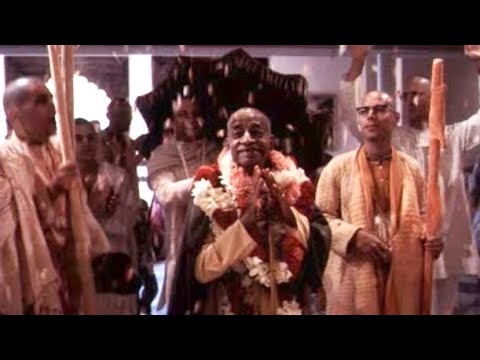

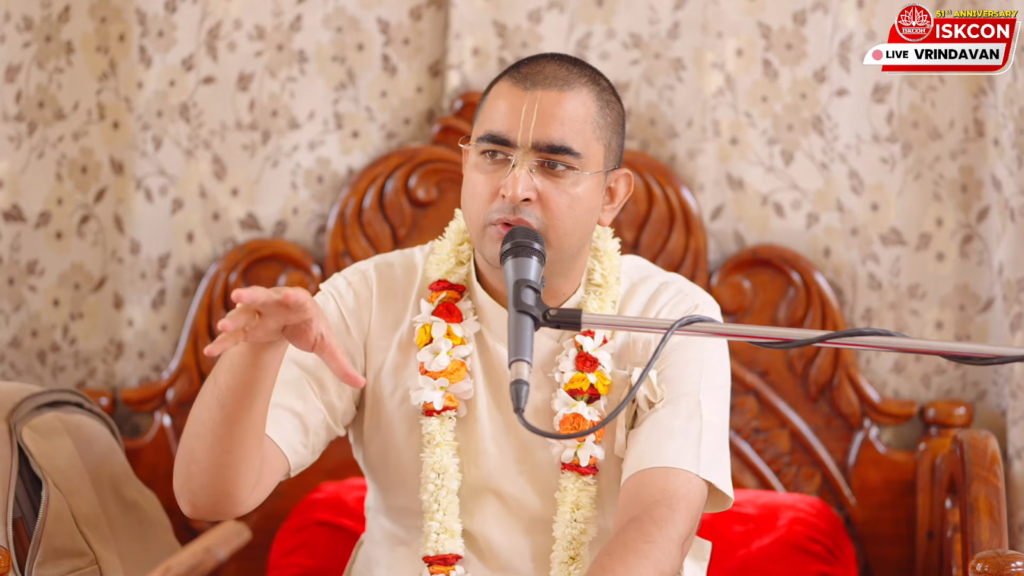
Presented on 12 July 2026, this featured video brings together comparatively rare photographs of Srila Prabhupada and the personal recollections of Her Grace Visakha Devi Dasi, one of the photographers who documented him during the formative years of the Hare Krishna movement. Its importance extends beyond nostalgia. The presentation functions as visual history, oral testimony and a study of spiritual leadership viewed through the experience of someone who repeatedly stood close enough to observe both public events and quiet, easily overlooked moments.
A witness with a photographer’s trained eye
Visakha Devi Dasi is not simply commenting on photographs made by someone else. Her relationship to this archive is direct: she helped create it. Trained in photography at the Rochester Institute of Technology, she developed technical expertise before encountering the Gaudiya Vaishnava tradition. Her early specialty book, Photomacrography: Art and Techniques, reflected an established interest in careful observation, close detail and disciplined visual composition. That background matters because professional photography demands more than operating a camera. It requires anticipation, sensitivity to light, awareness of human behavior and the ability to recognize significance before a fleeting moment disappears.
In March 1971, she travelled to Bombay after receiving an invitation from John Griesser, the photographer later known as Yadubara Dasa. He had gone to India while working on a graduate project about the Hare Krishna community. Visakha Devi Dasi’s preserved recollections indicate that she did not arrive as an unquestioning believer. Her initial outlook was cautious and shaped by a largely secular background. This detail gives her testimony particular depth: the relationship she describes developed through observation, sustained association and gradual intellectual and spiritual engagement rather than instant acceptance.
Her first meeting with A. C. Bhaktivedanta Swami Prabhupada took place in Bombay. She brought her photography book, and he examined it in the simple room where he was staying. What remained with her was not a theatrical display but an impression of calmness, courtesy and ease. The episode is revealing precisely because it is ordinary. Historical personalities are often remembered through major speeches and institutional achievements, yet character may become most visible in small interactions: the manner in which a visitor is received, the attention given to unfamiliar work and the atmosphere created in a room.
From documentary project to spiritual apprenticeship
Photography initially provided the reason for her presence in India, but it also became a path into a deeper encounter with bhakti. When she and Yadubara Dasa considered producing a photographic essay on Indian village life, Srila Prabhupada directed them toward Vrindavan. The resulting period of immersion exposed her to the sacred geography, devotional practices and everyday Vaishnava culture of the region. On 29 November 1971, during a ceremony in Vrindavan, she received initiation and the name Visakha. The transition did not erase her professional identity; it gave that identity a new purpose.
She subsequently photographed Srila Prabhupada and his communities in India, Europe and the United States. This geographical range makes the visual record historically valuable. The photographs do not document an isolated teacher in a single cultural setting. Collectively, they trace a period in which a Krishna-centered devotional tradition moved across languages, nations and social environments. Temples, public festivals, private rooms, morning walks, rituals, conversations and journeys became parts of a transnational religious archive.
Why rarer photographs matter
The description “rarer” should be understood carefully. It need not mean that every image has never been published or seen before. It may instead identify photographs that have circulated less widely than the familiar portraits reproduced in books, temples and online collections. That distinction is important because uncommon frames can complicate an established visual memory. A well-known portrait often becomes an icon, while a less familiar photograph may restore movement, setting, sequence and human relationship.
A photograph is evidence, but it is never self-explanatory. It records what appeared within a particular frame at a fraction of a second, while excluding what stood beyond its edges and what happened immediately before or after the exposure. Visakha Devi Dasi’s commentary therefore adds essential context. The photographer can identify circumstances, explain why a position was chosen, describe an obstacle that had to be overcome and recall the emotional atmosphere that a silent image cannot preserve on its own.
The pairing of image and testimony also reveals how memory operates. A photograph can prompt details that remained dormant for decades: the arrangement of a room, the direction of a person’s gaze, the intensity of a kirtan or the concentration visible during worship. At the same time, responsible historical reading recognizes that recollection is situated. Memory interprets as well as retrieves. Its devotional standpoint should be acknowledged, neither dismissed as inherently unreliable nor treated as an exhaustive account of every event.
The technical discipline behind a devotional archive
The photographs belong to the era of film rather than instantaneous digital review. Film imposed finite exposures, physical processing and a delay between making an image and knowing whether it had succeeded. Changing light, moving subjects, crowded rooms and active ceremonies required rapid judgments about focus, timing and composition. A photographer could not casually produce hundreds of nearly identical frames and select one afterward. Each exposure involved material cost and the possibility that an unrepeatable moment might be lost.
Those constraints help explain the concentrated attention behind the surviving images. The photographer had to watch patterns of gesture, anticipate movement and remain close without disrupting worship or conversation. This balance is especially delicate in religious documentation. The camera must be present enough to preserve history, yet restrained enough not to turn a sacred act into a performance for the lens.
Within bhakti, Visakha Devi Dasi understood photography as seva, or service. That understanding transformed technical labor into an act of preservation and communication. Her broader recollections describe occasions when access was difficult or a clear view was blocked. Her response was not merely to secure a privileged position for herself, but to recognize that the resulting image could allow people far beyond the immediate gathering to witness the event. The camera thus became a bridge between a local moment and a global audience.
What the memories reveal about Srila Prabhupada
Across Visakha Devi Dasi’s preserved accounts, several qualities recur: attentiveness, spiritual concentration, practical judgment, personal encouragement and an ability to redirect difficulties toward constructive service. These traits emerge through episodes rather than abstract praise. She recalls the care with which he performed worship, the focus he gave to the Deities rather than to the people watching him and the undivided attention he offered even when a disciple brought him a comparatively small editorial question.
Such details complicate the modern assumption that leadership is primarily a matter of public visibility. Srila Prabhupada’s public achievements were substantial, but these memories emphasize presence: the capacity to attend seriously to the person, duty or sacred object immediately before him. In this account, authority was communicated not only through lectures and institutional decisions but also through listening, observation, correction and encouragement.
Visakha Devi Dasi also recalls feeling supported in her photographic service. This is historically relevant because her work required mobility, confidence and access to spaces in which expectations about gender could create practical barriers. Her testimony presents Srila Prabhupada’s encouragement as a source of protection and resolve. The photographs are therefore evidence not only of their subject but also of the agency of the woman behind the camera.
Placing the presentation in historical context
Srila Prabhupada travelled from India to the United States in 1965 and established the International Society for Krishna Consciousness in New York in 1966. During the following years, he taught Gaudiya Vaishnava theology, translated and commented upon major Sanskrit texts, established communities and encouraged public practices such as kirtan, scriptural study and prasadam distribution. His international mission developed during a period of rapid cultural change, when many young people were questioning inherited assumptions about religion, society and the purpose of life.
Photography, film, audio recording and print publishing were integral to the transmission of that mission. These media preserved a teacher’s physical presence while carrying teachings and practices beyond the limits of a single place. Visakha Devi Dasi’s contribution belongs to this broader history of modern religious communication. Her photographs helped establish the visual vocabulary through which later generations would recognize Srila Prabhupada and understand the early international development of ISKCON.
The presentation should therefore be approached as a focused primary-source encounter rather than a complete biography. Its strength lies in proximity. It allows one participant to explain what she noticed while documenting a spiritual teacher whom she knew personally. Broader historical questions—dates, institutional developments, parallel testimonies and publication histories—can then be studied alongside that account.
How to read the photographs closely
Careful viewing begins by separating observation from interpretation. A viewer may first note visible facts: posture, facial expression, direction of gaze, distance between people, objects in the room, architectural setting and the distribution of attention within the frame. Interpretation follows only afterward. A lowered gaze, for example, may suggest concentration, but its meaning becomes more secure when supported by the photographer’s account, the known occasion and adjacent images from the same sequence.
Background details deserve particular attention. Clothing, microphones, vehicles, temporary stages, devotional objects and the composition of a crowd can reveal how the movement operated materially. These elements place spiritual memory within social history. They show that religious transmission depends not only on ideas but also on travel, translation, domestic hospitality, public gathering, publishing, food preparation and the work of many visible and invisible participants.
The emotional effect of the photographs will differ by audience. Devotees may experience them as aids to remembrance and darshana, while historians may treat them as documents of modern Gaudiya Vaishnavism. Viewers unfamiliar with ISKCON may encounter a spiritual teacher less as a distant institutional figure and more as a person moving through specific relationships and environments. These readings need not exclude one another. A photograph can carry devotional, historical and aesthetic significance at the same time.
A lesson in attentive remembrance
The presentation offers a broader lesson about memory in an age of overwhelming digital imagery. Vast numbers of photographs are now produced, shared and forgotten with little contextual information. Visakha Devi Dasi’s work demonstrates the value of preserving authorship, date, location, sequence and personal testimony. Without such metadata, an image may remain visually powerful while losing much of its historical meaning.
Her example also makes the discipline of attention relatable beyond photography. Meaningful service often begins with noticing what others overlook: a subtle gesture, an unmet need, a moment of hesitation or a task that must be completed without recognition. The memories associated with these photographs suggest that spiritual formation can occur through repeated acts of careful observation, responsibility and perseverance rather than through dramatic experience alone.
Bhakti and respectful Dharmic dialogue
Gaudiya Vaishnavism represents a distinctive Krishna-centered bhakti tradition within the diverse landscape of Hindu thought and practice. Its theology should be understood on its own terms, just as Buddhism, Jainism and Sikhism possess their own histories, doctrines and disciplines. Genuine Dharmic unity does not require these traditions to be collapsed into a single system. It becomes more credible when differences are studied accurately while shared commitments—ethical self-discipline, compassion, service, remembrance and the search for liberation—support respectful dialogue.
Viewed in that spirit, Visakha Devi Dasi’s presentation is more than an internal recollection from one community. It is a case study in how a living tradition preserves lineage, transmits memory and uses modern technology without abandoning devotional intention. It also demonstrates how personal testimony can connect institutional history with the intimate experience of learning from a guru.
A practical way to watch
The video rewards more than one viewing. A first viewing can follow the narrative without interruption, allowing the photographs and memories to establish their emotional and historical rhythm. A second can focus on visual evidence, including composition, setting, gesture and the relationship between foreground and background. Dates, locations and names can then be compared with archival captions or other firsthand accounts. This method preserves the immediacy of personal testimony while adding the care required for responsible historical study.
Rare photographs should also be handled ethically. Photographer credit, original captions and contextual information should remain attached whenever images are reproduced. Heavy cropping, aesthetic alteration or circulation without provenance may unintentionally distort the record. Preservation is not merely the storage of files; it is the maintenance of the relationships that make those files intelligible.
Ultimately, the enduring power of this presentation comes from the meeting of two forms of attention: the photographer’s attention to a fleeting visible moment and the disciple’s attention to the character and teachings of her spiritual guide. Visakha Devi Dasi’s photographs preserve surfaces—faces, places, gestures and gatherings—while her memories provide depth. Together, they offer later generations a carefully framed encounter with Srila Prabhupada, the early Hare Krishna movement and the demanding yet deeply human work of turning remembrance into spiritual service.
Research note: Biographical and historical context has been cross-checked against the School of Bhakti profile of Visakha Dasi, Vanipedia’s preserved collection of her firsthand recollections and the original featured video linked above.
Inspired by this post on Dandavats.


Leave a Reply
You must be logged in to post a comment.