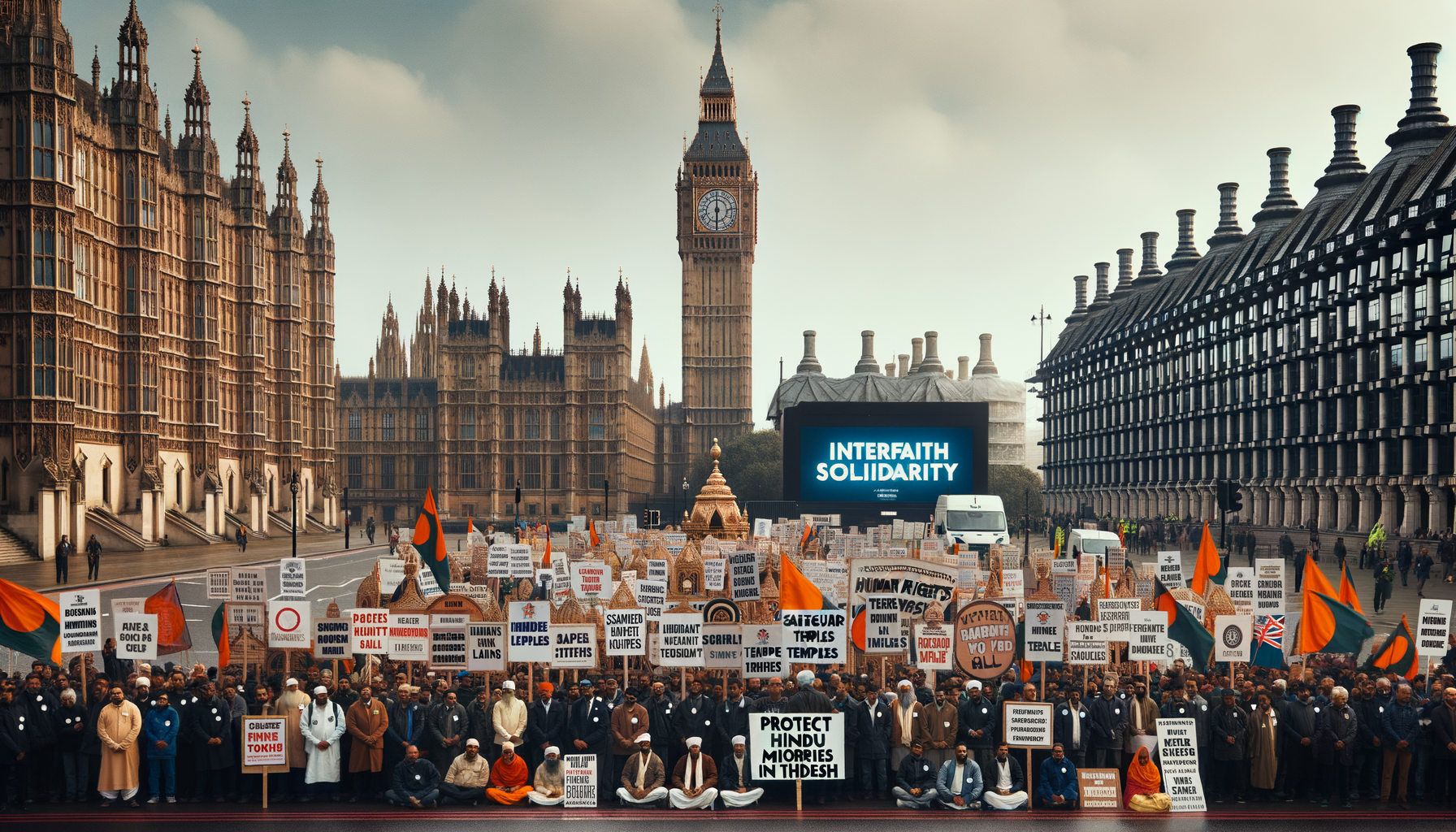
Outside the UK Parliament in Westminster, a peaceful and highly visible protest brought together members of the British Hindu and Bangladeshi diaspora, alongside interfaith allies, to call for decisive action to protect Hindu minorities in Bangladesh. Participants urged the Labour government to apply diplomatic pressure on Dhaka to safeguard temples, end targeted violence described by organisers as genocide, and uphold universal human rights standards. The gathering emphasised unity across dharmic traditionsHindu, Buddhist, Jain, and Sikhframing protection of minorities as a moral imperative rooted in pluralism and nonviolence.
Chants, placards, and coordinated messaging underscored a consistent set of demands: protect places of worship, prevent further attacks, and ensure accountability through fair and transparent legal processes. Observers noted a tone of sober resolve rather than partisanship, with many expressing concern for family and community members in Bangladesh. For the wider South Asian diaspora, the event resonated as a call to defend religious freedom and communal harmony across borders.
Former Labour MP Virendra Sharma said: “I am urging the British government and all those forces who always work for human rights to protect the interests of the minorities in Bangladesh. – Naomi Canton” His remarks reflected the protest’s broader framing of the issue as one of minority rights and rule-of-law protections, rather than a sectarian dispute.
A digital van circled Parliament Square, displaying messages that highlighted the persecution of Hindus in Bangladesh and the need for urgent redress. Visuals from the processionshared widely on social mediaamplified the protest’s core themes: safeguarding temples, preventing mob violence, and supporting interfaith coexistence.
Several short videos recorded on-site captured interviews with participants and scenes of peaceful crowd management. These clips conveyed the emotional weight of the moment, as attendees described fear, loss, and a desire for dignity and security for families and communities in Bangladesh. For many, the protest represented both an expression of solidarity and a principled appeal to international norms of human rights and minority protections.
Context from recent public discourseincluding parliamentary mentions, civil society briefings, and worldwide vigilshas reinforced the urgency of the situation. Reports shared by activists, students, and human rights advocates reference killings, sexual violence, and desecration of temples, calling for independent investigations and consistent prosecution of perpetrators. While terminology and emphases vary, a common objective emerges: to uphold the safety, rights, and cultural heritage of Hindus and other minorities in Bangladesh in line with international law.
Participants reiterated that advocacy for Bangladeshi Hindus is inseparable from a broader commitment to dharmic unity and interfaith harmony. By centring compassion and accountability, the protest framed its aims as protective rather than adversarialseeking a Bangladesh where diverse communities, including Hindu, Buddhist, Jain, Sikh, and Muslim citizens, can live free from fear. The appeal to the British government was therefore cast as a request for principled diplomacy: to encourage sustained human rights dialogues, institutional safeguards, and community-level confidence-building that preserve pluralism and peace.
Inspired by this post on Hindu Human Rights Blog.