
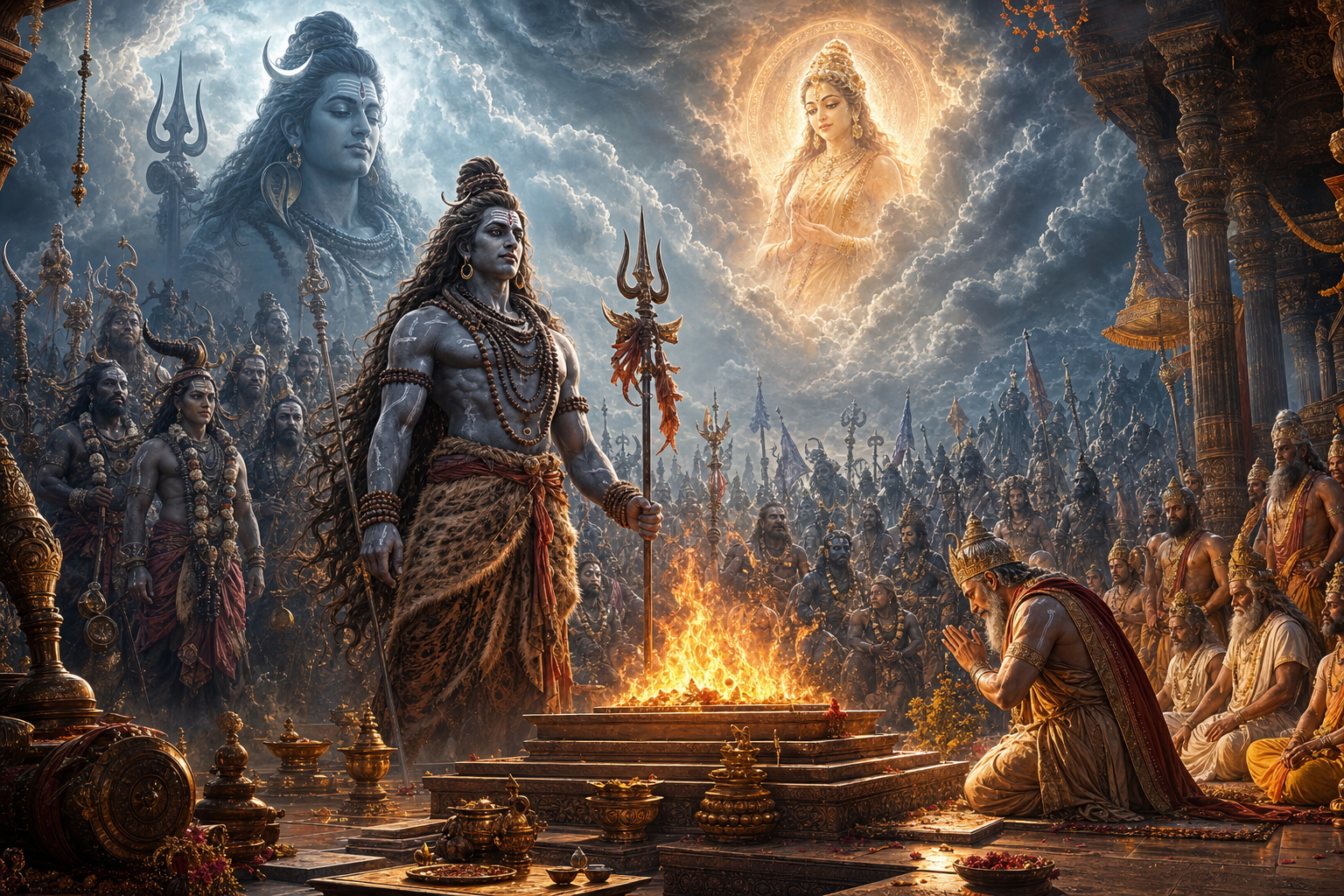
Rudra-formed ganas in Daksha Yajna belong to one of the most intense and theologically rich episodes in Hindu sacred literature. The narrative is remembered not merely as a story of destruction, but as a profound teaching on humility, dharma, ritual integrity, devotion, and the spiritual danger of pride. In this episode, Daksha’s yajna becomes the stage on which the limits of external ritual are exposed when reverence, truth, and spiritual maturity are absent.
The episode is most famously associated with the conflict between Daksha Prajapati, Sati, and Lord Shiva. Daksha, a powerful progenitor and ritual authority, organizes a grand sacrifice but deliberately excludes Shiva. This exclusion is not a minor social insult in the sacred narrative; it represents a deeper metaphysical disorder, because Shiva is not merely a deity among deities but the principle of dissolution, transcendence, tapas, and supreme consciousness. A yajna that rejects such a principle becomes outwardly grand yet inwardly incomplete.
Sati, the daughter of Daksha and consort of Shiva, attends the sacrifice despite Shiva’s caution. Her arrival reveals the moral fracture at the heart of Daksha’s ritual world. Instead of receiving her with affection and dignity, Daksha continues his contempt toward Shiva. Sati’s anguish is not presented as ordinary emotional hurt alone; it is the pain of seeing adharma dressed in ritual authority. Her self-immolation, described in various Puranic traditions with theological variation, marks the collapse of a sacred order that had already been hollowed out by ego.
When news of Sati’s death reaches Shiva, the narrative turns from grief to cosmic fury. Shiva’s anger is not depicted as uncontrolled rage in the ordinary human sense. It is divine correction, a force that arises when sacred balance has been violated. From this fury emerges Virabhadra, the terrible warrior manifestation of Shiva, often described as born from Shiva’s matted locks or from the concentrated energy of his wrath. Alongside Virabhadra appear hosts of ganas, bhutas, pramathas, and fierce beings who embody Rudra-like force.
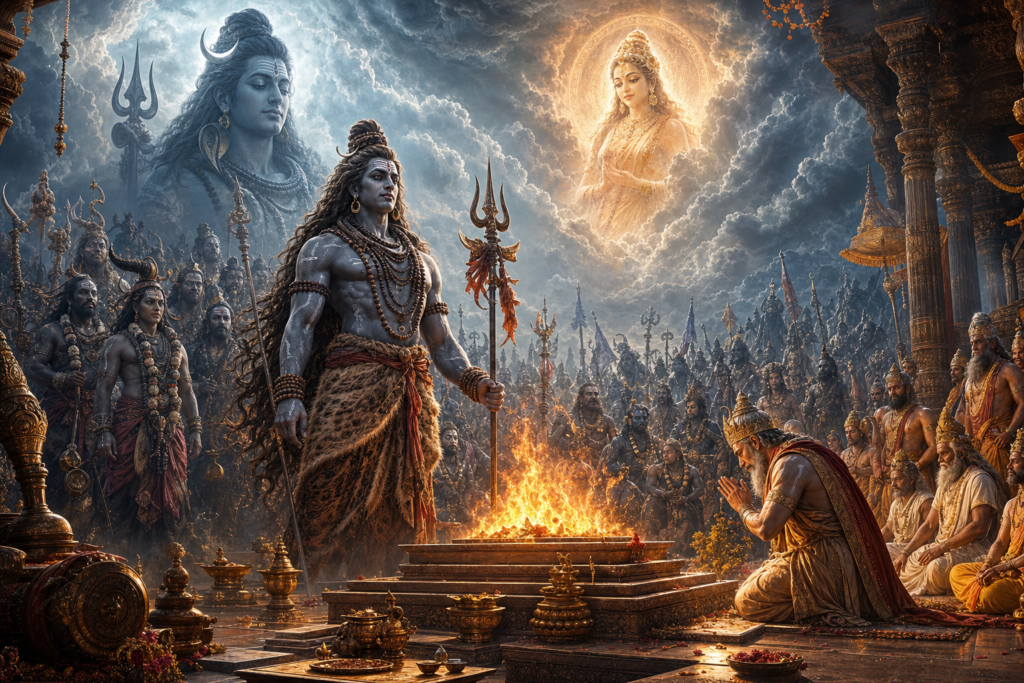
The phrase “thousands of ferocious ganas in the form of Rudras” captures the atmosphere of this sacred episode. In Shaiva imagination, the ganas are not decorative attendants. They are liminal, powerful, unpredictable, and spiritually charged beings associated with Shiva’s domain beyond conventional social order. When they take on Rudra-like forms, they become instruments of cosmic severity. Their terrifying appearance expresses the truth that dharma is not always gentle in its corrective form.
Rudra, in Vedic and Puranic thought, carries layered meanings. Rudra is fierce, healing, storm-like, ascetic, and compassionate in a paradoxical way. The same power that terrifies also cures; the same force that dissolves also liberates. Therefore, the Rudra-formed ganas at Daksha’s yajna should not be reduced to a violent army. They represent the manifestation of a sacred law: when pride corrupts sacrifice, when ritual becomes an instrument of exclusion, the divine order responds by breaking the false structure.
Virabhadra’s arrival at the yajna is described with martial and cosmic imagery. The sacrificial arena, filled with priests, deities, ritual fires, offerings, chants, and social hierarchy, is suddenly confronted by beings who do not submit to the arrogance of the assembly. This contrast is essential. Daksha’s ritual represents formal orthodoxy without humility, while Shiva’s ganas represent the wild, uncontained power of the sacred that cannot be domesticated by status or pride.
The destruction of the yajna, therefore, is not a rejection of yajna itself. Hindu scriptures do not present sacrifice, worship, mantra, or sacred discipline as meaningless. Rather, the episode teaches that ritual must be aligned with reverence, sincerity, and dharma. A yajna performed with ego, contempt, and spiritual blindness becomes spiritually defective. The ganas destroy not sacrifice as a principle, but sacrifice emptied of sacred consciousness.
This distinction matters deeply for the interpretation of Hindu rituals. The Daksha Yajna episode does not encourage hostility toward ritual tradition; it protects ritual tradition from becoming mechanical, arrogant, or exclusionary. The sacred fire is not honored by offerings alone. It is honored by humility, truthfulness, proper intention, and recognition of the divine in its many forms. Daksha’s failure lies in mistaking ritual authority for spiritual superiority.
In several Puranic tellings, the ganas attack the sacrificial space with terrifying energy. They disturb the rites, defeat guardians, punish participants, and shatter the proud confidence of Daksha’s assembly. Symbolically, this is the breaking of a false cosmos. The yajna had claimed to represent order, but because it excluded Shiva and dishonored Sati, it had become a ritualized disorder. The ferocity of the ganas reveals the hidden instability already present within the sacrifice.
Daksha’s beheading is one of the most memorable details of the episode. In theological terms, the head often represents identity, pride, speech, judgment, and command. Daksha’s head, the seat of arrogance and contempt, is removed. Later, when the cosmic order is restored, Daksha is revived with the head of a goat in many versions of the narrative. This restoration is not mere humiliation; it is transformation. The proud sacrificer survives only after being remade through consequence.
The goat-head motif also has ritual significance because the goat is associated with sacrificial symbolism in ancient ritual contexts. Daksha, who presided over sacrifice with pride, becomes marked by the very sacrificial order he mishandled. The image is stark and instructive. A person who treats dharma as possession rather than responsibility becomes subject to the corrective power of dharma itself.
Sati’s role must also be treated with seriousness. She is not a passive figure in the narrative. Her anguish, protest, and self-offering expose the moral emptiness of Daksha’s conduct. As Shiva’s consort, she represents Shakti, the living energy without which consciousness does not manifest. The insult to Shiva is inseparable from the dishonoring of Shakti. The collapse of the yajna follows from the dishonoring of both transcendence and sacred feminine power.
The later rebirth of Sati as Parvati completes the theological arc. The story does not end in destruction. It moves toward renewal, reunion, tapas, and the reestablishment of divine harmony. This is central to Shaiva thought: dissolution is not nihilism. Shiva’s destructive power clears the field for restored balance. The ganas who terrify the ritual assembly are part of a larger cosmic process in which disorder is exposed, purified, and ultimately transformed.
The ganas themselves deserve careful attention. In popular imagination, they are often described as Shiva’s attendants, but their role is much deeper. They stand at the boundary between the civilized and the wild, the formal and the ecstatic, the visible and the invisible. Their presence around Shiva indicates that the divine includes beings and energies that society may marginalize, fear, or fail to understand. Shiva’s retinue is a theological statement about radical sacred inclusion.
This inclusive dimension has great relevance for the unity of dharmic traditions. Hinduism, Buddhism, Jainism, and Sikhism differ in doctrine, practice, and metaphysical emphasis, yet they share a civilizational respect for inner discipline, ethical conduct, spiritual humility, and the overcoming of ego. The Daksha Yajna narrative can be read in that wider dharmic spirit. Pride, contempt, and rigid superiority fracture sacred life; humility, reverence, and self-correction restore it.
In this sense, the Rudra-formed ganas are not merely mythic warriors. They are symbols of the forces that arise when sacred order is violated by arrogance. Every tradition recognizes such a pattern in its own language. In Hindu thought it may be expressed through Rudra, Shiva, Shakti, and dharma. In Buddhist language, one may speak of the consequences of ignorance and ego-clinging. In Jain thought, one may reflect on passions that bind the soul. In Sikh wisdom, haumai, or ego-centeredness, is recognized as a major spiritual obstacle. The shared insight is clear: pride corrupts the path.
The academic study of the Daksha Yajna episode also shows how Hindu sacred literature works through layered symbolism rather than simple moralism. Daksha is not merely a villain; he represents a type of religious authority that has lost humility. Shiva is not merely an offended deity; he represents the transcendent reality that cannot be excluded from sacred life. Sati is not merely a victim; she is the force of truth that refuses to normalize insult and adharma. Virabhadra and the ganas are not merely destroyers; they are agents of divine correction.
The story also contains a warning for communities. Religious life can become vulnerable when status overtakes sincerity. A temple, yajna, scripture recitation, pilgrimage, vrata, or philosophical debate can all become spiritually weakened if they are driven by vanity. The Daksha Yajna episode insists that sacred practices must remain connected to compassion, reverence, and self-restraint. Without these, even the most elaborate ceremony can become spiritually fragile.
For devotees of Lord Shiva, the episode has an emotional depth that goes beyond textual analysis. It touches the experience of seeing the misunderstood ascetic, the one outside conventional honor, vindicated by cosmic truth. Shiva is often depicted as dwelling in cremation grounds, covered in ash, surrounded by beings who do not belong to polished society. Yet he is Mahadeva, the great deity, the inner consciousness beyond appearances. Daksha’s error is the error of judging the sacred by social ornament rather than spiritual reality.
This makes the episode especially relevant in modern religious and cultural life. Communities still struggle with outward markers of respectability, hierarchy, and social approval. The story of Daksha and Shiva asks whether the sacred is being honored in substance or only in form. It encourages a more mature spirituality, one that respects tradition without becoming proud, protects ritual without becoming rigid, and honors diversity without losing discipline.
The Rudra-formed ganas also help explain why Shiva is called both auspicious and terrible. The name Shiva means auspicious, yet Shiva’s forms include Rudra, Bhairava, Virabhadra, and other fierce manifestations. This is not contradiction but theological completeness. Auspiciousness is not always soft. Sometimes the auspicious act is the destruction of falsehood, the breaking of pride, and the clearing away of corruption. The terrible form becomes compassionate when it restores truth.
In ritual theology, yajna is meant to sustain relationship: between humans and devas, between visible and invisible worlds, between duty and offering. Daksha’s yajna fails because relationship is broken. He invites many but excludes Shiva. He performs sacred action but violates sacred respect. The ganas’ attack reveals that a ritual universe cannot remain stable when it is built on deliberate dishonor. The divine cannot be manipulated by formal correctness alone.
The narrative also offers a subtle teaching on speech. Daksha’s insult is verbal, but its consequences become cosmic. Words in Hindu sacred thought are not trivial. Vak, mantra, blessing, curse, praise, and insult all carry power. The misuse of speech in a sacred assembly becomes a form of adharma. Sati’s response and Shiva’s fury both show that language directed toward the divine and toward devotees must be handled with responsibility.
Another important theme is the relationship between asceticism and household order. Daksha represents lineage, progeny, social structure, and sacrificial institution. Shiva represents renunciation, inwardness, cremation-ground wisdom, and transcendence. Hindu tradition does not ultimately reject either pole. Instead, it seeks integration. The conflict occurs when one pole despises the other. A healthy dharmic society needs both order and transcendence, both ritual and realization, both family life and tapas.
The restoration after the destruction is therefore crucial. Shiva’s wrath does not remain endlessly destructive. Daksha is revived, the gods are restored, and the cosmic order continues. The episode teaches accountability without eternal condemnation. Even Daksha, after severe consequence, is given the possibility of corrected understanding. This is consistent with the broader dharmic vision in which transformation remains possible after error.
The story’s emotional power comes from its movement through insult, grief, fury, destruction, repentance, and restoration. It is easy to focus only on the spectacular violence of Virabhadra and the ganas, but the deeper teaching lies in the restoration of truth. The ferocity is not the final message. The final message is that sacred life must be aligned with humility and reverence, and when it is not, correction becomes unavoidable.
From a Shaiva perspective, Virabhadra is a manifestation of Shiva’s protective force. He protects the dignity of Sati, the sanctity of devotion, and the truth that Shiva cannot be excluded from the cosmic order. His terrifying form is therefore not random aggression. It is focused, purposeful, and theological. The ganas who accompany him magnify this force, showing that the entire unseen retinue of Shiva responds when adharma enters the sacrificial field.
The term gana itself suggests a group, host, or collective. In Shiva’s context, it becomes a sacred community of unconventional beings under divine leadership. This idea carries a social and spiritual lesson. Those who appear outside elite norms may still belong deeply to the divine order. Shiva’s ganas are not excluded because they are strange; they are gathered, ordered, and sanctified by proximity to Mahadeva. Daksha’s polished assembly proves less spiritually aligned than Shiva’s fearsome retinue.
This reversal is one of the most powerful features of the narrative. The respectable assembly becomes the site of adharma, while the wild attendants become agents of truth. Hindu sacred literature frequently uses such reversals to challenge superficial judgment. The forest may hold wisdom; the ascetic may be greater than the king; the socially dismissed may be closer to the divine than the socially honored. Daksha Yajna belongs to this wider pattern of spiritual correction.
The episode also deepens the meaning of Shiva as Pashupati, lord of beings. Shiva’s lordship extends beyond the orderly and the refined. He is lord of devas, humans, animals, spirits, yogis, outcastes, ganas, and cosmic forces. In him, the boundaries of sacred belonging expand. The Rudra-formed ganas at Daksha’s yajna dramatize this expansive sovereignty. They are fierce because they belong to a deity who governs not merely polite ritual space, but existence in its totality.
In temple traditions, the memory of Virabhadra and the ganas often survives through iconography, local legends, and ritual imagination. Virabhadra may be shown armed, intense, and warrior-like, carrying the authority of Shiva’s wrath. Such imagery is not meant to encourage ordinary anger. It teaches that divine force is disciplined by dharma. Human anger easily becomes egoic, but divine wrath in sacred narrative is framed as the restoration of cosmic balance.
There is also a philosophical caution here. The human mind often tries to divide the divine into acceptable and unacceptable forms. Daksha accepts ritual grandeur but rejects Shiva’s ash-smeared transcendence. He accepts order but rejects dissolution. He accepts status but rejects humility. The story shows that reality cannot be edited according to social preference. The divine includes creation, preservation, dissolution, concealment, and grace.
This fivefold understanding is later central in many Shaiva traditions, where Shiva’s cosmic functions include srishti, sthiti, samhara, tirobhava, and anugraha. The Daksha Yajna episode particularly emphasizes samhara and anugraha: destruction and grace. The yajna is destroyed, but the world is not abandoned. Daksha is punished, but not erased. Sati’s body is lost, but Shakti returns as Parvati. What appears catastrophic becomes part of a larger movement toward restored sacred unity.
For readers seeking spiritual insight, the story may be approached as an inner allegory. Daksha represents the ego that performs good actions for recognition. The yajna represents spiritual practice. Sati represents the purity of devotion. Shiva represents inner consciousness beyond social validation. Virabhadra represents the fierce self-correction that arises when the soul can no longer tolerate hypocrisy. The ganas represent the many forces within life that dismantle false pride.
Such an inward reading does not replace the traditional narrative; it complements it. Hindu scriptures often operate on multiple levels: historical-sacred, ritual, theological, symbolic, psychological, and devotional. The Daksha Yajna episode remains meaningful because it speaks to all these levels at once. It is a cosmic event in sacred literature, a ritual warning, a devotional drama, and a psychological map of ego and correction.
The story also protects the dignity of devotion. Sati’s pain arises because love and reverence are mocked by arrogance. In many families and communities, sincere devotion may be misunderstood by those who value status more than spiritual depth. The episode affirms that devotion is not weakness. When devotion is insulted, the sacred order itself bears witness. The response may not always be immediate in ordinary life, but the principle remains: contempt toward sincere devotion corrodes the one who holds it.
At the same time, the episode should not be read as permission for sectarian hostility. Its purpose is not to elevate one community by insulting another, but to teach that no sacred path should be treated with contempt. This is especially important in a dharmic framework committed to unity among Hindu, Buddhist, Jain, and Sikh traditions. The lesson is humility before the sacred, respect for diverse spiritual expressions, and rejection of ego-driven exclusion.
The Daksha Yajna narrative therefore continues to matter because it addresses a recurring problem in religious life: the temptation to confuse external control with spiritual authority. Daksha controls the invitation, the ritual field, and the social order. Yet he does not control truth. Shiva, though excluded, remains cosmically present. The ganas, though uninvited, become the instruments through which truth enters the arena.
This is why the image of thousands of Rudra-like ganas is so powerful. It suggests that divine reality has innumerable ways of correcting imbalance. A single insult, when rooted in ego and directed toward the sacred, can call forth vast consequences. The number “thousands” conveys more than quantity; it evokes overwhelming force, cosmic scale, and the many-sided power of Rudra.
The episode is also a reminder that Lord Shiva’s compassion cannot be separated from his severity. He is Ashutosh, easily pleased by sincere devotion, yet he is also the one whose wrath burns through falsehood. This duality is not arbitrary. True compassion sometimes requires the removal of what harms the soul. In Daksha’s case, pride must be broken before recognition can arise.
In the end, the destruction of Daksha’s sacrifice is not a story about chaos triumphing over order. It is a story about deeper order correcting superficial order. Daksha’s yajna had the appearance of sacred structure, but Shiva’s intervention restored the moral and metaphysical foundation that the ritual had lost. The Rudra-formed ganas were terrible because the disorder they confronted was profound.
The enduring lesson is that dharma requires humility. Ritual requires reverence. Knowledge requires self-restraint. Power requires accountability. Devotion requires dignity. The Daksha Yajna episode, with its fierce ganas, Virabhadra’s wrath, Sati’s anguish, and Shiva’s terrible grace, remains a luminous teaching on what happens when sacred form is severed from sacred truth.
For contemporary readers, the narrative invites a careful self-examination. The question is not only whether Daksha was wrong, but where Daksha-like pride appears in personal, institutional, and communal life. Whenever spiritual practice becomes a display, whenever tradition becomes a tool of superiority, whenever another path is dismissed without understanding, the warning of Daksha Yajna becomes relevant again.
The Rudra-formed ganas should therefore be remembered with both awe and discernment. They are fierce, but their ferocity serves restoration. They destroy, but only what has become spiritually corrupt. They frighten, but their presence awakens humility. In the sacred memory of Daksha Yajna, they stand as the terrible army of Lord Shiva, reminding every generation that the divine is not flattered by grandeur; it is honored by truth.
Inspired by this post on Hindu Blog.








Leave a Reply
You must be logged in to post a comment.