
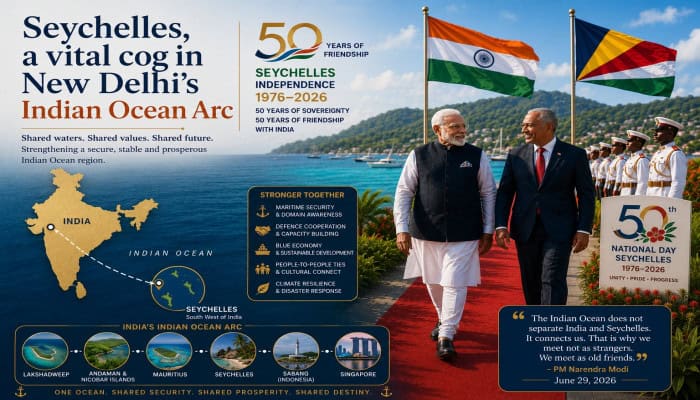
Seychelles occupies a far larger place in Bharat’s Indian Ocean strategy than its physical geography first suggests. With a land area of roughly 460 square kilometres and an Exclusive Economic Zone of about 1.3 million square kilometres, the archipelago illustrates a central truth of maritime geopolitics: small island states can hold vast strategic weight when they sit near critical Sea Lines of Communication, fisheries, undersea routes, energy flows, and blue economy zones.
Prime Minister Narendra Modi’s three-day visit to Seychelles from June 27 to June 29, 2026, therefore carried meaning beyond ceremonial diplomacy. The visit coincided with the 50th anniversary of Seychelles’ independence and 50 years of diplomatic relations between India and Seychelles. It also came at a time when the Indian Ocean Region is increasingly shaped by maritime security competition, supply-chain vulnerabilities, climate pressures, illegal fishing, narcotics trafficking, piracy risks, and the strategic behaviour of major powers.
The symbolism of the visit was evident in the reception by Seychellois President Patrick Herminie and Vice President Sebastien Pillay. Diplomatic ceremonies often appear formal from a distance, but in the Indian Ocean they carry practical significance. They signal trust, continuity, and a willingness to build partnerships that are not limited to defence transactions or episodic aid. In the case of India and Seychelles, the relationship rests on history, diaspora, maritime geography, development cooperation, and a shared interest in keeping the ocean stable, open, and respectful of sovereign equality.
That equality is essential. India’s approach to Seychelles has consistently required sensitivity because the two states are vastly different in population, military capacity, and economic scale. A serious India-Seychelles partnership cannot be built on the assumption that size determines dignity. It must be built on the recognition that Seychelles, like other island nations, brings sovereign agency, local knowledge, maritime jurisdiction, and regional legitimacy to the table. This is why the Indian doctrine of SAGAR, Security and Growth for All in the Region, has found relevance in the western Indian Ocean.
Seychelles’ strategic value begins with location. The islands lie in the western Indian Ocean, near maritime routes that connect the Persian Gulf, East Africa, the Mozambique Channel, the wider Indo-Pacific, and the approaches toward South Asia. Commercial shipping, energy flows, naval deployments, fishing fleets, and submarine cables all make this oceanic space more than an empty expanse. It is a dense operational environment where maritime domain awareness, legal enforcement, and diplomatic coordination are increasingly decisive.
For Bharat, Seychelles forms part of a larger maritime arc that includes the Arabian Sea, the island states of the western Indian Ocean, the East African littoral, Sri Lanka, Maldives, Mauritius, and the approaches to Southeast Asia. This arc is not simply a military map. It is a civilisational, commercial, security, and ecological geography. Ancient trade routes, Indian diaspora communities, temple networks, merchants, sailors, food traditions, and linguistic traces all form part of the deeper history that precedes modern statecraft.
The historical connection between Indians and Seychelles is often traced to the arrival of Indians on the Thelemaque at Saint Anne Island in 1770. Later migrations from Tamil Nadu, Gujarat, and other parts of Bharat strengthened commercial and cultural bonds. Over time, the Indian community became part of Seychellois society, contributing to trade, entrepreneurship, religious life, cuisine, and public culture. This people-to-people connection is not a decorative footnote; it is a living bridge that gives diplomacy social depth.
The emotional resonance of this connection is visible in ordinary cultural continuities. Food, language, family networks, festivals, and places of worship preserve memory in ways that formal treaties cannot. When Indian-origin families in Seychelles maintain links with Tamil, Gujarati, Hindu, Jain, Sikh, or broader Indic traditions, they also demonstrate how culture travels without requiring political domination. The most durable civilisational influence is often quiet, familial, and service-oriented.
This is also where Dharmic civilisational values can contribute positively to diplomacy. A Dharmic approach to external relations is strongest when it expresses sewa, mutual respect, restraint, dialogue, and reverence for plural traditions. In a multicultural island society such as Seychelles, cultural diplomacy should never become sectarian assertion. It is more effective when it strengthens harmony among communities and recognises that Hindu, Buddhist, Jain, Sikh, and other Indian-origin traditions have historically flourished through coexistence, adaptation, and ethical conduct.
The geopolitical importance of Seychelles is also tied to the blue economy. The country’s fisheries, marine biodiversity, tourism economy, coral reefs, and ocean resources are central to its national future. For an island state, maritime security is not an abstract defence concept; it is food security, environmental protection, coastal livelihood, climate resilience, and sovereign control over marine wealth. Illegal, unreported, and unregulated fishing can be as damaging to such a state as a conventional security threat.
India’s cooperation with Seychelles has therefore had a strong maritime security component. Over the years, India has assisted with patrol assets, coastal surveillance, hydrographic support, training, capacity building, and anti-piracy cooperation. Such measures matter because a vast EEZ cannot be effectively governed by political claim alone. It requires radar networks, patrol coordination, trained personnel, interoperable systems, legal procedures, and rapid information sharing.
The western Indian Ocean has already shown why this matters. Somali piracy in previous decades revealed how quickly maritime disorder can disrupt global trade. More recent concerns include narcotics routes, arms movement, grey-zone activity, illegal fishing fleets, and the vulnerability of undersea infrastructure. Seychelles, because of its location, can serve as a partner in building a layered maritime domain awareness network across the Indian Ocean Region.
At the same time, the partnership must remain carefully calibrated. The debate around Assumption Island in earlier years showed that strategic cooperation cannot ignore domestic sentiment in Seychelles. Any Indian security role in the islands must be transparent, mutually agreed, and firmly anchored in Seychellois sovereignty. For Bharat, this is not merely a diplomatic courtesy; it is a strategic necessity. Trust is the most valuable infrastructure in island partnerships.
Prime Minister Modi’s 2026 visit was widely reported as including discussions on development cooperation, maritime security, digital connectivity, and institutional collaboration. Reports also noted agreements such as an extradition treaty, the introduction of India’s Unified Payments Interface in Seychelles, and a line of credit for priority development projects. Such instruments reveal the broadening nature of India-Seychelles relations: the partnership is no longer limited to ships, patrols, or symbolic cultural events, but now extends into finance, digital infrastructure, governance, and legal cooperation.
Digital cooperation deserves particular attention. UPI’s expansion to Seychelles is not just a payments story. It reflects Bharat’s growing ability to offer Digital Public Infrastructure as a development partnership tool. For small states dependent on tourism, services, remittances, and international mobility, low-cost and interoperable digital payment systems can reduce friction in everyday economic life. If implemented with local regulatory care, such systems can strengthen people-to-people contact, tourism flows, and small business convenience.
Development finance is equally important. Lines of credit and project assistance can improve infrastructure, public services, and connectivity, but their value depends on execution, transparency, and local relevance. The Indian model must distinguish itself from extractive or debt-heavy patterns of external engagement. In Seychelles, successful development cooperation should be measured not by the scale of announcements alone, but by whether projects strengthen local capacity, environmental sustainability, and public trust.
The strategic environment around Seychelles also cannot be separated from China’s expanding Indian Ocean presence. Beijing’s commercial ports, naval access arrangements, infrastructure financing, and diplomatic outreach have changed the calculations of regional states. However, India’s response should not reduce Seychelles to a chessboard square in great-power rivalry. Island nations are not passive objects; they pursue multi-vector diplomacy to protect their interests. Bharat’s advantage lies in proximity, historical familiarity, diaspora trust, and a development style that can be more consultative if handled wisely.
This is why the language of partnership matters. When India treats Seychelles as an equal maritime neighbour rather than as a strategic outpost, it aligns its policy with both realism and civilisational ethics. Realism acknowledges the importance of SLOCs, maritime surveillance, naval access, and counter-piracy. Civilisational ethics insists that power must be restrained by respect, responsibility, and reciprocity. The combination is what can make Bharat’s Indian Ocean policy more durable than transactional competition.
Climate change is another decisive area. Seychelles is vulnerable to sea-level rise, coral bleaching, coastal erosion, extreme weather, and marine ecosystem stress. For island states, climate resilience is national security. India’s cooperation in renewable energy, disaster relief, early warning systems, coastal management, and resilient infrastructure can therefore deepen strategic trust. The Indian Ocean cannot be secure if its island societies are ecologically insecure.
Humanitarian assistance and disaster relief also form a natural pillar of cooperation. India’s naval and coast guard capabilities can support evacuation, medical assistance, emergency supplies, and post-disaster recovery across the region. In the Indian Ocean, the ability to respond quickly after cyclones, oil spills, maritime accidents, or public health emergencies is a form of soft power with hard security value. It reassures partners that India’s presence is beneficial in moments of vulnerability.
The visit’s ceremonial elements, including India’s participation in Seychelles’ 50th Independence Day celebrations, should be read in this wider context. Military contingents marching in a national celebration are not merely visual gestures. They represent institutional familiarity and defence confidence between two states. Yet the deeper message is that the Indian Ocean’s stability depends on cooperation between navies, coast guards, diplomats, development agencies, scientists, businesses, and diaspora communities.
Prime Minister Modi’s reported address to the National Assembly of Seychelles added another layer of significance. Parliamentary diplomacy matters because it speaks to a society beyond the executive branch. It acknowledges democratic institutions and public opinion. For India, which seeks to present itself as a responsible partner in the Global South, engaging the legislature of a small island democracy reinforces the idea that strategic cooperation must remain publicly intelligible and politically legitimate.
The phrase that the Indian Ocean is a shared home captures the emotional and strategic core of this relationship. A shared home requires security, but also care. It requires law enforcement, but also environmental stewardship. It requires economic opportunity, but also cultural respect. For Bharat and Seychelles, the ocean is not a barrier separating two unequal states; it is the medium through which history, trade, memory, and strategic responsibility converge.
Seychelles’ importance to Bharat should therefore be understood through four connected lenses. First, it is a maritime security partner located near vital routes. Second, it is a blue economy state whose oceanic jurisdiction far exceeds its landmass. Third, it is a cultural partner with deep Indian diaspora links. Fourth, it is a diplomatic partner whose support strengthens India’s credibility in the western Indian Ocean and the broader Indo-Pacific region.
The future of the partnership will depend on how well both sides translate symbolism into institutions. Regular maritime exercises, real-time information sharing, capacity building for Seychelles’ coast guard, climate-resilient infrastructure, educational exchanges, digital payment integration, health cooperation, tourism links, and cultural diplomacy can together create a dense network of trust. In maritime strategy, such density is often more useful than dramatic announcements.
Bharat’s larger Indian Ocean vision will also need to remain inclusive of other regional partners, including Mauritius, Maldives, Sri Lanka, Madagascar, Comoros, East African littoral states, and ASEAN-linked maritime economies. Seychelles is a vital node, but not an isolated one. Its value rises when it is connected to a wider architecture of regional stability, sustainable development, disaster response, and maritime law enforcement.
The India-Seychelles relationship thus demonstrates how modern geopolitics and older civilisational bonds can reinforce each other. Ships, radars, credit lines, treaties, and payment systems provide the technical framework. Diaspora memory, cultural familiarity, Dharmic respect for plurality, and the emotional warmth of shared history provide the social foundation. Neither dimension is sufficient on its own. Together, they make the partnership resilient.
In the decades ahead, Seychelles will remain central to any serious Indian Ocean strategy. Its small landmass should not obscure its oceanic reach, diplomatic agency, and strategic location. For Bharat, treating Seychelles as a trusted equal is both morally sound and geopolitically wise. The arc of the Bharatiya Ocean will be secure only when its island partners feel respected, empowered, and included in shaping the region’s future.
This analysis is informed by the original discussion at MyInd and contemporary reporting on the 2026 India-Seychelles engagement, including accounts from The Economic Times and The Times of India.
Inspired by this post on Hindu Post.









Leave a Reply
You must be logged in to post a comment.