
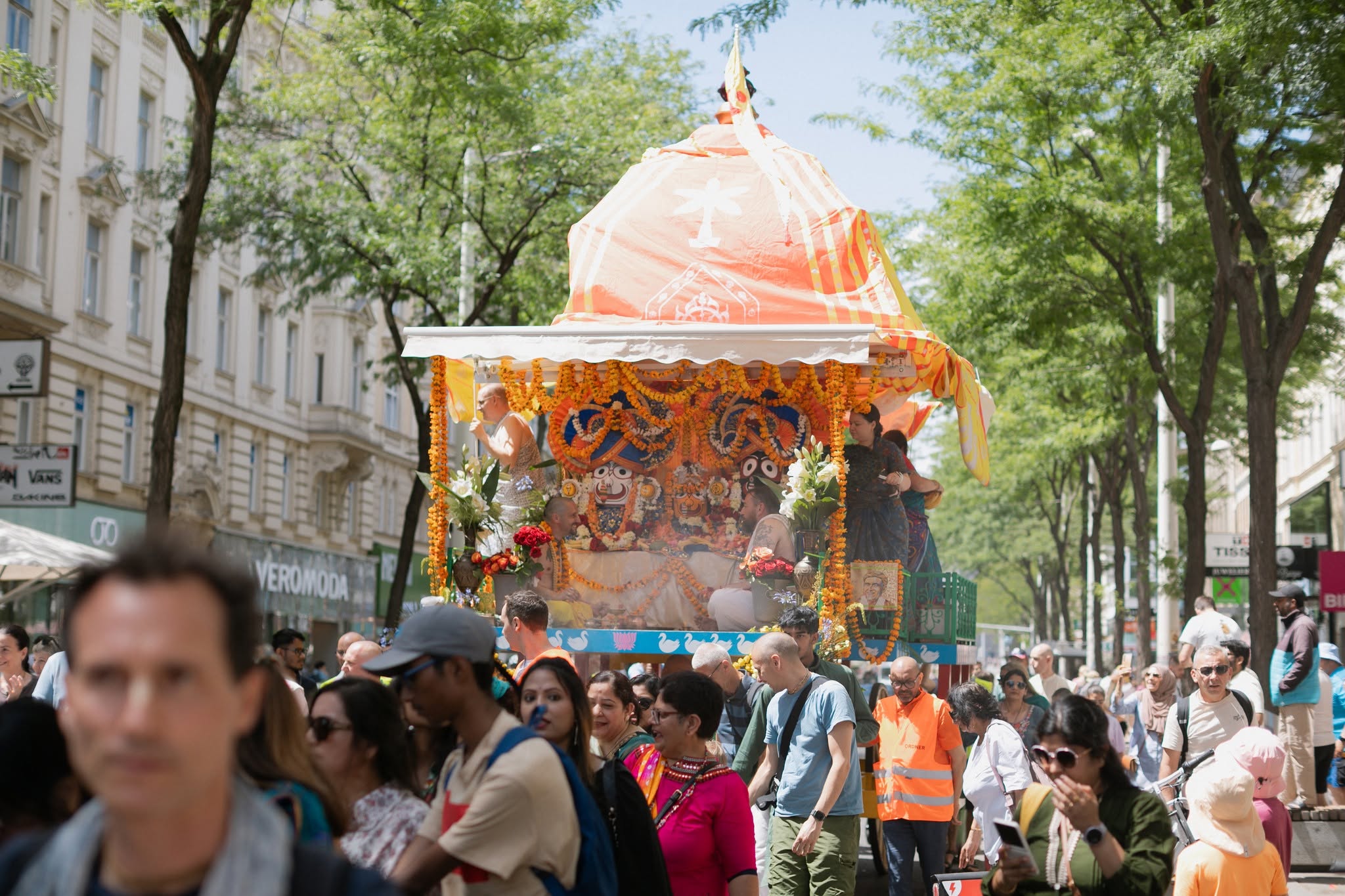
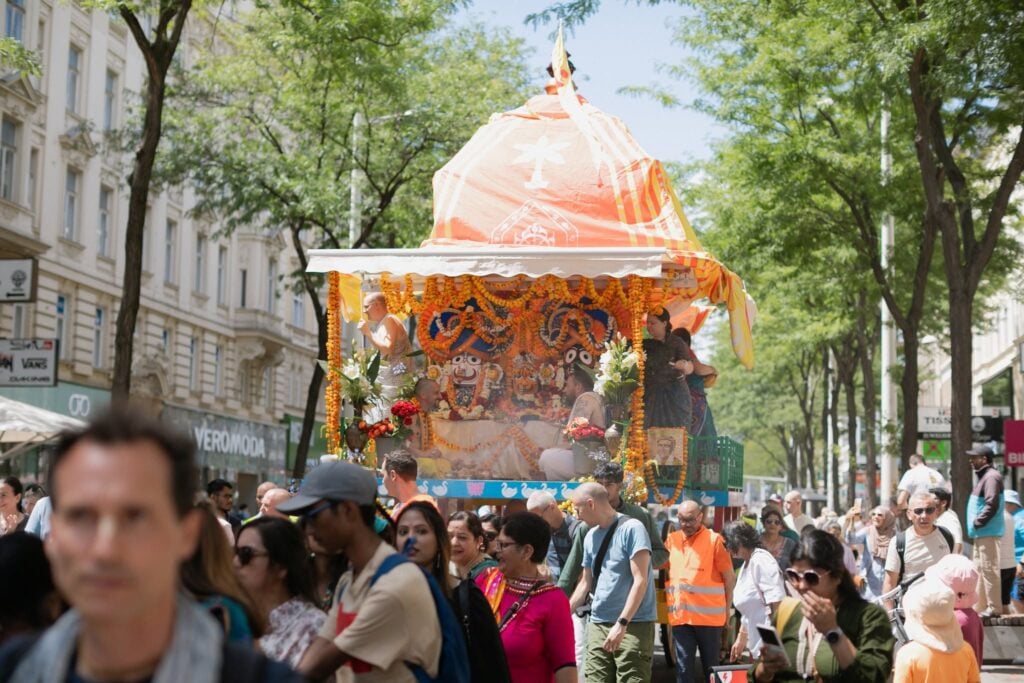
Ratha Yatra 2026 in Vienna, associated with Vedisches Zentrum Wien – ISKCON Vienna, stands as a significant example of how an ancient dharmic festival continues to find living expression in modern European public life. The original report records an extraordinary celebration marked by smiles, service, kirtan, and a joyful spirit. That brief description captures the emotional essence of the event, but the deeper significance of Ratha Yatra reaches much further: it is a public theology of movement, community, sound, service, and shared sacred memory.
Ratha Yatra, often translated as the Festival of Chariots, is most closely associated with Lord Jagannath of Puri in Odisha. In the Vaishnava tradition, Lord Jagannath is worshipped as a deeply compassionate form of Lord Krishna, accompanied by Baladeva and Subhadra. The movement of the chariot through the streets is not merely a procession; it is a symbolic act in which the divine comes outward, beyond the temple walls, toward the wider society. In that sense, Ratha Yatra is both ritual and invitation: it carries sacred presence into civic space and invites all people, regardless of background, to participate through sight, sound, service, and shared devotion.
The Vienna celebration reflects the global development of the Hare Krishna movement and the broader presence of Hindu spiritual traditions in the diaspora. ISKCON communities across the world have helped make Ratha Yatra recognizable in cities far removed from Puri, while retaining its central devotional grammar: the chariot, the sacred names, kirtan, prasadam, seva, and collective participation. In Vienna, these elements gain a distinctive local setting. A historic European city becomes, for a few hours, a moving sacred landscape in which devotional sound, public celebration, and intercultural encounter meet.
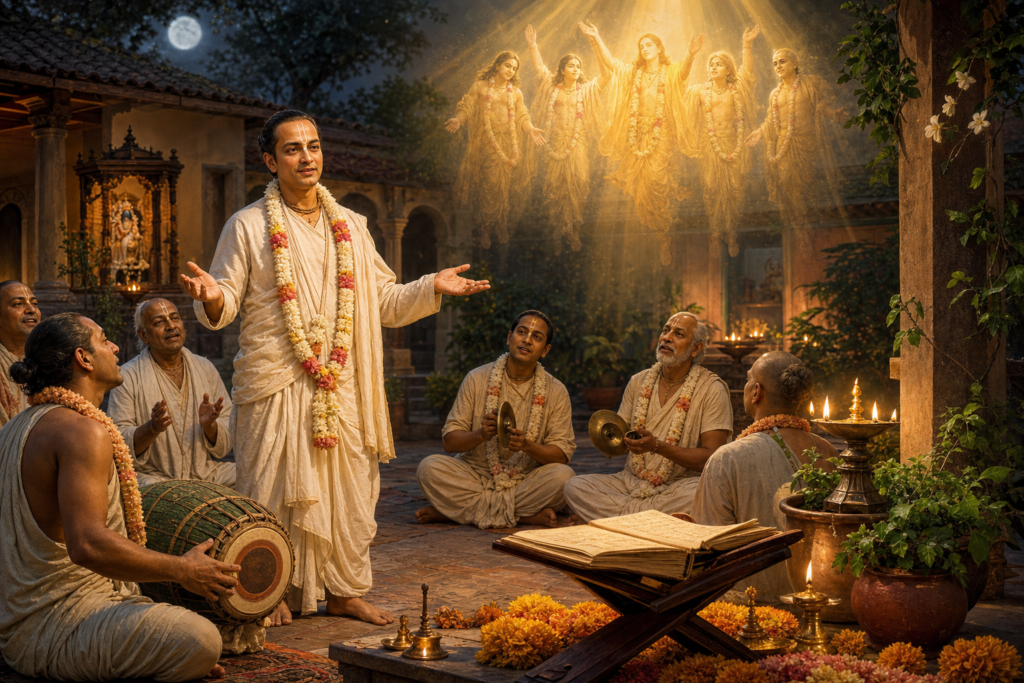
The importance of kirtan in such a festival cannot be overstated. Kirtan is not simply music used to decorate a religious event. In Gaudiya Vaishnavism, congregational chanting is a disciplined spiritual practice rooted in the theology of the holy name. The chanting of the names of Krishna and the public singing associated with sankirtana create a participatory field where devotion is shared rather than privately contained. For observers who may be unfamiliar with the tradition, the soundscape of Ratha Yatra often becomes the first point of encounter: cymbals, mridanga rhythms, call-and-response singing, and the steady repetition of sacred names form an accessible gateway into Krishna consciousness.
Service, or seva, forms the practical backbone of the festival. The source note rightly emphasizes the role of everyone whose service helped make the celebration special. A public Ratha Yatra depends on many forms of visible and invisible labor: organizing routes, preparing devotional offerings, decorating the chariot, coordinating volunteers, supporting musicians, welcoming guests, maintaining cleanliness, and ensuring that the event remains safe and orderly. From an academic perspective, this service structure reveals how devotional communities function as social institutions. They do not merely preserve belief; they organize cooperation, transmit values, and train participants in disciplined responsibility.
The chariot itself carries layered meaning. On the surface, it is the vehicle of the festival, the central visual focus around which the procession gathers. Symbolically, it represents the movement of the divine toward the human community. In many devotional interpretations, the ropes pulled by devotees become signs of relationship: the community does not command the divine, but participates in a reciprocal act of love and surrender. The chariot also transforms urban space. Streets normally defined by traffic, commerce, and routine become temporary corridors of worship, sound, and collective memory.
Ratha Yatra also has a distinctive social quality. Unlike many religious ceremonies that take place within a temple, monastery, gurudwara, vihara, or household shrine, this festival is deliberately public. It opens itself to passersby, families, children, students, elders, and visitors who may have no prior relationship with Hinduism or Vaishnava practice. This public character gives the festival a bridge-building function. It allows spiritual traditions to be encountered through hospitality rather than argument, through music rather than abstraction, and through shared joy rather than institutional distance.
In the context of a blog committed to unity among dharmic traditions, the Vienna Ratha Yatra offers an important model. While the festival is rooted in Vaishnava devotion to Lord Jagannath, its wider values resonate across Hindu, Buddhist, Jain, and Sikh traditions: disciplined service, sacred community, humility, compassion, reverence, and the public expression of spiritual life. Dharmic traditions differ in theology, ritual form, metaphysics, and historical development, yet they frequently converge around the cultivation of inner refinement and ethical responsibility. A festival such as Ratha Yatra can therefore be appreciated both as a specific Vaishnava celebration and as part of a broader dharmic culture of devotion, remembrance, and community care.
The emotional power of the Vienna celebration lies in its combination of discipline and joy. The original note mentions smiles and joyful spirit, which may appear simple at first glance. Yet in community religious life, such expressions matter. Joy is not an accidental by-product of the festival; it is one of its communicative forms. It shows that devotion is not only preserved in texts and doctrines but embodied in faces, gestures, songs, and shared labor. For many participants, these memories become part of their spiritual formation, especially for younger generations growing up in multicultural environments where inherited traditions must be made meaningful in daily life.
Vienna is a particularly meaningful setting for such a celebration because European cities increasingly function as meeting grounds for global religious traditions. Hindu festivals in Europe are no longer private cultural imports limited to immigrant communities. They are public expressions of living traditions that contribute to the religious, cultural, and civic diversity of contemporary society. When organized with care, Ratha Yatra demonstrates how a Hindu festival can be both faithful to its roots and open to the wider public. It becomes a form of cultural heritage in motion.
From a technical perspective, successful public festivals require more than devotional enthusiasm. They require coordination, permissions, crowd management, sound planning, volunteer training, transport logistics, food safety awareness where prasadam is distributed, and sensitivity to local civic norms. The smoothness of a festival is often the result of months of preparation that remains mostly unseen by casual attendees. This is why gratitude toward volunteers is not merely polite language. It recognizes the infrastructure of devotion: the many acts of preparation that allow sacred celebration to appear effortless.
The role of prasadam, though not explicitly detailed in the brief source note, is traditionally central to ISKCON festivals and to the culture of Vaishnava hospitality. Prasadam means food that has been offered to Krishna and then shared. In public festivals, it becomes a theological and social practice at once. It expresses the idea that spiritual life is not separated from ordinary human needs, and it allows guests to experience hospitality in a tangible form. Alongside kirtan and the chariot procession, prasadam often becomes one of the most memorable aspects of Ratha Yatra for first-time visitors.
Ratha Yatra also challenges narrow assumptions about religion as purely private belief. The festival presents religion as embodied culture: music, movement, dress, food, ritual objects, public ethics, and collective memory. It also shows how Hindu traditions have historically integrated philosophy with celebration. Behind the visible procession stands a sophisticated theological world involving bhakti, divine accessibility, sacred sound, and the relationship between the individual soul and the Supreme. The public festival is therefore not a simplification of doctrine, but a popular and participatory form through which doctrine becomes lived experience.
The Vienna event also reveals the durability of diasporic religious identity. For devotees and well-wishers connected with Vedisches Zentrum Wien – ISKCON Vienna, Ratha Yatra is not only an annual festival but a renewal of belonging. It strengthens networks of friendship, service, and shared purpose. It allows participants to remember India’s sacred geography while standing in Austria’s urban landscape. This dual belonging is one of the defining features of modern dharmic communities abroad: they remain rooted in ancient traditions while learning to communicate those traditions in new languages, institutions, and public spaces.
The festival’s inclusive spirit is especially important. Ratha Yatra does not require every participant to possess advanced theological knowledge before joining the celebration. A person may begin simply by watching the chariot, hearing kirtan, accepting prasadam, or appreciating the atmosphere of devotion. This openness reflects a broad dharmic sensibility: spiritual life can be approached through many doors. Intellectual study, ritual discipline, music, food, pilgrimage, meditation, and service can all become pathways of transformation when guided by sincerity.
In this way, the 2026 Vienna celebration becomes more than a local community event. It becomes a case study in how Hindu festivals can sustain continuity without becoming static. The form is ancient, yet the setting is contemporary. The theology is rooted in Vaishnava tradition, yet the social impact reaches interfaith and intercultural audiences. The mood is joyful, yet the structure depends on disciplined seva. The festival is public, yet it invites inward reflection. These layered qualities explain why Ratha Yatra continues to inspire devotion across continents.
The gratitude expressed by Vedisches Zentrum Wien – ISKCON Vienna toward participants, volunteers, kirtan leaders, and the wider community is therefore deeply appropriate. A festival of this nature is never created by one person alone. It arises from shared intention, coordinated effort, and the willingness of many people to serve something larger than themselves. The remembered smiles, songs, and joyful moments are not incidental details; they are evidence of a community temporarily gathered around sacred purpose.
Ratha Yatra 2026 in Vienna should be understood as a meaningful contribution to the spiritual and cultural life of the city. It brought Lord Jagannath’s festival into a European public setting while preserving the central features of Vaishnava devotion: kirtan, seva, community, and joy. It also affirmed a broader dharmic message that remains urgently relevant in plural societies: sacred traditions can be practiced with conviction while remaining welcoming, generous, and open-hearted. In that balance of devotion and hospitality, the festival’s lasting significance becomes clear.
Inspired by this post on Dandavats.



Leave a Reply
You must be logged in to post a comment.