
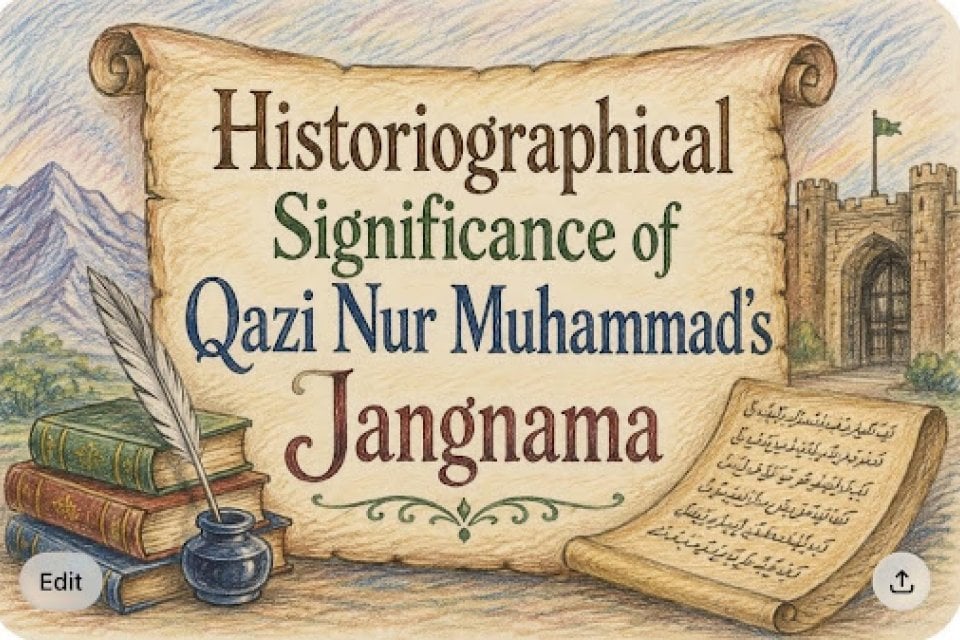
Qazi Nur Muhammad’s Jangnama occupies a demanding place in Indian historiography because it is not simply a war poem, a Persian chronicle, or a partisan account of an eighteenth-century campaign. It is all three at once. Composed in the turbulent decades after the Third Battle of Panipat, the text records the world of Ahmad Shah Durrani’s north Indian expeditions, the Baloch contingent associated with Nasir Khan of Kalat, and the rapidly rising power of the Sikh misls in Punjab. Its importance lies precisely in this tension: it speaks from within a hostile political and religious camp, yet it preserves evidence that later historians cannot ignore.
The term Jangnama means a narrative of war, and in the Persianate literary world such works combined eyewitness detail, courtly praise, moral judgement, religious vocabulary, and poetic convention. Qazi Nur Muhammad’s work must therefore be read with two habits at the same time. It should be read as testimony from a participant or near-participant in the 1764-1765 Durrani campaign, but it should also be read as a crafted text shaped by patronage, fear, loyalty, resentment, and genre. That double reading is what makes the work historiographically significant.
The historical background is essential. By the early 1760s the Mughal order in northern India had weakened severely, the Marathas had suffered a devastating blow at Panipat in 1761, and Ahmad Shah Durrani attempted to maintain influence over Punjab through military expeditions and appointed governors. Yet the Sikh misls were not a marginal force waiting to be noticed by imperial chroniclers. They had rebuilt after persecution, reorganized around flexible military networks, and used speed, local knowledge, and confederated leadership to contest Afghan authority. Jangnama captures this moment when imperial confidence confronted a resilient regional power rooted in faith, discipline, memory, and mobility.
For Indian history, the text is valuable because it records the transition from empire-centered politics to confederated regional assertion. The eighteenth century is often flattened into a story of decline: Mughal decline, Maratha setback, Afghan invasion, and British advance. Qazi Nur Muhammad’s account complicates that pattern. It shows Punjab as an active theatre where sovereignty was being renegotiated from below. The Sikh misls appear not as accidental raiders but as organized armed communities capable of frustrating a major transregional power. This is one reason the work matters to Sikh history, Indian historiography, and the wider study of post-Mughal state formation.
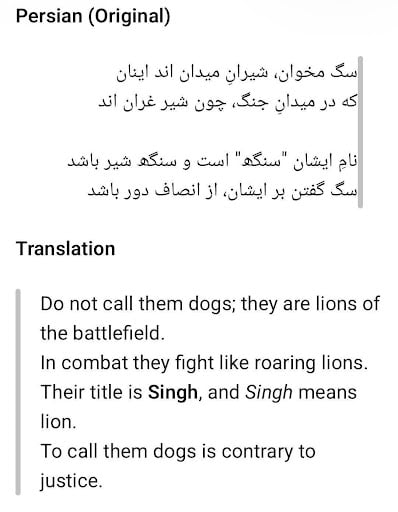
The most striking feature of Jangnama is its hostile admiration. Qazi Nur Muhammad used severe polemical language for the Sikhs, reflecting the religious and political prejudices of his milieu. Yet the same narrative also acknowledges their courage, discipline, and military competence. This makes the chronicle a classic example of the hostile witness in historical method. When praise appears inside a text that has no emotional reason to praise its opponent, historians treat that admission with special care. The admiration is not sentimental; it is extracted by experience. The battlefield forced recognition.
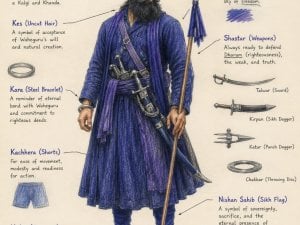
This feature is especially important for understanding Sikh martial ethics. Later Sikh memory often emphasizes courage, protection of the vulnerable, resistance to tyranny, and refusal to submit to oppressive power. A hostile Persian account cannot be treated as a Sikh devotional text, yet its observations help triangulate those traditions. Where the chronicle notes bravery, tactical coherence, and restraint, it becomes evidence from outside the community’s own self-description. Such evidence does not replace Sikh sources; it strengthens the historian’s ability to compare internal memory with external testimony.
The work also offers technical military data. It preserves glimpses of troop movement, battlefield positioning, river crossings, pursuit, ambush, baggage vulnerability, and the tactical pressures of campaigning across Punjab. The Durrani army represented a more conventional imperial formation, while the Sikh forces frequently exploited mobility and local terrain. The repeated pattern of advance, harassment, withdrawal, regrouping, and renewed pressure reveals why the Afghans could win engagements yet fail to impose durable control. Military history is not only about who held the field at sunset. It is also about supply, morale, pursuit, intelligence, and the ability to return after apparent defeat.

In that sense, Jangnama helps explain the strategic resilience of the Sikh misls. Their power did not depend on a single capital, a single royal household, or a single pitched battle. It grew through distributed leadership, sacred centers, mobile armed bands, revenue claims, local alliances, and the shared discipline of the Khalsa. To readers familiar with later state formation under Maharaja Ranjit Singh, the text offers a view of the earlier confederate phase: less centralized, often rougher, but already formidable. The Sikh Empire did not appear suddenly in 1799. It was preceded by decades of struggle, adaptation, and political experimentation.
The chronicle is equally important for the history of perception. Qazi Nur Muhammad saw the Sikhs through the categories available to him: religious opposition, political disorder, military threat, and moral shock. His language reveals how an eighteenth-century Persianate Muslim chronicler tried to make sense of a community that did not fit older imperial assumptions. The Sikhs were not merely rebels, not merely peasants in arms, and not merely local chiefs. They were a disciplined religious-political formation whose rise disturbed inherited hierarchies. The discomfort in the text is therefore evidence. It shows the strain placed on older political vocabulary by new realities.
At the same time, responsible reading requires caution. Jangnama is not a neutral archive. It contains exaggeration, emotional judgement, sectarian vocabulary, and the literary conventions of victory and lament. Numbers in such sources often need verification. Moral descriptions must be compared with other Persian, Punjabi, Sikh, Maratha, Afghan, and later colonial records. The historian’s task is not to accept or reject the text wholesale. The task is to ask what kind of truth each passage can carry: eyewitness detail, political anxiety, poetic ornament, communal prejudice, or reluctant observation.
This distinction is central to historiography. A biased source is not useless; it is useful in a different way. Bias tells the reader where power, fear, loyalty, and identity are located. When Qazi Nur Muhammad condemns the Sikhs, the condemnation reveals his ideological world. When he describes their battlefield effectiveness, the description reveals the pressure of events. When he frames the campaign in religious terms, the framing reveals how war was morally narrated in his circle. When modern readers separate these layers, the text becomes richer rather than poorer.
The work also has literary significance. It belongs to the Indo-Persian tradition at a time when Persian remained a major language of administration, elite culture, diplomacy, and historical writing across large parts of South Asia. Its poetic form should not be dismissed as decoration. Meter, metaphor, invocation, praise, denunciation, and lament shaped how events were remembered. In premodern and early modern historiography, poetry could function as record, argument, and emotional archive. Jangnama therefore reminds modern readers that historical knowledge in India was preserved not only in bureaucratic documents but also in verse, oral memory, religious literature, inscriptions, letters, and regional chronicles.
For the study of Punjab, the chronicle is a window into a frontier society under intense pressure. Punjab in this period was not a passive corridor for invaders. It was a contested civilizational zone where Afghan ambitions, Mughal residues, Sikh resurgence, local chieftaincies, agrarian society, sacred geography, and commercial routes intersected. The names of rivers, towns, forts, routes, and camps in such narratives are not incidental. They map the geography of power. They show how control of land depended on movement through doabs, access to supplies, and the ability to command or terrorize local populations.
The emotional force of the text comes from its proximity to violence. Eighteenth-century Punjab saw massacres, desecrations, plunder, reprisals, and repeated campaigns that devastated civilian life. A mature reading of Jangnama should not convert that suffering into communal hatred. It should instead deepen historical seriousness. The archive records conflict, but the purpose of studying conflict is not to reproduce inherited bitterness. It is to understand how communities endured, how ethical codes mattered under pressure, and how political violence shaped collective memory. This approach aligns with a broader dharmic commitment to truth, restraint, justice, and civilizational self-knowledge.
That point matters because the Sikh tradition is part of the wider family of dharmic civilizational experience while also possessing its own distinct theology, institutions, scriptures, and historical path. Reading Qazi Nur Muhammad’s account with respect for Sikh sovereignty of memory strengthens, rather than weakens, unity among Hindu, Sikh, Jain, and Buddhist traditions. Dharmic unity does not require erasing difference. It requires recognizing shared ethical concerns: defense of dignity, protection of sacred spaces, courage before oppression, reverence for truth, and the discipline to remember history without surrendering to hatred.
The chronicle also helps correct simplistic narratives about the eighteenth century. It was not merely an age of chaos before British order, a colonial trope that long distorted Indian historiography. It was an age of intense Indian political creativity. The Marathas, Sikhs, Jats, Rajputs, Mysore, regional nawabs, monastic orders, mercantile networks, and local warrior communities all participated in reworking power after Mughal decline. Jangnama records one fragment of that larger transformation. Its value increases when placed beside Marathi bakhars, Sikh rahit and historical texts, Persian chronicles, European travel accounts, revenue records, and regional oral traditions.
Modern historians such as Ganda Singh, Hari Ram Gupta, J. S. Grewal, and later scholars of Sikh and Afghan history have used such Persian sources carefully because they preserve details unavailable elsewhere. Yet modern use of Jangnama must avoid two errors. The first error is romantic extraction: taking only the passages that praise Sikh courage and ignoring the structure of the text. The second error is hostile literalism: repeating the polemical vocabulary as if it were objective description. The responsible method is contextual reading. The text should be mined for evidence, but its rhetoric must be marked as rhetoric.
One of the most useful questions to ask is why the Sikh forces appear so vividly in an enemy account. The answer is historical pressure. They were impossible to ignore. Their military presence disrupted plans, threatened baggage, challenged movement, and made occupation costly. Their political rise also signaled that sacred community could become a durable political actor. This was not only a military development; it was a transformation in the relationship between faith and power. The Khalsa ideal gave spiritual meaning to resistance, while the misl structure provided practical mechanisms for action.
The text also illuminates the limits of invasion as a political strategy. Ahmad Shah Durrani could enter Punjab, defeat opponents, devastate territories, and appoint allies. Yet repeated campaigns did not create stable legitimacy. The Sikh misls could disperse, survive, return, and rebuild. This distinction between coercive reach and durable authority is one of the major lessons of the period. States and armies may conquer space temporarily, but legitimacy requires institutions, consent, continuity, and the ability to protect ordinary life. Jangnama unintentionally records the failure of coercion to extinguish a rooted community.
For readers today, the chronicle can feel unsettling because it refuses easy moral comfort. It contains prejudice and evidence, violence and admiration, poetry and reportage. That complexity is precisely why it should be studied. Historical maturity grows when readers can face an uncomfortable source without becoming captive to its anger. A dharmic approach to history asks for clarity, not denial; memory, not vengeance; and courage, not exaggeration. Jangnama rewards that discipline because it shows how even an adversarial voice can preserve fragments of truth.
The historiographical significance of Qazi Nur Muhammad’s Jangnama therefore rests on several pillars: its proximity to the Durrani-Sikh conflict, its Persianate literary form, its hostile yet revealing portrayal of the Sikh misls, its evidence for eighteenth-century military practice, and its place in the larger transition from Mughal imperial order to regional Indian powers. It is not a complete history of Punjab, Sikh resistance, or Afghan ambition. It is a sharp and partial lens. But sharp partial lenses are often indispensable when reconstructing a fractured age.
Its deepest value may be ethical as much as historical. The text forces modern readers to ask how communities are remembered by their adversaries, how prejudice can coexist with recognition, and how disciplined resistance can survive repeated devastation. In the story of Sikh resilience, it provides outside testimony to qualities that the dharmic traditions broadly honor: bravery, self-command, loyalty to sacred duty, and refusal to surrender dignity. For Indian historiography, that makes Jangnama more than a chronicle of war. It is a document of civilizational endurance.
Further orientation for readers may begin with comparative historical entries on the Sikh tradition and the Durrani campaigns, including https://en.wikipedia.org/wiki/History_of_Sikhism, https://en.wikipedia.org/wiki/Ahmad_Shah_Durrani, and https://en.wikipedia.org/wiki/First_Sikh_invasion_of_Multan_(1764). These should be treated as starting points, not substitutes for critical editions, translations, and specialist scholarship on Persian chronicles, Sikh history, and eighteenth-century Punjab.
Inspired by this post on SikhNet – News.






Leave a Reply
You must be logged in to post a comment.