
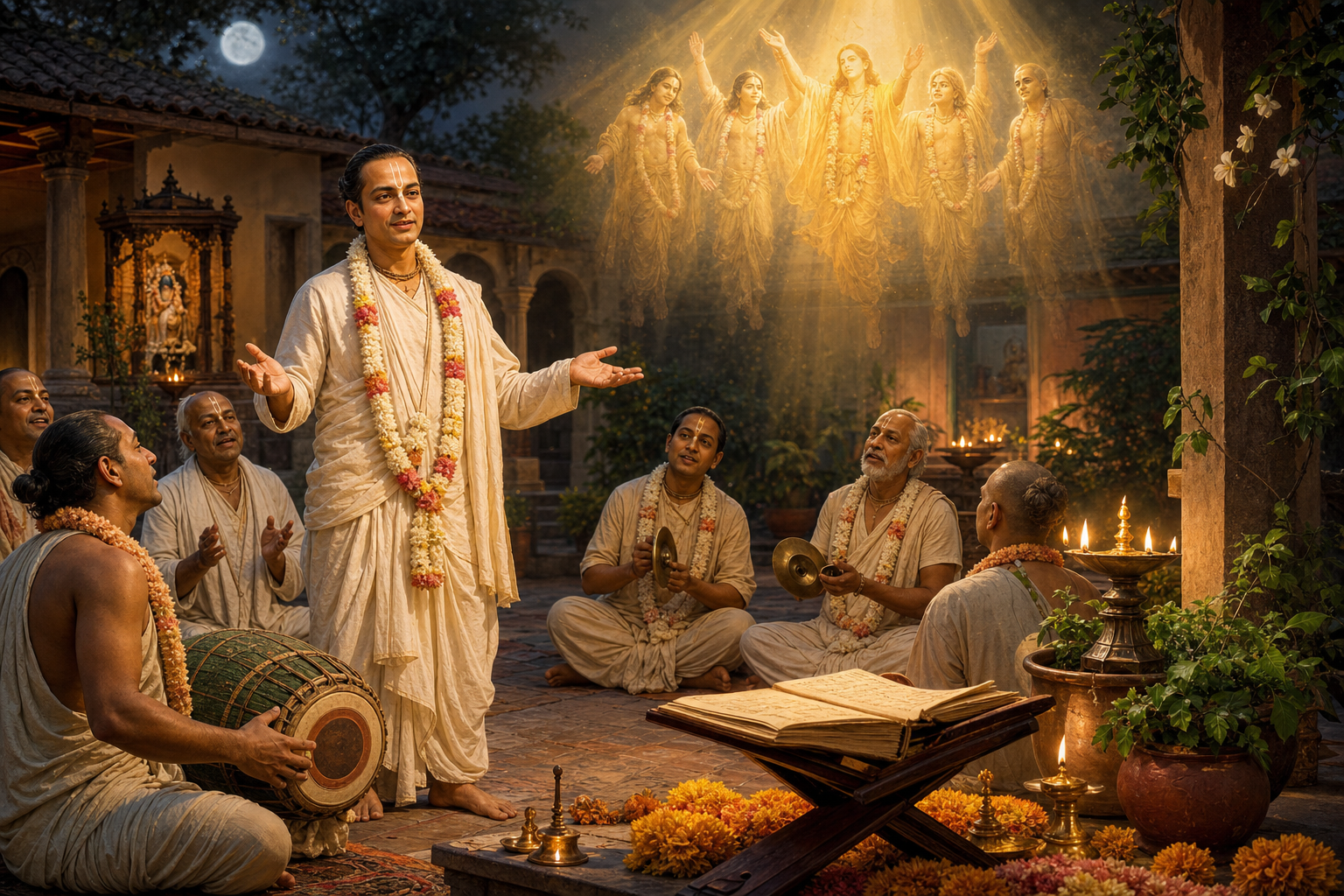
Srivasa Pandita, also honored as Srivasa Thakura in the Gaudiya Vaishnava tradition, occupies a deeply cherished place in the history of bhakti, sankirtana, and the devotional life of Bengal. He is remembered not merely as a companion of Sri Chaitanya Mahaprabhu, but as one of the Pancha Tattva, the fivefold theological manifestation through which Gaudiya Vaishnavism explains the descent of divine love into the world. His life shows how devotion can be practiced with scholarship, hospitality, humility, courage, and unwavering trust in Krishna.
Modern readers often encounter Srivasa Pandita through brief references: his home in Navadvipa, his participation in kirtan, his place in the Pancha Tattva mantra, or the moving account of his composure during the death of his son. Yet these fragments, when studied together, reveal a complete spiritual personality. Srivasa represents the devotee whose faith is not theoretical. It is lived in the house, tested in public pressure, refined through grief, and expressed in service to a wider community.
The historical setting of Srivasa Pandita belongs to late fifteenth- and early sixteenth-century Bengal, a period of intense religious, literary, and social movement. Navadvipa was a renowned center of Sanskrit learning, logic, ritual scholarship, and intellectual debate. Into this world came Sri Chaitanya Mahaprabhu, whose devotional movement emphasized nama-sankirtana, the congregational chanting of the divine names, as a practical and accessible path of bhakti. Srivasa Pandita became one of the crucial householders who helped this movement take social form.
Gaudiya sources describe Srivasa as originally connected with Srihatta, often identified with the Sylhet region, before he came to Navadvipa for the association of devotees and the atmosphere of sacred learning. He is remembered along with his brothers Sripati, Srirama, and Srinidhi. His wife, Malini Devi, is also honored in the devotional tradition for her service, kindness, and participation in the early community around Chaitanya Mahaprabhu. This family setting is important because Srivasa’s sanctity was not separate from domestic life; rather, his home became a model of household spirituality.
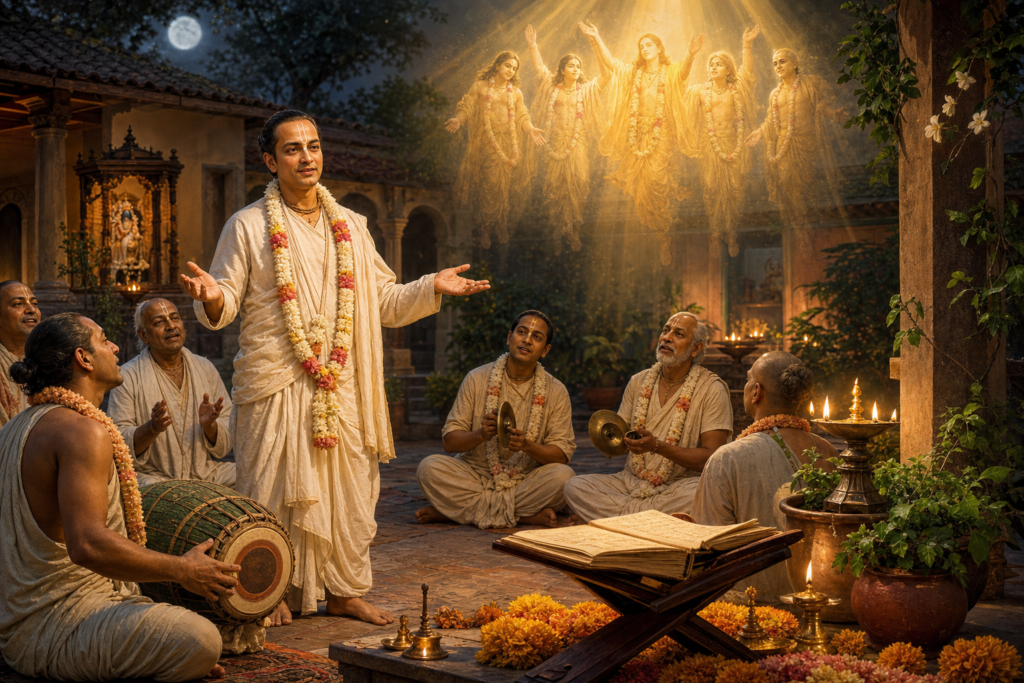
The name most associated with him is Srivasa Angan, the courtyard of Srivasa. In devotional memory, this was not simply a private residence. It became the sacred space where Chaitanya Mahaprabhu and his intimate associates gathered for nocturnal kirtan, ecstatic worship, and the cultivation of Krishna consciousness. A home became a temple, a courtyard became a spiritual academy, and a family dwelling became one of the symbolic birthplaces of a movement that would later travel far beyond Bengal.
This transformation of domestic space is one of Srivasa Pandita’s most enduring lessons. Hindu spirituality has never been confined only to forests, monasteries, or formal temples. The grihastha, or householder, can also become a custodian of dharma. Srivasa shows that a household becomes sacred when it is organized around seva, remembrance, hospitality, discipline, and shared devotion. In a modern world where spiritual life is often separated from work, family, and public responsibility, his example restores an integrated vision.
In Gaudiya Vaishnava theology, Srivasa Pandita is included in the Pancha Tattva: Sri Krishna Chaitanya, Prabhu Nityananda, Sri Advaita, Gadadhara, and Srivasa with the devotees. The Pancha Tattva is not only a list of revered personalities; it is a theological map of divine compassion. Chaitanya is understood as the combined mercy of Radha and Krishna, Nityananda as expansive grace, Advaita as the call that invites divine descent, Gadadhara as the devotional potency, and Srivasa as the community of pure devotees who receive, preserve, and distribute bhakti.
Srivasa’s position as the representative of the devotee community is significant. It means that devotion is not only a private emotional state. It becomes visible through sangha, shared practice, disciplined conduct, and mutual responsibility. Kirtan requires voices to come together. A tradition requires memory, teaching, and hospitality. A movement requires those who will open their doors even when social pressure or political anxiety makes such openness difficult. Srivasa Pandita stands at precisely this point where personal devotion becomes community strength.
The scriptural and hagiographical sources associated with Srivasa include Sri Chaitanya-bhagavata of Vrindavana Dasa Thakura and Sri Chaitanya-caritamrita of Krishnadasa Kaviraja. These texts are devotional biographies rather than modern academic biographies, so their purpose is theological, ethical, and spiritual as much as historical. They preserve the memory of Srivasa through stories that communicate what the tradition values: surrender, loyalty, humility, reverence for the divine name, and fearlessness in devotional service.
One of the most powerful narratives about Srivasa Pandita concerns the death of his son during kirtan. According to the devotional account, while Chaitanya Mahaprabhu and the devotees were absorbed in chanting, Srivasa’s son passed away inside the house. Srivasa did not want the kirtan to stop. His response was not coldness or denial; it was a radical prioritization of divine presence. The story portrays a devotee whose grief is real, but whose trust in Krishna is deeper than grief.
This episode must be read carefully. It should not be used to glorify emotional suppression or indifference to family suffering. Rather, within the devotional framework, it reveals the spiritual discipline by which sorrow is held within a larger vision of the soul, karma, divine will, and the eternal relationship between the jiva and Bhagavan. For many people, loss breaks the inner structure of life. Srivasa’s example teaches that bhakti does not remove pain by argument; it gives pain a sacred context in which the heart can remain turned toward the divine.
Theologically, this story reflects a central principle of bhakti: the devotee does not belong to the world in a possessive sense, and even family relationships become sanctified when understood as entrusted relationships rather than objects of ownership. This is not a rejection of love. It is a purification of love. Srivasa loved his family, but his love was anchored in Krishna. That anchoring allowed him to serve without panic, grieve without despair, and surrender without bitterness.
Srivasa Pandita is also connected with the public expansion of sankirtana. The early kirtans in his courtyard were intimate, but the devotional energy they generated could not remain private forever. The movement around Chaitanya Mahaprabhu eventually moved into public space, challenging narrow social boundaries and making the chanting of divine names accessible to people across learning, status, and background. Srivasa’s home functioned as a seedbed for this wider devotional democratization.
The encounter with social resistance, especially in traditions recounting opposition from local authorities such as the Kazi, also forms part of the Srivasa narrative. These accounts should be approached with historical sensitivity and without hostility toward any community. Their constructive lesson is that religious devotion sometimes has to negotiate public order, misunderstanding, and fear. Chaitanya’s movement, with Srivasa among its central household supporters, responded not through hatred but through kirtan, moral courage, and the insistence that devotion should be expressed with dignity.
For a blog committed to unity among dharmic traditions, Srivasa Pandita’s life offers a generous interpretive frame. Bhakti in Hinduism, compassion in Buddhism, ahimsa in Jainism, and seva in Sikhism all point toward a transformation of the self away from ego and toward a life of service, discipline, and sacred responsibility. Srivasa’s path is distinctively Vaishnava, centered on Krishna and Chaitanya Mahaprabhu, yet the virtues he embodies are recognizable across dharmic traditions: humility, steadiness, reverence, self-control, hospitality, and devotion to truth.
His life also clarifies the meaning of bhakti as more than sentiment. In popular usage, devotion can sometimes be reduced to emotion, song, or ritual enthusiasm. Srivasa Pandita demonstrates that mature bhakti includes intellectual respect for scripture, disciplined association with sadhus, ethical restraint, service to guests, courage under pressure, and the willingness to sacrifice personal comfort for a higher purpose. The emotional sweetness of kirtan rests on a foundation of character.
Srivasa’s association with the Bhagavata Purana tradition is especially important. Gaudiya Vaishnavism places the Srimad Bhagavatam at the center of its theology, reading it as the mature fruit of Vedic wisdom and as a primary revelation of Krishna bhakti. Srivasa’s devotional life was not anti-intellectual. It emerged within a learned culture in which scriptural hearing, recitation, interpretation, and lived practice reinforced one another. His example corrects the false division between scholarship and devotion.
The connection between Srivasa and Narada Muni in Gaudiya tradition deepens this point. Narada is the wandering sage of bhakti, the teacher whose presence links scripture, music, remembrance, and divine love. To identify Srivasa with the mood or manifestation of Narada is to place him in the lineage of devotional transmission. He is not remembered primarily as a political figure, philosopher, or institutional founder, but as a carrier of bhakti-rasa through sound, association, and service.
Kirtan, in Srivasa’s world, was not performance. It was sadhana. The chanting of names such as Krishna, Rama, and Hari was understood as a direct means of purification in Kali Yuga. The power of sankirtana lies in its simplicity and depth: the voice participates, the body responds, the mind is gathered, the community becomes synchronized, and the heart is invited into remembrance. Srivasa’s courtyard became a laboratory of this sacred sound, where theology was experienced through collective devotion.
A modern technical reading of Srivasa Pandita’s contribution can identify several layers. Socially, he provided space and stability for an emerging devotional community. Ritually, he hosted regular kirtan and sacred gatherings. Theologically, he embodied the devotee principle within the Pancha Tattva. Ethically, he modeled courage and surrender. Psychologically, he demonstrated resilience under grief. Culturally, he helped shift bhakti from private piety into a public, participatory movement. These dimensions together explain why his memory has endured.
His life is also relevant to contemporary Hindu families and dharmic communities. Many people struggle to make spiritual practice consistent amid professional pressure, digital distraction, social fragmentation, and intergenerational change. Srivasa does not offer an escapist answer. He offers a household answer: create sacred rhythms, welcome good association, protect time for chanting or prayer, honor scripture, serve guests, and let the home become a place where dharma is practiced rather than merely discussed.
There is also a lesson in spiritual hospitality. Srivasa did not become great by withdrawing his house from others. He became great by offering it. In many dharmic traditions, hospitality is a form of worship because the guest, the saint, the seeker, and the hungry person all provide opportunities for seva. Malini Devi’s remembered role strengthens this point: Srivasa’s sanctified household was not the achievement of one person alone, but of a family culture shaped by devotion.
Srivasa Pandita’s example also warns against reducing religious life to identity without transformation. He belonged to a tradition, but his greatness came from realized conduct. He supported kirtan, accepted suffering with dignity, served devotees, and helped build a community of practice. For contemporary readers, this distinction matters. Dharma is weakened when it becomes only a label; it becomes luminous when it disciplines speech, action, emotion, and relationship.
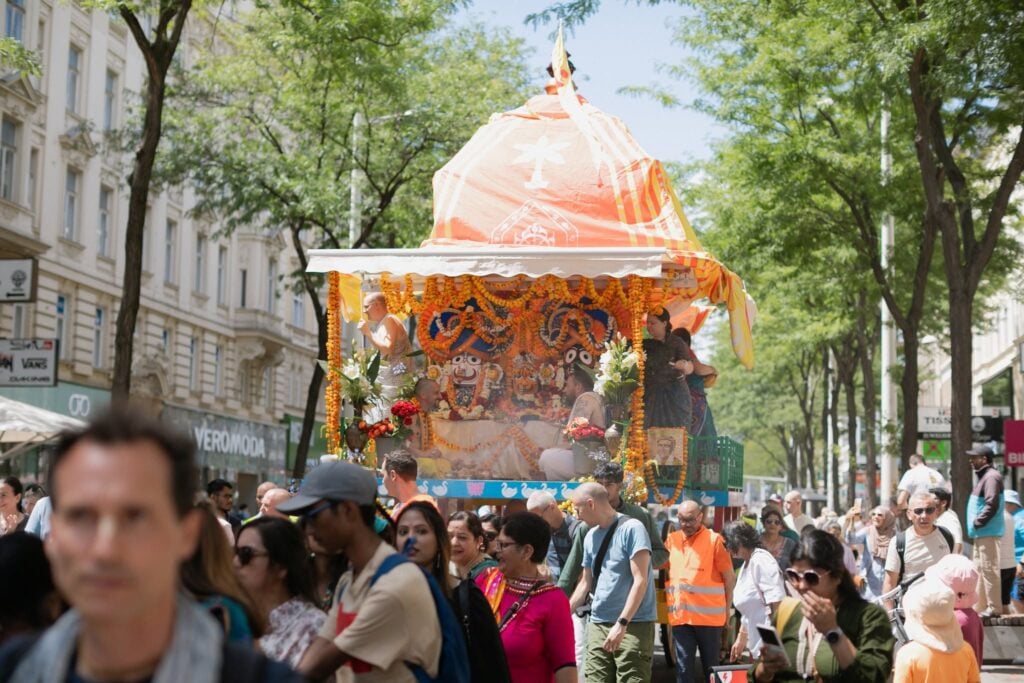
His legacy continues through Gaudiya Vaishnavism, the Hare Krishna movement, the memory of Srivasa Angan in Mayapur, and the daily recitation of the Pancha Tattva mantra by devotees around the world. Whenever that mantra is chanted, Srivasa’s name is remembered not as an ornament of the past but as a living principle: the Lord’s grace is received and shared through devotees. The sacred community is not secondary to bhakti; it is one of the ways bhakti becomes embodied.
The academic study of Srivasa Pandita must therefore hold two perspectives together. Historically, available sources do not provide a modern chronological biography with complete dates, political documentation, or neutral archival detail. Devotionally, the tradition preserves a coherent portrait of a saint whose importance lies in his relationship with Chaitanya Mahaprabhu and the early sankirtana movement. A responsible reading respects both facts: the limits of historical reconstruction and the depth of sacred memory.
Srivasa Pandita’s life finally teaches that bhakti is both intimate and expansive. It begins in the heart, enters the home, gathers a community, and then moves into the world as song, service, courage, and compassion. His story is not merely about one saint of Bengal. It is about the possibility that any home, when shaped by sincerity and discipline, can become an angan of devotion. In that sense, Srivasa remains profoundly contemporary.
Sources consulted for historical and theological orientation include the traditional accounts associated with Sri Chaitanya-bhagavata and Sri Chaitanya-caritamrita, along with public reference material on Srivasa Thakura, Gaudiya Vaishnavism, Chaitanya-caritamrita, and Chaitanya-bhagavata. These sources help situate Srivasa Pandita within the broader history of Lord Caitanya, Krishna consciousness, sankirtana, and the Vaishnava Saints of Bengal.
Inspired by this post on Dandavats.



Leave a Reply
You must be logged in to post a comment.