

Viparita Karani Mudra occupies a distinctive place in Hatha Yoga, Tantra, and the wider spiritual heritage of Bharatavarsha. It is often translated as the “reversed action seal,” yet this simple phrase barely captures its philosophical depth. In the older yogic imagination, the human body is not treated as a mechanical object but as a sacred field of consciousness, a living yantra in which forces of ascent and descent, preservation and dissolution, stillness and transformation interact continuously. Within that worldview, inversion is never merely a posture. It is a deliberate reorientation of energy, attention, breath, and time.
The traditional claim that Viparita Karani Mudra “conquers time and death” should be understood with care. Classical yoga often speaks in symbolic, poetic, and esoteric language. Time and death are not only biological realities; they also represent decay, distraction, unconscious living, and the steady loss of vital awareness. Viparita Karani Mudra is therefore best approached as a disciplined yogic method for conserving vitality, calming the nervous system, refining prana, and turning consciousness away from habitual outward movement toward inward steadiness.
In many modern yoga spaces, Viparita Karani is identified with the familiar restorative posture commonly called legs-up-the-wall pose. That variation can be deeply beneficial, especially for relaxation, fatigue, and gentle circulation. However, classical Viparita Karani Mudra is more than a passive resting pose. It belongs to the family of mudras in Hatha Yoga, where the body, breath, subtle anatomy, concentration, and energetic intention are integrated into a single practice. The distinction matters because a mudra is not merely a shape; it is a seal, a psychophysical arrangement designed to influence the movement of prana and awareness.
Traditional texts describe the human body through a subtle map of nadis, chakras, prana, apana, bindu, and amrita. In this symbolic physiology, a cooling lunar principle is often associated with the upper region of the body, while a heating solar principle is associated with the lower region, especially the digestive fire. The nectar of immortality, sometimes called amrita or soma, is said to descend from the lunar center and become consumed by the solar fire. Viparita Karani Mudra reverses this downward loss. By placing the body in an inverted relation to gravity and directing awareness upward, the practice is said to preserve the subtle nectar and support longevity, clarity, and spiritual steadiness.
This teaching should not be reduced to crude physiology, nor should it be dismissed as superstition. Yogic language often operates simultaneously at several levels: anatomical, energetic, psychological, contemplative, and metaphysical. The “nectar” may be understood as a symbol of refined vitality, hormonal balance, mental coolness, meditative absorption, or the subtle joy that arises when prana is no longer scattered through restless sensory activity. The “sun” may represent digestive heat, metabolic expenditure, compulsive desire, or the ordinary consumption of life-force through unregulated living. The mudra becomes a disciplined method for interrupting dissipation and restoring inward coherence.
Classical Hatha Yoga texts praise Viparita Karani Mudra because it embodies one of yoga’s central principles: transformation often begins by reversing the ordinary pattern. The senses usually move outward. The mind chases objects. Breath follows agitation. Energy descends into habit, fatigue, and compulsion. Inversion symbolically and practically challenges that pattern. The practitioner turns the body upside down, but more importantly, turns attention away from fragmentation and toward the axis of inner awareness. In this sense, Viparita Karani Mudra is not an escape from the world; it is a training in how to stand within the world without being completely drained by it.
The word viparita means reversed, inverted, or contrary to the usual order. Karani implies action, method, or doing. Mudra means seal, gesture, or energetic lock. Together, Viparita Karani Mudra may be understood as the seal of reversed action. This name is important. It suggests that the practice is not simply about putting the legs above the head. It is about reversing the flow of attention, reversing the habitual expenditure of prana, and reversing the tendency to identify the self only with the body’s decline. Such reversal is deeply aligned with the broader dharmic pursuit of self-knowledge.
Within Hindu spiritual traditions, the body is frequently viewed as a temple, a kshetra, and a vehicle for sadhana. This view does not deny the body’s impermanence. Rather, it gives impermanence a sacred context. The body is cared for because it supports dharma, meditation, service, mantra, devotion, self-discipline, and insight. Viparita Karani Mudra reflects this vision. It does not promise that the physical organism can be made immortal in a literal sense. It points instead to the possibility that disciplined practice can slow inner fragmentation, deepen vitality, and help consciousness recognize that it is not exhausted by bodily change.
The practice also resonates with the shared contemplative concerns of dharmic traditions. Hinduism, Buddhism, Jainism, and Sikhism differ in theology, metaphysics, and ritual expression, yet all recognize the need to discipline the mind, refine conduct, reduce attachment, and orient life toward liberation, wisdom, or union with the Divine. Viparita Karani Mudra belongs specifically to the yogic and tantric streams of Hindu practice, but its deeper lesson is widely intelligible: human beings suffer when awareness is pulled downward into compulsive habit, and they recover dignity when attention is lifted toward clarity, restraint, and inner freedom.
From a practical standpoint, the modern restorative variation of Viparita Karani can be accessible to many practitioners. In its simplest form, the hips are placed near a wall, the legs rest upward, the spine lies on the floor, and the breath becomes slow and natural. A folded blanket or bolster may support the pelvis if comfortable. The arms can rest by the sides or across the abdomen. The eyes soften. The jaw releases. The practice often produces a quieting effect because it reduces unnecessary muscular effort while gently changing the relationship between circulation, breath, and sensory attention.
The classical mudra, however, may involve a more active inversion with the pelvis lifted and supported by the hands or props, resembling a mild shoulder-supported inversion. This form requires greater preparation, steadiness, and guidance. It is not appropriate to force the neck, compress the throat, or imitate advanced shapes without training. Traditional yoga gives great importance to adhikara, meaning fitness or preparedness. A practice becomes beneficial when it matches the practitioner’s capacity. The same technique can become harmful when pride, haste, or imitation replaces intelligent discipline.
Viparita Karani Mudra is often associated with the regulation of prana. In yogic anatomy, prana is not merely breath, though breath is one of its most visible expressions. Prana is the vital organizing force that animates the body-mind. When prana is disturbed, the mind becomes restless, the senses become overactive, and the body may feel depleted. When prana is steady, attention becomes collected and meditation becomes more natural. Inversion, especially when combined with relaxed breathing and inward awareness, is traditionally understood to help redirect prana toward the central channel, the sushumna nadi.
The relationship between Viparita Karani Mudra and the nervous system is also worth considering in contemporary language. Gentle supported inversion can create conditions of rest: reduced effort, slower breathing, decreased sensory demand, and a feeling of containment. Many practitioners experience this as a shift from agitation toward parasympathetic calm. Such effects should not be exaggerated into medical claims, but they are consistent with the lived experience of restorative yoga. A person who has spent the day standing, working, arguing, commuting, or absorbing digital overload may find that a few quiet minutes in this posture feel like an internal reset.
This relatable dimension helps explain why the practice remains meaningful. The modern world constantly pulls attention outward. Notifications, deadlines, social comparison, and emotional overstimulation consume mental nectar in their own way. Viparita Karani Mudra offers a counter-gesture. The body becomes still. The legs rise. The breath slows. The gaze withdraws. Even without elaborate esoteric interpretation, the practitioner may sense a reversal of the day’s momentum. What was scattered begins to gather. What was heated begins to cool. What was heavy begins to feel spacious.
Traditional praise of the mudra often includes references to youthfulness, freedom from decay, and preservation of vitality. These statements should be read within the idiom of Hatha Yoga, where longevity is valued because it gives the practitioner more opportunity for sadhana. The aim is not vanity. The aim is not the denial of aging. The aim is the conservation of life-force for higher realization. In this respect, Viparita Karani Mudra differs from modern wellness culture when wellness becomes merely aesthetic. Classical yoga asks not only how long one can live, but what consciousness is being cultivated while one lives.
Breath is central to the practice. In a gentle form, no strainful pranayama is necessary. The breath may simply be observed as it lengthens naturally. The abdomen softens, the ribs widen, and exhalation becomes complete without force. In more advanced settings, teachers may integrate specific breath ratios, bandhas, or meditative visualization, but these should be learned directly and gradually. The essential principle is that the posture must serve steadiness. If breath becomes rough, the neck feels compressed, the face tightens, or anxiety increases, the practice has lost its yogic quality and should be modified or stopped.
The mudra also invites reflection on the yogic meaning of death. In ordinary life, death is feared as the end of possession, identity, memory, and control. In yoga, death is also the continuous loss of awareness into unconscious habit. Every moment of mechanical reaction is a small death of discernment. Every surrender to anger, greed, distraction, or despair consumes subtle vitality. To “conquer death” in a yogic sense is to awaken to that which is not destroyed by changing mental states. Viparita Karani Mudra supports this inquiry by placing the practitioner in a condition of still reversal, where the usual rush of identity temporarily loosens.
The practice should be approached with humility rather than sensationalism. Esoteric techniques in Hatha Yoga were traditionally transmitted within disciplined frameworks that included yama, niyama, diet, moderation, mantra, devotion, and guidance from a competent guru. Removing a mudra from this larger ethical and spiritual matrix can turn it into mere technique. The deeper power of Viparita Karani Mudra lies not in the outer inversion alone but in the integration of physical steadiness, moral restraint, breath awareness, subtle attention, and reverence for the sacred nature of embodied life.
There are also clear safety considerations. People with glaucoma, uncontrolled high blood pressure, serious neck injury, recent stroke, significant heart conditions, advanced pregnancy complications, or medical restrictions around inversion should seek professional guidance before attempting any inverted practice. Those who experience dizziness, pressure in the head, breathlessness, numbness, or pain should come out of the posture carefully. Supported legs-up-the-wall may be gentle for many people, but even gentle practices must be adapted to the individual. Yoga is not proven by endurance of discomfort; it is proven by clarity, steadiness, and appropriate discernment.
A thoughtful sequence may begin with simple grounding. The practitioner can lie on the back, observe the breath, release the shoulders, and then place the legs up a wall with the pelvis at a comfortable distance. The lower back should not feel strained. The neck should remain neutral. The throat should feel open. The posture may be held for a few minutes at first, gradually increasing only if the body responds well. After coming out, it is wise to rest on one side briefly before sitting up. This transition preserves the calm generated by the practice and prevents abrupt disturbance.
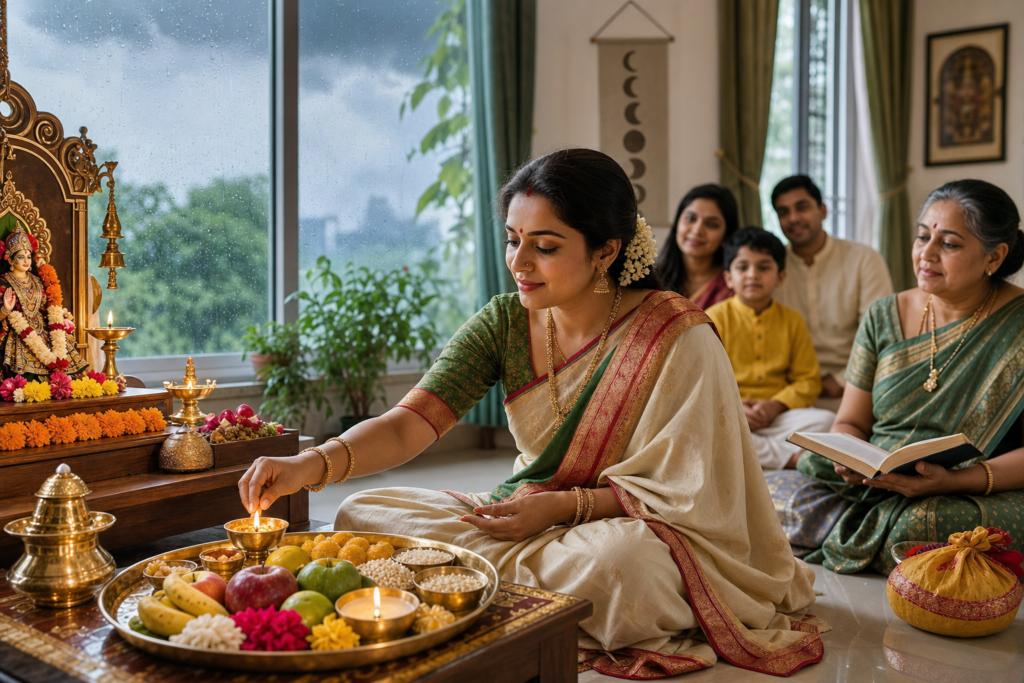
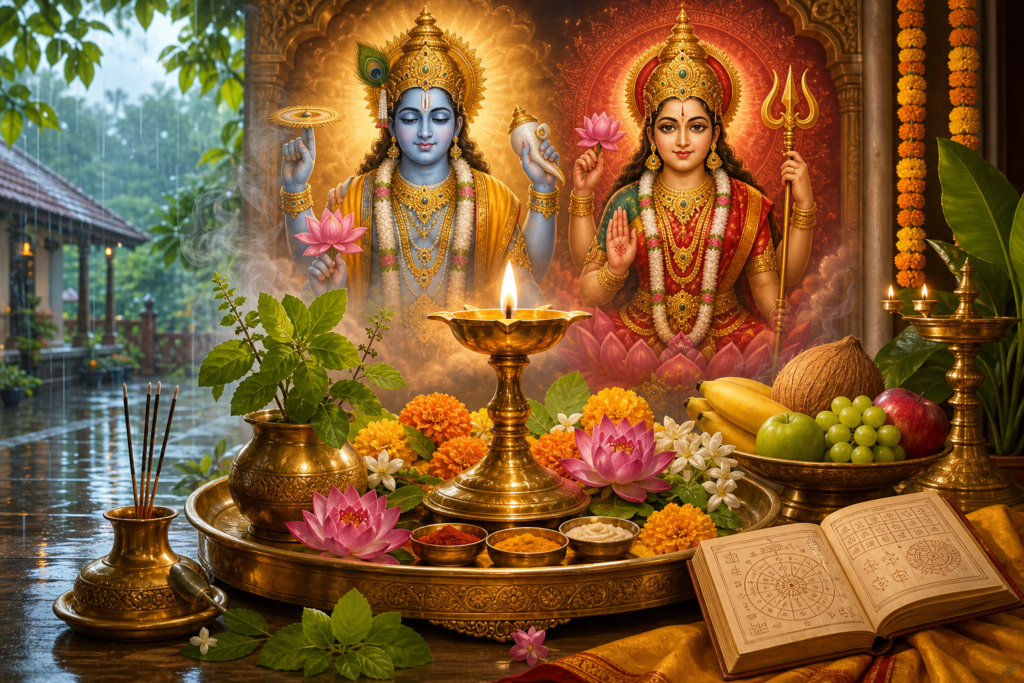
For meditative refinement, awareness may be placed at the heart, the breath, or the space between the eyebrows, depending on one’s tradition and instruction. Some practitioners mentally repeat a mantra. Others contemplate the upward movement of prana or the preservation of amrita. Devotional practitioners may dedicate the practice to Shiva, Vishnu, Devi, Guru, or the chosen form of the Divine. Such variations reflect the generous diversity of Hindu spiritual life. The mudra does not demand uniformity of devotion; it provides a sacred structure through which different forms of worship and inner discipline may be harmonized.
Viparita Karani Mudra also has philosophical significance because it challenges the assumption that progress is always forward, faster, louder, and more visible. Yogic progress is often quiet and inward. It may look like stopping, reversing, resting, or withdrawing. Yet this withdrawal is not weakness. It is a deliberate conservation of energy for higher clarity. In a culture that celebrates constant output, the mudra teaches that preservation is also a sacred act. To protect one’s prana from waste is to honor the Divine intelligence within the body.
The symbolism of inversion can also be read through the lens of dharma. Adharma often appears when values are inverted in the wrong way: means become ends, consumption replaces restraint, appearance replaces substance, and power replaces wisdom. Yogic inversion reverses this confusion. It restores the proper hierarchy by placing awareness above impulse, breath above agitation, and inner truth above external noise. Thus, Viparita Karani Mudra becomes more than a posture for health; it becomes a contemplative reminder that the human being must periodically reverse worldly conditioning in order to recover alignment with dharma.
The practice’s connection to amrita is especially evocative. In the Puranic imagination, amrita is the nectar sought during the Samudra Manthan, the churning of the cosmic ocean. In yogic practice, the ocean is internal. The churning occurs through tapas, breath, discipline, devotion, and meditation. The nectar is not seized through force; it is revealed when the practitioner becomes steady enough to receive it. Viparita Karani Mudra visually dramatizes this process. The body becomes a vessel turned toward preservation, and the mind becomes a witness to the subtle sweetness that emerges when rest and alertness meet.
Modern practitioners can benefit from holding both perspectives together: the symbolic and the practical. On the practical level, Viparita Karani may soothe fatigue, support relaxation, and create a gentle meditative pause. On the symbolic level, it teaches conservation of vitality, reversal of harmful habits, and inward ascent. On the philosophical level, it reminds the practitioner that the body is not an obstacle to spirituality when treated with reverence and discipline. On the devotional level, it becomes an offering of stillness to the Divine presence within.
It is important, however, to resist the temptation to oversell the practice. Viparita Karani Mudra should not be presented as a cure-all or as a substitute for medical care, ethical living, healthy sleep, balanced food, or emotional maturity. Its greatness lies in integration. When practiced as part of a broader yogic life, it can become a profound support for mental clarity and spiritual refinement. When isolated from context and exaggerated through miracle claims, its teaching becomes distorted. Academic honesty and spiritual reverence both require careful language.
The enduring relevance of Viparita Karani Mudra lies in its ability to speak to several dimensions of human life at once. It addresses the tired body, the overstimulated nervous system, the scattered mind, the seeker of subtle energy, and the contemplative who reflects on time and mortality. It belongs to the technical world of Hatha Yoga and the symbolic world of Tantra, yet it remains accessible as a moment of humble reversal. In that union of depth and simplicity, its sacred character becomes clear.
Viparita Karani Mudra ultimately teaches that the conquest of time does not mean refusing change. It means learning how not to be spiritually consumed by change. The body ages, duties continue, and the world remains uncertain. Yet within disciplined stillness, prana can be gathered, attention can be clarified, and the practitioner can remember a deeper center. The sacred inversion therefore becomes a quiet act of resistance against inner dissipation. It preserves not only the symbolic nectar of life, but also the dignity of living with awareness, restraint, and devotion.
Inspired by this post on Hindu Blog.








Leave a Reply
You must be logged in to post a comment.