
ISKCON of DC Live Stream presents more than a video feed from a temple. It functions as a digital doorway into Krishna consciousness, Gaudiya Vaishnavism, bhakti yoga, kirtan, deity worship, and the everyday devotional culture of a living Hindu temple community in the Washington, D.C. region.
The significance of such a livestream becomes clearer when it is understood within the broader history of ISKCON, the International Society for Krishna Consciousness. Founded in 1966 in New York by A. C. Bhaktivedanta Swami Prabhupada, ISKCON emerged from the Gaudiya Vaishnava tradition, a devotional school rooted in the worship of Sri Krishna and shaped by the teachings of Sri Chaitanya Mahaprabhu. Its core practice is bhakti, or loving devotional service, expressed through chanting, study, worship, service, and community life.
A temple livestream is therefore not merely a broadcast of religious activity. It carries a ritual ecology. The viewer is introduced to the rhythm of arati, bhajans, mantra recitation, scriptural reflection, prasadam culture, and the quiet discipline that sustains daily worship. Even when watched from a living room, office, student dormitory, hospital room, or distant country, the stream makes visible the continuity of temple practice across space.
In the Hindu tradition, darshan is often described as sacred seeing. It is not only the devotee looking toward the deity; it is also the devotee becoming inwardly available to divine presence. A livestream cannot fully replace the sensory fullness of temple life, including fragrance, sound, touch, congregation, and the offering of service. Yet it can still support remembrance, discipline, and connection, especially for those who are elderly, ill, traveling, isolated, or geographically distant from a temple.
ISKCON of DC Live Stream should be read in this context as a modern extension of an ancient devotional instinct: the desire to remain connected to the sacred. The medium is contemporary, but the impulse is old. Devotees have always found ways to gather around sacred sound, sacred image, and sacred memory. Digital media now allows that gathering to happen across time zones and national borders.
The technical structure of a temple livestream also deserves attention. A successful broadcast must balance devotional sensitivity with practical media design. The camera should preserve the dignity of the altar, the audio should clearly carry kirtan and spoken teachings, and the platform should remain stable enough to serve viewers who may tune in regularly for morning or evening worship. In this sense, live streaming becomes a form of seva, because technology is used in service of spiritual access rather than distraction.
YouTube has become a practical tool for temples because it supports live video, replay access, embedding, mobile viewing, and global discoverability. These features matter for diaspora communities. A family in another city can follow a festival, a student can hear a class after exams, and a devotee who has moved away can remain connected to familiar kirtans and the mood of a home temple.
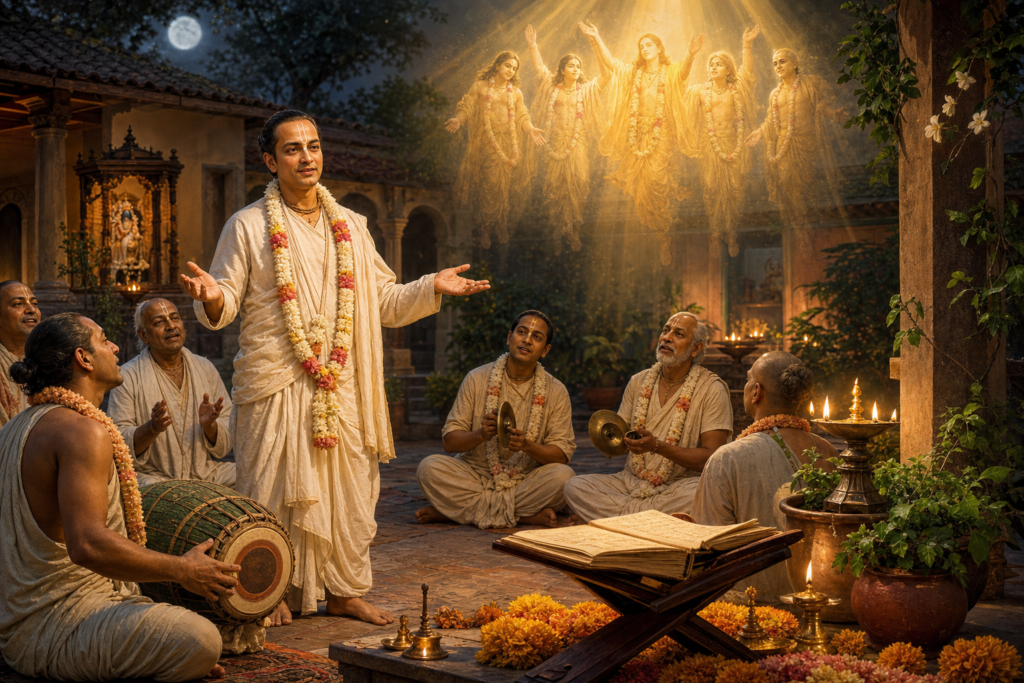
The most recognizable element in ISKCON practice is congregational chanting of the Hare Krishna maha-mantra. Kirtan is both musical and theological. It is musical because it uses melody, rhythm, call and response, and collective participation. It is theological because sacred sound is treated as a direct means of spiritual association. The livestream allows this sound-centered practice to travel beyond the temple hall.
For many viewers, the emotional impact of such a stream lies in its ordinariness. There may be no dramatic production, no elaborate narration, and no need for cinematic editing. The power is in repetition: lamps offered, mantras sung, devotees seated, bells sounded, scriptures opened, and Krishna remembered. The repetition gives the day a sacred architecture.
This is one reason livestreamed worship has become important in contemporary Hindu diaspora life. Migration often separates families from ancestral temples, familiar festivals, and community networks. Digital darshan helps reduce that distance. It creates a shared devotional reference point for children, parents, grandparents, newcomers, and seekers who may be exploring Hindu spirituality for the first time.
From an academic perspective, ISKCON of DC Live Stream also illustrates how religious communities adapt without abandoning inherited structures. The altar remains central. The mantra remains central. The scriptures remain central. What changes is the mode of transmission. This distinction is important, because tradition does not survive by becoming static; it survives by carrying its essential principles into new social and technological conditions.
Gaudiya Vaishnavism places particular emphasis on the relationship between the individual soul and Krishna. Its devotional culture is personal, relational, and participatory. A livestream can support that participation when it is approached with attention rather than passive consumption. Viewers may chant along, sit respectfully, read connected verses, prepare simple offerings at home, or use the stream as a cue for daily sadhana.
The livestream also has educational value. A person unfamiliar with ISKCON can observe the structure of worship before visiting in person. The visual setting helps explain terms such as arati, kirtan, murti, prasadam, bhakti, and seva in a way that abstract definitions cannot. The result is a gentle form of religious literacy, especially useful in plural societies where communities often live near one another without deeply understanding one another.
Within the larger dharmic family, such educational visibility matters. Hinduism, Buddhism, Jainism, and Sikhism differ in theology, practice, and historical development, yet they share deep civilizational concerns with discipline, compassion, self-transformation, ethical living, and liberation from ego-centered life. A well-presented temple livestream can strengthen respect for these dharmic traditions by showing devotion as lived practice rather than as stereotype or abstraction.
The best way to understand this stream is not as entertainment, but as a devotional resource. Entertainment seeks novelty. Sadhana seeks depth. The value of a temple broadcast is not that every minute is visually new, but that it invites the viewer to become inwardly steady. In a noisy digital environment, this is a meaningful contrast.
There is also a subtle discipline involved in watching sacred content online. The same device that carries kirtan can also carry distraction. A thoughtful viewer may therefore treat the stream differently from ordinary media: lowering interruptions, sitting attentively, avoiding casual commentary, and remembering that the video is connected to a living altar and a practicing community.
This distinction is especially relevant for younger audiences. Digital platforms often train the mind toward speed, judgment, comparison, and constant switching. A livestream of temple worship can train a different capacity: patient attention. The viewer learns to remain with sound, image, mantra, silence, and ritual sequence. That patience is itself a spiritual exercise.
ISKCON’s emphasis on prasadam, vegetarian discipline, mantra meditation, scriptural study, and devotional service also gives the livestream a broader ethical context. The visible worship is only one layer. Behind it stands a way of life that connects food, speech, time, community, learning, and conduct to spiritual purpose. This integrated vision is one reason Krishna consciousness continues to attract interest across cultures.
In the Washington, D.C. area, where public life is shaped by diplomacy, migration, universities, policy institutions, and religious diversity, a Hindu temple livestream also becomes a quiet statement of cultural presence. It shows that dharmic traditions are not confined to memory or homeland. They are practiced, sung, studied, and transmitted in the contemporary West by families, monks, scholars, volunteers, and seekers.
The value of the livestream increases during festivals. Days connected with Krishna, Radha, Lord Jagannath, Gaura Purnima, Janmashtami, Govardhan Puja, and other Vaishnava observances often include extended kirtan, discourses, special offerings, and larger congregational participation. For those unable to attend physically, the broadcast preserves at least a portion of the festival experience and allows the home to become spiritually aligned with the temple calendar.
At the same time, digital access should not weaken embodied community. The healthiest use of a livestream is complementary. It can prepare a newcomer for a visit, sustain a devotee between visits, support the homebound, and connect distant well-wishers. But temple life also depends on physical service, human friendship, shared meals, mentorship, and the discipline of showing up in person when possible.
Viewed technically, culturally, and spiritually, ISKCON of DC Live Stream is a small example of a large transformation in religious life. Temples are learning to preserve sanctity while using public platforms. Devotees are learning to practice attention in digital space. Communities are learning to make sacred culture accessible without reducing it to mere content.
This balance is not easy, but it is important. When handled responsibly, a livestream can protect the dignity of worship, broaden access, educate the public, support diaspora continuity, and deepen daily remembrance. It can also help build bridges across communities by presenting Hindu spirituality in a direct, peaceful, and disciplined form.
The enduring lesson of the ISKCON of DC Live Stream is that devotion can travel through modern instruments without losing its essential orientation. The camera, microphone, internet connection, and video platform are not sacred in themselves. Their value comes from the service they perform: bringing sacred sound, Krishna bhakti, and temple worship into the lives of people who are seeking steadiness, meaning, and connection.
For viewers approaching the stream sincerely, the experience can be simple and profound. One may pause, listen, chant, observe, and remember. In that act of remembrance, a live video becomes more than a screen. It becomes a practical aid to bhakti, a point of contact with community, and a reminder that the sacred can still shape daily life in the middle of the modern world.
Inspired by this post on Dandavats.





Leave a Reply
You must be logged in to post a comment.