
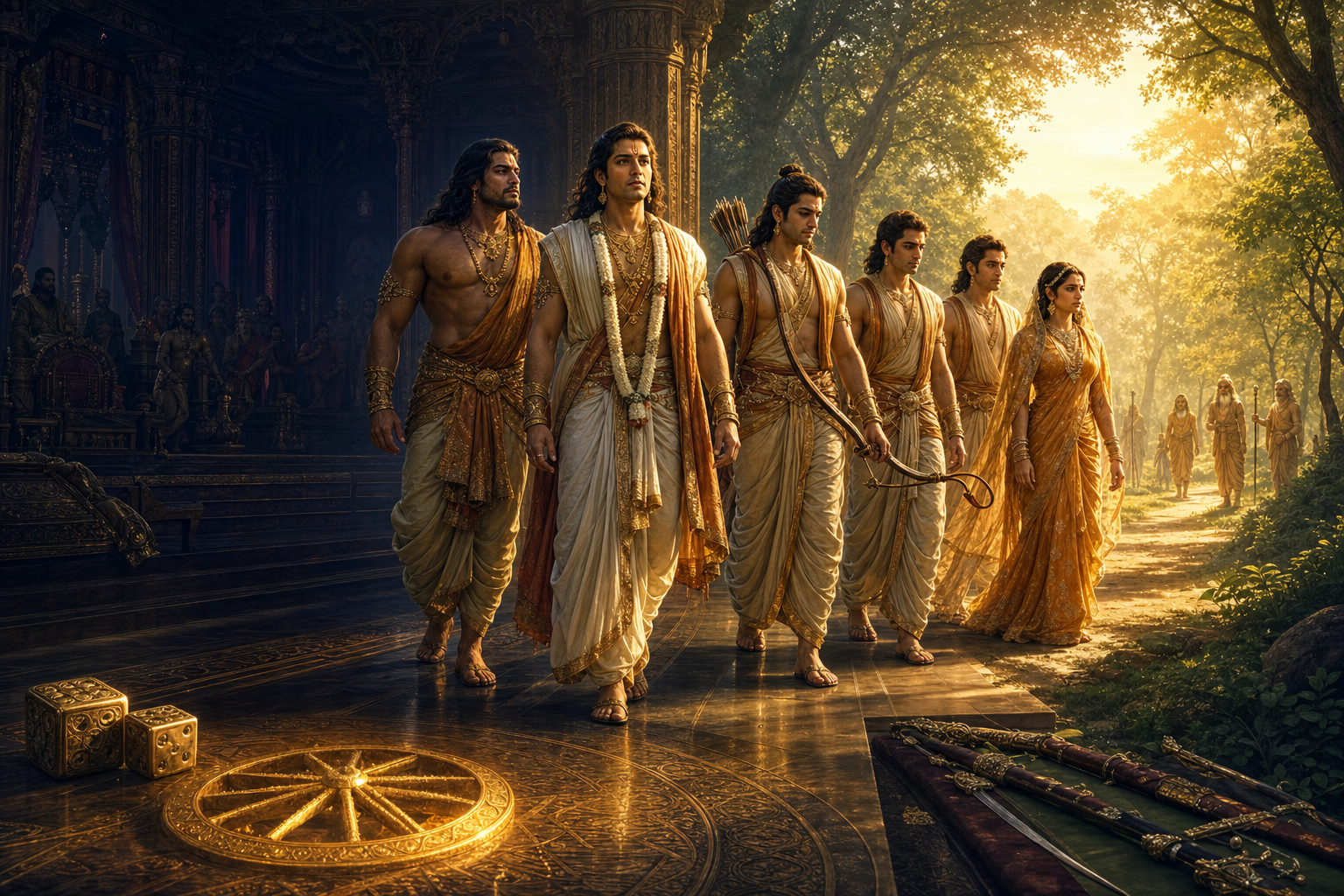
The question of why the Pandavas accepted exile after the dice game remains one of the most powerful moral problems in the Mahabharata. On the surface, the decision appears almost impossible to justify in political terms. Bhima had the strength to crush many warriors in open combat, Arjuna possessed unmatched mastery of weapons, Nakula and Sahadeva were trained princes of exceptional discipline, and Draupadi had been publicly humiliated in a court that should have protected her. If power alone were the measure of right action, the Pandavas could have refused the wager, challenged Duryodhana immediately, and attempted to retake Indraprastha by force.
Yet the Mahabharata does not present power as the highest principle. It places power under the governance of dharma, and this is the key to understanding Yudhishthira’s choice. The exile was not a sign of weakness, cowardice, or political confusion. It was a deliberate acceptance of a painful obligation in order to preserve moral legitimacy, expose adharma, protect social order, and allow time for the deeper consequences of injustice to become visible.
The dice game itself was deeply compromised. Shakuni’s skill, Duryodhana’s envy, Dhritarashtra’s weakness, and the silence of the elders created a situation in which justice was already wounded before the final wager was even spoken. Draupadi’s question in the assembly, whether Yudhishthira had any right to stake her after losing himself, remains one of the sharpest legal and ethical challenges in the epic. The court could not answer her clearly, because the very guardians of dharma had become trapped between loyalty, fear, attachment, and institutional paralysis.
In that atmosphere, an immediate violent response by the Pandavas would have satisfied anger but weakened their moral position. Bhima’s rage was understandable and even righteous in emotional terms, but rage alone cannot define dharma. The Mahabharata repeatedly distinguishes between strength used under discipline and strength used under impulse. Had the Pandavas attacked in the royal court, the conflict would have appeared to many as a rebellion by defeated gamblers rather than a principled stand against injustice.
Yudhishthira’s acceptance of exile therefore served a larger purpose. He chose to honor the visible terms of the wager, even when the spirit of justice had been violated by deceit. This does not mean that the epic endorses gambling, humiliation, or political manipulation. Rather, it shows the difficult burden placed on a ruler who must think beyond personal injury. Yudhishthira understood that a king’s conduct shapes public trust. If he broke an oath in the heat of suffering, even against wrongdoers, the authority of his future rule would be morally weakened.
This is where Rajadharma becomes central. A ruler is not merely a warrior with territory; he is the custodian of order. The Pandavas had to show that their claim to kingship did not rest only on military capacity. It rested on restraint, truthfulness, discipline, and concern for the stability of the realm. In the Mahabharata, the right to rule is not secured merely by victory. It must be supported by dharma, consent, reputation, and the ability to bear suffering without abandoning principle.
The exile also gave moral clarity to the conflict. Before the dice game, the rivalry between the Pandavas and Kauravas could still be interpreted as a family dispute over succession and prestige. After the exile, the contrast became sharper. The Pandavas endured hardship, honored their word, lived among sages, protected people, gained spiritual and martial discipline, and waited for the proper time. The Kauravas, by contrast, used temporary power to deepen their arrogance. Time revealed character more effectively than argument could have done.
Bhima’s strength, Arjuna’s archery, and the twins’ skill were not wasted in exile. They were refined. Arjuna’s journey for divine weapons, Bhima’s encounters in the forest, Yudhishthira’s dialogues with sages, and Draupadi’s unwavering memory of injustice all transformed suffering into preparation. The forest was not merely a punishment; it became a moral and spiritual training ground. The Pandavas entered exile as dispossessed rulers, but they emerged as disciplined instruments of a larger dharmic restoration.
This distinction is important for understanding Kshatra Dharma. The warrior’s duty is not endless aggression. It is the protection of justice through controlled force. War becomes righteous only when other means have been exhausted and when the cause is not private revenge but the restoration of order. The Pandavas did not renounce war forever. They renounced premature war. Their restraint made the later Kurukshetra War morally intelligible, because it followed insult, exile, negotiation, and repeated attempts at peace.
Sri Krishna’s later diplomacy confirms this point. Before the war, he did not immediately demand total destruction of the Kauravas. He sought settlement and even accepted the possibility of peace for a minimal territorial concession. This matters because the Mahabharata does not glorify violence for its own sake. It recognizes that adharma sometimes becomes so entrenched that force is necessary, but it also insists that force must be preceded by patience, counsel, and a clear moral record.
The Pandavas’ exile also protected the unity of the broader social world. A sudden attack in Hastinapura could have plunged the kingdom into chaotic civil conflict without preparation, alliances, or public clarity. By accepting exile, the Pandavas allowed the moral failure of the Kaurava leadership to become visible to kings, sages, citizens, and allies across Bharata. Their suffering became testimony. Their patience became evidence. Their eventual return was not the return of ambitious princes but the return of wronged heirs who had fulfilled every condition imposed upon them.
Draupadi’s role in this moral architecture must not be reduced to passive suffering. She repeatedly reminds the Pandavas that forgiveness without justice can become complicity. Her pain keeps the ethical wound open. At the same time, the epic does not allow vengeance alone to rule the response. The tension between Draupadi’s demand for justice, Bhima’s demand for immediate punishment, Arjuna’s discipline, and Yudhishthira’s commitment to dharma gives the episode its enduring depth.
From a philosophical perspective, the Pandavas’ choice demonstrates that dharma often operates in tragic circumstances where every option carries pain. They were not choosing between comfort and sacrifice. They were choosing between two forms of suffering: the suffering of restraint and the suffering of disorder. Their decision shows that dharma is not sentimental softness. It can require immense inner strength, especially when the injured party has the capacity to retaliate immediately.
This is why the exile episode remains relevant beyond the Mahabharata’s historical and sacred setting. Human life often presents moments when retaliation seems justified, available, and emotionally satisfying. Yet the deeper question is whether the action will restore order or merely extend injury. The Pandavas teach that power becomes noble only when governed by self-mastery. Without dharma, strength becomes domination. With dharma, strength becomes protection.
The episode also speaks to unity among dharmic traditions. Hindu, Buddhist, Jain, and Sikh ethical frameworks all give importance, in their own distinct ways, to restraint, truth, discipline, responsibility, and the purification of intention. The Pandavas’ exile can therefore be read not only as a Hindu epic moment but also as a broader reflection on the dharmic conviction that outer victory must be rooted in inner order. Justice without self-control can become destructive, while patience without courage can become surrender. The Mahabharata holds both truths together.
Yudhishthira’s decision should therefore not be confused with approval of injustice. He did not accept the moral legitimacy of Draupadi’s humiliation or Duryodhana’s greed. He accepted the burden of his vow so that the eventual struggle would stand on firmer ground. This is the paradox at the heart of the episode: by refusing to seize power when they could, the Pandavas became more worthy of power when the time came.
The triumph of the Pandavas was not simply that they won the war. Their deeper triumph was that they allowed dharma to define the terms of their struggle. Exile purified their claim, disciplined their strength, exposed the Kauravas’ adharma, and transformed personal injury into a universal moral lesson. In the Mahabharata, this is the difference between conquest and rightful restoration. The Pandavas could have overpowered the Kauravas in anger, but by accepting exile, they ensured that when power finally returned to them, it returned under the authority of dharma.
Inspired by this post on Hindu Blog.





Leave a Reply
You must be logged in to post a comment.