
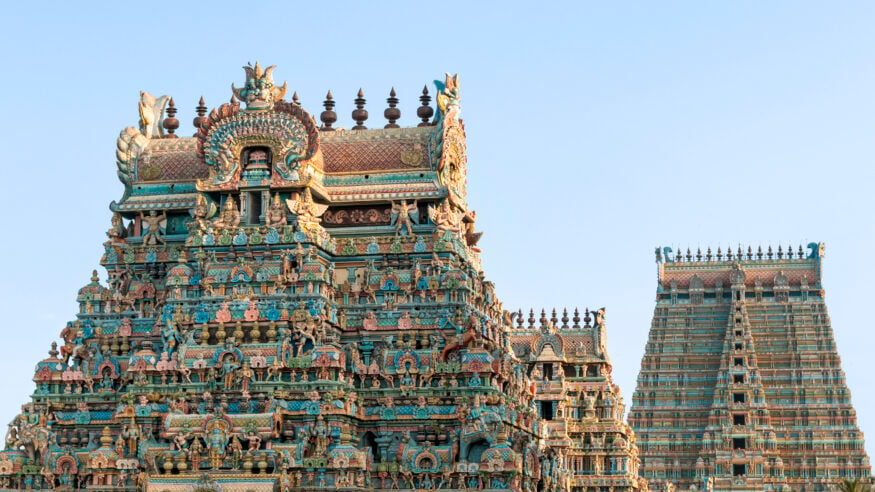
Srirangam as Bhooloka Vaikuntha
Srirangam, the sacred island temple-town of Sri Ranganathaswamy in Tamil Nadu, is not merely a destination on a pilgrimage map. It is a civilizational archive, a living ritual ecosystem, and one of the most profound sacred geographies of the Sri Vaishnava tradition. Situated between the Kaveri and Kollidam rivers, the temple complex is widely regarded as the largest functioning Hindu temple complex in the world, extending across roughly 156 acres and organized through seven concentric enclosures. Its architecture, ritual calendar, hymnic memory, and theological symbolism have made it central to the study of Hindu temples, Vaishnava spirituality, Tamil devotional literature, and the continuity of Sanatana Dharma.
The emotional force of Srirangam is perhaps best introduced through the words of Thondaradippodi Alwar, whose devotion to Lord Ranganatha transforms theology into intimate longing:
Pachai maamalai pol meni pavala vaay kamala sengaN
Achutha amaraR eerae aayar tham kozhunthae ennum
Ichuvai thavira yaan poi indhira logam aalum

Achuvai peRinum vendaen aranga maa nagar uLaanae
“Oh Lord of Srirangam! You have a complexion resembling a lush green mountain, coral-red lips, and beautiful red eyes like a lotus. Oh, Achyutha, the Lord of the celestials and the jewel of the cowherds! This sweet devotion I have for you is so fulfilling that even if I were granted the joy of ruling over Indra’s heaven, I would not desire it over being near you in Srirangam.”
These lines are not devotional ornamentation alone. They establish the central mood of Srirangam: the conviction that proximity to the divine, even for a fleeting moment, exceeds every other form of attainment. During Adhika Maasa, when the Hindu lunar calendar inserts an additional month for spiritual observance, that mood becomes especially intense. The pilgrim does not simply enter an old temple; the pilgrim enters a field of accumulated prayer, philosophical refinement, historical struggle, and living bhakti.
A Journey Redirected Toward Sri Ranga
The journey to Srirangam began unexpectedly. After visiting Tiruvannamalai, the initial plan was to proceed to Chidambaram, another major sacred center of Tamil Nadu. Local guidance, however, indicated that buses to Chidambaram were limited. In the heat of the afternoon, while waiting uncertainly, a bus arrived bearing the word “Trichy” in English. Among several buses marked only in Tamil, this single visible sign created an immediate recognition. The decision to board it seemed practical at first, yet later assumed the character of providence.
Only after boarding did the full meaning of the route become apparent. Trichy is the gateway to Srirangam, the Antya Ranga among the three major Ranganatha kshetras associated with the Kaveri river system. The other two, Adi Ranga at Srirangapattana and Madhya Ranga at Shivanasamudra, had already been visited. What appeared to be a sudden change of travel plan became the completion of a devotional circuit. Sri Ranga was no longer a distant theological reference or a name in hymns; the sacred island had become the next step in an unfolding pilgrimage.
Such moments are common in Hindu pilgrimage narratives. A journey begins with itinerary, transport, inconvenience, language, heat, and uncertainty; yet the devotee later reads those fragments as part of a larger pattern of grace. Srirangam’s power lies partly in this transformation of ordinary travel into sacred movement. The bus stand, the road to Trichy, the confusion over routes, and the sudden recognition of Antya Ranga become part of the pilgrim’s inner preparation.
The Eternal Island of the Reclining Ranganathaswamy
Srirangam stands on a natural island shaped by the Kaveri and Kollidam rivers. Its geography is not incidental. In Hindu sacred geography, rivers are not merely physical watercourses but carriers of memory, sanctity, fertility, and ritual possibility. The Kaveri, venerated as a sacred river of South India, gives Srirangam the character of a tirtha: a crossing point between the material and the spiritual, between historical time and mythic time.
Temple tradition connects Sri Ranganatha with the Itihasa world of the Treta Yuga. The reclining form of Vishnu is said to have belonged to the Ikshvaku dynasty and to Sri Rama, who later gifted the deity to Vibhishana. During Vibhishana’s journey toward Lanka, the deity became established at Srirangam, where He chose to remain. This sacred narrative gives the temple a direct connection to Ramayana memory, linking Sri Rama, Vibhishana, Vishnu bhakti, and the southern landscape into one devotional continuum.
Historically, Srirangam developed through many layers of patronage. Its early foundations are associated with the Sangam and early Chola periods, and the temple expanded substantially under the Cholas, Pandyas, Hoysalas, and Vijayanagara rulers. The result is not a single-period monument but a layered architectural organism. Mandapas, gopurams, enclosures, shrines, processional routes, inscriptions, and ritual spaces together record the work of dynasties, acharyas, artisans, administrators, and generations of devotees.
The temple’s seven concentric enclosures, often described as Saptha-Prakaram, are among its most striking features. They are not only defensive or urban structures; they are theological diagrams in stone. Moving inward through these enclosures, the pilgrim symbolically passes from worldly space into increasingly sanctified space. Commerce, daily life, residence, ritual preparation, shrines, and the final sanctum are not divided as secular and sacred opposites. Rather, Srirangam reveals how dharmic civilization integrates daily life into a sacred order.
The towering Rajagopuram, rising to about 236 feet, intensifies this sense of sacred scale. Yet Srirangam’s greatness does not depend solely on size. Its deeper significance lies in continuity. It remains a functioning temple-town where worship, festivals, recitation, administration, pilgrimage, and community life continue. The temple is not only preserved; it is inhabited, served, sung to, and loved.
The First Darshan in the Early Morning
The first visit began around 5 AM, when the temple was already alive with expectation. A long queue of devotees had formed before entry. Such queues can appear externally as a logistical inconvenience, but within the devotional world they carry another meaning. They gather people of different regions, languages, ages, and social backgrounds into one shared discipline of waiting. In that waiting, the darshan becomes more than sight; it becomes a cultivated readiness.

Upon entering, the grandeur of the temple unfolded gradually. Carved walls, painted surfaces, ancient mandapas, and sacred images conveyed the artistic refinement of South Indian temple architecture. The vigrahas were not encountered as museum objects but as living presences embedded within worship. The atmosphere carried the density of devotion: pilgrims from across Bharat, the disciplined movements of temple staff, the sound of chanting, and the visible presence of ISKCON sannyasis added to the devotional texture of the morning.
A special darshan ticket was purchased in the hope of receiving a clearer glimpse of Sri Ranganathaswamy. Yet the first approach to the sanctum brought uncertainty. The dim light revealed smaller murtis, while the reclining Lord remained partly hidden in the darkness of the sanctum. For a moment, there was confusion over whether the principal deity had truly been seen. This moment is worth noting because it reveals a recurring tension in temple experience: the pilgrim longs for clarity, while the sanctum often offers revelation only through partial sight, shadow, flame, and concentration.
A fellow devotee then pointed toward the reclining form behind the smaller murtis. That gesture, simple and compassionate, changed the experience. Returning quickly to the inner line of sight, the pilgrim saw the cheeks and eyes of Sri Ranganathaswamy in the faint glow of the deepam. It was not a complete visual survey, yet it was enough. In Hindu darshan, completeness is not measured only by optical visibility. A single glimpse, when received with humility and longing, can become permanent in memory.
The emotional response was immediate. Tears followed, not from theatrical sentiment but from the sense that the devotion had been acknowledged. The encounter also carried a practical observation: brighter illumination might help many devotees who travel long distances for the darshan of the reclining Lord. Still, the limitation of light did not diminish the experience. It intensified the awareness that sacred sight often arrives through effort, assistance, grace, and inward attention.
After leaving the sanctum, another meaningful coincidence appeared. A previously written article on Sri Madhya Ranganathaswamy had been published on the very day of this darshan at Srirangam. In devotional interpretation, such timing is not dismissed as ordinary chance. It becomes Krupa, a subtle confirmation that the journey through Adi Ranga, Madhya Ranga, and Antya Ranga had been held together by Sri Ranganatha’s grace.
Vipranarayana and the Mercy of Lord Ranganatha
As the temple visit continued, the memory of Vipranarayana naturally arose. His story is central to the devotional world of Srirangam because it demonstrates a profound principle of bhakti: divine grace does not abandon a devotee even when the devotee becomes inwardly lost. Vipranarayana lived near the Kaveri at Srirangam and dedicated himself to cultivating a garden of tulasi and fragrant flowers for Lord Ranganathaswamy. His life was structured around seva. Each day, he made garlands and offered them to the Lord with single-minded devotion.
That disciplined life was disrupted by Deva Devi, a court dancer whose beauty and determination drew Vipranarayana away from his spiritual routine. In the narrative, she first approached him through disguise and service, gradually winning his confidence. Vipranarayana’s fall is not presented merely as moral failure; it is a study of how attachment can redirect even a disciplined mind when vigilance weakens. The abandoned garden, the neglected garlands, and the broken rhythm of seva become symbols of spiritual displacement.
When his resources were exhausted, Vipranarayana was cast aside and left in despair. At this point, the narrative takes a dramatic theological turn. Lord Ranganatha Himself, unable to bear the suffering of His devotee, assumed the form of Azhagiyamanavala Daasan and carried a golden vessel from the temple treasury to Deva Devi, presenting it as a gift from Vipranarayana. The next morning, the missing vessel was discovered, and Vipranarayana was arrested on suspicion of theft.
In prison, Vipranarayana’s sorrow became self-recognition. He wept not simply out of fear, but because he understood the distance between his earlier devotion and his present condition. That night, Lord Ranganatha appeared in the king’s dream and revealed the truth: Vipranarayana was innocent, and the Lord Himself had taken the vessel to free His devotee from attachment and bring him back to His feet.
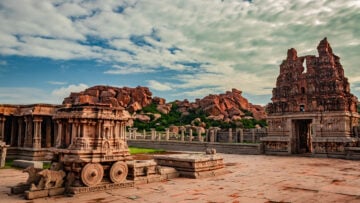
“Vipranarayana is blameless. I broke my own treasury and brought the vessel to Deva Devi myself, merely to free my devotee from the chains of worldly attachment and guide him back to my feet.”
The king released Vipranarayana with honor, and the devotee emerged transformed. He became Thondaradippodi Alvar, “the saint who is the dust at the feet of the Lord’s devotees.” His later hymns, especially the Thirumalai, carry the spiritual force of a person who knew both fall and rescue. The story remains compelling because it refuses spiritual despair. It teaches that a devotee may stumble, but divine compassion can restore the deepest orientation of the soul.
For a modern pilgrim walking through Srirangam, this story gives the temple an added emotional depth. The temple is not only a monument of perfect saints. It is also a place where brokenness, longing, repentance, and restoration are given sacred language. Such narratives keep bhakti traditions accessible to ordinary human beings who know distraction, weakness, and the need for grace.
Pillai Lokacharya and the Protection of Namperumal
Srirangam’s sacred history also includes episodes of danger, preservation, and sacrifice. In the temple-town, a shrine dedicated to Pillai Lokacharya recalls one of the most consequential moments in the history of Sri Vaishnava resilience. The early fourteenth century brought severe political instability to South India, including military campaigns associated with the Delhi Sultanate. Between 1311 and 1323 CE, Srirangam faced grave danger, and the temple community had to protect both the immovable Moolavar, Sri Ranganatha, and the processional deity, Namperumal.
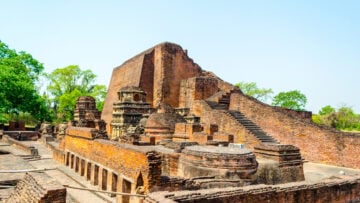
The Moolavar could not be moved quickly because of His size and fixed sanctum position. Temple servants therefore concealed the deity behind a protective wall of brick and stone, blending the barrier into the temple’s architecture. This act of concealment was not abandonment. It was a strategic form of service, a way of preserving the sanctum until safer times returned.
The Utsavar, Namperumal, required another form of protection. As a portable and precious icon, He was vulnerable to seizure. Pillai Lokacharya, already advanced in age, took responsibility for safeguarding Namperumal. The deity was placed in a closed palanquin and carried away with a group of disciples. This journey was dangerous, marked by forests, uncertainty, and the threat of violence. During the escape, the group encountered bandits, and Pillai Lokacharya reportedly surrendered valuables to ensure the safety of the deity.
At Jyotishkudi, exhausted by the journey and burden of responsibility, Pillai Lokacharya attained his final departure. His death is remembered not as defeat but as fulfillment of duty. In the Sri Vaishnava memory of Srirangam, he stands as a guardian whose sacrifice helped preserve the living heart of the temple.
Namperumal’s exile continued for decades. Traditions remember the deity’s movement through places of refuge, including Gingee, Tirupati, and Melukote. Only after the Vijayanagara resurgence under Kumara Kampana in the fourteenth century did Srirangam return to stability. The concealed wall was dismantled, the Moolavar was revealed, and Namperumal returned in triumph. This episode shows that temple history is not simply the history of kings and invasions; it is equally the history of priests, acharyas, disciples, artisans, and communities who understood preservation as a sacred duty.
In a broader dharmic sense, the legacy of Pillai Lokacharya speaks beyond sectarian boundaries. Hinduism, Buddhism, Jainism, and Sikhism have each preserved sacred institutions through periods of hardship, adapting methods of continuity without abandoning spiritual memory. Srirangam’s survival is therefore also a case study in civilizational resilience, showing how devotion and disciplined organization can protect cultural heritage across centuries.
Sri Ramanujacharya and the Architecture of Sri Vaishnava Thought
To understand Srirangam in its mature religious form, one must understand Sri Ramanujacharya (1017–1137 CE). He did not create Vaishnava devotion from nothing; the Tamil Alvars, Nathamuni, and Yamunacharya had already shaped powerful streams of theology, poetry, ritual, and surrender. Ramanujacharya’s genius lay in systematization. He organized inherited devotion into a coherent philosophical, institutional, and liturgical tradition.
At Srirangam, Ramanujacharya strengthened temple administration, ritual order, and community participation. The Kovil Olugu tradition associates him with the structuring of temple service and the integration of different social groups into the functioning of the temple. His vision was not merely managerial. It was theological: the temple was to embody the order of divine grace, where service to the Lord and service to His devotees became inseparable.
His intellectual contribution is equally significant. Ramanujacharya articulated Vishishtadvaita Vedanta, a philosophical system that affirms unity without erasing real difference. The individual self, the universe, and Ishvara are profoundly related, with the Lord as the inner controller and foundation of all existence. This vision avoids both crude dualism and abstract dissolution. It gives metaphysical dignity to the world, to devotion, to the embodied person, and to service.
Srirangam also became a major center of Ubhaya Vedanta, the “dual Vedanta” that honors both Sanskrit Vedic revelation and the Tamil Divya Prabandham. The hymns of Nammalvar and other Alvars were not treated as lesser vernacular devotion but as scriptural expressions of direct spiritual realization. This balance of Sanskrit and Tamil is one of the most important achievements of the Sri Vaishnava Sampradaya. It demonstrates how dharmic traditions can preserve canonical depth while speaking in the language of lived devotion.
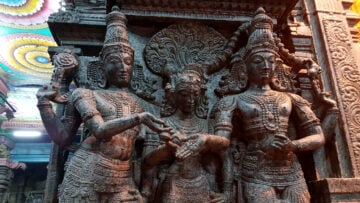
Central to the Srirangam experience is the idea of Vibhuti Dvayam, the two realms under divine sovereignty. Leela Vibhuti refers to the material universe, the realm of time, action, change, and embodied experience. Nitya Vibhuti refers to Vaikuntha, the eternal spiritual realm free from decay and governed by pure divine presence. The temple’s layout may be read as a ritual movement from Leela Vibhuti toward Nitya Vibhuti. The outer enclosures include daily life, shops, streets, and human movement; the inner sanctum reveals the reclining Lord as the axis of eternal reality.
In this sense, Srirangam is rightly called Bhooloka Vaikuntha, Vaikuntha on earth. The phrase is not a poetic exaggeration. It expresses a specific theological insight: the sanctum becomes the point at which the eternal realm is made accessible within the human world. The devotee does not reject the earth in order to seek the divine; rather, the earth itself becomes sanctified through the Lord’s presence.
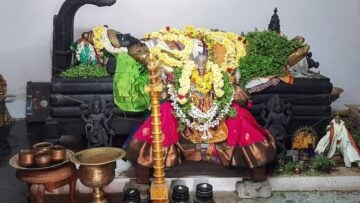
The shrine of Sri Ramanujacharya within Srirangam adds another layer to this sacred geography. Tradition holds that after his departure from the earthly plane in 1137 CE, his physical form was preserved within the temple complex in a seated posture known as Thiruvarasu. Devotees identify the shrine not merely as a memorial but as the continuing presence of the Acharya. Periodic ritual applications using natural substances such as camphor, saffron, and sacred preparations are associated with the preservation of this revered form.
Whether approached through devotion, history, or religious anthropology, the shrine communicates a powerful idea: the Acharya remains within the temple he helped shape. His presence is not abstract. It is spatial, ritual, and communal. Srirangam therefore preserves not only the deity of Lord Ranganatha but also the lineage of teachers who interpreted, served, and transmitted His worship.
Ranganayaki Thayar, the Thousand Pillars, and the Mood of Rest

The pilgrimage continued through other sacred points of the temple. The Thousand Pillars Mandapa, though closed at the time, remained significant as an architectural and historical marker. Such mandapas testify to the temple’s role as more than a place of individual prayer. They supported festivals, assemblies, processions, music, recitation, and artistic life. In South Indian temple culture, architecture and ritual are inseparable; stone creates the pathways through which community devotion moves.
Darshan of Sri Ranganayaki Thayar brought the devotional experience into balance. In Sri Vaishnava theology, Thayar’s presence is indispensable. She is associated with compassion, mediation, and the maternal accessibility of divine grace. A temple centered on Sri Ranganatha is therefore also a temple shaped by Sri Ranganayaki’s tenderness. The devotee approaches the Lord not through fear alone, but through the assurance of mercy.
After the sequence of darshans, sitting quietly in the temple for more than an hour allowed the experience to settle. This period of stillness is often the most meaningful part of pilgrimage. Once movement ceases, the temple begins to speak differently. The lives of the Alvars, the discipline of acharyas, the tears of ordinary devotees, the labor of artisans, the courage of preservers, and the daily rhythm of worship become one continuous field of reflection.
Srirangam has inspired saints because it offers a rare union of scale and intimacy. Its walls are vast, its gopurams monumental, and its historical memory immense. Yet the decisive moment may still be a partial glimpse of the Lord’s eyes in lamplight, a stranger’s gesture in a queue, or a quiet seat in a prakaram after darshan. This combination of public grandeur and private tenderness is one reason the temple continues to shape Hindu spirituality across regions and generations.
Thiruppan Alvar and the Final Captivation of Sight
The final mood of Srirangam is captured by Thiruppan Alvar, whose hymns describe the progressive vision of Lord Ranganatha from His feet upward. One of the remembered verses says:
“Amalan ādi pirān aḍiyārkkennai āṭpaḍutta vimalanviṇṇavar kōn viraiyār pozhil vēṅgaḍavan nimalanninmalan nīdi vānavan nīḷ madhil araṅgaththammānthirukkamala pādam vandhu en kaṇṇinuḷḷana okkinradhē.“
The verse expresses the total transformation of vision. Having seen the Lord of Srirangam, the eyes no longer seek ordinary objects with the same hunger. The deep complexion of the Lord, His beauty as the cowherd Krishna, His sovereignty over the celestials, and His presence within the great walls of Srirangam all converge into one experience of spiritual captivation. The theological claim is clear: darshan reorders perception.
That is the enduring lesson of Srirangam. The temple does not merely provide historical information, aesthetic pleasure, or ritual merit. It re-educates the senses. It teaches the eyes to seek sacred form, the mind to remember lineage, the body to wait and walk in discipline, and the heart to understand grace as something both majestic and intimate.
In the end, Srirangam remains a place where Nammalvar’s devotional inheritance, Thondaradippodi Alwar’s humility, Thiruppan Alvar’s vision, Pillai Lokacharya’s sacrifice, and Ramanujacharya’s philosophical architecture meet at the reclining form of Sri Ranganathaswamy. The pilgrim leaves the island physically, but the experience does not leave the pilgrim. The presence of Sri Ranganathaswamy continues inwardly, carried as memory, instruction, and grace.
Srirangam therefore stands as one of the great living centers of Hindu pilgrimage, temple history, Sri Vaishnava philosophy, and spiritual continuity. It is a sacred geography where history is not dead, poetry is not decorative, ritual is not mechanical, and devotion is not sentimental excess. It is Bhooloka Vaikuntha: the place where the eternal enters the earthly, and where even a partial glimpse can become a lifetime’s inner light.
Inspired by this post on Indica Today.






Leave a Reply
You must be logged in to post a comment.