
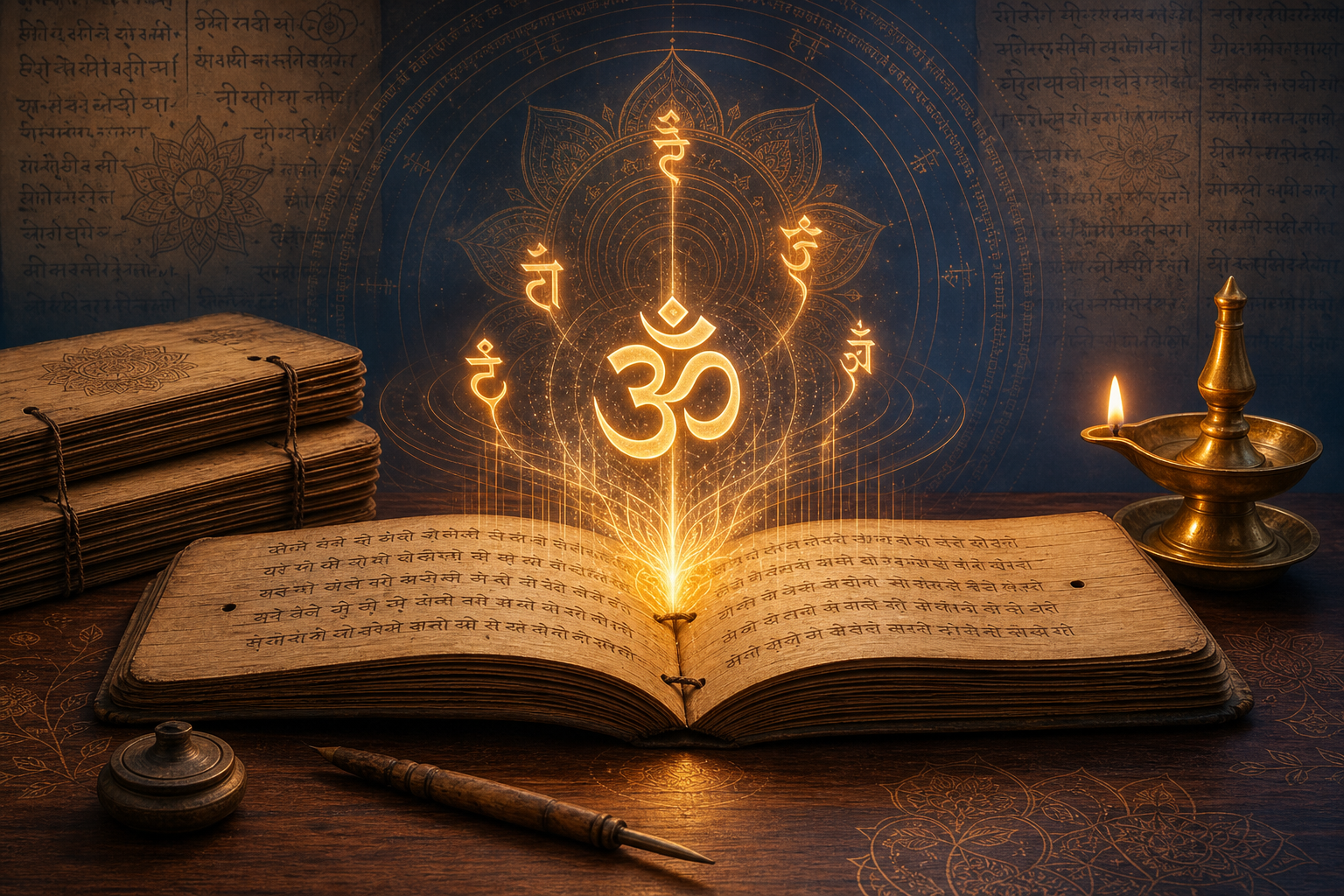
The Ekaksharakosha, attributed to Purushottamadeva, occupies a compact yet intellectually significant place in the Sanskrit lexicographical tradition. Its title literally points to a “treasury of single syllables” or “one-letter words,” and that description immediately places it near one of the most fascinating boundaries in Indian thought: the boundary between language, sound, meaning, memory, mantra, and metaphysics.
In ordinary language study, a dictionary is expected to define words. In the world of Sanskrit learning, however, a kosha or nighantu often does much more. It preserves layers of meaning, poetic usages, technical associations, ritual vocabulary, philosophical implications, and traditional correspondences. The Ekaksharakosha becomes especially important because it turns attention to the smallest meaningful sound units: single syllables that may function as words, names, symbols, or sacred sound-forms.
This concern with compact sound is one reason the text becomes relevant to Tantrism. Tantric traditions, especially within Shaiva, Shakta, Vaishnava, Buddhist, and broader Dharmic streams, often treat sound not merely as a vehicle of communication but as a form of power. A syllable may be understood as a seed, a doorway, a condensed presence, or a sonic body of a deity, principle, or state of consciousness. The Sanskrit term bīja, meaning “seed,” captures this idea with unusual precision.
The Ekaksharakosha should not be reduced to a Tantric manual. It is best understood as a lexicon that becomes useful for Tantric interpretation because Tantra itself gives extraordinary importance to single syllables. When a tradition meditates upon Om, Hrīṃ, Śrīṃ, Klīṃ, Aiṃ, Haṃ, or other sacred sounds, the question of how syllables carry meaning becomes more than grammatical. It becomes theological, ritual, psychological, and contemplative.
Purushottamadeva belongs to the wider Sanskrit scholarly world in which grammar, lexicography, poetics, ritual, and philosophy were deeply interconnected. Such works were not composed for casual reading. They were tools for students, ritual specialists, poets, teachers, commentators, and seekers who needed to move confidently through dense Sanskrit literature. A single syllable in a mantra, hymn, commentary, or Tantric passage could carry multiple meanings, and a lexicon helped preserve those possibilities.
The technical value of the Ekaksharakosha lies in its recognition that Sanskrit meaning is not always linear. A sound may have a grammatical role, a lexical meaning, a symbolic association, and a ritual use at the same time. This layered approach is central to many Dharmic traditions, where language is treated as a disciplined field rather than a merely arbitrary system. The text therefore reflects an intellectual culture in which precision and sacred imagination operate together.
Tantric traditions often speak of sound as śabda, vibration, mantra, or the subtle expression of consciousness. In this view, the universe is not silent matter awaiting description; it is already patterned, resonant, and meaningful. Sanskrit phonetics, with its careful organization of vowels, consonants, points of articulation, aspiration, nasality, and resonance, offered Indian thinkers a refined map for exploring this relationship between sound and reality.
The importance of single syllables becomes clearer when the concept of mantra is examined. A mantra is not merely a phrase repeated for emotional comfort. In many traditions, it is a structured sound-form received through lineage, recited with discipline, and understood through layers of ritual and philosophical interpretation. A bīja mantra is even more condensed. It is like a seed that contains a whole tree in potential form. Its force lies in compression.
For this reason, a one-syllable lexicon carries significance beyond vocabulary. It offers a way of seeing how Indian scholarship noticed the density of sound. The Ekaksharakosha preserves the idea that even the smallest vocal unit may carry a network of meanings. In Tantric reading, this becomes especially suggestive because the bīja is never “small” in a spiritual sense. It is small only in outward form; inwardly, it may represent a deity, a cosmic principle, a chakra, an element, or a state of realization.
The most famous example is Om, also written as Oṃ or Aum. In the Upanishadic and later Dharmic imagination, Om is not a decorative sound. It is associated with Brahman, the totality of existence, the waking, dreaming, deep sleep, and transcendent states, and the sacred beginning of recitation. Tantric traditions inherit and reinterpret this sound in many ways, often placing it at the beginning of mantras as a sanctifying and energizing syllable.
Other bīja sounds are linked with specific deities, powers, or modes of worship. Hrīṃ is frequently associated with Shakti and the heart of divine manifestation. Śrīṃ is often connected with Lakshmi, auspiciousness, beauty, abundance, and radiance. Aiṃ is associated with Saraswati, learning, speech, and knowledge. Klīṃ is often connected with attraction, devotion, and the power of relational energy. These associations vary by lineage and text, so they must be handled with care rather than flattened into universal formulas.
The Ekaksharakosha is valuable in this context because it belongs to a culture of disciplined interpretation. It reminds the reader that a syllable does not become meaningful through imagination alone. Meaning is shaped through usage, tradition, grammar, recitation, commentary, and lived practice. Tantrism may intensify the spiritual significance of sound, but it does so within inherited systems of Sanskrit learning.
This is especially important for modern readers. In contemporary spiritual culture, bīja mantras are often presented as quick tools for relaxation, manifestation, or personal empowerment. Such uses may reflect genuine interest, but they can also remove mantras from their ritual, ethical, and philosophical setting. A text such as the Ekaksharakosha helps restore seriousness to the discussion. It shows that sacred sound belongs to a sophisticated knowledge tradition, not to casual novelty.
The academic study of the Ekaksharakosha also reveals the unity and diversity of Dharmic traditions. Hindu Tantric lineages, Buddhist mantra traditions, Jain engagements with sacred syllables, and Sikh reverence for Naam and sacred utterance do not collapse into one identical system. Yet they share a deep respect for the transformative capacity of sound, disciplined remembrance, and awakened speech. This shared reverence can be studied without erasing difference.
In Hindu traditions, sound is closely connected with Vāc, speech as sacred presence. The Vedas themselves are preserved through exact oral recitation, and their authority is inseparable from sound. In Tantric traditions, this inheritance becomes more explicitly mapped onto the subtle body, deity worship, mantra initiation, and contemplative practice. The Sanskrit alphabet may be visualized as a garland of powers, and letters may be installed ritually within the body through nyāsa.
In Buddhist Tantric traditions, especially within Vajrayana, seed syllables often function as visual and sonic centers of meditation. A deity may be visualized as arising from a syllable, and the syllable may itself represent awakened mind. This does not make Buddhist and Hindu Tantric systems identical, but it does show how Indian and trans-Indian contemplative cultures used sound as a bridge between language and realization.
Jain traditions, while often distinct in theological structure, also give profound importance to sacred formulae such as the Namokar Mantra. Its power lies not in worship of a creator deity but in reverence for liberated beings, teachers, and spiritual excellence. Sikh tradition, too, places extraordinary emphasis on Naam, Shabad, and the transformative remembrance of the Divine. These traditions should be understood in their own terms, yet their shared respect for sacred sound contributes to a broader Dharmic conversation.
From this perspective, the Ekaksharakosha becomes more than a narrow lexical artifact. It is a reminder that Indian knowledge systems often work through subtlety. A small syllable can carry philosophical weight. A brief sound can open a long chain of associations. A compact lexicon can preserve a worldview in which language, memory, ritual, poetry, and liberation are connected.
The text also invites reflection on how Sanskrit dictionaries differ from many modern expectations of reference books. A modern dictionary usually aims to give practical definitions for contemporary usage. A Sanskrit kosha, especially in the older tradition, may preserve synonyms, rare meanings, mythic associations, divine names, poetic equivalences, and technical applications. It is not merely descriptive; it is pedagogical and cultural.
This pedagogical role matters because Sanskrit learning historically depended on memory. Students often memorized grammatical rules, verbal roots, meters, lists of synonyms, and condensed technical texts. A one-syllable lexicon would serve this mnemonic world well. It arranged knowledge in concentrated form, making it easier for trained readers to recall meanings while interpreting poetry, scripture, ritual manuals, or philosophical passages.
Tantrism added another dimension to this culture of memory. In ritual practice, the exact sound of a mantra matters. Pronunciation, initiation, intention, rhythm, breath, visualization, and lineage guidance are often treated as essential. This is why the study of sacred syllables cannot be separated from discipline. A bīja is not simply an object of curiosity; in a traditional context, it is approached with preparation and reverence.
The relationship between letter and body is one of the most distinctive features of Tantric thought. Many Tantric systems associate letters with chakras, petals, subtle channels, deities, elements, and forms of consciousness. The body is not treated as an obstacle to spirituality but as a field of sacred correspondence. Sound enters this field through recitation, breath, visualization, and awareness.
This approach can feel unfamiliar to modern readers trained to separate language from embodiment. Yet everyday experience already shows that sound affects the body. A harsh word can disturb the nervous system; a gentle chant can steady breathing; a remembered phrase can evoke grief, courage, or devotion. Tantric traditions develop this ordinary insight into a highly disciplined spiritual science. They ask what happens when sound is refined, sanctified, repeated, and aligned with consciousness.
The Ekaksharakosha contributes to this inquiry by preserving the semantic possibilities of small sound units. Even when it does not prescribe ritual practice, it supports the interpretive world in which ritual practice becomes intelligible. A practitioner, commentator, or scholar encountering a syllable in a mantra may ask: what does this sound signify, what names does it evoke, what tradition surrounds it, and how has it been understood?
Such questions are essential because Tantric language is often intentionally compressed. A mantra may not explain itself in prose. A diagram, deity-form, syllable, gesture, or ritual sequence may hold meaning in symbolic form. Lexicons, commentaries, and oral instruction become necessary companions. Without them, the reader may either dismiss the material as obscure or romanticize it without understanding.
Academic clarity therefore requires two cautions. First, not every Sanskrit syllable in a lexicon is automatically a Tantric bīja. Second, not every Tantric bīja can be fully explained by dictionary meaning alone. The power of mantra in traditional settings depends on more than lexical definition. It involves lineage, ritual authorization, sound, repetition, meditation, ethical preparation, and the inner orientation of the practitioner.
At the same time, lexical knowledge should not be dismissed. Traditional Indian scholarship rarely separates practice from learning. Grammar, phonetics, hermeneutics, and ritual are mutually supportive. The precision of Sanskrit grammar protects meaning; the science of phonetics protects sound; the lexicon preserves semantic range; the tradition of practice gives these tools a living purpose.
The Ekaksharakosha also demonstrates the Indian tendency to see richness in brevity. This is visible across Sanskrit intellectual culture: sutras compress systems into aphorisms, mantras condense devotion into sound, seed syllables compress deity into vibration, and philosophical terms carry centuries of debate. Brevity is not treated as emptiness. It is treated as concentrated potential.
For students of Sanskrit, this is both beautiful and demanding. A single syllable may open into multiple meanings depending on context. A word may function differently in Vedic recitation, classical poetry, grammar, Vedanta, Tantra, ritual instruction, or devotional literature. The reader must develop patience. The tradition rewards slow reading, careful listening, and humility before inherited knowledge.
For students of Tantrism, the lesson is equally important. Tantra cannot be understood only through dramatic imagery, secret rituals, or modern stereotypes. It must be studied through texts, lineages, metaphysics, language, temple traditions, philosophy, art, yoga, and lived devotion. The Ekaksharakosha points to this quieter side of Tantric study: the disciplined attention to sound and meaning.
This disciplined attention can also serve a contemporary cultural purpose. Many misunderstandings about Tantra arise because it is either sensationalized or dismissed. A study of texts such as the Ekaksharakosha helps restore balance. It shows that Tantric traditions are not anti-intellectual. They are rooted in complex systems of interpretation, practice, and sacred language.
The text’s relevance to Dharmic unity lies in this shared reverence for disciplined sound. Hinduism, Buddhism, Jainism, and Sikhism each maintain distinctive doctrinal identities, yet all recognize that speech can shape consciousness. Whether through mantra, japa, stotra, sutra, Naam, or sacred recitation, sound becomes a medium of remembrance, purification, insight, and devotion.
This unity should not be sentimentalized. It is strongest when grounded in accurate study. Respect among Dharmic traditions grows when each tradition is understood carefully and sympathetically. The Ekaksharakosha contributes to such study by revealing how much intellectual care was invested in the smallest units of sacred language.
Modern readers may find emotional resonance here as well. In a noisy age, the idea that one syllable can hold meaning is deeply countercultural. It invites attention rather than distraction. It suggests that depth is not always found in volume, speed, or complexity. Sometimes depth appears in a single sound repeated with awareness, received through tradition, and contemplated with sincerity.
The Ekaksharakosha therefore deserves to be studied not as an isolated curiosity but as part of a larger Sanskrit and Tantric ecology. It belongs beside grammar, phonetics, mantra-shastra, ritual manuals, philosophical commentaries, and devotional practice. It shows how the Sanskrit tradition trained the mind to notice the power of small forms.
Its enduring significance lies in the insight that sound, meaning, and consciousness are deeply connected. In Tantrism, this insight becomes a spiritual method. In Sanskrit lexicography, it becomes a scholarly discipline. In Dharmic culture more broadly, it becomes a way of honoring speech as sacred responsibility. The one syllable is never merely one syllable; it may be a doorway into language, memory, deity, knowledge, and inner transformation.
Inspired by this post on Hindu Blog.
