
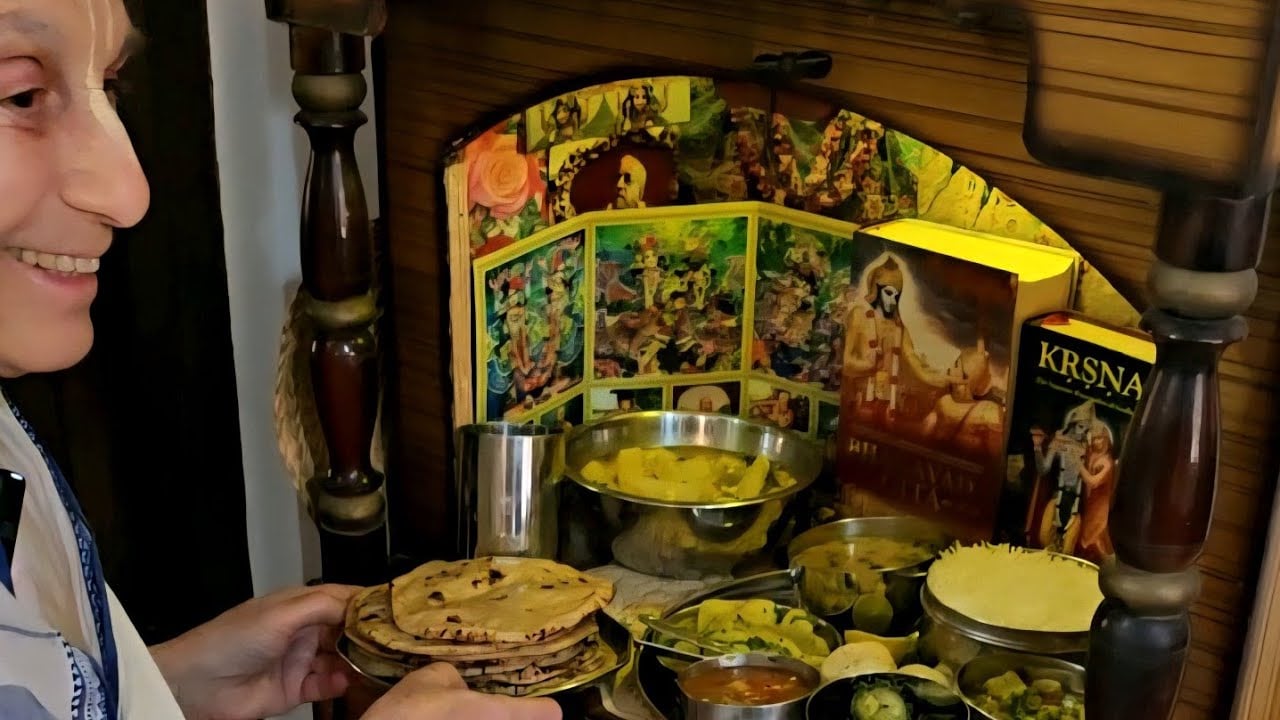
Her Grace Daiviśakti Mataji’s cooking class on preparing a lunch for Srila Prabhupada with his special 3-tiered cooker offers more than a kitchen demonstration. It preserves a living memory of devotional service, culinary discipline, and the quiet theological depth behind prasadam in the Hare Krishna tradition. What may appear outwardly as a “basic” lunch becomes, on closer examination, a precise devotional practice shaped by cleanliness, timing, ingredient consciousness, humility, and reverence for the spiritual master.
The video, shared through the Sankirtana_ocean channel, presents Her Grace Daiviśakti Mataji as she explains how she would prepare lunch for Srila Prabhupada using the distinctive 3-tiered cooker associated with that service. The surviving description emphasizes the spontaneous nature of the class and the rare value of seeing a devotee explain a method learned through direct devotional experience rather than through abstract theory alone.
Srila Prabhupada, the founder-acharya of ISKCON, brought Krishna consciousness to a global audience in the twentieth century and placed extraordinary emphasis on prasadam, the sanctified vegetarian food offered first to Lord Krishna. In that tradition, cooking is not merely domestic labor. It is seva, a disciplined offering of body, mind, senses, resources, and intention. The cook’s task is therefore both practical and contemplative: food must be prepared properly, but the consciousness behind the preparation is treated as equally important.
The 3-tiered cooker is significant because it reflects a practical economy of time, heat, space, and attention. A stacked cooking system allows several preparations to be coordinated at once, usually with steam and contained heat moving efficiently through multiple levels. In a devotional kitchen, this kind of arrangement is not simply a matter of convenience. It supports punctuality, reduces unnecessary disturbance, and helps the cook maintain focus while preparing several components of a meal in a controlled sequence.
Traditional Vaishnava cooking for offering generally rests on a few consistent principles. The food is vegetarian, prepared without tasting during cooking, kept clean from the beginning, and offered to Krishna before being honored as prasadam. Within many ISKCON kitchens, preparations avoid meat, fish, eggs, onion, and garlic, reflecting the community’s long-standing standards for sattvic devotional food. These standards are not arbitrary restrictions; they are part of a wider discipline meant to cultivate clarity, restraint, and spiritual awareness.
A lunch prepared for Srila Prabhupada would naturally be approached with particular seriousness. The spiritual master is not treated as a casual diner but as a representative of the guru-parampara, the disciplic succession through which sacred knowledge is received and practiced. In that context, every detail matters: the purity of ingredients, the condition of the cooking vessels, the order of preparation, the temperature of serving, and the mood with which the meal is assembled.
The word “basic” in this setting deserves careful attention. A basic lunch does not mean careless, plain, or spiritually ordinary. It suggests a foundational meal, one that depends on disciplined essentials rather than ornamental excess. Rice, dal, vegetables, breads, chutneys, sweets, or other accompaniments may appear according to circumstance, but the heart of the preparation remains the same: nourishing food, cleanly cooked, respectfully offered, and served with devotion.
Her Grace Daiviśakti Mataji’s contribution is valuable because women devotees have often carried, preserved, and transmitted the practical culture of temple life through kitchens, home worship, festival preparation, and personal service. Academic accounts of religious movements sometimes focus heavily on institutions, public preaching, or doctrinal debates, yet the devotional kitchen is one of the places where theology becomes daily practice. The preparation of prasadam demonstrates how belief is embodied through touch, timing, discipline, and care.
The emotional force of such a class lies in its ordinariness. Many people encounter religion through ceremonies, scriptures, or public festivals, but devotional culture often becomes most understandable through repeated acts of service. Washing vegetables, measuring grains, managing steam, cleaning vessels, and arranging a plate can become forms of remembrance. The kitchen becomes a small sacred space where attention is trained and where practical skill becomes inseparable from spiritual intention.
In Krishna consciousness, prasadam also carries a social and cultural significance. Food offered to Krishna is then distributed and honored, making it a bridge between worship and community. This principle has helped ISKCON communities across the world create temples, festivals, restaurants, relief programs, and home gatherings where people encounter dharmic spirituality through taste, hospitality, and shared nourishment. The sacred meal is therefore both personal and communal.
The practice also resonates with broader dharmic traditions. Hinduism, Buddhism, Jainism, and Sikhism each contain rich food ethics shaped by compassion, restraint, non-harm, gratitude, and community service. While their theological frameworks differ, the shared respect for mindful preparation and sanctified eating helps illuminate a common civilizational thread. A Vaishnava cooking class, when understood generously, can therefore support unity among dharmic traditions rather than sectarian separation.
Cleanliness is central to this discipline. In devotional cooking, cleanliness extends beyond visible hygiene. It includes organized space, clean utensils, fresh ingredients, mental steadiness, and disciplined conduct. A cook preparing for an offering avoids casual tasting, idle handling, and distracted behavior because the kitchen is treated as an extension of worship. Such standards may seem demanding to modern habits, but they preserve the sacred boundary between ordinary consumption and devotional offering.
The 3-tiered cooker also teaches an important lesson in restraint. Modern kitchens often celebrate abundance, variety, and display, but a compact multi-level cooker emphasizes coordination and simplicity. It asks the cook to think through sequence, moisture, heat, density, and timing. The heavier or longer-cooking items require proper placement and planning; the more delicate preparations require protection from overcooking. Such attention transforms cooking into a technical discipline guided by devotional purpose.
This is why the class matters as oral history. Devotional communities preserve their heritage not only through books and lectures but also through remembered procedures. A senior devotee showing how lunch was prepared for Srila Prabhupada provides a form of embodied archive. The gestures, sequence, cautions, and practical observations carry a kind of knowledge that written recipes alone often fail to communicate.
The spiritual logic behind the practice can be traced to the Bhagavad Gita’s teaching that Krishna accepts offerings made with devotion. The emphasis falls not on extravagance but on bhakti. This principle explains why a simple meal can be spiritually profound when prepared with sincerity. The value of the offering is not measured only by culinary complexity; it is measured by purity of intention, adherence to devotional standards, and serviceful consciousness.
For contemporary readers, the lesson is highly practical. A devotional kitchen does not require theatrical display. It requires order, care, humility, and consistency. Even in a modern apartment or small family kitchen, the same principles can be honored: clean the space, choose wholesome ingredients, cook without agitation, avoid waste, remember the divine purpose of the meal, and offer the food before eating. Such habits slowly reshape the relationship between the body, mind, food, and sacred life.
There is also a valuable ecological and ethical dimension. A simple vegetarian lunch prepared with attention to purity and moderation naturally encourages resource efficiency, reduced waste, and mindful consumption. The 3-tiered cooker itself represents a compact method of cooking that can conserve energy and time. In this respect, traditional devotional practice aligns with contemporary concerns about sustainable living, even though its primary motivation remains spiritual rather than merely environmental.
The class also challenges a common misconception that spirituality belongs only to meditation rooms, temples, or philosophical discussions. In the bhakti tradition, the ordinary activities of life can be spiritualized when connected with Krishna. Cooking becomes meditation. Serving becomes worship. Eating becomes gratitude. Cleaning becomes discipline. This integration of daily life and spiritual practice is one reason Krishna consciousness has remained accessible across cultures and generations.
Her Grace Daiviśakti Mataji’s demonstration therefore deserves attention not merely as a nostalgic recollection of Srila Prabhupada’s personal service, but as a practical lesson in how a dharmic household or temple kitchen can function. It shows how knowledge travels through hands, habits, vessels, recipes, and remembrance. It also honors the unseen devotional labor that sustains spiritual communities from one generation to the next.
The enduring message is clear: prasadam begins before the plate reaches the altar. It begins in the cook’s consciousness, in the selection of ingredients, in the cleanliness of the workspace, in the disciplined use of tools, and in the intention to serve. A 3-tiered cooker may be a practical kitchen instrument, but in this context it becomes part of a sacred technology of devotion, helping transform a simple lunch into an offering of love, memory, and disciplined bhakti.
Inspired by this post on Dandavats.









Leave a Reply
You must be logged in to post a comment.