
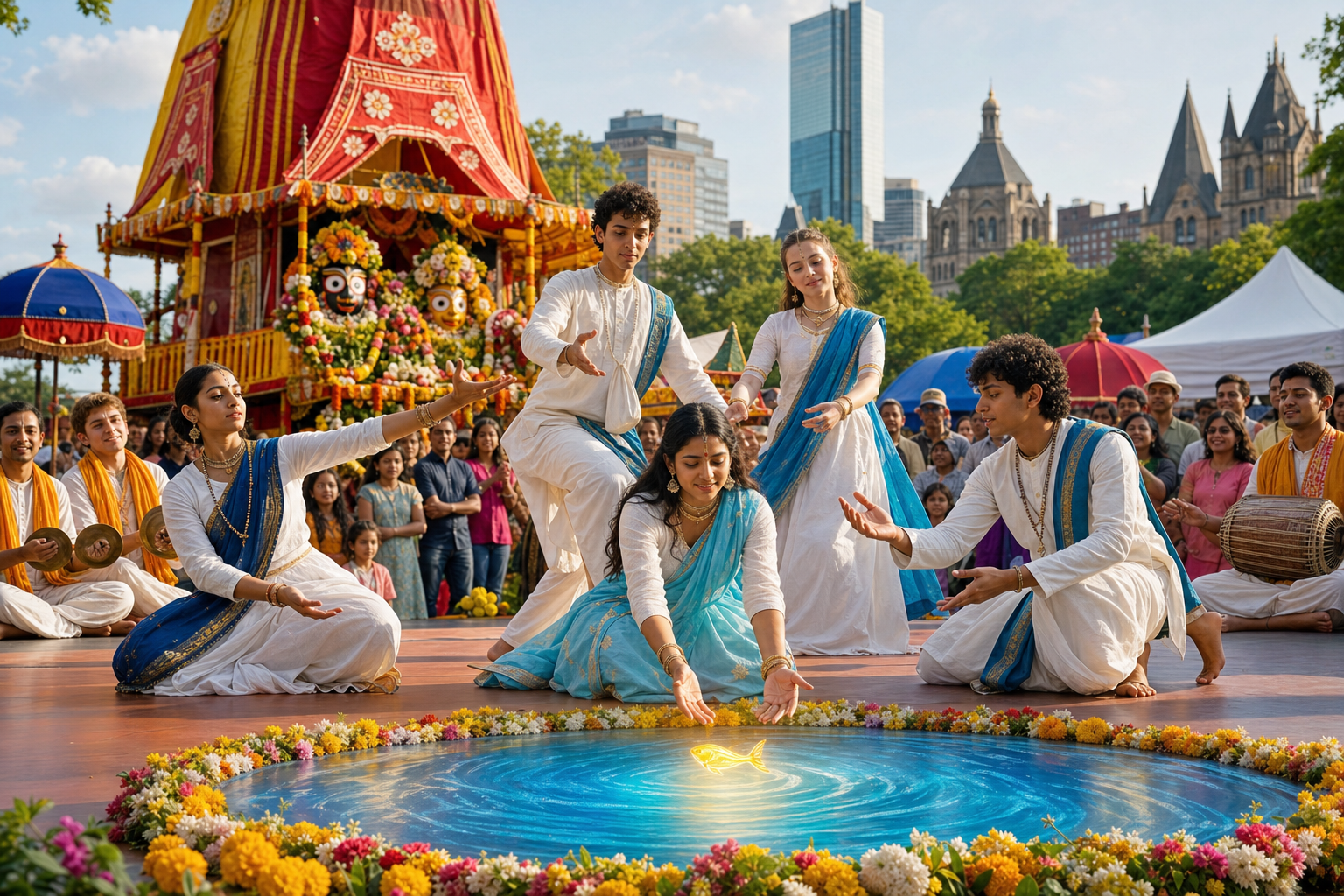
The stage presentation titled “Fish Out Of Water”, performed by the ISKCON Youth Ministry Bus Tour at Boston Ratha Yatra 2026, stands as more than a cultural program attached to a public festival. It represents a living example of how devotional theatre, youth education, and diaspora community life can come together around the wider spiritual universe of Lord Jagannath, Sri Krishna, bhakti, seva, and shared dharmic values.
Boston Ratha Yatra belongs to the broader Hare Krishna Festival of Chariots tradition, a public celebration rooted in the ancient Jagannath Ratha Yatra of Puri. In that tradition, Lord Jagannath, Lord Baladeva, and Subhadra Devi are brought before the public in a chariot procession, symbolically making divine presence accessible beyond the walls of the temple. This accessibility is central to the event’s devotional power: the sacred does not remain distant, restricted, or abstract, but enters the public street through music, prasadam, kirtan, dance, theatre, and community participation.
The title “Fish Out Of Water” carries a strong metaphorical force. A fish removed from water may still appear alive for a moment, but it has been separated from the very element that sustains it. In a Vaishnava devotional reading, the image can be understood as the condition of the jiva, the individual soul, when separated from conscious remembrance of Krishna. The phrase is simple enough for a young audience, yet philosophically rich enough to carry deeper reflections on identity, belonging, alienation, and spiritual nourishment.
As a youth performance, the play’s significance lies not merely in its entertainment value but in its pedagogical method. Theatre allows philosophical themes to become embodied. Instead of presenting Krishna consciousness only through lectures or formal instruction, dramatic storytelling allows young performers and viewers to encounter ideas through movement, dialogue, humor, music, emotion, and conflict. This is particularly effective for second-generation and third-generation Hindu diaspora communities, where cultural memory must often be transmitted across languages, geographies, and social environments.
The ISKCON Youth Ministry Bus Tour has long been associated with bringing young devotees into active service through travel, performance, kirtan, and festival participation. The bus tour model is educational in a practical sense: participants learn teamwork, discipline, punctuality, public presentation, devotional etiquette, and responsibility toward a larger community. These are not minor outcomes. They form the social architecture through which spiritual identity becomes stable, lived, and joyful rather than theoretical or inherited only in name.
Within the context of Boston Ratha Yatra 2026, “Fish Out Of Water” can be understood as part of a larger cultural ecosystem. Ratha Yatra is not only a procession; it is a public classroom. Its chariots, kirtan, prasadam distribution, books, dance, and stage performances each communicate a different dimension of Sanatana Dharma. A play by youth performers adds a particularly important voice because it shows that Hindu culture and Vaishnava spirituality are not museum pieces preserved only by elders. They remain creative, adaptable, and meaningful in the hands of a new generation.
The emotional appeal of such a play comes from its relatability. Many young people in diaspora settings know what it means to feel displaced, misunderstood, or caught between worlds. The phrase “fish out of water” can describe the experience of being spiritually curious in a secular environment, culturally Indian in a Western setting, religiously observant among peers who may not understand devotion, or inwardly searching while surrounded by constant distraction. A devotional play can translate these tensions into a shared language without reducing them to complaint or identity politics.
From an academic perspective, the performance belongs to a long Indian tradition in which sacred ideas are transmitted through art. The Nāṭyaśāstra, temple performance traditions, kirtan, bhajans, kathakatha, dance drama, and festival theatre all show that Indian civilization has rarely treated art as separate from spiritual instruction. Performance is not only aesthetic; it is ethical, communal, and transformative. In this sense, a youth play at Ratha Yatra participates in an old civilizational pattern while speaking in a contemporary idiom.
The Vaishnava emphasis on bhakti gives the theme additional depth. Bhakti is not simply emotion; it is disciplined love directed toward the Supreme. In Krishna consciousness, the soul’s natural state is understood as loving service to Krishna. When that relationship is forgotten, human life can become restless, performative, and fragmented. The image of a fish outside water therefore becomes an accessible theological statement: the soul flourishes when situated in its proper spiritual environment.
This message also has relevance beyond one sampradaya. The broader dharmic family, including Hinduism, Buddhism, Jainism, and Sikhism, has repeatedly emphasized that human life requires inner discipline, ethical clarity, and liberation from ego-driven confusion. While these traditions differ in doctrine and practice, they share a serious concern for self-transformation. A performance such as “Fish Out Of Water” can therefore be appreciated as part of a wider dharmic conversation about how people become disconnected from wisdom and how they return to a more truthful way of living.
There is also a sociological dimension to the performance. Youth-led religious art helps communities avoid the passive consumption of culture. When young devotees rehearse, memorize, collaborate, travel, and perform, they become producers of culture rather than spectators. This shift matters deeply for Hindu diaspora life. A community survives across generations not only by preserving rituals, but by enabling young people to create meaningful forms of participation within those rituals.
The public setting of Ratha Yatra adds another layer of importance. Unlike private temple events, a street festival invites neighbors, students, families, curious passersby, and people from diverse backgrounds to encounter Hindu devotional culture in an open civic space. In such a setting, a youth drama can serve as a bridge. It can communicate without requiring prior theological knowledge, and it can invite reflection without demanding immediate agreement. This is one of the strengths of festival culture: it teaches through hospitality.
The Boston setting is especially meaningful because the city is associated with universities, intellectual exchange, immigrant histories, and interfaith visibility. A Ratha Yatra performance in such an environment becomes part of a larger conversation about religious pluralism and cultural confidence. The presence of ISKCON youth on stage signals that Hindu and Vaishnava traditions can participate in public life with intelligence, discipline, artistic expression, and openness.
The technical strength of devotional theatre lies in compression. A short play can condense philosophy, social observation, humor, and moral instruction into a form that audiences remember. Visual cues, costumes, gestures, music, and pacing help create emotional memory. When a young person sees peers embody spiritual struggle and resolution on stage, the message can become more immediate than abstract explanation. This is why performance has remained central to Hindu cultural transmission for centuries.
The supplied source material provides only the title, image reference, and basic attribution, so specific claims about the full plot, dialogue, staging, or cast should be treated cautiously unless a complete video or transcript is available. Even with that limitation, the framing is clear enough to identify the event as a youth-led ISKCON cultural performance connected to Boston Ratha Yatra 2026. Responsible interpretation therefore focuses on the verifiable context: the title, the performers, the festival setting, and the well-established devotional and cultural meanings associated with Ratha Yatra and Krishna consciousness.
The value of “Fish Out Of Water” ultimately lies in how it invites reflection on spiritual belonging. In a world where young people often face distraction, loneliness, social pressure, and identity confusion, the play’s central metaphor can be read as a reminder that human beings need more than achievement, entertainment, and external validation. They need a sustaining inner environment. In the bhakti tradition, that environment is cultivated through remembrance of Krishna, association with devotees, service, sacred sound, prasadam, and a life aligned with dharma.
For families and community leaders, the performance offers a practical lesson. Youth engagement cannot depend only on instruction from above. It must include trust, responsibility, artistic opportunity, and meaningful service. When young devotees are given the stage, they do not merely repeat tradition; they test it, inhabit it, and make it speak to their own generation. That process is essential for the continuity of Hindu culture and the vitality of the Hare Krishna movement.
Seen in this light, “Fish Out Of Water” is not just the name of a play. It is a compact spiritual diagnosis and a hopeful cultural response. It suggests that disconnection is real, but not final. Through devotion, community, disciplined practice, and creative expression, the soul can return to its sustaining element. At Boston Ratha Yatra 2026, the ISKCON Youth Ministry Bus Tour appears to have used theatre to make that message visible, memorable, and emotionally accessible.
Inspired by this post on Dandavats.








Leave a Reply
You must be logged in to post a comment.