
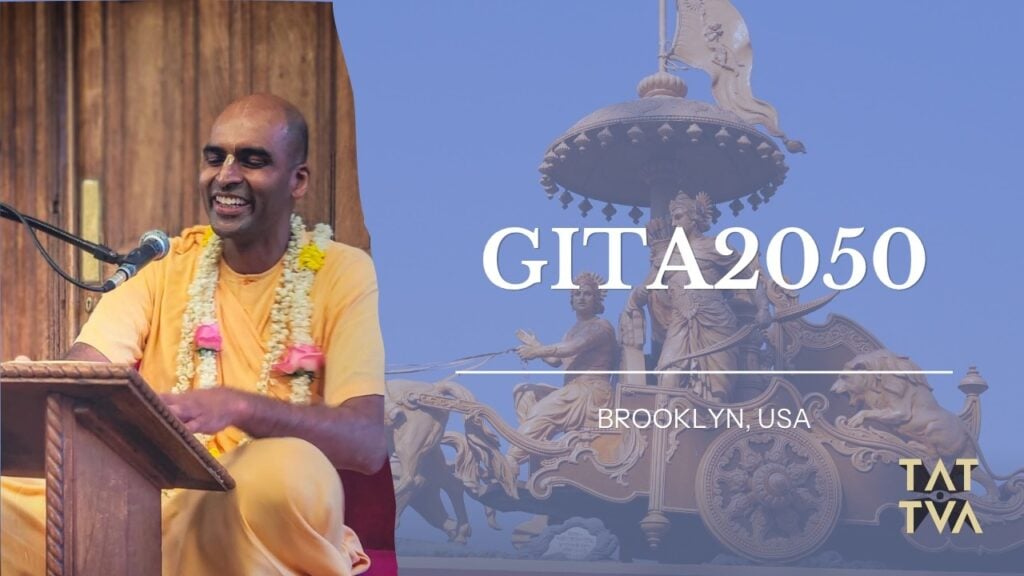
Lecture context: On Tuesday, 30th June 2026, Shyamsundar Das presented a Bhaktivedanta Manor Media class on ŚB 3.16.18, a verse from the Third Canto of the Śrīmad-Bhāgavatam. The verse appears in the chapter concerning Jaya and Vijaya, the two doorkeepers of Vaikuṇṭha, and it belongs to a profound theological dialogue in which the sages acknowledge the Supreme Lord as the source, protector, and ultimate purpose of dharma.
ŚB 3.16.18 states: tvattaḥ sanātano dharmo rakṣyate tanubhis tava dharmasya paramo guhyo nirvikāro bhavān mataḥ. The verse identifies sanātano dharmaḥ as eternal rather than sectarian, temporary, or merely social. Its central claim is that dharma is preserved through divine manifestations and that the unchanging Supreme Reality is the deepest objective of religious life. In academic terms, the verse presents dharma not only as moral order, ritual duty, or inherited identity, but as a metaphysical relationship between the living being, the cosmos, and the Divine.
The setting is important. The Third Canto narrates the episode in which the four Kumāras, great sages known for their purity and spiritual intensity, arrive at the gates of Vaikuṇṭha. Jaya and Vijaya obstruct them, and the resulting curse becomes one of the most dramatic theological moments in the Bhāgavata Purāṇa. The episode is not merely a story about offense and punishment. It examines humility, divine justice, spiritual etiquette, and the astonishing idea that even conflict can be woven into a larger movement toward restoration.
Within this context, ŚB 3.16.18 functions as a doctrinal anchor. The sages recognize that the Supreme Lord is nirvikāra, unchanging, even while appearing through many tanubhiḥ, or manifestations. This creates a subtle theological balance: the Divine engages dynamically with the world, yet remains untouched by the instability that characterizes material existence. For students of Hindu philosophy, this is a significant point because it shows how the Bhāgavata tradition integrates personal devotion with metaphysical permanence.
The phrase sanātano dharmo is especially powerful because it resists reduction. Dharma is often translated as religion, duty, law, ethics, nature, order, or sacred responsibility, yet none of these English equivalents fully contains its meaning. In this verse, dharma refers to the eternal function of the living being: loving service, conscious alignment with truth, and participation in a reality that does not begin or end with changing social conditions. This allows the verse to speak beyond ritual identity while still honoring the disciplined practices of Hindu tradition.
Shyamsundar Das’s chosen verse invites reflection on a question that remains deeply relevant: what protects dharma in an age of distraction, fragmentation, and spiritual consumerism? The Bhāgavata answer is not merely institutional. Dharma is protected when its ultimate purpose is remembered. Temples, scriptures, teachers, festivals, vows, and philosophical systems all have value when they lead toward deeper realization, humility, and devotion. Without that inner orientation, even impressive religious activity can become external, competitive, or hollow.
The verse also carries a technical theological distinction between means and end. Religious practices are means: study, chanting, worship, austerity, service, pilgrimage, and ethical discipline. The end is the awakening of the soul’s relationship with the Supreme. In the Bhāgavata framework, practices are not dismissed; they are dignified by being placed in proper relation to their goal. This is a crucial point for maintaining harmony among dharmic traditions, because diverse practices can be respected when their deeper purpose is understood.
For many practitioners, this teaching becomes emotionally meaningful because spiritual life is rarely experienced as an abstract system. It is encountered in ordinary human moments: a morning mantra recited with difficulty, a temple visit after a period of grief, a scripture verse heard at the right time, or a quiet act of service performed without recognition. ŚB 3.16.18 gives language to those moments by suggesting that dharma is not a private invention. It is a living current that sustains and reorients the heart.
The Bhāgavata Purāṇa repeatedly emphasizes that the Supreme Lord appears in many forms to protect dharma. These manifestations should not be understood as arbitrary interventions. They express a theological principle: whenever harmony is threatened, divine presence becomes accessible in forms suited to time, place, and need. This principle is visible throughout Hindu sacred literature, from Varāha lifting the Earth to Nṛsiṁha protecting Prahlāda, from Rāma embodying maryādā to Kṛṣṇa revealing the intimacy of bhakti.
At the same time, a dharmic reading must avoid turning devotion into hostility toward other sincere paths. The broader Hindu tradition has long recognized gradations of practice, plurality of worship, and the reality that seekers approach the Divine through different temperaments and disciplines. The deepest unity among Hinduism, Buddhism, Jainism, and Sikhism is not uniformity of doctrine, but a shared seriousness about truth, self-discipline, compassion, liberation, and the transformation of consciousness. ŚB 3.16.18 can therefore be read as a call to depth rather than a license for sectarian rivalry.
The chapter’s narrative also teaches that nearness to sacred space does not automatically guarantee spiritual maturity. Jaya and Vijaya stand at the gates of Vaikuṇṭha, yet their lapse in discernment leads to separation. This is a sobering theme. It suggests that religious proximity, status, vocabulary, or institutional role cannot substitute for humility. In contemporary terms, a person may be close to scriptures, temples, rituals, or communities and still need inner refinement. Dharma is protected not by pride of belonging, but by transformation of character.
The four Kumāras represent another dimension of spiritual life: the authority of purity. Their youthful appearance conceals profound realization, and this reversal challenges superficial judgment. The episode warns against evaluating seekers by age, appearance, social position, or external presentation. In a world that often rewards performance, branding, and visible authority, the Bhāgavata insists that spiritual insight may appear in unexpected forms. This principle remains essential for healthy religious communities.
The term dharmasya paramo guhyaḥ, the most confidential purpose of dharma, points toward the heart of bhakti. The confidential element is not secrecy in an elitist sense. It is hidden because it is subtle, interior, and easily missed when attention remains fixed on external identity. The highest purpose of dharma is not merely to produce social respectability or ritual correctness, but to awaken surrender, love, service, and steady remembrance of the Divine.
This perspective has practical consequences. Ethical conduct becomes more than rule-following; it becomes a way of honoring the Divine presence in all beings. Scriptural study becomes more than intellectual accumulation; it becomes a discipline of seeing reality more clearly. Worship becomes more than transaction; it becomes relationship. Community becomes more than shared labels; it becomes a field for service, patience, and accountability.
ŚB 3.16.18 also offers a useful framework for distinguishing eternal principles from changing forms. Languages, customs, musical styles, temple architecture, social arrangements, and educational methods may vary across regions and eras. The eternal principle is the orientation toward truth, devotion, liberation, and compassionate responsibility. This distinction helps preserve tradition without freezing it into lifeless repetition. It also allows dharmic communities to speak meaningfully to younger generations without diluting the substance of the teachings.
In the language of Vedānta, the verse affirms that the Supreme is both the source and goal of dharma. This avoids two extremes. One extreme reduces religion to human culture alone, treating sacred practice as merely historical or sociological. The other extreme ignores the embodied disciplines through which realization matures. The Bhāgavata integrates both: dharma is lived through concrete practices, but its root and fulfillment are transcendental.
The unchangeability of the Supreme, expressed through nirvikāraḥ, is especially relevant for spiritual psychology. Human beings often experience instability: changing emotions, shifting relationships, uncertain identities, and fluctuating confidence. A tradition centered on an unchanging Divine reality provides a reference point beyond these fluctuations. Devotion does not deny emotional life; it gives emotion a stable center. This is why bhakti literature often speaks with both philosophical rigor and deep tenderness.
The verse further encourages a disciplined understanding of avatāra theology. Divine manifestations are not mythic decorations added to philosophy; they are central to the Bhāgavata’s explanation of how the eternal engages with the temporal. Through avatāras, the Divine protects dharma, uplifts devotees, corrects arrogance, and restores cosmic and moral balance. This theological structure gives sacred history a purposeful shape rather than presenting it as a sequence of disconnected events.
In relation to Jaya and Vijaya, the verse also helps explain how apparent fallenness can become part of a larger return. Their descent into the material world is severe, yet it is not meaningless. The Bhāgavata tradition sees their births as powerful opponents of the Lord as part of a divine arrangement that ultimately brings them back to Vaikuṇṭha. This does not romanticize wrongdoing, but it does affirm that divine grace can operate even through painful consequences.
For contemporary readers, one of the most useful lessons is that dharma must be protected internally before it can be defended externally. Public advocacy, cultural preservation, and religious education are important, but they become credible only when accompanied by humility, integrity, and compassion. A community that remembers the paramo guhyaḥ, the confidential purpose of dharma, is better equipped to avoid both insecurity and arrogance.
The class title, 30Jun2026 | ŚB 3.16.18 – Shyamsundar Das, may appear simple as a media entry, yet the verse itself opens a wide field of reflection. It connects Bhāgavata theology, Sanatana Dharma, Vaishnava devotion, ethical practice, avatāra doctrine, and the lived experience of seekers. Its enduring message is that dharma is not sustained by external structure alone. It is sustained by remembrance of the Supreme, by disciplined practice, and by the gradual purification of the heart.
The practical conclusion is clear: spiritual life becomes mature when its practices are connected to their highest purpose. Chanting, study, worship, service, and community life should lead to humility, steadiness, devotion, and respect for sincere seekers. ŚB 3.16.18 therefore remains more than a verse for theological analysis. It is a guide for living Sanatana Dharma with clarity, depth, and unity in a world that urgently needs both conviction and compassion.
Inspired by this post on Dandavats.




Leave a Reply
You must be logged in to post a comment.