
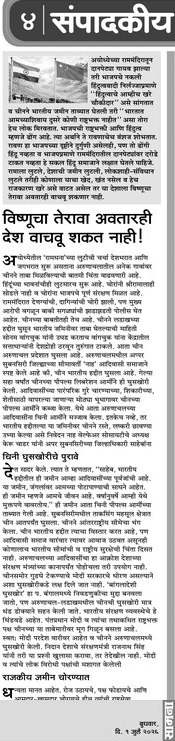
The July 2, 2026 political controversy around the Shiv Sena (Uddhav Balasaheb Thackeray), the Bharatiya Janata Party, China, and the Ram Mandir cannot be understood merely as another round of partisan rhetoric. It reflects a deeper debate about how Hindutva, patriotism, temple governance, national security, and democratic accountability are being interpreted in contemporary Indian politics. The immediate trigger was a strongly worded Saamana editorial titled “विष्णूचा तेरावा अवतारही देश वाचवू शकत नाही!” or “Even the Thirteenth Incarnation of Vishnu Cannot Save the Country,” which sharply criticised Prime Minister Narendra Modi and the BJP over alleged Chinese incursions and alleged irregularities involving Ayodhya Ram Mandir donations.
The editorial’s central claim was that the BJP’s public language of patriotism and Hindutva had become inconsistent with the actual responsibilities of governance. Shiv Sena (UBT) argued that a party cannot credibly present itself as the sole guardian of Hindu interests while, in its view, failing to protect both national territory and the ethical sanctity of a major Hindu temple institution. This critique was framed not simply as an electoral attack, but as a moral accusation: that religious symbolism is being used for political legitimacy while difficult questions of transparency, security, and constitutional responsibility remain insufficiently answered.
Because the matter involves allegations, it is important to distinguish between established facts, political claims, and unresolved questions. The report states that Shiv Sena (UBT), through Saamana, alleged thefts or misappropriation involving donation boxes and valuables linked to the Ram Mandir. It also alleged that China had expanded its presence in sensitive border areas, including Arunachal Pradesh and Ladakh. The BJP had not immediately responded to the editorial’s allegations at the time of the report. Therefore, the controversy should be read as a major political charge that requires evidence, institutional clarification, and accountable public communication rather than as a settled judicial finding.
The Ram Mandir issue carries immense emotional weight because Ayodhya is not only a political symbol but also a civilisational and devotional space for millions of Hindus. The temple represents memory, faith, legal struggle, community aspiration, and a long public movement. Any allegation concerning temple donations naturally evokes concern among devotees who see offerings not as ordinary funds but as acts of bhakti, sacrifice, and trust. In Dharmic traditions, offerings made at a sacred site are tied to reverence, accountability, and the duty of custodianship. That is why even an allegation of misuse can provoke strong moral discomfort among ordinary devotees.
Shiv Sena (UBT) used this emotional terrain to challenge the BJP’s Hindutva credentials. The editorial argued that claiming devotion to Lord Rama while failing to address alleged irregularities at a Ram temple would represent a contradiction between religious rhetoric and ethical conduct. Its comparison with Ravana was intentionally provocative. The editorial suggested that while Ravana is traditionally remembered as an antagonist in the Ramayana, he was not, in its phrasing, a hypocrite who stole from Ram temple donation boxes. The comparison was polemical, but its political purpose was clear: to accuse the ruling party of moral inconsistency.
From an academic perspective, the controversy illustrates the difference between devotional Hindutva, political Hindutva, and administrative Hindutva. Devotional Hindutva is rooted in reverence, pilgrimage, ritual, scripture, and community continuity. Political Hindutva mobilises identity, sentiment, and civilisational memory within democratic competition. Administrative Hindutva, if it is to carry credibility, must translate cultural confidence into transparent institutions, fair procedures, temple protection, heritage governance, and national service. The Saamana editorial’s criticism was that the BJP has prioritised symbolic and electoral Hindutva while falling short on administrative accountability.
The second major theme was national security. Shiv Sena (UBT) alleged that the Centre had remained insufficiently vocal about Chinese activity near sensitive border regions while maintaining a louder political posture on Pakistan and Bangladeshi infiltration. The editorial referred to concerns from Arunachal Pradesh, including claims associated with members of the indigenous Nah tribal community in the Upper Subansiri district. It alleged that the People’s Liberation Army had encroached upon Indian territory in the Taksing revenue area and that local warnings about Chinese expansionist activity had not received adequate official attention.
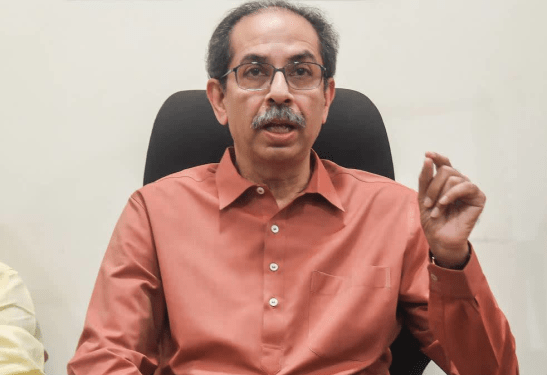
These claims fall within a broader and long-running strategic problem: India’s unsettled border with China and the risks associated with the Line of Actual Control. Since the 2020 Galwan Valley clash, in which 20 Indian soldiers were killed, public discussion of China-India conflict has carried a sharper emotional and strategic charge. Border infrastructure, surveillance, local community testimony, military readiness, and diplomatic signalling have all become central to national security debates. Shiv Sena (UBT) sought to connect these issues to the BJP’s larger nationalist claims, arguing that patriotism must be tested by performance at the frontier, not only by slogans in domestic politics.
The editorial also referred to activist Sonam Wangchuk, alleging that concerns raised about Chinese intrusions in Ladakh were met with charges of being anti-national and with detention. Whether every detail of that political claim is accepted or contested, the broader question remains significant: how should a democracy handle citizens, activists, border communities, and local representatives who raise security concerns? In a healthy republic, criticism of policy should not automatically be equated with disloyalty. National security requires discipline, but it also requires credible feedback from people who live closest to contested terrain.
The editorial’s criticism of Prime Minister Narendra Modi was sharpened by the phrase “13th incarnation of Lord Vishnu,” a reference associated in public debate with earlier remarks attributed to Ram Janmabhoomi Teerth Kshetra General Secretary Champat Rai. Saamana used the phrase to argue that even divine language cannot rescue a political order if institutions fail in their earthly duties. The point was rhetorical rather than theological. It was directed at personality cult politics, where leaders may be described in devotional or semi-sacred terms by admirers, even though democratic governance requires scrutiny, not sanctification.
This aspect of the controversy raises an important Dharmic question. Hindu political thought, when read through ideas such as Rajadharma, does not remove rulers from accountability. The king, leader, minister, or public servant is judged by protection of people, defence of territory, fairness in taxation, honesty in administration, and restraint in the use of power. Across Hindu, Buddhist, Jain, and Sikh ethical traditions, authority is expected to serve Dharma, not replace it. No leader, party, or faction should become larger than the principles of justice, humility, truthfulness, and public duty.
For many citizens, the emotional force of this debate lies in a familiar experience: reverence for sacred spaces often coexists with frustration at political management of those spaces. Devotees may donate with faith, stand in long queues, trust temple bodies, and accept inconvenience as part of pilgrimage. Yet that faith can be wounded when allegations of corruption, opaque administration, or political interference arise. This is why temple governance is not a minor administrative matter. It touches religious sentiment, public trust, heritage preservation, and the moral authority of institutions that claim to act in the name of Dharma.
At the same time, responsible discussion must avoid turning intra-Hindu political disagreement into social fragmentation. Shiv Sena (UBT), BJP supporters, temple devotees, border communities, and national security officials may hold sharply different views. Yet the objective should not be to deepen hostility among Hindus or among Dharmic communities. The constructive objective is to insist that sacred institutions remain clean, public claims remain evidence-based, and political power remains answerable. Unity among Hinduism, Buddhism, Jainism, and Sikhism is strengthened not by silence before wrongdoing, but by principled accountability and mutual respect.
The controversy also reveals a tension in Indian political discourse around the word “anti-national.” When used carefully, it can describe conduct that genuinely threatens sovereignty or security. When used carelessly, it can become a tool to suppress uncomfortable questions. The Saamana editorial accused the ruling establishment of applying harsh labels to critics while not showing comparable firmness toward China. This argument is politically charged, but it points to a wider democratic concern: a republic must be strong enough to confront external threats and mature enough to hear internal criticism.
Another important dimension is the comparison between China, Pakistan, and Bangladesh in nationalist rhetoric. The editorial alleged that the BJP aggressively highlights Bangladeshi infiltration, especially in West Bengal, and frequently projects strength against Pakistan, but is less transparent or forceful when addressing Chinese pressure along the frontier. Such comparisons are common in opposition politics, but they also invite a serious policy question. Different borders involve different military, diplomatic, demographic, and geopolitical realities. However, public confidence requires clear communication about each challenge rather than selective outrage shaped by electoral advantage.
India’s China challenge is technically complex. It involves high-altitude deployment, competing territorial perceptions, infrastructure races, intelligence gathering, satellite monitoring, negotiations at military and diplomatic levels, and the lived realities of frontier communities. Arunachal Pradesh has long been central to Chinese claims, while Ladakh became especially prominent after the 2020 crisis. Any claim of territorial encroachment must be examined through official maps, local testimony, military assessment, and parliamentary accountability. The emotional vocabulary of patriotism cannot substitute for detailed evidence, but neither should technical complexity become an excuse for public opacity.
Similarly, the Ram Mandir donation controversy requires institutional clarity. If allegations are unfounded, responsible authorities should communicate transparently and help prevent misinformation from spreading among devotees. If irregularities exist, they should be investigated through proper procedures, and accountability should follow without political shielding. Temples that command national devotion require systems that are visibly clean: audited accounts, accountable trusteeship, secure handling of offerings, clear reporting, and respect for the spiritual purpose of donations. The credibility of Hindu institutions depends on both faith and disciplined administration.
The Saamana editorial’s language about Kali Yuga, selfishness, corruption, and moral decline is best understood as a cultural idiom used to describe political disillusionment. In Hindu discourse, Kali Yuga is often invoked when public life appears marked by greed, hypocrisy, social disorder, and weakening Dharma. The editorial used this idiom to intensify its allegation that India is facing simultaneous moral and strategic failures. Such language can be powerful, but it must be handled carefully so that spiritual concepts do not become merely partisan weapons. Dharma is diminished when invoked only to attack opponents and not to discipline one’s own side.
The BJP’s position, though not included as an immediate response in the report, would likely emphasise its role in the Ram Janmabhoomi movement, national security policy, border infrastructure, diplomatic handling of China, and broader Hindu cultural revival. That perspective remains politically influential and cannot be ignored in any balanced reading of the controversy. The central issue, however, is not whether a party has historical claims to cultural nationalism. The issue is whether present claims are matched by present accountability, especially when sacred donations and border sovereignty are under public discussion.

Shiv Sena (UBT)’s criticism must also be understood in the context of Maharashtra politics and the split within Shiv Sena. The Uddhav Thackeray-led faction has repeatedly contested the BJP’s claim to represent authentic Hindutva, especially after the political realignments involving Eknath Shinde and the BJP. In that setting, Saamana editorials often serve as ideological interventions, not merely news commentary. The attack on BJP patriotism and Hindutva was therefore both a national critique and a regional political assertion: Shiv Sena (UBT) sought to claim a moral space in the Hindutva debate while accusing the BJP of instrumentalising the same language.
The most constructive reading of this controversy is not that one political camp possesses all virtue and another possesses none. A more serious reading is that India’s public life needs stricter standards when religion and nationalism are invoked. If a party appeals to Lord Rama, it must be prepared for questions about temple ethics. If it appeals to patriotism, it must be prepared for questions about territorial integrity. If it appeals to democracy, it must accept scrutiny from opposition parties, citizens, activists, journalists, and border communities. These standards should apply across parties and governments.
For Dharmic public culture, the lesson is especially important. Hinduism, Buddhism, Jainism, and Sikhism each contain deep traditions of self-correction, restraint, courage, truth-seeking, and service. Political identity should not overshadow those ethical resources. A society rooted in Dharma should be capable of defending temples without corruption, defending borders without propaganda, and defending democracy without demonising dissent. The Saamana editorial may be combative in tone, but the questions it raises can be transformed into a broader civic principle: sacred trust and national trust must both be protected through transparency.
The controversy over the “13th Avatar” phrase ultimately reveals the danger of excessive political sacralisation. In a constitutional democracy, leaders may receive admiration, but they should not be placed beyond critique. Devotion belongs to the divine; accountability belongs to public office. When these categories become blurred, citizens may hesitate to ask necessary questions, and institutions may weaken under the pressure of personality-driven politics. Dharmic traditions do not require such confusion. They offer a richer model in which power is legitimate only when it serves truth, justice, protection, and the welfare of all.
Thus, the Shiv Sena (UBT) attack on the BJP over China and the Ram Mandir row is significant because it brings together three sensitive domains: religious credibility, national security, and democratic responsibility. Its allegations require verification, its rhetoric requires careful interpretation, and its underlying questions deserve public attention. India’s strength will not come from treating every criticism as betrayal or every slogan as proof of patriotism. It will come from institutions that answer clearly, temples that are governed honestly, borders that are defended seriously, and a political culture that recognises Dharma as a standard of conduct rather than a campaign label.
Inspired by this post on Struggle for Hindu Existence.
