
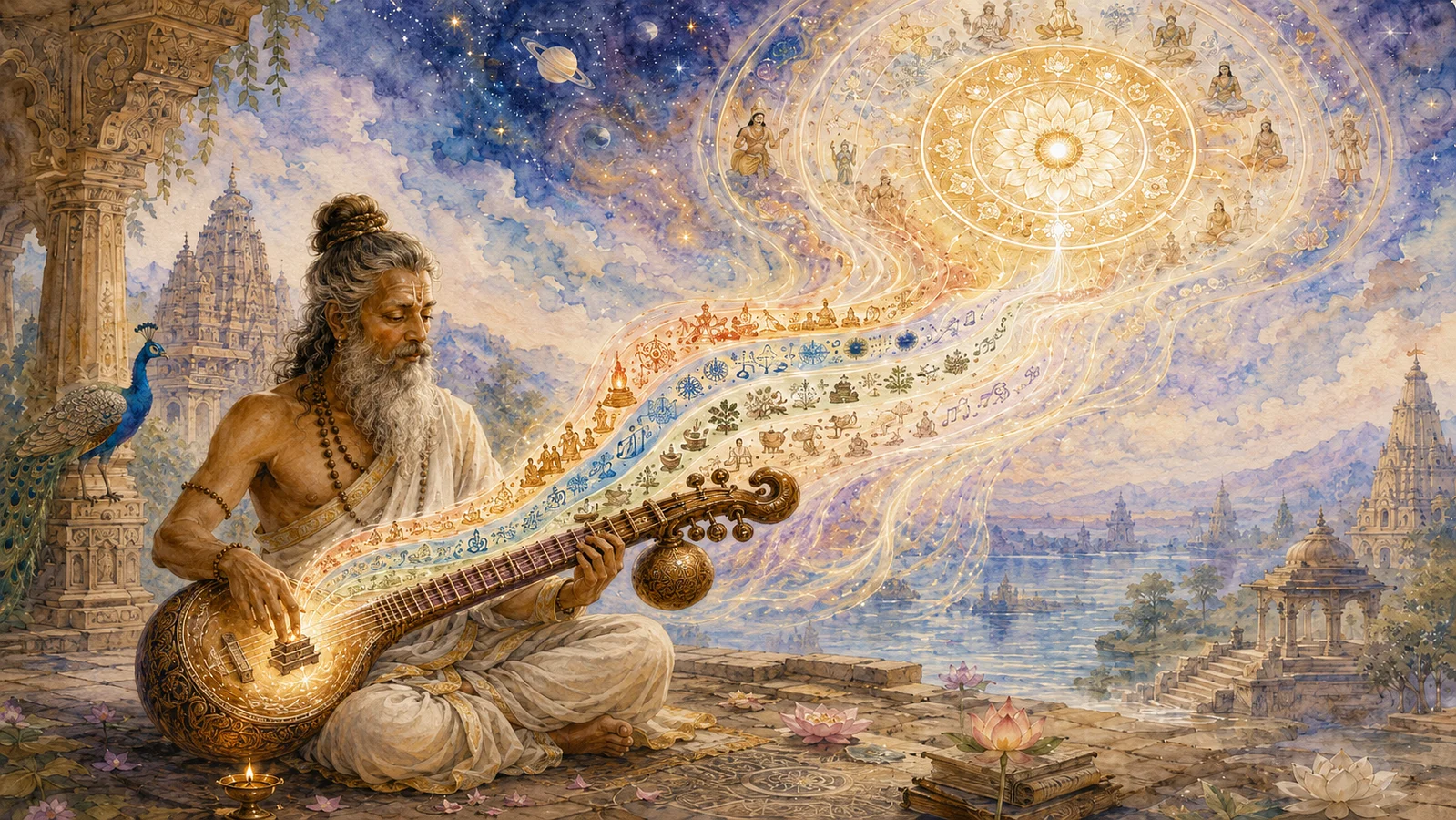
The closing movement of Śrī Madhusūdana Sarasvatī’s Prasthānabheda presents one of the most profound hermeneutical gestures in the Bhāratīya Knowledge Tradition. It does not treat the plurality of philosophical systems as a battlefield of mutually cancelling doctrines. Instead, it interprets them as a carefully graded landscape of inquiry, discipline, and realization. The many prasthānas, or established pathways of teaching, are understood as converging toward the recognition of non-dual Brahman, even when their methods, vocabularies, and metaphysical emphases differ.
This insight is especially important for any serious engagement with Indian Philosophy, Hindu darśanas, Vedānta, and the wider Dharmic civilizational inheritance. The Bhāratīya intellectual world never depended on a single uniform formulation imposed upon all seekers. It preserved debate, disagreement, refinement, commentary, and counter-commentary, while still holding that truth must be approached through adhikāra, or the eligibility and preparedness of the student. A teaching that appears preliminary in one context may be indispensable in another. A doctrine that seems incomplete from the standpoint of Advaita Vedānta may still function as a valid and compassionate step in the seeker’s ascent.
Śrī Madhusūdana Sarasvatī’s claim is both bold and disciplined: the munis who composed the various prasthānas were not confused thinkers offering contradictory fragments. They were sarvajña, endowed with comprehensive insight. Their diversity of teaching was not a failure of philosophy, but an expression of pedagogical intelligence. This distinction matters because it prevents the study of Dharma from collapsing into sectarian triumphalism. It also prevents a shallow relativism in which all positions are treated as equally final. The different systems can be respected without losing sight of the culminating vision that Madhusūdana identifies as Advaita.
At the heart of this passage stands the Sanskrit statement: sarveṣāṃ prasthāna-kartṝṇāṃ munīnāṃ vivartavāda-paryavasānenādvitīye parameśvare pratipādye tātparyam | na hi te munayo bhrāntāḥ, sarvajñatvāt teṣām |
Its meaning is clear and philosophically weighty: “The ultimate purport of all the munis who composed the various prasthānas culminates in Vivartavāda and is in the non-dual supreme Being who is their subject-matter. Those munis were not deluded — they were omniscient.” The sentence is not merely an Advaitic assertion of superiority. It is a method of reading the entire tradition with reverence, hierarchy, and philosophical responsibility. It affirms that the wise teachers of different systems knew what they were doing, and that their teachings were shaped according to the inner condition of those whom they addressed.
Vivartavāda, in the Advaita Vedānta context, is the doctrine that the world is an apparent manifestation rather than a real transformation of Brahman. Brahman does not undergo alteration, division, depletion, or mutation. The appearance of multiplicity is explained through avidyā and adhyāsa, not through an actual change in the absolute reality. This is why the rope-snake illustration, or Rajjusarpa Nyaya, remains so central to Advaitic teaching. A rope may be mistaken for a snake in dim light, yet the rope never becomes a snake. The error belongs to cognition, not to the underlying reality.
In this framework, the universe of names and forms is not dismissed as meaningless. Rather, it is understood according to its level of reality. The empirical world is pragmatically valid within vyavahāra, the domain of ordinary experience, ethical action, ritual, language, social order, and sādhanā. Yet from the standpoint of paramārtha, the ultimate truth, Brahman alone is real, non-dual, indivisible, and self-luminous. The apparent contradiction between the world of practice and the truth of non-duality is resolved by recognizing layered modes of understanding.
This layered approach explains why multiple prasthānas could exist within the Bhāratīya Knowledge Landscape without being treated as accidental noise. Nyāya trains the intellect in disciplined reasoning and valid means of knowledge. Vaiśeṣika classifies reality through categories and substances. Sāṅkhya offers a refined analysis of prakṛti and puruṣa. Yoga gives a practical psychology of restraint, concentration, and samādhi. Mīmāṃsā protects the authority of Vedic action, injunction, and ritual precision. Vedānta turns inquiry toward Brahman, the Self, and liberation. Each system cultivates an indispensable faculty of the seeker.
Such a reading is not anti-intellectual reconciliation for its own sake. It is a sophisticated model of philosophical pedagogy. The human being does not arrive at the highest truth by intellectual appetite alone. The mind must be prepared, sharpened, steadied, purified, and turned inward. A person attached to ritual responsibility may first require the discipline of karma and dharma. A person confused about inference may need the clarity of logic. A person restless in body and mind may require Yoga. A person drawn to metaphysical analysis may pass through Sāṅkhya. A person ready for the final inquiry may enter Vedānta.
This is why Madhusūdana’s position has lasting relevance for the unity of Dharmic traditions. Unity does not require flattening differences. Hinduism, Buddhism, Jainism, and Sikhism have preserved distinct metaphysical languages, disciplines, devotional orientations, and liberating insights. Yet they share a civilizational respect for sādhanā, ethical transformation, restraint, wisdom, compassion, and the possibility of freedom from bondage. The blog’s larger objective of unity among Dharmic traditions is strengthened when plurality is understood as an expression of spiritual maturity rather than a symptom of fragmentation.
From this perspective, philosophical disagreement need not become hostility. A Jain emphasis on anekāntavāda, a Buddhist analysis of impermanence and non-attachment, a Sikh commitment to nām, seva, and hukam, and a Hindu Vedāntic inquiry into Brahman may be studied with seriousness and respect. Their doctrinal differences should not be erased, but neither should they be weaponized. The Dharmic mode of learning is strongest when it allows rigorous debate while preserving reverence for sincere seekers and realized teachers.
The emotional force of this vision lies in its generosity. Many modern readers encounter Indian traditions through fragmented categories: religion versus philosophy, ritual versus reason, devotion versus knowledge, tradition versus freedom. The Prasthānabheda offers a more integrated map. It suggests that the aspirant does not need to despise earlier stages in order to move beyond them. A child learning the alphabet is not mocked because poetry lies ahead. A student practicing logic is not dismissed because realization is higher. A devotee engaged in worship is not inferior because inquiry into the Self is subtle. Each stage has dignity when it is ordered toward truth.
This pedagogical compassion is one of the defining features of the Bhāratīya Jnana Parampara. Teachers did not address humanity as a uniform mass. They recognized differences in temperament, discipline, intellectual refinement, emotional maturity, karmic disposition, and spiritual readiness. The result was not chaos, but a vast educational architecture. The śāstras speak in many registers because human beings awaken in many ways. Some are moved by devotion, some by inquiry, some by disciplined action, some by meditation, some by service, and some by the direct shock of existential questioning.
Advaita Vedānta, as interpreted through Madhusūdana Sarasvatī, can therefore be seen as a culminating standpoint rather than a sectarian negation of all that precedes it. It does not deny the utility of worship, ritual, logic, meditation, ethics, or devotion. It places them within a hierarchy of realization. The central claim is that the final removal of ignorance occurs through knowledge of the non-dual Self, but the mind that receives this knowledge must be made fit. This is why śravaṇa, manana, and nididhyāsana are not isolated techniques; they presuppose moral discipline, steadiness, discrimination, and dispassion.
The idea that all prasthānas converge in non-dual Brahman also requires careful handling. It should not be reduced to the slogan that every doctrine says the same thing. The systems often disagree sharply. Nyāya realism, Sāṅkhya dualism, Mīmāṃsā ritualism, and Advaita non-dualism cannot be made identical at the level of formal doctrine. Madhusūdana’s hermeneutic is subtler: the sages taught according to the level and need of the seeker, and when the trajectory of teaching is followed to its highest purpose, it culminates in the recognition of the non-dual supreme reality.
This distinction protects both truth and harmony. Without hierarchy, philosophical study becomes vague inclusivism. Without respect, hierarchy becomes arrogance. The genius of the passage lies in holding both together. Other traditions are not dismissed as bhrānta, deluded or mistaken in a crude sense. Their founders are honored as munis. Yet the culmination is still identified with Advaita and Vivartavāda. This makes the passage a model for serious Dharmic dialogue: respectful, discriminating, rooted in śāstra, and oriented toward liberation.
For contemporary Hindu Studies and Indian Knowledge Systems, this approach has practical consequences. It challenges the habit of reading Indian philosophy through rigid Western categories of mutually exclusive schools. It also challenges modern sectarian readings that isolate one sampradāya from the larger civilizational matrix. The Bhāratīya intellectual tradition is neither a random collection of opinions nor a centralized dogma. It is a living network of inquiry, practice, revelation, commentary, debate, and realization.
The Prasthānabheda therefore becomes more than a classificatory text. It becomes a guide to intellectual humility. It teaches that the existence of many methods does not invalidate truth; it may reveal the compassion of teachers who understand the complexity of human awakening. It also teaches that reverence for plurality need not mean the abandonment of ultimate clarity. A civilization can honor many paths while still preserving a rigorous account of the highest reality.
In the Advaitic reading, Brahman is not one object among many, not a deity placed inside a competing theological catalogue, and not an abstract concept produced by speculation. Brahman is satya, the self-existent reality because of which all appearance is possible. The Self is not separate from Brahman. The realization of this identity is moksha, the end of fundamental ignorance. When this truth is misunderstood, the world appears as binding multiplicity. When it is known, the same world is no longer a source of bondage.
This does not produce indifference to life. Properly understood, Advaita deepens ethical seriousness. If the same Self is the ground of all beings, then compassion is not merely moral instruction; it becomes an expression of metaphysical insight. Dharma, seva, restraint, truthfulness, and non-injury acquire deeper meaning. The seeker does not abandon the world in contempt. Rather, bondage to false identification is loosened, and action can become clearer, quieter, and less ego-driven.
The passage also speaks to the modern crisis of inherited knowledge. Many people approach ancient śāstra either with uncritical nostalgia or with reflexive skepticism. The Prasthānabheda encourages a third route: disciplined trust joined with inquiry. It invites readers to ask why different teachings were given, what kind of aspirant each teaching addresses, and how each contributes to the refinement of consciousness. This is a more demanding approach than simply choosing a school and dismissing the rest.
Such a framework can enrich contemporary education. A serious curriculum on Indian Knowledge Systems should not present the darśanas as museum pieces. It should show how logic, metaphysics, language, ritual theory, psychology, ethics, meditation, and liberation are connected. Students should learn that Bhāratīya thought developed through precision and debate, not vague mysticism. They should also learn that the ultimate aim of this knowledge was not merely intellectual display, but freedom from avidyā and alignment with reality.
Madhusūdana Sarasvatī’s generosity toward other prasthāna-kartṛs is also a lesson in how to disagree within a tradition. The presence of disagreement does not require contempt. In fact, disagreement conducted within shared reverence can become a means of refinement. The great commentators disagreed because truth mattered. Their debates were not casual opinion exchanges; they were disciplined attempts to protect the path to liberation. This is why their disagreements still nourish philosophical inquiry today.
The unifying vision of the Prasthānabheda should therefore be read as a civilizational principle. Diversity is not denied. Difference is not sentimentalized. Hierarchy is not weaponized. The many teachings are interpreted through their purpose, audience, and place in the seeker’s journey. The final aim is the recognition of the non-dual supreme reality, but the road toward that recognition may involve many valid disciplines. This is a mature model of unity in diversity, rooted in Dharma rather than modern slogan.
For those seeking to understand Hindu philosophy, Advaita Vedānta, and the wider Dharmic intellectual heritage, this passage offers a powerful corrective. It asks readers to move beyond the habit of reducing traditions to labels. It asks them to see śāstra as a living pedagogy. It asks them to recognize that the sages taught not to win ideological contests, but to lead different seekers from partial understanding toward fuller vision. In that movement from plurality to non-duality, the Bhāratīya Knowledge Landscape reveals both its philosophical rigor and its spiritual compassion.
The enduring value of this teaching lies in its balance. It preserves Advaita’s uncompromising account of Brahman while honoring the wisdom of the many munis who shaped the prasthānas. It affirms that intellectual diversity can serve liberation when guided by truth. It reminds contemporary seekers that the path of knowledge is not contempt for other paths, but the ability to understand their place, purpose, and culmination. In an age marked by fragmentation, this vision remains urgently relevant: many methods, many temperaments, many disciplines, yet one supreme reality toward which the deepest inquiry points.
Inspired by this post on Hindu Post.
