
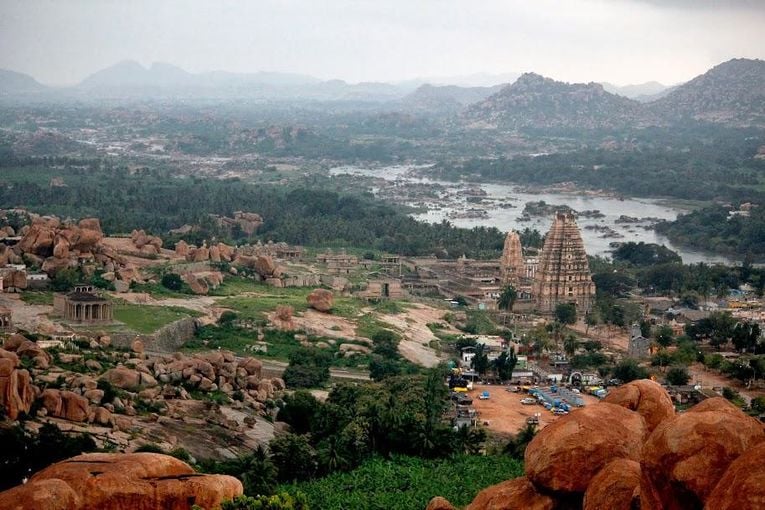
Vijayanagara remains one of the most extraordinary urban achievements in Indian history. Known today through the monumental landscape of Hampi in Karnataka, the city was not merely a royal capital or an archaeological ruin. It was a fortified metropolis, a sacred geography, a hydraulic engineering project, a centre of trade, and a vast artistic workshop where temple architecture, sculpture, painting, ritual, administration, and military planning met in one coherent civilizational vision.
Located on the southern bank of the Tungabhadra River, across from the older settlement of Anegondi, Vijayanagara rose to imperial prominence from the fourteenth century onward. The traditional founding date of 1336 CE is associated with Harihara I and Bukka I of the Sangama line, while the intellectual and spiritual memory of Vidyaranya Svaami remains closely tied to the city’s early formation. Yet the region was not empty before the empire. Hampi, also remembered in older sacred geography as Pampakshetra and linked with Kishkindha traditions, contained earlier shrines, settlements, tanks, and cultural memories that the Vijayanagara rulers inherited, expanded, and monumentalized.
The site’s power begins with its landscape. Granite boulders, riverine edges, open plains, ridgelines, and defensible passages created a natural theatre for imperial planning. Vijayanagara’s builders did not impose a city upon the land in a flat or abstract manner. They worked with terrain, water, sacred routes, and military visibility. The result was a capital in which temples, bazaars, fortifications, agricultural zones, palatial platforms, tanks, processional streets, and gateways formed an integrated urban organism.
UNESCO recognizes the Group of Monuments at Hampi as a World Heritage Site and describes the surviving landscape as a record of more than 1,600 remains, including temples, shrines, mandapas, royal complexes, defence structures, gateways, stables, water features, memorials, and urban fragments. The Archaeological Survey of India similarly notes that the monuments of Vijayanagara, also known as Vidyanagara in honour of Vidyaranya, were built broadly between AD 1336 and 1570, from the age of Harihara I to Sadasiva Raya. This long building history matters because the city was not a single project. It was a layered capital, continually reshaped by changing rulers, religious patronage, military pressures, and expanding economic networks.
The imperial background is essential to understanding the architecture. Vijayanagara was ruled by successive dynasties, most prominently the Sangama, Saluva, Tuluva, and Araveedu lines. Each dynasty inherited the responsibility of defending a large South Indian realm while sustaining temples, agrarian systems, ports, trade corridors, and regional elites. The reign of Krishna Deva Raya from 1509 to 1530 is often treated as the high point of imperial power, literary patronage, and monumental activity, but the capital’s built environment reflects contributions across generations.
The city was admired by foreign travellers from Persia, Italy, Portugal, and other regions. Abdur Razzaq, who visited in the fifteenth century, famously conveyed astonishment at its scale and magnificence. Such accounts must always be read critically, because travel writing carries its own conventions, assumptions, and limits. Even so, when textual testimony is compared with the surviving remains, the broad impression is persuasive: Vijayanagara was one of the great cities of the medieval world, wealthy enough to astonish outsiders and complex enough to challenge modern archaeologists.
Its fortification system reveals a capital built for endurance. Literary and archaeological references indicate multiple lines of defence, with walls using the natural strength of boulder-strewn terrain. The city was not simply enclosed by a wall; it was protected through a layered defensive landscape. Roads, gates, watch points, agricultural spaces, and settlement clusters were incorporated into a broader security design. This is why Vijayanagara should be studied as both sacred capital and military city. Its beauty did not soften its strategic intelligence.
The hydraulic system was one of Vijayanagara’s most technical achievements. The region is seasonally dry, and a capital of such scale could not survive on religious patronage or military power alone. It required water management. Tanks, canals, aqueducts, anicuts, wells, stepped tanks, channels, and reservoirs sustained ritual life, domestic use, gardens, agriculture, and royal functions. The Krishna Pushkarini and other stepped tanks show that water architecture was both practical and aesthetic. Geometry, stonework, and ritual usability were combined with a careful understanding of flow, storage, and terrain.
The ASI records the discovery of a square stepped tank near the Mahanavami Dibba, along with coins, ceramics, terracotta objects, stucco figures, household utensils, sculptural fragments, and other evidence of urban life. These finds reveal a society far more complex than a simple temple town. Vijayanagara was a capital of administrators, artisans, soldiers, merchants, priests, pilgrims, agricultural workers, patrons, and visiting diplomats. Its ruins preserve the memory of governance as much as devotion.
Vijayanagara art cannot be separated from Vijayanagara architecture. Sculpture, painting, pillar design, friezes, gateways, temple plans, and ceremonial spaces worked together. Art served devotion, political authority, public memory, and aesthetic education. The sacred and the civic were not isolated spheres. A temple wall could narrate the Ramayana or Mahabharata; a palace platform could display imperial ceremony; a bazaar street could lead a pilgrim, trader, and courtier through the same ceremonial axis.
The painting traditions associated with the Vijayanagara world deserve particular attention. The frescoes and ceiling paintings at sites such as Lepakshi show technical confidence, narrative density, and an unmistakable South Indian visual grammar. Figures are not merely decorative. They carry story, gesture, hierarchy, ornament, rhythm, and theological meaning. Lepakshi’s murals, including depictions connected with Shaiva, Vaishnava, and epic themes, demonstrate that painting in the Vijayanagara period was not a minor craft beside sculpture. It was a major mode of sacred storytelling.
Sculpture at Hampi and related Vijayanagara sites shows a distinctive combination of mass, movement, and iconographic clarity. The monumental Narasimha image, the large Ganesha sculptures, the carved pillars of mandapas, the horses, yalis, dancers, warriors, guardians, divine figures, and narrative panels all reveal a confident artistic language. Granite, a difficult material, was handled with discipline and imagination. The result is not the delicate softness of some earlier stone traditions, but a powerful visual grammar suited to a martial and devotional capital.
The Narasimha sculpture is especially significant because it combines theology and political symbolism. Narasimha is the fierce protective form of Vishnu, associated with the rescue of Prahlada and the defeat of oppressive power. In the Vijayanagara setting, such imagery could speak simultaneously to devotion, royal protection, and the moral obligation to defend dharma. The image is therefore not only an object of art history. It is a statement about sacred power, justice, and sovereignty.
Vijayanagara architecture is often described as Dravidian, but that label alone is insufficient. The city certainly stands within the broad South Indian temple-building tradition, with gopuras, mandapas, pillared halls, processional streets, cloistered enclosures, sacred tanks, and axial planning. Yet the scale, urban integration, festival streets, royal platforms, and hydraulic systems justify treating Vijayanagara as a mature architectural style in its own right. It absorbed older Chalukya, Hoysala, Tamil, Kannada, Andhra, Jain, and broader Indic precedents while developing a monumental idiom suited to empire.
The Vitthala temple complex represents one of the highest achievements of this architectural language. Its stone chariot, musical pillars, mandapas, gopurams, bazaar street, stepped tank, and ritual layout make it a concentrated study in Vijayanagara design. The temple is dedicated to Vitthala, a form of Krishna associated with the wider devotional world of Vithoba worship. Its architecture shows how regional bhakti, royal patronage, processional ritual, and technical stonecraft could be brought together in a single sacred complex.
The Virupaksha Temple, still active in worship, is equally central. Dedicated to Virupaksha, a form of Shiva, it connects Hampi’s older sacred identity with Vijayanagara’s imperial presence. Its towering gopura, courtyards, pillared spaces, shrines, and continuing ritual life make it one of the strongest examples of continuity at the site. Unlike many monuments that now stand silent, Virupaksha remains a living temple. For a modern visitor, this continuity changes the experience of Hampi: the site is not merely ruins, but a place where memory still breathes through worship, festival, and pilgrimage.
The Hazara Rama Temple offers another kind of evidence. Its sculpted panels, especially those connected with the Ramayana, show how royal and sacred narratives intersected. The temple’s location within the royal centre suggests a close relationship between kingship, epic memory, and ethical governance. In such a setting, Rama was not simply a devotional figure. He represented an ideal of rule, restraint, duty, and moral order that could be visually placed before the courtly world.
The Krishna Temple, Achyutaraya Temple, Pattabhirama Temple, Chandrasekhara Temple, Hemakuta group, Ganesa images, Jain temples, and numerous smaller shrines create a sacred network rather than a single monument-focused landscape. This network is important for understanding Dharmic pluralism at Vijayanagara. Shaiva, Vaishnava, Shakta, Smarta, Jain, and local sacred traditions all found architectural expression. The broader Indic civilizational habit of accommodating multiple paths is visible not as theory alone, but as stone, street, shrine, tank, and ritual space.
This plural religious landscape also helps frame Vijayanagara for a contemporary audience committed to unity among Hinduism, Buddhism, Jainism, and Sikhism. The empire was historically rooted in South Indian Hindu kingship, yet its artistic and urban environment also preserved Jain presence and older sacred layers. ASI records even mention inscribed Buddhist sculptures of the 2nd-3rd century AD unearthed in the wider site context. Such evidence encourages a civilizational reading that is confident without being narrow. Hampi’s lesson is not sectarian triumphalism; it is the disciplined protection of sacred culture, artistic excellence, and social order across Dharmic diversity.
The secular and royal buildings of Vijayanagara are just as important as the temples. The Lotus Mahal, Queen’s Bath, Elephant Stables, royal enclosures, guard quarters, audience halls, treasury areas, palace foundations, and Mahanavami Dibba reveal a courtly world of ceremony, administration, military display, and elite life. These structures also complicate simplistic stylistic labels. Some secular buildings show arches, domes, and forms that scholars have associated with Indo-Islamic architectural vocabulary. Yet this should not be treated as cultural dependency. It is better understood as architectural adaptation within a fundamentally Vijayanagara urban and political context.
The Mahanavami Dibba is especially revealing. This large ceremonial platform was associated with royal spectacle, public ritual, and the Dasara festival. Its carved panels depict processions, animals, dancers, warriors, courtly scenes, and imperial activity. It was not merely a platform of stone. It was a theatre of sovereignty, where the king’s role as protector, patron, and ritual centre could be publicly enacted. In this sense, Vijayanagara architecture was performative: it created spaces where power could be seen, remembered, and ritually renewed.
Economic life was equally central to the city. Bazaars lined temple streets, and the wider empire was connected to inland trade, coastal ports, horses, textiles, spices, precious stones, and diplomatic exchange. Vijayanagara’s rulers understood that sacred construction required material foundations. Temples needed endowments. Armies needed horses and revenue. Festivals needed artisans and merchants. Waterworks needed labour and planning. The splendour of Hampi therefore rests upon a deeper structure of agrarian management, taxation, craft production, and trade.
The city’s relationship with Portuguese power on the western coast must be examined through this practical lens. Vijayanagara was a land empire, while the Portuguese entered the Indian Ocean as a naval and commercial force. Diplomatic contact, horse trade, coastal politics, and military necessity shaped the relationship. It is academically safer to avoid romantic overstatement in either direction. Vijayanagara neither existed in isolation nor became derivative of European contact. It negotiated maritime realities while preserving its own political and cultural grammar.
The fall of Vijayanagara after the Battle of Talikota in 1565 remains one of the defining ruptures in South Indian history. The Deccan sultanate coalition defeated the imperial forces, and the capital suffered major destruction. The political history after Talikota is complex: the Araveedu line continued, and centres such as Penukonda, Chandragiri, and Vellore became important. Yet Hampi as the great imperial capital never recovered its earlier metropolitan role. The ruins visible today are therefore not simply old buildings; they are the remains of a broken urban world.
That destruction should be remembered with sobriety rather than bitterness. A serious historical approach recognizes violence, political rivalry, betrayal, military miscalculation, and structural pressures without reducing the past to slogans. The deeper lesson of Vijayanagara lies in the relationship between cultural confidence and institutional strength. Art flourished because administration, water management, economic networks, military protection, and sacred patronage sustained it. When those systems fractured, even a magnificent capital became vulnerable.
Hampi’s preservation today is therefore a civilizational responsibility. UNESCO notes continuing challenges involving development pressure, visitor use, modern construction, infrastructure, and the need to protect the integrity of the landscape. These concerns are not abstract heritage language. Anyone who has walked through a major archaeological site understands how easily neglect, careless tourism, unregulated growth, and visual clutter can weaken the dignity of a place. Heritage preservation requires more than admiration; it requires policy, maintenance, scholarship, community involvement, and disciplined public behaviour.
For students of Indian history, Vijayanagara offers a corrective to narrow readings of the medieval period. It shows that South India was not peripheral. It shows that Indian urbanism did not disappear after earlier classical ages. It shows that temple architecture could be technically sophisticated, economically embedded, and politically central. It also shows that Dharmic civilization expressed itself not only in texts and rituals, but in engineering, planning, sculpture, painting, water systems, military design, and public ceremony.
For visitors, the emotional force of Hampi often comes from contrast. The landscape is vast, but many structures are broken. The temples are grand, but some mandapas are silent. The river still moves, but the imperial court is gone. This contrast creates a disciplined kind of reverence. It does not invite nostalgia alone. It asks what kind of society can build with such ambition, what kind of institutions can protect such achievement, and what kind of cultural memory can carry it forward without distortion.
Vijayanagara’s art and architecture ultimately reveal a civilization thinking in stone. The gopuras express ascent. The mandapas express assembly. The tanks express purification and practical intelligence. The bazaars express prosperity. The royal platforms express power. The sculptures express theology, ethics, and narrative memory. The fortifications express vigilance. Together, they form a city where the sacred, political, economic, and artistic were not separate fragments, but parts of a larger order.
The city deserves to be studied with accuracy, protected with care, and remembered with maturity. Vijayanagara was not only a capital of kings; it was a capital of builders, sculptors, painters, priests, merchants, soldiers, administrators, farmers, and pilgrims. Its ruins at Hampi continue to teach that cultural greatness is never accidental. It is planned, funded, defended, renewed, and transmitted. In that sense, the City of Victory remains more than a memory of the past. It is a demanding standard for the future of Indian cultural heritage.
Sources consulted for factual grounding include the Indic Civilizational Portal essay on Vijayanagara, UNESCO World Heritage Centre’s entry for the Group of Monuments at Hampi, and the Archaeological Survey of India’s Hampi World Heritage documentation.
Inspired by this post on Indic Portal.









Leave a Reply
You must be logged in to post a comment.