Tag: South Indian Temples

  • Somaskanda Murti: Powerful Shiva Family Iconography and Sacred Temple Wisdom

    Somaskanda Murti: Powerful Shiva Family Iconography and Sacred Temple Wisdom

    The Somaskanda Murti is one of the most profound forms in South Indian Shaiva iconography, presenting Lord Shiva with Uma and Skanda as a sacred family. This expanded study explains its Pallava origins, Chola refinement, temple placement, ritual significance, and philosophical symbolism. The form reveals the unity of Shiva and Shakti, the sacred role of…

  • Mannargudi’s Mismatched Earrings: A Powerful Krishna Legend of Living Devotion

    Mannargudi’s Mismatched Earrings: A Powerful Krishna Legend of Living Devotion

    Mannargudi’s Rajagopalaswamy Temple in Tamil Nadu preserves one of the most tender Krishna traditions: the story of the deity’s two different earrings. This rewritten article explains the legend as a meaningful expression of bhakti, where Krishna’s loving haste becomes visible through sacred ornamentation. It places the story within the temple’s wider history, architecture, festivals, and…

  • Vijayanagara’s Enduring Splendor: Hampi’s Art, Architecture, and Sacred Power

    Vijayanagara’s Enduring Splendor: Hampi’s Art, Architecture, and Sacred Power

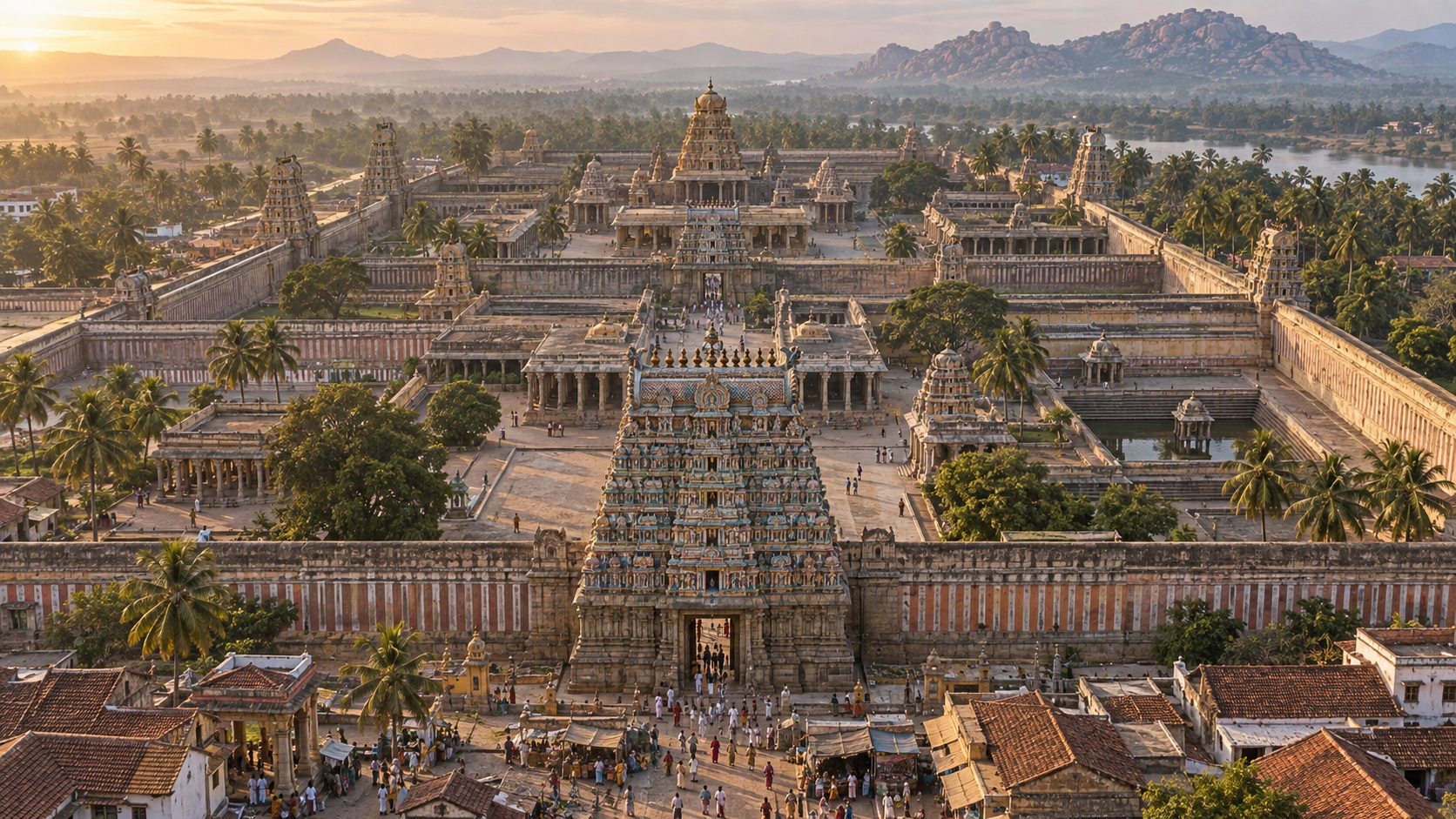
    Vijayanagara at Hampi was one of medieval India’s most sophisticated capitals, combining sacred architecture, military planning, hydraulic engineering, royal ceremony, and artistic excellence. This rewritten study explains how the city developed on the Tungabhadra River and why its landscape of temples, tanks, fortifications, palaces, bazaars, and sculptures remains central to Indian history. It highlights the…

  • Soundararaja Perumal Temple: A Powerful Divya Desam of Beauty and Grace

    Soundararaja Perumal Temple: A Powerful Divya Desam of Beauty and Grace

    Soundararaja Perumal Temple at Nagapattinam is one of the 108 Divya Desams of Lord Vishnu and a major shrine in the Sri Vaishnava tradition. The temple worships Vishnu as Soundararaja Perumal and Lakshmi as Soundaravalli Thayar, presenting divine beauty as a form of grace and spiritual refuge. Its sacred legends connect the site with Brahma,…

  • Suchindram’s Sacred Hanuman Tail: Why the Butter Offering Still Moves Devotees

    Suchindram’s Sacred Hanuman Tail: Why the Butter Offering Still Moves Devotees

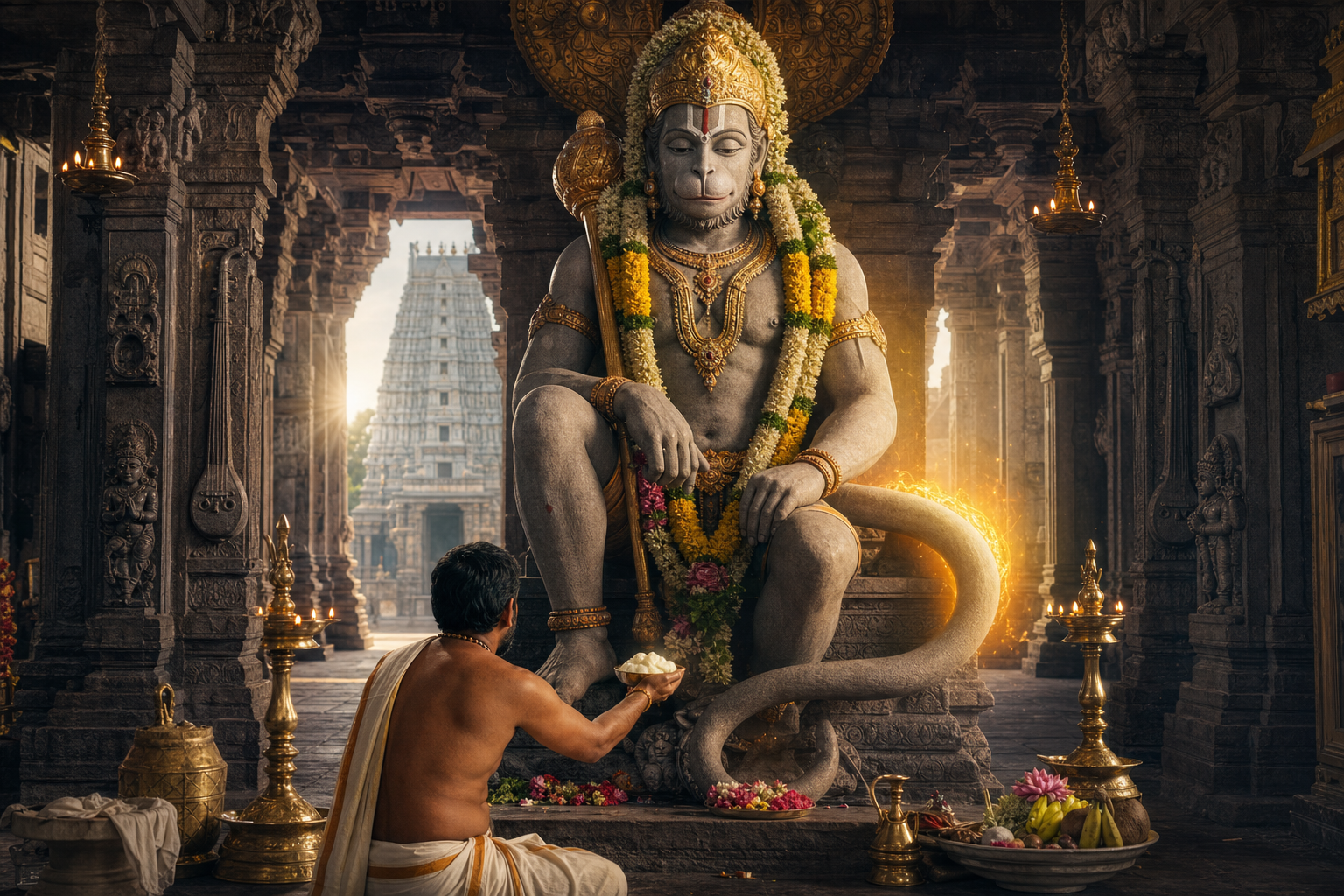
    Suchindram Temple near Kanyakumari is one of Tamil Nadu’s most remarkable sacred spaces, known for the Sthanumalayan form that unites Shiva, Vishnu, and Brahma. Its Hanuman shrine preserves a deeply moving devotional tradition: the offering of butter associated with cooling the sacred memory of Hanuman’s burning tail in the Ramayana. This practice reveals how ritual,…

  • Jalandhara Samhara: The Rare Shiva with Chatra FormIconography, Symbolism, and Temple Lore

    Jalandhara Samhara: The Rare Shiva with Chatra FormIconography, Symbolism, and Temple Lore

    This long-form study examines Jalandhara Samhara, the rare Shiva form sometimes depicted with a chatra (parasol), situating it within Puranic narrative, Agamic prescriptions, and South Indian temple practice. It clarifies how the icon differs from Nataraja, Lingodbhava, and Dakshinamurti by foregrounding righteous protection and ethical sovereignty. The chatra’s symbolism is analyzed as both royal regalia…

  • Unveiling Goddess Kaveri in Hindu Sculpture: Iconography, Ritual Power, and Sacred Geography

    Unveiling Goddess Kaveri in Hindu Sculpture: Iconography, Ritual Power, and Sacred Geography

    Goddess Kaveri, revered as a living river and divine mother, is rendered in Hindu sculpture through a precise visual grammar that blends Shilpa Shastra canons with the lived rhythms of sacred geography. This essay explains how to recognize her iconography, from kumbha and lotus attributes to makara-toranas and gentle mudras, and shows where she commonly…

  • Thanjai Mamani Koil: Unraveling Thanjavur’s Sacred Triple Divya Desam and Living Heritage

    Thanjai Mamani Koil: Unraveling Thanjavur’s Sacred Triple Divya Desam and Living Heritage

    Thanjai Mamani Koil in Thanjavur is a rare triadic Divya Desam where three adjacent Vishnu sanctums share a single sacred precinct. Celebrated in the Naalayira Divya Prabandham, the complex embodies a living synthesis of theology, architecture, and ritual practice in the Kaveri delta. The three deitiesNeelamegha Perumal, Manikundra Perumal, and Veera Narasimha Perumaloffer complementary experiences…

  • Andal Kondai Unveiled: Iconography, Ritual Craft, and the Living Heritage of Goda Devi

    Andal Kondai Unveiled: Iconography, Ritual Craft, and the Living Heritage of Goda Devi

    The Andal Kondaithe iconic coiffure of Goda Deviunites temple iconography, Tamil craft, and living Vaishnava practice. Rooted in Andal’s poetry and early medieval South Indian heritage, the hairstyle operates as both a technical structure and a devotional sign. Temple alankara teams build the kondai with a rigorous grammar of bun, braid, ornaments, and fresh flowers,…

  • Awe-Inspiring Rameswaram Pilgrimage: Sri Ramanathaswamy Temple, Rama Setu, Sacred Shores

    Awe-Inspiring Rameswaram Pilgrimage: Sri Ramanathaswamy Temple, Rama Setu, Sacred Shores

    Rameswaram on the Gulf of Mannar is a conch-shaped island central to the Char Dham yatra and home to the Jyotirlinga of Sri Ramanathaswamy. Scriptural accounts in Srimad-Bhagavatam and Caitanya Caritamrta attest to its enduring sanctity, while Ramayana memory links the shrine to Rama Setu. The temple’s nearly 4,000-foot pillared corridor exemplifies South Indian temple…

  • Trichy Rockfort Pilgrimage: Abhishekam, 400 Steps, and Timeless South Indian Heritage

    Trichy Rockfort Pilgrimage: Abhishekam, 400 Steps, and Timeless South Indian Heritage

    This research-driven account documents a 09.02.2026 pilgrimage to the Trichy Rockfort Temple complex, tracing an early start from Kalyanapuram via Kumbakonam to Tiruchirappalli and culminating in multiple Abhishekham rites with honey, milk, curd, and Panchamirtham. It explains the sacred sequence of Manikka Vinayakar, Thayumanaswami, and Ucchi Pillayar temples, the significance of climbing over 400 steps,…

  • Padma Nidhi of Kubera in South Indian Temples: Timeless Gate Guardians of Abundance

    Padma Nidhi of Kubera in South Indian Temples: Timeless Gate Guardians of Abundance

    Padma Nidhipaired with Śaṅkha Nidhifunctions as a liminal, auspicious guardian at South Indian temple thresholds, especially in Tamil Nadu. Grounded in Agamic and Śilpa-śāstra prescriptions, the pair integrates with dvarapālas and Gaja-Lakṣmī to create a complete doorway program of protection, grace, and prosperity. As personifications of Kubera’s treasures, these compact, pot-bellied figures translate the metaphysics…

  • Veenadhara Dakshinamurthy: Shiva’s Musician-Guru in Pallava and Chola Temple Art

    Veenadhara Dakshinamurthy: Shiva’s Musician-Guru in Pallava and Chola Temple Art

    Veenadhara Dakshinamurthy portrays Shiva as the musician-guru, where wisdom becomes audible as sacred sound. Distinguishing aasana (seated) and sthanaka (standing) variantslinked respectively with Chola refinement and early Pallava dynamismclarifies how form encodes function in South Indian temple architecture. The veena symbolizes disciplined harmony of senses and breath, turning listening into a pathway of learning. Practical…

  • Madanikas in Hindu Temples: Sacred Feminine in StoneSymbolism, History, and Devotional Aesthetics

    Madanikasalso known as śālabhañjikāsare among the most evocative symbols in Hindu temple architecture, uniting beauty, devotion, and metaphysics. This comprehensive overview traces their origins in early yakṣī imagery at Bharhut and Sanchi, follows their classical flowering in Hoysala temples at Belur, Halebidu, and Somanathapura, and situates related figures at Khajuraho, Konark, and Warangal. It explains…

  • Decoding Lakshmi’s Sacred Iconography: Why the Owl Vanishes in South Indian Temples

    Goddess Lakshmi’s iconography differs across regions, and South Indian temples rarely depict an owl as her vahana because Agamic traditions prioritize lotus and elephant symbolism. Drawing on the Pancharatra and Vaikhanasa frameworks, South Indian sanctums present Lakshmi as Shri on the lotus or as Gaja Lakshmi, emphasizing auspiciousness, rainfall, fertility, and ethical prosperity. In contrast,…

  • Complete Margazhi Guide to Chennai Temples: Discover Vaikunta Ekadasi, Arudra Darshan

    Margazhi Masam in Chennai is a complete, immersive season of devotion, ritual scholarship, and cultural heritage. Visitors can experience Vaikunta Ekadasi at major Vaishnava temples, Arudra Darshan at key Shaiva shrines, and early-morning recitations of Thiruppavai and Thiruvempavai. Select temples also host music and dance, revealing the deep ties between bhakti and aesthetics. Architectural featuresgopurams,…

  • The Brihadeeshwara Temple: A Pan-Indian Hindu Cultural Complex

    The Brihadeeshwara Temple: A Pan-Indian Hindu Cultural Complex

    In this essay series, we explore the magnificent legacy of Rajaraja Chola, a revered Indian king who left an indelible mark on the country’s cultural and spiritual heritage. Rajaraja’s remarkable contributions to the Brihadeeshwara Temple, his endowments, and meticulous record-keeping reveal a deep commitment to preserving India’s heritage. Through his selfless acts of devotion, Rajaraja…

  • How “Śivapada Śekhara” Rajaraja Chola Built the Brihadeeshwara Temple

    How “Śivapada Śekhara” Rajaraja Chola Built the Brihadeeshwara Temple

    An essay series covering various aspects of the building of the majestic Brihadeeshwara Temple, which was first conceived in the imagination of Raja Raja Chola. This essay series narrates what he did. And what happened to what he bequeathed to the Sanatana civilisation, culture, and society.