
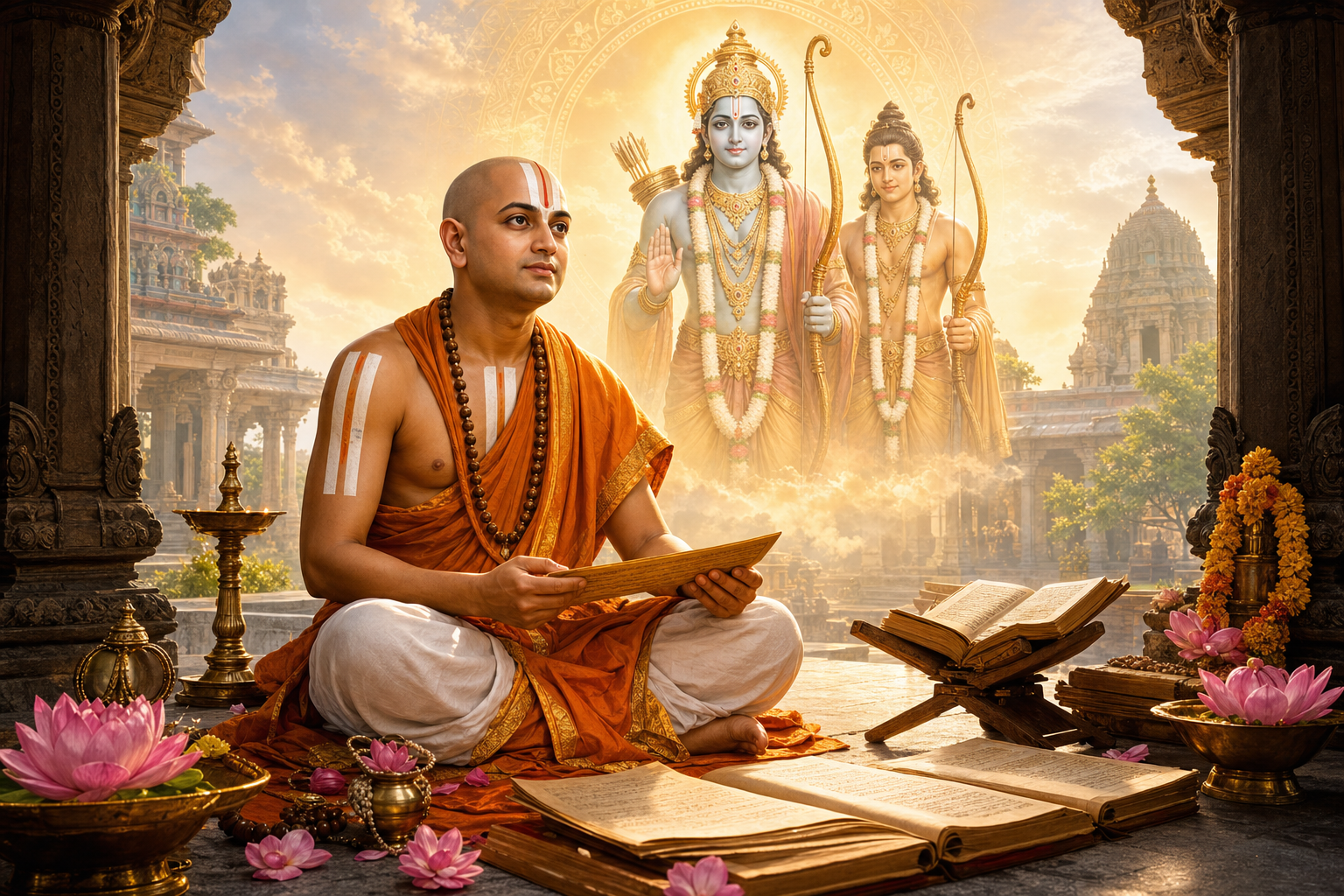
Sri Ramanujacharya occupies a central place in Hindu religious history as one of the most influential acharyas of the Vaishnava tradition. Born in 1017 CE at Sriperumbudur in present-day Tamil Nadu, he became a philosopher, theologian, social teacher, temple organizer, and spiritual reformer whose influence continues to shape Hindu spirituality nearly a millennium later. His life is remembered not merely because he wrote profound commentaries, but because he showed how philosophy, devotion, discipline, and compassion could become a single way of living.
The name “Ramanuja” itself carries devotional meaning. Traditionally understood as “the younger brother of Rama,” it evokes Lakshmana, the ideal servant-companion of Sri Rama in the Ramayana. This association is not incidental. It reveals a spiritual temperament rooted in service, surrender, loyalty, humility, and loving obedience to the Divine. In that sense, Ramanujacharya’s name becomes a theological statement: the highest wisdom is not cold abstraction, but intimate devotion expressed through disciplined service.
Although Ramanujacharya is most directly associated with Sri Vaishnavism and the worship of Sriman Narayana, his connection to Rama Bhakti is deeply meaningful. In the Vaishnava understanding, Rama is not separate from Vishnu or Narayana; he is one of the most beloved manifestations of the Supreme. Rama embodies dharma, compassion, royal responsibility, restraint, and moral beauty. For devotees, Rama Bhakti is therefore not only the emotional love of a sacred figure, but also the cultivation of ethical life, self-control, truthfulness, and devotion to righteousness.
Ramanujacharya’s philosophical system, known as Vishishtadvaita Vedanta, offers a powerful framework for understanding this devotion. Vishishtadvaita is often translated as “qualified non-dualism.” It affirms that Brahman is one, but this unity is not an empty or impersonal sameness. The individual soul and the universe are real, meaningful, and dependent on the Supreme. This allows devotion to retain its full dignity. The devotee is not asked to dismiss the world as meaningless, nor to erase personal love for God. Instead, the soul is invited to recognize its eternal relationship with the Divine.
This is where Ramanujacharya’s teaching becomes especially relevant to Rama Bhakti. In a purely abstract spirituality, love may appear secondary to knowledge. In Ramanuja’s vision, love is a form of knowledge brought to life. To know the Supreme is to love the Supreme; to love the Supreme is to serve the Supreme; and to serve the Supreme is to live in harmony with dharma. Rama, as Maryada Purushottama, becomes the perfect focus for such devotion because his life demonstrates the union of divine majesty and humanly intelligible virtue.
Ramanujacharya’s devotion was never sentimental in a shallow sense. His bhakti was disciplined, scriptural, and embodied. He drew upon the Vedas, Upanishads, Bhagavad Gita, Brahma Sutras, Pancharatra texts, Tamil Divya Prabandham hymns of the Alvars, and the living temple traditions of South India. His scholarship did not weaken devotion; it gave devotion intellectual strength. His devotion did not weaken scholarship; it gave scholarship warmth, purpose, and accessibility.
One of his greatest contributions was the harmonization of Sanskritic Vedanta and Tamil devotional spirituality. The Alvars had poured out intense love for Vishnu and his forms in Tamil hymns, making divine experience available in the language of the people. Ramanujacharya honored that devotional inheritance and integrated it into a broader theological system. This preserved the emotional power of bhakti while grounding it in rigorous Vedantic thought. The result was not a narrow sectarian identity, but a living sampradaya capable of embracing philosophy, poetry, ritual, temple worship, and community life.
The emotional force of Rama Bhakti within this framework can be understood through the figure of Lakshmana. Lakshmana’s life in the Ramayana is marked by tireless service. He does not seek independent glory; his identity is fulfilled in accompanying Rama. Since the name Ramanuja evokes Lakshmana, the acharya’s spiritual mission can be seen through that same lens. He taught that the soul’s dignity is not diminished by surrender to God. On the contrary, surrender reveals the soul’s true nature.
In Sri Vaishnava theology, this surrender is often described through the language of prapatti, or complete refuge in the Divine. Prapatti is not passivity. It is a conscious turning of the heart toward God with trust, humility, and responsibility. It recognizes that human effort matters, but also that liberation ultimately depends on divine grace. This balance between effort and grace is one of Ramanujacharya’s most enduring gifts to Hindu philosophy.
Rama Bhakti becomes especially powerful when viewed through prapatti. In the Ramayana, Rama protects those who seek refuge in him. The episode of Vibhishana’s surrender is a classic example in the Vaishnava imagination. Even when others doubt Vibhishana’s intentions, Rama affirms the sanctity of refuge. For Ramanujacharya’s tradition, this is not merely a narrative moment; it is a theological principle. The Divine is compassionate, accessible, and responsive to sincere surrender.
Ramanujacharya’s life also demonstrates the social implications of devotion. He is remembered for opening spiritual access more widely and emphasizing that birth alone cannot be the measure of divine eligibility. Traditional accounts describe his concern that sacred knowledge and temple participation should not remain restricted to a narrow circle. While historical details may be discussed differently across sources, the broad memory of Ramanujacharya within the Hindu world is clear: he made devotion more accessible, more organized, and more socially meaningful.
This point is crucial for understanding the heart of Vaishnavism. Bhakti is not only private emotion. It creates community. It teaches reverence, service, hospitality, humility, and shared sacred memory. In temples, homes, pilgrimages, festivals, recitations, and daily worship, the devotee learns to see life as participation in a divine order. Ramanujacharya’s work strengthened this communal dimension by giving Sri Vaishnavism durable institutions, philosophical clarity, and a theology of grace that could speak to ordinary people.
His association with major sacred centers such as Srirangam, Kanchipuram, Melukote, and Tirupati shows the practical dimension of his spirituality. He was not a philosopher isolated from lived religion. He engaged with temple administration, ritual order, devotional education, and community formation. This made his Vedanta visible. For many practitioners, that visibility matters deeply: philosophy becomes more persuasive when it can be sung, worshipped, cooked as prasadam, walked as pilgrimage, and practiced as service.
The Sri Vaishnava tradition that grew around his teachings preserved both Sanskrit and Tamil streams of sacred expression. This dual reverence carries an important civilizational lesson. Hindu Dharma has long flourished through plurality: Vedic recitation, temple ritual, philosophical debate, vernacular poetry, household worship, yogic discipline, and devotional singing have all found their place. Ramanujacharya did not flatten this diversity. He ordered it around a central principle: loving surrender to the Supreme, expressed through dharma and compassion.
Within this broader dharmic spirit, Ramanujacharya’s legacy also supports harmony among Hinduism, Buddhism, Jainism, and Sikhism. These traditions differ in metaphysics, theology, ritual, and historical development, yet they share a civilizational concern for discipline, liberation, ethical conduct, compassion, self-transformation, and the overcoming of ego. Ramanujacharya’s emphasis on humility before truth, reverence for the teacher, and spiritual practice as lived transformation can be appreciated within that wider dharmic family without erasing genuine differences.
His Vedanta also provides a meaningful response to a modern spiritual problem: the fragmentation of knowledge and feeling. Many people encounter religion either as inherited ritual without explanation or as abstract philosophy without emotional nourishment. Ramanujacharya brings these dimensions together. He shows that ritual can be intelligent, philosophy can be devotional, and devotion can be ethically demanding. Rama Bhakti, in this light, becomes a path where the mind, heart, and conduct are trained together.
The enduring appeal of Sri Rama in Vaishnavism lies in this integration. Rama is loved as the divine king, the obedient son, the faithful husband, the compassionate protector, the disciplined warrior, and the upholder of dharma. These roles make Rama accessible to human experience. People facing family duty, moral conflict, exile, grief, leadership, loyalty, or sacrifice can find in Rama a sacred mirror. Ramanujacharya’s theology allows this devotion to be more than admiration; it becomes a relationship between the soul and the Supreme.
At the center of this relationship is grace. Ramanujacharya did not deny the importance of effort, learning, discipline, or ethical living. Yet he refused to make liberation a matter of spiritual ego. The soul does not conquer God through austerity; it receives grace through surrender, devotion, and divine compassion. This insight remains emotionally powerful because it speaks to human limitation. Even sincere seekers experience weakness, doubt, fatigue, and moral struggle. The path of prapatti offers hope without removing responsibility.
That hope explains why Ramanujacharya remains a living presence in Hindu spirituality. His image is not confined to academic study. His teachings are remembered in temples, recited in homes, celebrated during Ramanujacharya Jayanti, and studied by seekers of Vedanta. His influence extends across centuries because he addressed permanent human questions: What is the nature of the soul? How is God known? What is the role of grace? How should devotion shape society? How can knowledge become love?
His answer was both philosophical and practical. The soul is real and eternally dependent on the Supreme. The world is real and meaningful as the body of God. Devotion is a valid and powerful means of spiritual realization. Surrender is not defeat, but fulfillment. Service is not social inferiority, but sacred participation. Community is not an accidental feature of religion, but a field in which devotion matures.
In this way, Sri Ramanujacharya’s Rama Bhakti is not limited to one historical period. It remains relevant wherever people seek a spirituality that is intellectually serious, emotionally sustaining, ethically grounded, and socially constructive. His life teaches that the highest philosophy need not be distant from the ordinary devotee. It can enter daily prayer, temple worship, family life, moral decision-making, and compassionate service.
The devotion that endures is therefore not merely a memory of the past. It is a living inheritance. Through Sri Ramanujacharya, Vaishnavism presents a vision in which Rama Bhakti, Vishnu worship, Vedanta, dharma, grace, and service become mutually reinforcing paths toward liberation. His legacy continues to remind the Hindu world that true spiritual greatness is measured not only by argument or authority, but by the ability to bring souls closer to the Divine with clarity, humility, and love.
Inspired by this post on Hindu Blog.
