
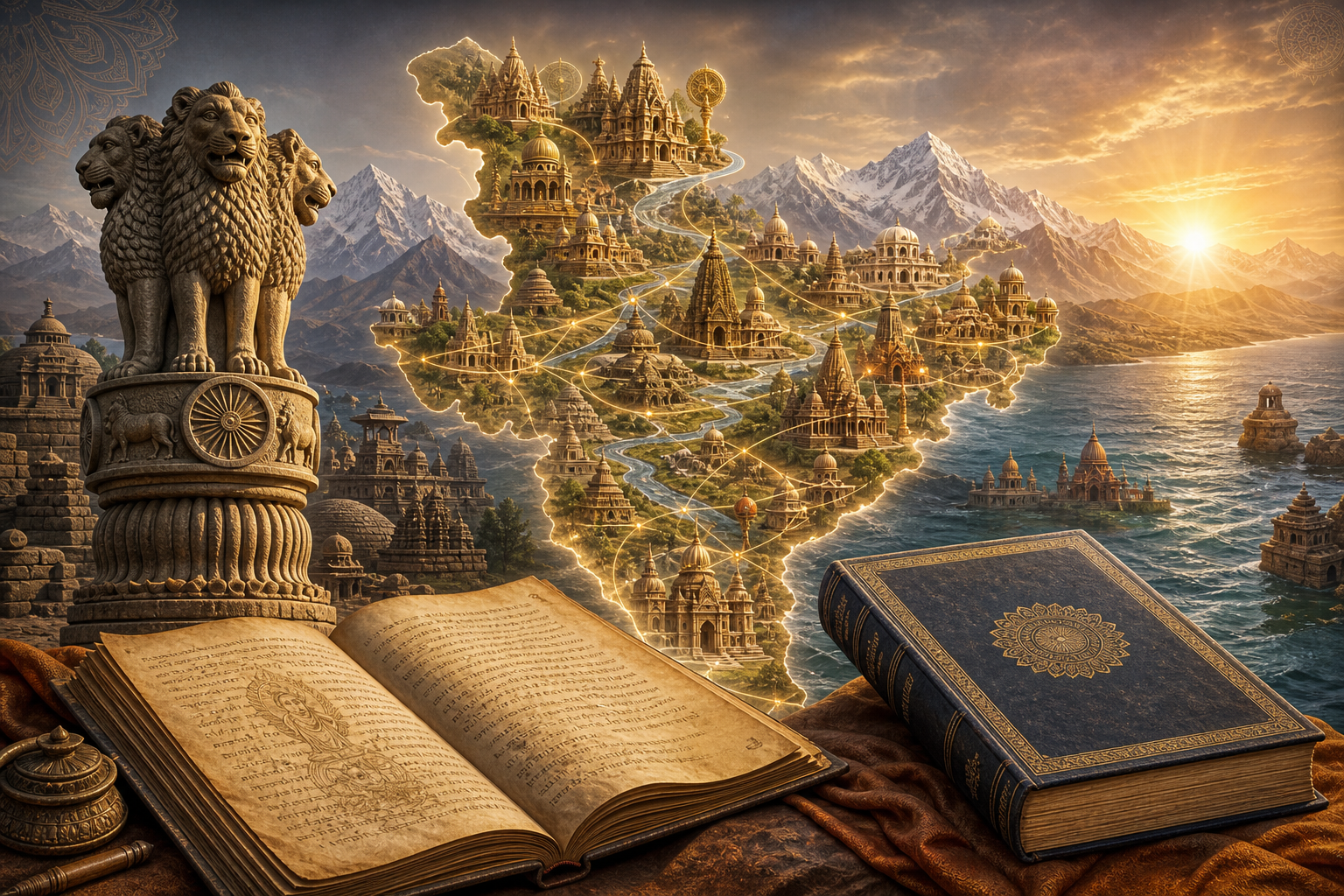
The claim that Bharat did not exist before 1947 has become a common online slogan, but it rests on a serious confusion between three different things: a modern constitutional state, a civilizational geography, and a continuous cultural memory. The Republic of India as a sovereign political state emerged through independence in 1947 and constitutional consolidation in 1950. Yet Bharat as a name, as a sacred-cultural landscape, and as a shared civilizational reference is far older than the transfer of power from the British Empire.
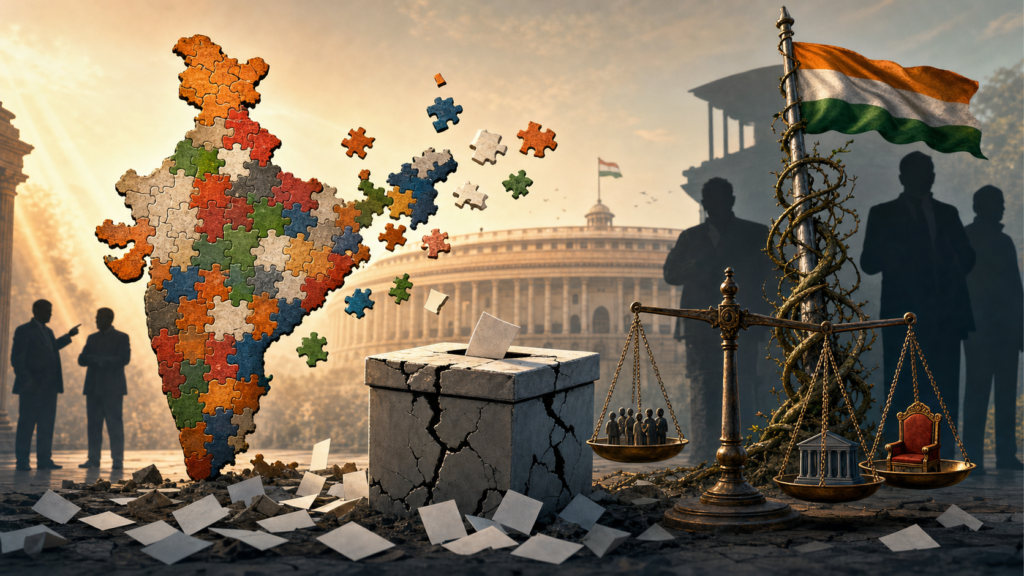
A historically careful position must begin with a distinction. If the question is whether the present Republic of India, with its Constitution, Parliament, Supreme Court, electoral system, federal states, and modern citizenship, existed before 1947, the answer is no. If the question is whether the people of the subcontinent possessed long-standing ideas of Bharat, India, Jambudvipa, Aryavarta, Hindustan, sacred geography, political unity, pilgrimage networks, intellectual exchange, and civilizational belonging, the answer is unmistakably yes.
The phrase ‘There was no India before 1947’ therefore functions less as historical analysis and more as rhetorical compression. It collapses statehood into nationhood, nationhood into civilization, and civilization into a single administrative border. Such compression may appear sophisticated, especially when presented as a correction to cultural pride, but it reduces a complex historical reality into a brittle slogan.
The first point of evidence is constitutional rather than ancient. Article 1 of the Constitution declares: ‘India, that is Bharat, shall be a Union of States.’ This wording did not invent Bharat from nothing; it recognized a civilizational name already alive in language, memory, politics, literature, and public imagination. The Constitution gave modern legal form to a name that carried historical depth.
That distinction matters because the Constitution itself does not treat Bharat as a decorative synonym. It places India and Bharat together at the foundation of the Union. In doing so, it acknowledges that the modern republic stands at the meeting point of constitutional modernity and civilizational continuity. This is not nostalgia; it is embedded in the legal self-description of the Indian state.
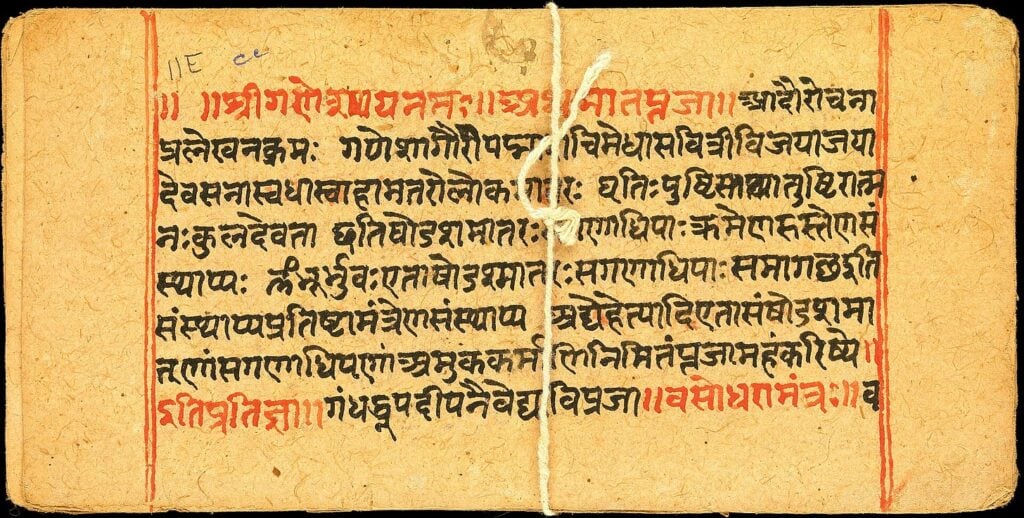
The older textual memory of Bharat is visible in the Puranic description of Bharatavarsha. A widely cited Sanskrit verse states: उत्तरं यत्समुद्रस्य हिमाद्रेश्चैव दक्षिणम् । वर्षं तद् भारतं नाम भारती यत्र संततिः ।। The usual sense is that the land north of the ocean and south of the snowy mountains is called Bharata, where the descendants of Bharata dwell. Whatever debates exist over the dating and layers of Puranic literature, the phrase shows that Bharat was imagined as a geographic and cultural field long before colonial cartography.
This does not mean that every ancient text described the same exact borders as the present Republic of India. Ancient geographies were layered, symbolic, political, sacred, and sometimes expansive in ways that do not map neatly onto modern survey lines. But the existence of changing boundaries does not mean the absence of civilizational identity. Boundaries shift in every old civilization; memory, vocabulary, pilgrimage, literature, and institutions often endure across those shifts.
The name India itself is also ancient in external usage. It derives ultimately from Sindhu, associated with the Indus, passing through Old Persian and Greek forms into later European languages. Foreign observers, traders, envoys, and conquerors used variations of India to refer to the lands beyond the Indus and south of the Himalayas. The term was not created by the British in 1947, even if British imperial rule later standardized it in administrative English.
Greek accounts such as those associated with Megasthenes and later classical writers show that outsiders recognized a broad Indian world in antiquity. These accounts were imperfect, sometimes exaggerated, and shaped by their own political agendas. Still, their very existence demonstrates that the subcontinent was not an unnamed mass waiting to be conceptually assembled by the British. It was already legible to outsiders as a distinct region with its own peoples, practices, wealth, learning, and political forms.
Political plurality is often mistaken for civilizational absence. Ancient Bharat was not always governed by one ruler from one capital. It contained janapadas, mahajanapadas, republics, monarchies, empires, temple-centered regions, trade cities, forest communities, monastic networks, and village institutions. That plurality is not evidence against Bharat; it is evidence of the historical form in which Bharat often existed.
The mahajanapadas of the first millennium BCE are especially important. They show a landscape of organized polities stretching across large parts of northern and central India, with names such as Magadha, Kosala, Kashi, Avanti, Gandhara, Vajji, Malla, Kuru, Panchala, and others. These were not colonial inventions. They were part of an old political vocabulary in which territory, people, kingship, assemblies, trade, and sacred authority interacted dynamically.
The rise of Magadha and later the Mauryan Empire gave one of the clearest early examples of subcontinental political integration. Chandragupta Maurya, Bindusara, and Ashoka ruled over extensive territories, and Ashoka’s inscriptions appeared across a vast region including areas now located in India, Pakistan, Nepal, Afghanistan, and Bangladesh. The inscriptions carried ethical and administrative messages under the language of dhamma, showing how political power, moral vocabulary, and geographic reach could operate across diversity.
Ashoka is particularly significant for the unity of dharmic traditions. His inscriptions do not represent a narrow sectarian command; they express a concern with moral conduct, restraint, welfare, respect, and public ethics. The Buddhist inheritance of Ashoka belongs to Buddhist history, but it also belongs to the larger civilizational history of Bharat because it shaped the moral and political imagination of the subcontinent and beyond.
Similar patterns of integration appeared through cultural networks rather than only imperial power. Sanskrit circulated as a language of learning, ritual, philosophy, poetics, polity, and inscription. Prakrits, Pali, Tamil, Kannada, Telugu, Bengali, Marathi, Odia, Punjabi, and many other languages carried regional genius while participating in larger civilizational exchanges. Bharat was never a one-language civilization; it was a many-language civilization with shared intellectual routes.
This is where the civilizational argument becomes stronger than a purely political one. A land can possess unity without uniformity. It can share categories of thought while preserving regional variation. Dharma, karma, samsara, moksha, nirvana, ahimsa, seva, tapas, yoga, sangha, tirtha, guru, shastra, and darshana did not mean identical things in every tradition, but they created overlapping vocabularies through which Hindus, Buddhists, Jains, Sikhs, and other communities could debate, differ, reform, and recognize one another.
Bharat’s unity has therefore never required sameness. Hindu, Buddhist, Jain, and Sikh traditions emerged in different historical contexts and developed distinct doctrines, institutions, and disciplines. Their differences must not be erased. Yet their histories are intertwined through geography, ethical inquiry, pilgrimage, debate, monastic and temple networks, royal patronage, vernacular literature, and shared civilizational concerns about liberation, duty, compassion, discipline, knowledge, and righteous conduct.
For many families, this continuity is not first encountered in academic books. It appears in names, festivals, journeys, stories told by grandparents, visits to rivers and temples, reverence for gurus and saints, respect for monks and sadhus, memories of Partition, songs of freedom, and the ordinary use of words such as Bharat Mata, desh, dharma, punya, and seva. These experiences are not a substitute for scholarship, but they explain why the civilizational idea of Bharat has remained emotionally durable.
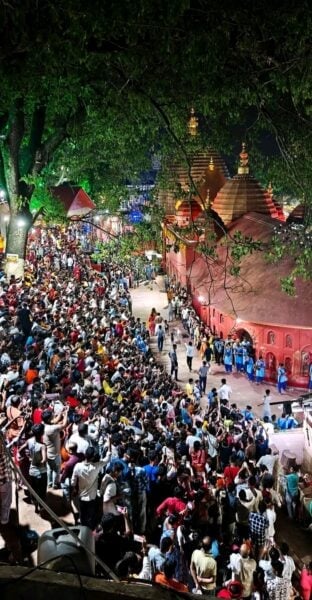
Sacred geography made that durability possible. Kashi, Prayag, Ayodhya, Mathura, Puri, Rameswaram, Dwarka, Kanchipuram, Ujjain, Bodh Gaya, Sarnath, Rajgir, Vaishali, Shravanabelagola, Palitana, Amritsar, Anandpur Sahib, Patna Sahib, Nanded, and countless other sites formed routes of memory. Pilgrimage taught people to imagine the land as connected even when political power was fragmented.
The epics also created a shared map. The Ramayana and Mahabharata were not merely literary works; they became civilizational frameworks retold in Sanskrit, Prakrit, Tamil, Awadhi, Bengali, Assamese, Odia, Malayalam, Kannada, Telugu, Marathi, and many other languages. Their regional retellings did not weaken unity. They deepened it by allowing local cultures to participate in a larger narrative inheritance.
Similarly, philosophical schools disagreed intensely while remaining part of a recognizable intellectual world. Vedanta, Samkhya, Yoga, Nyaya, Vaisheshika, Mimamsa, Buddhist schools, Jain philosophy, Sikh theological reflection, Bhakti movements, Tantra, and many vernacular traditions argued over metaphysics, ethics, ritual, knowledge, liberation, and social conduct. Debate itself became a sign of belonging to a shared civilizational conversation.
The medieval period also does not support the claim that Bharat was absent. It was a period of conflict, synthesis, resistance, adaptation, temple building, temple destruction, literary production, trade, regional state formation, and spiritual renewal. The Cholas, Palas, Rashtrakutas, Pratiharas, Chalukyas, Vijayanagara, Ahoms, Marathas, Rajputs, Sikhs, and many others operated in different political settings, yet the cultural memory of the land remained active through inscriptions, pilgrimage, royal titles, ritual networks, and vernacular traditions.
Nor can the existence of multiple kingdoms be treated as proof that India did not exist. By that standard, Italy did not exist before the nineteenth century, Germany did not exist before unification, and Greece did not exist before the modern Greek state. Such claims would be absurd if they denied older Greek, German, or Italian civilizational identities. The same logic should be applied consistently to Bharat.
The British did contribute to administrative centralization through railways, census operations, codified law, a centralized bureaucracy, modern education, revenue systems, and imperial mapping. But contribution is not creation from nothing. Colonial rule reorganized, exploited, classified, and governed an already existing civilizational landscape. It did not produce the Sanskritic, Prakritic, Pali, Tamil, Jain, Buddhist, Sikh, Bhakti, temple, monastic, pilgrimage, and philosophical inheritances that preceded it by centuries and millennia.
In fact, colonial categories often narrowed older identities by forcing fluid communities into rigid census boxes and legal compartments. The British state did not simply discover Indian society; it also classified it in ways that served governance. Modern historical analysis must therefore be careful not to mistake colonial administrative categories for the full truth of precolonial social reality.
The freedom movement further demonstrates that Bharat was not an artificial afterthought. Leaders and communities across regions invoked Bharat, India, Hindustan, swaraj, swadeshi, dharma, rights, citizenship, sacrifice, and national dignity. They disagreed on methods and visions, but they did not mobilize a people who had no prior civilizational memory. Anti-colonial nationalism transformed older identities into a modern political project.
It is also important to avoid an opposite error. To say that Bharat existed before 1947 does not mean that the past was politically uniform, socially perfect, or free of internal conflict. The historical record includes hierarchy, contestation, sectarian rivalry, regional warfare, social exclusion, and painful ruptures. A mature understanding of Bharat does not require romantic denial. It requires the ability to see continuity and complexity together.
This balanced view is especially important for the unity of dharmic traditions. Hinduism, Buddhism, Jainism, and Sikhism should not be collapsed into one another, nor should they be artificially separated from their shared civilizational soil. Their unity lies not in doctrinal sameness but in long interaction, ethical seriousness, reverence for disciplined practice, and a common geography of memory. That unity can be affirmed without erasing difference.
Thus, the phrase ‘Bharat did not exist before 1947’ is historically misleading. The modern Indian state began in the twentieth century, but Bharat as a civilizational name, cultural geography, intellectual field, sacred landscape, and political aspiration has deep roots. The better formulation is more precise: the Republic of India is modern; the civilization of Bharat is ancient; the task of independent India has been to give constitutional form to that inheritance while protecting plural citizenship.
The most responsible conclusion is neither triumphalist nor dismissive. Bharat before 1947 was not always one state, but it was far more than a colonial map. It was a layered civilization of memory, pilgrimage, argument, kingship, monastic discipline, temple culture, trade, philosophy, poetry, sacred geography, and social aspiration. To recognize this is not to reject modern constitutional India. It is to understand why the Constitution could say, with historical confidence, ‘India, that is Bharat.’
Reference points for further verification include discussions of the names of India, the mahajanapadas, the Edicts of Ashoka, and Article 1 of the Constitution of India. These references should be read critically and supplemented with primary texts, inscriptions, and specialist scholarship, but they provide useful entry points into the historical debate.
Inspired by this post on Hindu Post.




Leave a Reply
You must be logged in to post a comment.