
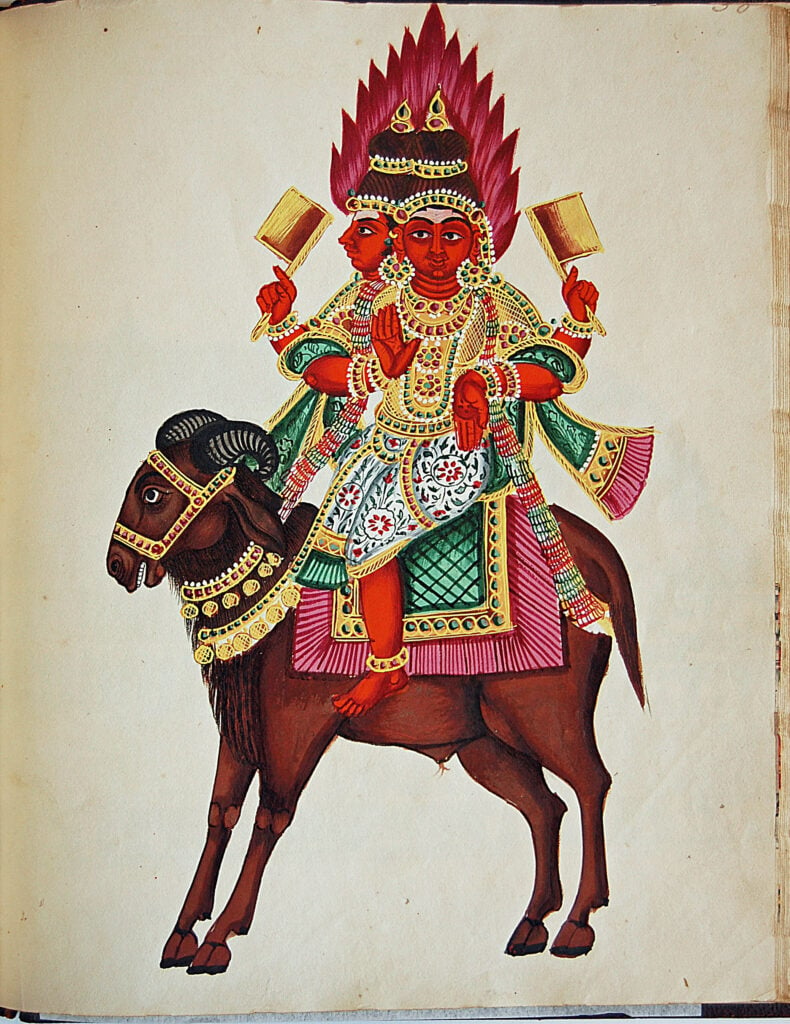
The history of Agnivamsa occupies a distinctive place in Indian history because it brings together Puranic memory, regional political traditions, Rajput identity, and the difficult problem of chronology. The subject cannot be treated merely as a legend, nor can it be reduced to a modern caste argument. It belongs to the wider study of Bharatavarsha, where lineages, ritual status, political authority, and civilizational memory often intersect in complex ways.
Agnivamsa, or the fire-lineage, is traditionally associated with a group of Kshatriya houses said to have emerged through a great yajna at Mount Arbuda, the ancient name of Mount Abu. The best-known Agnivamsa houses are the Paramaara, Prathihaara, Chahamaana, and Chaalukya. These lineages later became central to Rajput history, especially in western and northern India, while the Chaalukyas also shaped the political and cultural history of South India.
The importance of this tradition lies not only in genealogy but also in the larger question it raises: how did Indian civilization understand social duty, political legitimacy, and the renewal of Kshatra Dharma during periods of upheaval? The Agnivamsa account suggests that the function of protection, governance, and military responsibility could be ritually affirmed when society required new guardians. In that sense, the tradition is not merely about descent; it is about responsibility.
Discussions of Rajput origins have often been distorted by two extremes. One extreme tries to dismiss Rajputs as foreign-origin communities descended from Huns, Scythians, or other Central Asian groups. Another extreme treats every major Rajput house as a direct continuation of the most ancient Solar or Lunar dynasties. A more balanced academic approach recognizes the antiquity, rootedness, and civilizational importance of Rajput lineages while also allowing for the layered nature of Indian political society.
The Agnivamsa tradition challenges the colonial habit of explaining Indian warrior houses through foreign origins. Colonial-era historiography often preferred external explanations for Indian institutions, especially when those institutions displayed military strength, political sophistication, or social continuity. The fire-lineage narrative, by contrast, places these houses within the sacred geography, ritual culture, and political evolution of Bharatavarsha.
At the heart of the tradition is Mount Arbuda. The account describes a yajna through which selected Brahma-Kshatra lineages were invested with Kshatriya tejas. The term Brahma-Kshatra itself requires careful handling. It does not imply weakness of Kshatriya identity. Rather, it points to a category known in Indian tradition, where varna, duty, tapas, lineage, and social function were understood through more than one historical pathway.
The example of Maharishi Vishvamitra is often relevant in this discussion. Indian tradition preserves the memory of a Kshatriya who, through tremendous tapas, became recognized as a Brahmarshi. If a Kshatriya lineage could enter the Brahminical fold through spiritual achievement and sacred recognition, then the reverse idea, that learned or ritually grounded lineages could assume Kshatriya responsibilities during a historical need, should not be dismissed without careful evidence.
The source tradition cited in the original discussion associates different Agnivamsa houses with Vedic affiliations: Paramaras with the Saama Veda, Chalukyas with the Shukla Yajurveda, Chahamanas with Trivedi associations, and Pratiharas with the Atharvana tradition. Whether every detail can be independently verified through inscriptional evidence is a separate historical question, but the structure of the tradition is meaningful. It presents these houses not as outsiders but as communities ritually integrated into the dharmic order.
Malava, or Malwa, becomes especially important in this account. This region, centered around Ujjain and Avanti, has long carried immense historical and sacred significance. Ujjain is associated with astronomy, Sanskrit literature, pilgrimage, temple culture, Kalidasa, and the famous memory of Vikramaditya. Any serious study of Agnivamsa must therefore place Malava at the center of the discussion, not as a peripheral kingdom but as a major node of Indian civilization.
The chronology presented in the original source follows the work of Pandit Kota Venkatachalam, also known as Pandit Chelam, whose reconstruction of ancient Indian chronology differs sharply from mainstream Indological timelines. His work argues that several chronological assumptions inherited from colonial scholarship require correction, including the placement of dynasties and the interpretation of classical references. This approach remains debated, but it is important because it reflects an indigenous attempt to reconcile Puranic records, inscriptions, literary evidence, and dynastic memory.
According to that chronology, Dhunji, a Brahmin ruler of Malava, united the Malavas and ruled under the broader influence of the Andhra Satavahana imperial world. Later, the Malava polity is said to have passed through dynastic change before Adab Panwar of the Agnivamsa assumed power. The Paramaara line, in this telling, becomes central to the later emergence of Vikramaditya Panwar, also known in Puranic memory as Paramaara Vikramaadhithya or Vikramarka.
The name Vikramaditya itself must be approached with caution. Indian history and literary tradition preserve multiple figures with this title. There is Sriharsa Vikramaditya in one chronological tradition, Chandra Gupta II Vikramaditya of the Gupta period, and the celebrated Paramaara Vikramaditya connected with Ujjain. Confusing these figures has produced many historical problems. A careful academic reading separates title, person, dynasty, and era rather than collapsing them into one legendary personality.
The Vikrama era of 57 BCE and the Salivahana Saka of 78 CE are central markers in the traditional memory of resistance against Saka power. The Agnivamsa account links the Paramaara Vikramaditya and later Salivahana with victories that changed the political landscape. Even where historians debate the precise identities behind these eras, the civilizational memory remains clear: Indian political tradition remembered the defeat of disruptive foreign powers as an event worthy of calendrical commemoration.
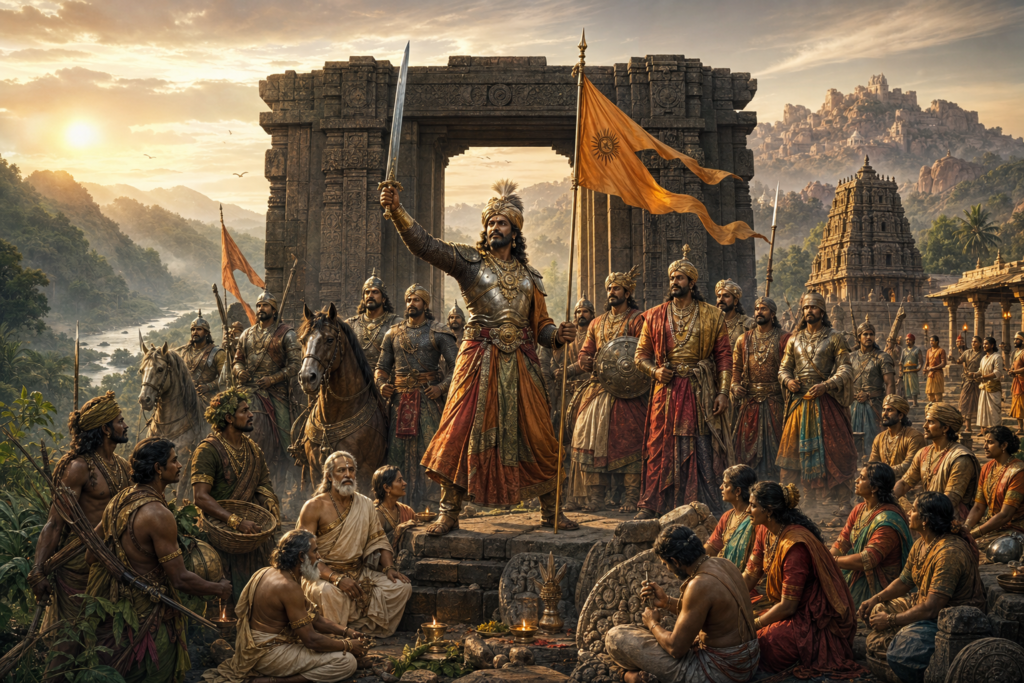
The four principal Agnivamsa houses each carry a distinct historical significance. The Paramaara, associated with Ujjain and Malava, became one of the most culturally resonant dynasties in western India. The Prathihaaras became famous for their role in defending northwestern India and resisting the westward pressure of the Abbasid Caliphate. The Chahamaanas, or Chauhans, became deeply associated with Ajmer, Delhi, and the later memory of Prithviraj Chauhan. The Chaalukyas shaped both western Indian and South Indian political history, leaving a major imprint on architecture, temple patronage, and regional statecraft.
The Paramaara story is inseparable from Ujjayini. The city’s sacred geography and intellectual legacy give the dynasty a cultural depth beyond political conquest. The Paramaara name is remembered through forms such as Parmar and Panwar, and its association with Vikramaditya gives it a special place in Rajput Heritage. In civilizational terms, the Paramaara tradition represents the union of literary memory, royal power, sacred geography, and political resilience.
The Chahamaana tradition, especially through Prithviraj Chauhan, reveals both the glory and tragedy of medieval Indian history. The first Battle of Tarain in 1191 CE showed the strength of the Rajput confederate world, while the second Battle of Tarain in 1192 CE exposed the dangers of disunity, strategic complacency, and failure to adapt to adversaries who did not share the same codes of war. This episode remains emotionally powerful because it is not merely a military defeat; it is a lesson in political realism.
The distinction between Achara Yuddha and Dharma Yuddha is useful here. War conducted among communities sharing similar ethical assumptions differs from war against forces that reject those restraints. The Mahabharata itself shows that Dharma Yuddha is not naive pacifism. It is a disciplined struggle to restore justice while recognizing the nature of the adversary. For Kshatra Dharma, courage must be joined to strategy, unity, and adaptability.
The rivalry between Prithviraj Chauhan and Jayachandra Gahadavala is often remembered through the simplified label of betrayal. A more responsible reading recognizes the broader political lesson: internal rivalry among dharmic powers can produce consequences far beyond the immediate dispute. The enduring lesson is not to demonize one community or lineage, but to understand that civilizational defense requires unity when the larger order is under threat.
The Chaalukyas complicate any narrow northern reading of Agnivamsa history. Although they are often remembered as a South Indian dynasty, especially through the Badami, Western, and Eastern Chalukya branches, the tradition also links their deeper lineage to Mount Arbuda. Their architectural achievements, temple patronage, inscriptions, and political influence across Karnataka, Andhra, Gujarat, and beyond make them indispensable to Indian history.
The Solanki name in Gujarat is commonly connected with the Chaalukya tradition. Attempts to rigidly separate Chaulukya and Chaalukya identities often miss the way names evolved through region, language, inscriptional practice, and political memory. The broader point is that these houses participated in a shared civilizational field while developing distinctive regional expressions.
The Prathihaaras deserve special attention in any discussion of Historical Research on early medieval India. Their resistance to Arab expansion after the initial Islamic conquests gave northern and western India crucial breathing room. Alongside other regional powers, including Chalukya forces in the south and later Rajput houses in the west, they helped prevent the rapid collapse of Indian political autonomy during a period when much of West and Central Asia had already undergone dramatic transformation.
Nagabhata I, Nagabhata II, and Mihir Bhoja stand out in Prathihaara memory. Their role in the tripartite struggle with the Palas and Rashtrakutas shows that early medieval India was not a passive landscape awaiting invasion. It was a competitive, militarized, intellectually rich, temple-building, Sanskritic and regional civilizational world in which major powers contested sovereignty.
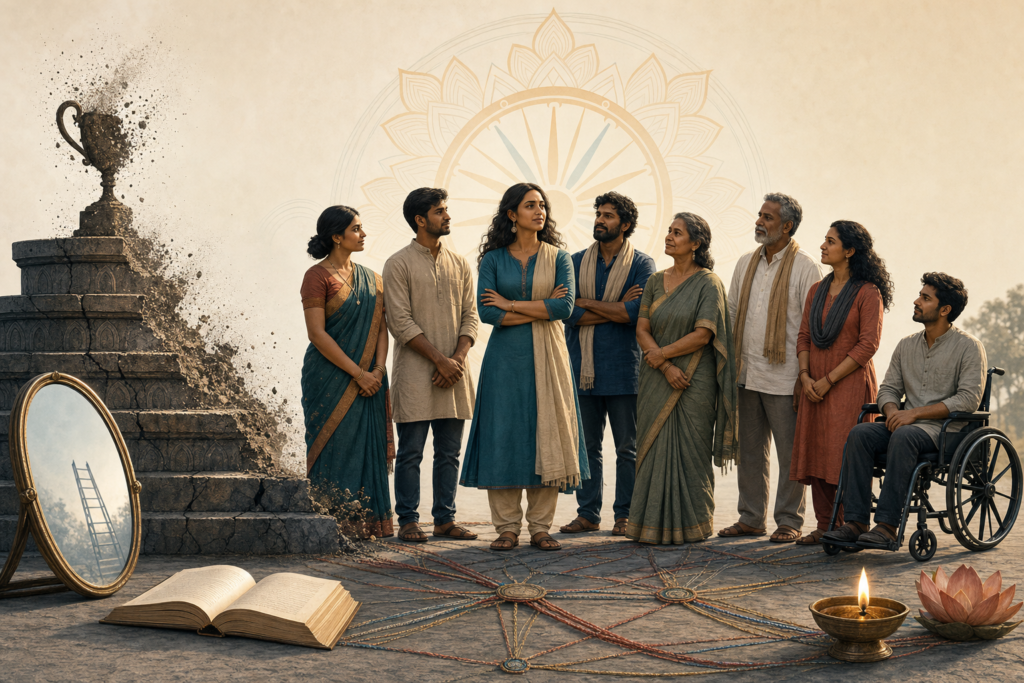
The Agnivamsa debate also raises the question of caste, varna, and historical identity. A dharmic reading must avoid both caste arrogance and rootless denial. Jaathivaadha, understood as rigid social vanity or hostility among communities, should not be confused with Varnashrama Dharma as an ethical framework of responsibility, discipline, learning, protection, production, and service. The healthier lesson of Agnivamsa is that social identity must be tied to duty, restraint, and contribution to the common good.
This point is especially important for unity among Hinduism, Buddhism, Jainism, and Sikhism. Dharmic traditions have often disagreed in philosophy, ritual, metaphysics, and institutional life, yet they share a civilizational respect for tapas, dharma, self-discipline, sacred geography, ethical conduct, and liberation-oriented life. The Agnivamsa story should therefore not be used to deepen sectarian or caste hostility. It should be used to understand how communities renew themselves during crisis.
Jain sources, for example, preserve important memories related to Ujjain, Kalaka, the Sakas, and the political world around Vikramaditya. Hindu Puranic traditions preserve other layers of the same civilizational memory. These traditions need not be read as enemies. When studied together, they reveal a more textured historical landscape in which multiple dharmic communities witnessed, interpreted, and transmitted memories of power, conflict, ethics, and restoration.
The emotional power of Agnivamsa lies in its insistence that identity is not empty prestige. A lineage is meaningful only when it protects society, upholds dharma, supports learning, builds institutions, and sacrifices for the larger janatha. Many readers encountering Rajput history feel admiration not because of titles alone, but because of the repeated willingness of warrior communities to stand in difficult times, often at enormous cost.
At the same time, responsible history must resist exaggeration. No community is strengthened by false claims, and no civilization is honored by insulting other communities. The strongest case for Rajput and Agnivamsa importance rests on their real contributions: defense of sacred geography, patronage of temples and literature, regional state formation, resistance to invasions, and preservation of Kshatra Dharma across centuries of upheaval.
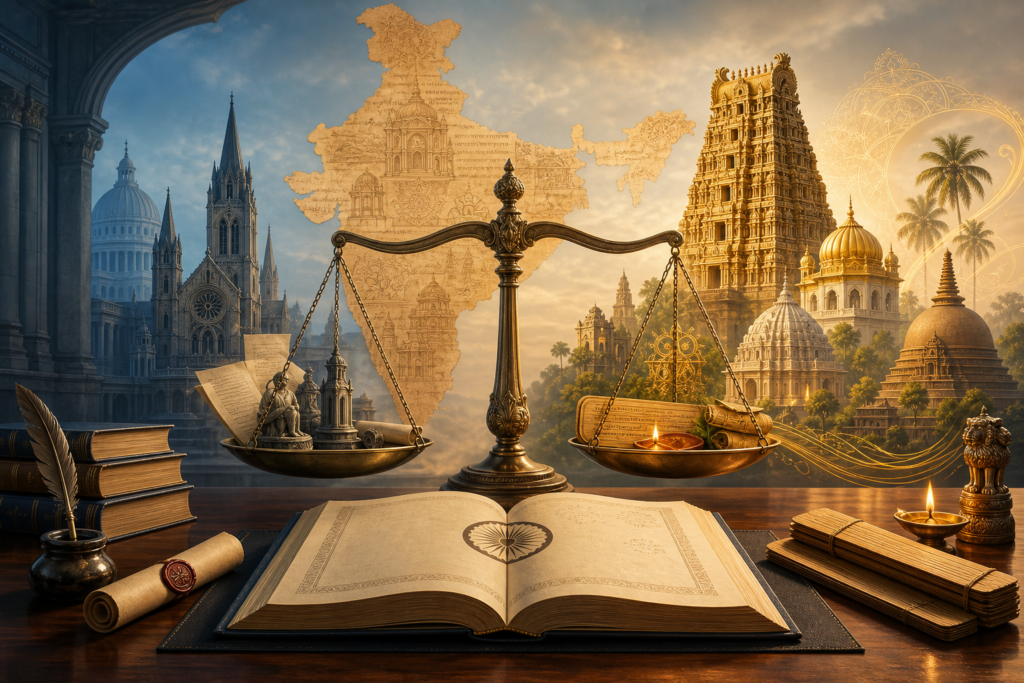
The colonial framing of Indian history often treated Puranic chronology as mythology, inscriptions as isolated data points, and indigenous historical memory as unreliable unless confirmed by external models. A more mature method does not accept every traditional claim uncritically, but neither does it dismiss native records by default. It compares Puranas, inscriptions, literary works, regional chronicles, calendars, foreign accounts, and archaeological evidence with intellectual humility.
Agnivamsa therefore becomes a case study in historiography. It asks how evidence is weighed, how colonial assumptions entered textbooks, how indigenous scholars such as Pandit Kota Venkatachalam challenged inherited timelines, and how communities remember themselves. Even when there is disagreement about dates such as 392 BCE, 57 BCE, or 78 CE, the debate itself is valuable because it forces Indian history to be studied on its own terms.
The most constructive conclusion is that Agnivamsa should be understood as a dharmic lineage tradition rooted in Indian sacred geography and political history. Its houses shaped the Rajput world, influenced north and south India, resisted external threats, and contributed to the long continuity of Hindu civilization. Its deeper message is not exclusion but renewal: when society faces disorder, new guardians must arise with discipline, legitimacy, and responsibility.
In that light, Agnivamsa is not merely a story of fire-born kings. It is a reflection on how a civilization remembers courage, corrects historical distortion, reconciles lineage with duty, and calls communities back to unity. The fire of Agni is not only a symbol of origin; it is also a symbol of purification, sacrifice, illumination, and resolve. For modern readers, the most enduring lesson is that dharmic strength depends on truth, humility, scholarship, and solidarity across all communities committed to Dharma.
Inspired by this post on Indic Portal.


Leave a Reply
You must be logged in to post a comment.