
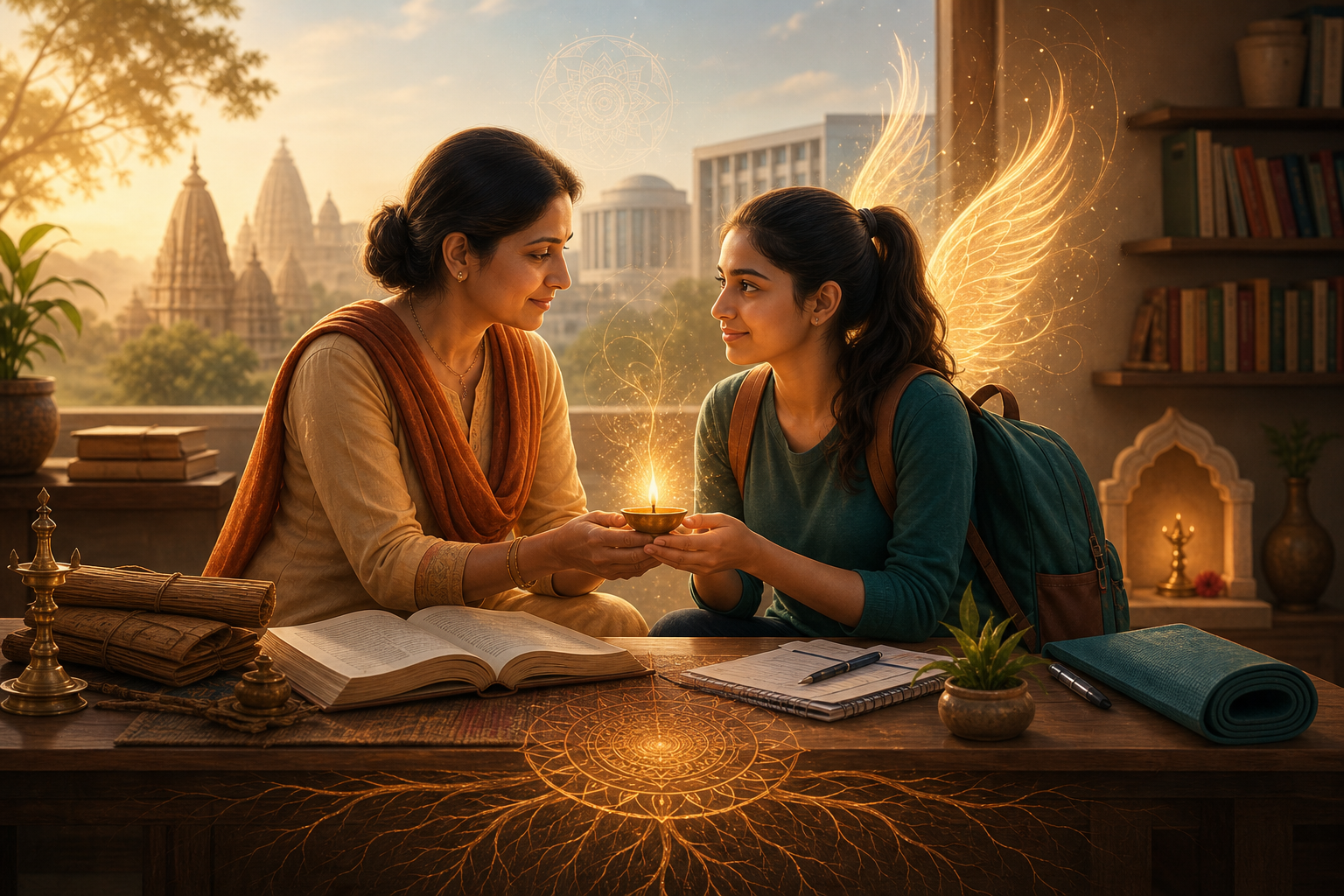
Passing the Flame to Gen-H
“Dharma, when destroyed, destroys. Dharma, when protected, protects.”
— Mahābhārata
Every visit to an antiquity gallery carries a quiet lesson. Ancient vessels, statues, inscriptions, coins, ritual objects, and architectural fragments often display astonishing beauty and technical refinement. Yet many of them also carry a silence that is difficult to miss. They belong to civilizations whose temples no longer function as living centers, whose schools of thought no longer shape everyday conduct, and whose ritual worlds have become primarily objects of scholarly reconstruction. The museum protects the artifact, but it cannot fully restore the living rhythm of a culture that once prayed, debated, healed, sang, and transmitted wisdom across generations.
This contrast gives O Dharmaputri! Indian Heart, Yogic Wings its emotional and intellectual force. The reflection surrounding the book is not merely a book review; it is a meditation on cultural continuity, Hindu Dharma, parenting, education, and the responsibilities that accompany civilizational inheritance. It asks a question that is deeply personal for many families and yet broadly relevant to all dharmic traditions: how can a living wisdom tradition be passed to the next generation without reducing it to compulsion, nostalgia, or decorative identity?
Hindu tradition remains alive precisely because it has not been confined to archives. It breathes through temple worship, home rituals, Sanskrit learning, regional languages, music, dance, Ayurveda, Yoga, storytelling, festivals, pilgrimage, and philosophical inquiry. The Gayathri Mantra may be chanted in Kumbakonam and Sydney; debates on Hindu philosophy may unfold in Kashi and Oxford; Carnatic music may carry memories of temple culture into modern auditoriums; Yoga and Ayurveda may continue to offer practical disciplines for body, mind, and consciousness. This continuity is not accidental. It has depended on ordinary families, teachers, gurus, institutions, and communities choosing, generation after generation, to keep the flame of Dharma alive.
The central concern of the book, therefore, is not whether the tradition possesses depth. The concern is transmission. A tradition can be profound and still fail to reach a child if it is presented only as obligation. A ritual can be sacred and still appear empty if its meaning is never explained. A philosophical inheritance can be vast and still remain inaccessible if the next generation hears only instructions, not reasons. The challenge before Gen-H, the emerging generation of Hindus and dharmic youth, is to receive Dharma as a living framework for discernment, resilience, compassion, self-knowledge, and inner freedom.
The Questions Have Not Changed
“Learning is wealth that nothing can destroy.”
— Thirukkural, 400.
The questions facing Gen-H are often described as modern questions, but they are in fact perennial ones. What is the purpose of human life? How should one choose rightly when moral language becomes relative? How can ambition be pursued without losing inner balance? How can relationships, wealth, duty, pleasure, and liberation be placed in proper proportion? How can one remain grounded when success is unstable, social approval is fleeting, and anxiety has become a common feature of contemporary life?
Hindu philosophy answers these questions through layered frameworks rather than through simplistic slogans. The Purusharthas — Dharma, Artha, Kama, Moksha — remain among the most sophisticated models of human aspiration. They do not reject prosperity, desire, family life, or public responsibility. Instead, they insist that these pursuits must be ordered by Dharma and ultimately illumined by Moksha. This is a practical vision of life, not an escape from life. It recognizes that human beings need livelihood, affection, beauty, discipline, social responsibility, and transcendence.
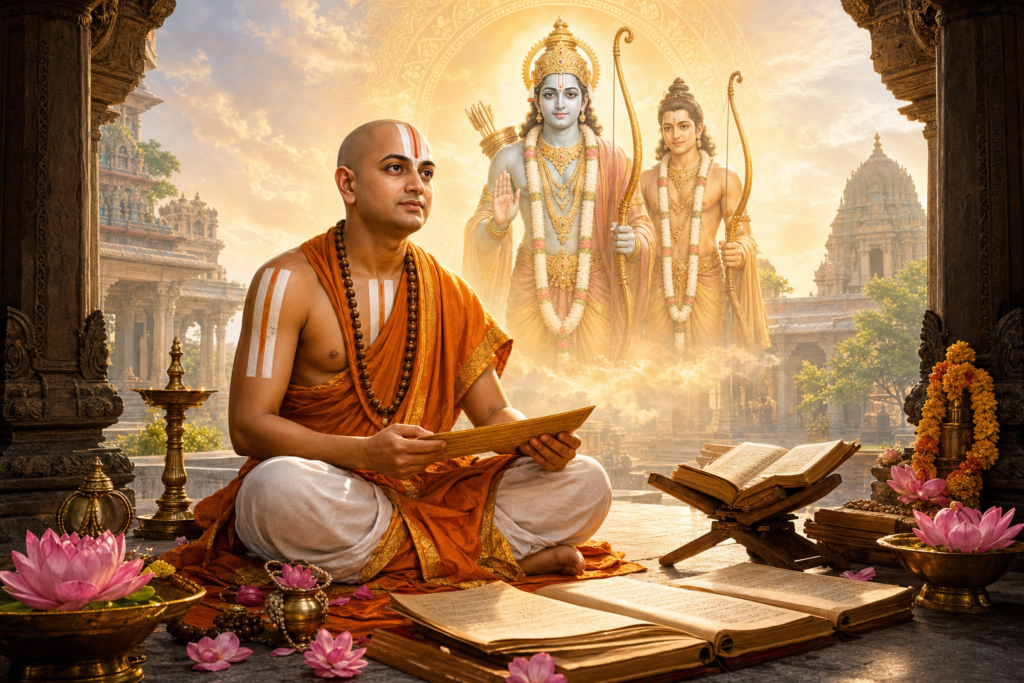
The Ramayana and Mahabharata serve a similar function. They are not merely narrative treasures or cultural memories. They are ethical laboratories. Their characters face dilemmas in which every available choice carries consequence. Rama, Sita, Lakshmana, Bharata, Draupadi, Bhishma, Karna, Arjuna, Yudhishtira, and Krishna all inhabit situations that demand discernment rather than mechanical rule-following. For a young person, this is crucial. Dharma is not presented as a rigid code detached from circumstance; it is presented as the art of aligning action with truth, duty, compassion, and cosmic order under real pressure.
The book also rightly brings Yoga and Ayurveda into the discussion of education. Maharishi Sushruta, Ayurveda, Patanjali’s Yoga Sutras, pranayama, asana, meditation, and sattvic living are not peripheral ornaments of Indian culture. They represent long-standing explorations of the body-mind connection, mental discipline, attention, breath, nervous system regulation, and holistic well-being. Modern wellness language often rediscovers fragments of this older knowledge, but the dharmic context integrates practice with ethics, self-study, restraint, service, and liberation.
The treatment of happiness is especially important. Modern societies frequently equate happiness with consumption, achievement, recognition, or the uninterrupted satisfaction of desire. Western political language has spoken of the pursuit of happiness, and modern psychology has developed useful models of motivation and self-actualization. Yet Vedanta and Yoga go further by identifying Ananda not as a passing emotion but as a dimension of the Self. Patanjali’s Yoga Sutras offer a disciplined method: when the fluctuations of the mind are stilled, the practitioner discovers a deeper ground of awareness. This is not a sentimental promise. It is a tested path of practice, inquiry, and realization.
The Problem Is Transmission, Not Tradition
“The finest gift a father gives his child is to see him stand foremost among the learned.”
— Thirukkural 67.
The difficulty is that modern family life often leaves little room for sustained transmission. School schedules, examinations, college preparation, career anxieties, screens, group chats, and social media compress the time in which deeper conversations might unfold. Many parents carry sincere reverence for Dharma but struggle to translate that reverence into language that a teenager can meaningfully engage. The result is often a gap between intention and reception.
There is also a subtler pedagogical problem. When Hindu tradition is presented only as rules to be obeyed, customs to be preserved, or festivals to be performed, young minds may experience it as external pressure. When rituals are separated from symbolism, cosmology, ethics, and inner discipline, they can be mistaken for superstition. When Sanskrit terms are introduced without experiential depth, they can become identity markers rather than doors into knowledge. The tradition becomes compelling when its philosophical, aesthetic, ethical, and spiritual dimensions are allowed to appear together.
Gen-H is often assumed to be impatient with depth. This assumption deserves scrutiny. Many young people are not rejecting depth; they are rejecting condescension. They are not necessarily uninterested in Dharma; they are often unconvinced by shallow explanations. They live in a world where information is abundant but wisdom is scarce, where opinions are immediate but attention is fragmented, and where identity is constantly negotiated. A serious dharmic education must therefore meet them with intellectual honesty, emotional maturity, and practical relevance.
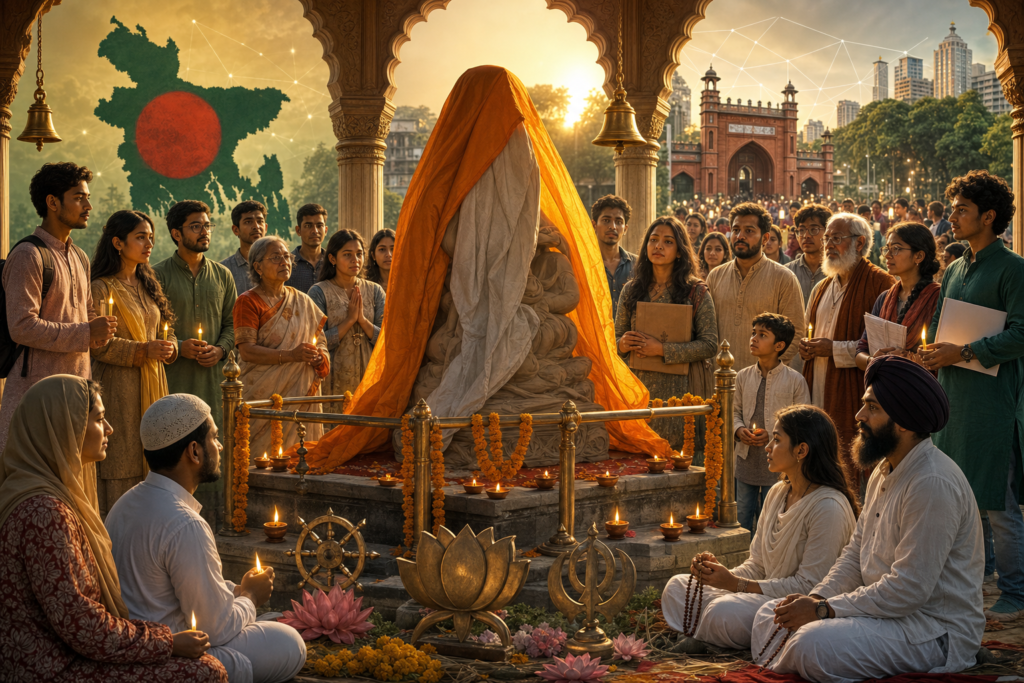
This applies not only within Hindu families but across dharmic traditions. Hinduism, Buddhism, Jainism, and Sikhism have distinct theologies, histories, scriptures, and disciplines, yet they share a broad civilizational respect for sadhana, self-mastery, compassion, non-harm, truthfulness, community responsibility, and liberation from egoic bondage. A blog committed to dharmic unity benefits from presenting these traditions with mutual respect rather than competitive insecurity. The future of Gen-H and related dharmic communities depends on depth without sectarianism, confidence without hostility, and rootedness without rigidity.
Paramparā: Knowledge Passed One After Another
“Thus received in succession, the royal sages knew this.”
— Bhagavad Gītā 4.2.
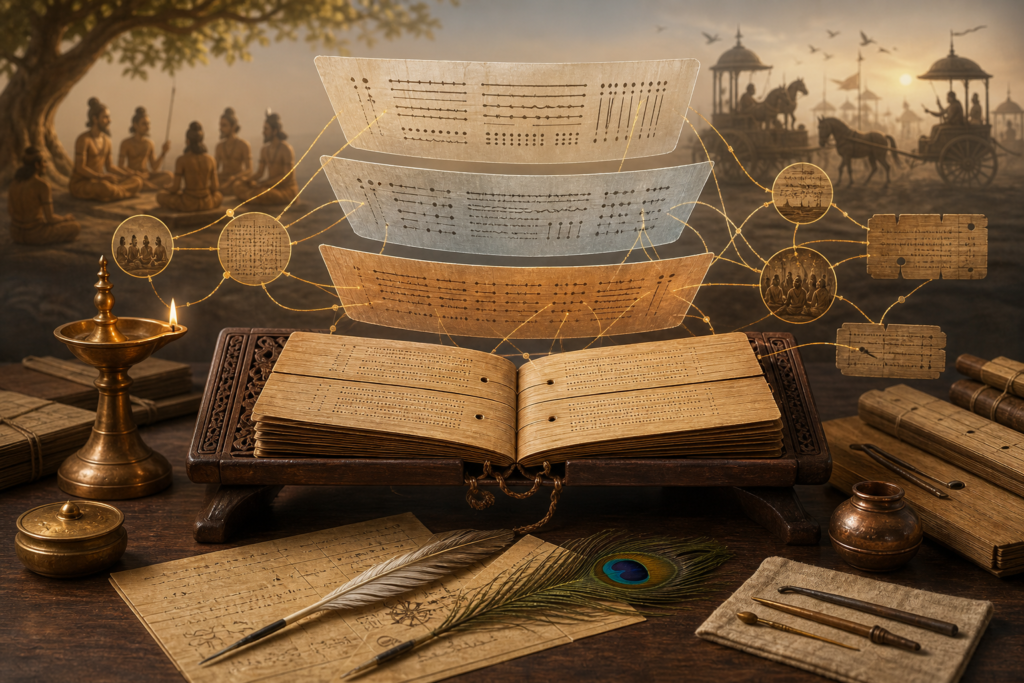
The word paramparā — literally “one after another” — offers a precise understanding of tradition. Knowledge is not preserved only by being written down. It is preserved by being embodied. It travels through teachers, parents, grandparents, gurus, peers, institutions, songs, stories, disciplines, festivals, and lived examples. A child learns not only from what is said at the dinner table but from what is practiced in moments of stress, illness, grief, celebration, conflict, and uncertainty.
For this reason, the goal cannot be mere familiarity with Sanskrit vocabulary or festival customs. Such familiarity has value, but it is only the beginning. The deeper goal is formation. When life becomes difficult, the next generation should have access to a reservoir of meaning. When anxiety arises, there should be practices of breath, mantra, prayer, meditation, seva, and self-inquiry. When moral confusion appears, there should be stories and principles that cultivate discernment. When success arrives, there should be humility. When failure arrives, there should be resilience.
Thiruvalluvar’s image in the Thirukkural remains apt: wisdom rises according to the depth of learning, like water rising in a sandy well according to how deeply it is dug. This metaphor captures the discipline required for dharmic education. Shallow exposure may produce sentiment, but sustained learning produces steadiness. The child who hears stories repeatedly, asks questions freely, observes practice at home, meets teachers, studies texts, and participates in community life gradually develops an inner grammar of Dharma.
The Mahabharata expresses the same insight through a striking educational formula: “One fourth from the teacher, one fourth from one’s own intelligence, one fourth from classmates, and one fourth only with time.” This is not merely an ancient saying; it is a sophisticated theory of learning. The teacher provides structure. The student’s own intelligence brings inquiry. Companions create dialogue and correction. Time transforms information into wisdom. Parents, gurus, satsang, yoga communities, and lived experience all become part of the same educational ecology.
Institutions matter in this ecology. Mathas, Ashrams, Gurukuls, Yoga Schools, Bala Vihar programs, Vedanta study circles, publications such as Vedanta Kesari, and contemporary forums for Indic knowledge have helped sustain Hindu thought in India and the diaspora. Similar forms of transmission exist in Buddhist sanghas, Jain pathshalas, Sikh gurdwaras, and community-led learning spaces. Yet no institution can replace the home. The most persuasive education comes when children see adults practicing what they hope to transmit: prayer without display, study without arrogance, service without calculation, and conviction without contempt.
The Family Experience Behind O Dharmaputri
“The learning gained in one birth protects a person across seven.”
— Thirukkural 398.
The emotional center of O Dharmaputri! Indian Heart, Yogic Wings lies in a familiar parental moment: a daughter preparing to leave home for university. Tuition, logistics, accommodation, documents, and practical arrangements can be planned. The harder question is whether enough inner preparation has been given. Has the child received a compass? Has conversation become conviction? Have stories become discernment? Have rituals become meaning? Has cultural inheritance become personal strength?
The book emerges from that threshold. It gathers frameworks, stories, principles, and honest engagements with difficult questions so that a young person leaving home may carry more than memory. The title itself, O Dharmaputri! Indian Heart, Yogic Wings, suggests both rootedness and flight. An Indian heart is not a narrow identity marker; it signifies civilizational memory, gratitude, and moral orientation. Yogic wings suggest freedom, discipline, inward expansion, and the capacity to move through the world without losing one’s center.
The figure of Uma in the reflection gives the discussion a human texture. A young adult returning from university with a yoga practice, sharper questions, and some confidence in traditional yogic and ayurvedic methods represents a living example of transmission in progress. This is not presented as parental achievement alone. The more convincing point is that the tradition becomes attractive when one comes close enough to experience its depth. A young person who discovers that Dharma can address exam stress, illness, ethical difficulty, emotional uncertainty, and the search for meaning is no longer merely inheriting a label. Such a person is beginning to inhabit a path.
This is where the book becomes relevant beyond one family. Many parents in Indian and diaspora contexts know the ache of wanting children to remain connected without feeling coerced. Many young people know the tension of wanting freedom without becoming rootless. A serious dharmic education can hold both needs together. It can affirm questioning as part of learning. It can treat tradition as a living inquiry rather than a frozen script. It can show that reverence and reason need not be enemies.
Why This Matters for Gen-H
Gen-H faces a world of extraordinary possibility and intense fragmentation. The global digital environment exposes young people to multiple worldviews before they have had time to develop a stable center. Career competition begins early. Mental health challenges are widespread. Relationships are shaped by speed, comparison, and insecurity. Public debate often rewards outrage more than wisdom. In such an environment, Hindu Dharma and the broader dharmic knowledge tradition can offer more than cultural pride. They can offer training in attention, duty, restraint, compassion, inquiry, and transcendence.
The Purusharthas can help young adults think about ambition without becoming consumed by it. The Bhagavad Gita can help them act with commitment while loosening attachment to results. The Ramayana can help them reflect on loyalty, sacrifice, leadership, and moral complexity. The Mahabharata can help them recognize the danger of ego, humiliation, greed, and unresolved resentment. Yoga Sutras can train the mind. Ayurveda can cultivate respect for rhythm, food, sleep, constitution, and seasonal balance. Vedanta can offer the deepest inquiry into identity, consciousness, and freedom.
At the same time, the transmission of Dharma must avoid triumphalism. A living tradition does not require insecurity. Its strength is best demonstrated through clarity, practice, humility, scholarship, and compassion. The unity of dharmic traditions is served when Hindu, Buddhist, Jain, and Sikh inheritances are presented as civilizationally connected yet internally distinct, each offering disciplines that refine the human being. Such an approach strengthens cultural confidence while reducing sectarian defensiveness.
The Flame Is Ours to Pass
“O Agni, lead us along the good path.”
— Ṛg Veda.
The enduring lesson of O Dharmaputri! Indian Heart, Yogic Wings is that cultural preservation is not enough. A living tradition must be understood, practiced, questioned, loved, and transmitted. It must reach young people not only as identity but as insight; not only as ritual but as inner discipline; not only as memory but as method. The flame of Dharma is passed most effectively when it illuminates actual life: study, friendship, conflict, illness, ambition, disappointment, service, family, and spiritual growth.
For parents, teachers, and community leaders, this requires preparation. It is not sufficient to demand reverence from the young. The adults entrusted with transmission must themselves study more deeply, practice more steadily, and speak more thoughtfully. They must be willing to say when they do not know, to seek guidance, and to learn alongside the next generation. Such humility does not weaken authority; it makes authority trustworthy.
The book’s deepest contribution lies in reminding families that Dharma is not passed in a single lecture. It is passed through repeated gestures, patient explanations, shared practices, and the quiet credibility of lived example. A conversation after dinner, a story told without haste, a mantra explained with care, a festival celebrated with meaning, a yoga practice sustained through difficulty, a moment of forgiveness, a disciplined response to anger — these are not small things. They are the everyday channels of paramparā.
If Gen-H receives this inheritance with depth, the benefit will not remain confined to one community. A generation formed by Dharma can contribute to families, institutions, scholarship, civic life, environmental responsibility, interfaith understanding, and global well-being. The aim is not withdrawal from the world but more conscious participation in it. The future needs young people who can combine rootedness with openness, discipline with compassion, and intellectual clarity with spiritual humility.
May this light illuminate the future.
References
[1]. “Dharma eva hato hanti, dharmo rakṣati rakṣitaḥ.” Mahābhārata, Vana Parva 313.128; also, Manusmr̥ti 8.15. Spoken by Yudhishṭhira to a Yakṣa during the forest exile.
[2]. The historical decline of ancient religious cultures in Egypt and the Hellenic world is discussed in relation to late antique imperial edicts, temple destruction, and changing political orders, including the Theodosian and Justinian periods.
[3]. “Kēṭil viḽucc elvam kalvi.” Thirukkural 400. From the ‘Kalvi’ chapter of the Thirukkural.
[4]. “Tantai makaṛkāṛṛum nanṛi — avaiyattu munti iruppaṉ ceyal.” Thirukkural 67, from the ‘Makaṭpēṛu’ chapter.
[5]. “Evaṃ paraparāprāptam imaṃ rājarṣayo viduḥ.” Bhagavad Gītā 4.2.
[6]. “Thottanaith Thoorum Manarkeni Maandharkkuk Katranaith Thoorum Arivu.” Thirukkural 396.
[7]. “Ācāryāt pādamādatte, pādaṃ śiṣyaḥ svamedhayā, Pādaṃ sabrahmacāribhyaḥ, pādaṃ kālakrameṇa ca.” Mahābhārata, Udyoga Parva 5.44.16.
[8]. “Orumaikkaṇ tāṉkaṛṛa kalvi oruvaṛku eḻumaiyum ēmāp puṭaittu.” Thirukkural 398.
[9]. “Agne naya supathā rāye asmān.” Ṛg Veda 1.189.1.
Inspired by this post on Indica Today.




Leave a Reply
You must be logged in to post a comment.