The enduring question of whether salvation belongs to "chosen people" or to people who choose has shaped religious and philosophical discourse for centuries. Framed technically, the debate concerns predestination and free will: whether a person’s final destiny is fixed from the outset or can be redirected through meaningful choice. The stakes are moral, existential, and communal, touching how societies interpret responsibility, cultivate humility, and extend compassion across traditions.
Predestination typically claims that a transcendent agency or impersonal order determines outcomes in advance, while free will asserts that human beings can initiate new causal chains by their decisions. Between these poles, compatibilism proposes that real agency and conditioning causes can coexist. As C. T. McIntyre notes in a classic overview, adherents of all sides have appealed to scriptures, while detailed, formal doctrines often crystallized through later theological reflection rather than through unambiguous scriptural formulations. This observation helps disentangle what texts say from how communities subsequently codify doctrine.
Three positions therefore orient the conversation: hard determinism (all actions are fixed by prior causes), libertarian free will (at least some human choices are not determined by prior states), and compatibilism (genuine agency arises within, not apart from, conditioning causes). In lived experience this complexity appears ordinary: people regularly feel both guided by circumstances and responsible for choices. The paradox is not an abstraction but an everyday intuition.
Abrahamic theologies have long negotiated this paradox. Thinkers as diverse as Augustine, Aquinas, Calvin, Arminius, and the proponents of Molinism debated whether divine foreknowledge and providence eclipse or accommodate freedom. Textual appeals exist for both divine election and moral responsibility, fueling rich intra-traditional debate. Yet the concern here is not adjudication within any one lineage, but rather a constructive comparison with dharmic traditionsHinduism, Buddhism, Jainism, and Sikhismtoward a unifying frame that affirms agency without denying causality.
Across dharmic thought, the logic of karma and dharma, along with attention to grace and disciplined practice, yields a nuanced model. Human agency is real, yet never isolated; conditions rule, yet do not tyrannize. This approach resists fatalism without embracing an unconditioned voluntarism. It encourages humility, effort, and compassion by acknowledging both the weight of causes and the transformative power of wise choice.
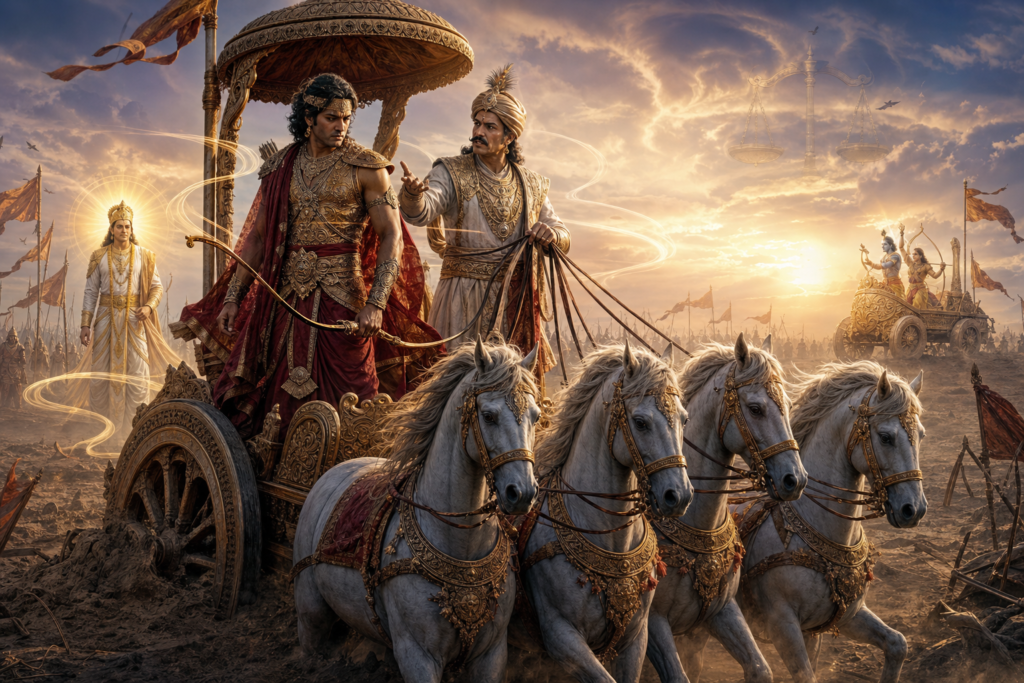
In Hindu philosophy, karma describes moral causality across lifetimes, while dharma concerns duties, virtues, and right alignment with truth. The Bhagavad Gita famously urges deliberation and choice after instruction, signaling that guidance does not negate agency. Classical discussions distinguish sanchita (stored karma), prarabdha (currently operative karma), and agami (karma being formed now). Prarabdha conditions present circumstances, yet puruṣārthapurposeful human striving in knowledge, devotion, and ethical actionshapes agami and thereby future trajectories. This is a form of compatibilism rooted in Vedic philosophy.
Vedāntic schools nuance the balance differently while preserving meaningful agency. Advaita emphasizes self-knowledge that dissolves the misidentification driving karmic bondage. Viśiṣṭādvaita highlights the synergy of self-effort and divine grace (śaraṇāgati). Dvaita underscores personal responsibility alongside dependence on the Lord’s will. Gaudiya Vaiṣṇava thought speaks of the jīva’s minute independence, inviting voluntary surrender grounded in bhakti. The Ishta concept further nurtures pluralism: each person may approach the Divine through a chosen ideal while honoring diverse pathsa cornerstone for unity in spiritual diversity.
Buddhist thought anchors freedom in dependent origination (pratītya-samutpāda): events arise interdependently, without a permanent self-author. Rejecting both fatalism and unconditioned will, Buddhism presents a practical pathethics, meditation, and wisdomthrough which volitional formations can be refined. The Dhammapada encapsulates this responsibility: “By oneself is evil done; by oneself is one defiled; by oneself is evil left undone; by oneself is one purified.” Agency functions within conditions, allowing radical transformation without positing a predestined elect.
Jain philosophy advances perhaps the most rigorous emphasis on personal responsibility within a karmic framework. Karma is conceived as subtle material influx binding the jīva, obscuring knowledge and bliss. Through vows (vrata), restraint (saṃyama), austerity (tapas), and repentance (pratikramaṇa), karmic matter is halted and shed. Liberation (mokṣa) is achieved not by divine fiat but by perfected self-effort guided by right vision, knowledge, and conduct. This is freedom-as-discipline: the more one skillfully chooses, the more one becomes capable of choosing well.
Sikh teaching harmonizes karma with hukam (Divine Order) and nādar (grace). Karma explains consequences, hukam expresses the pervading divine wisdom structuring existence, and grace opens the heart to divine remembrance (simran) and service (seva). In Sikhism, no person is eternally condemned; the path is open through remembrance, righteous living, and the Guru’s grace. This is a compassionate compatibilism: live in hukam, shoulder responsibility, and remain receptive to grace that softens ego and heals division.
Drawn together, these dharmic perspectives uphold four interacting pillars: conditioning causes (karma and circumstances), meaningful choice (puruṣārtha, right intention), path and practice (dharma, śīla, yoga, simran, seva), and grace (kṛpā/nādar) in those schools that affirm it. Conditioning makes choice consequential; choice refashions conditioning; disciplined practice stabilizes the will; and grace, where affirmed, accelerates insight and softens the heart. The result is a robust account of moral responsibility that does not require an exclusive, preselected cohort of the saved.
This model also reframes the fear of irrevocable condemnation. In Hindu, Buddhist, Jain, and Sikh sources, remedial pathways exist even after grievous error. Naraka in Hindu sources is corrective and impermanent, samsaric suffering in Buddhism remains workable through insight and compassion, Jain austerities methodically purify karmic accretions, and Sikh remembrance turns the heart back toward the One. The moral arc is demanding yet merciful, structured yet spacious.
For contemporary readers, the debate becomes personal at life’s crossroads: choosing a vocation, responding to harm, or deciding whether to stand for truth under pressure. One often senses powerful inherited conditionsfamily history, cultural patterns, luckyet also the dignity of choice. The dharmic vision validates both feelings. It affirms that nobody is excluded by birth from the highest good, and that everyone can rise, step by step, by aligning intention, practice, and compassion.
Philosophically, this is neither sheer determinism nor unfettered spontaneity. Causes shape the field; wisdom navigates the field. Neuroscience and psychology add that habits and environments bias decisions, and traditions respond by recommending practices that reshape attention and desirejapa and dhyāna in Hinduism, vipassanā and mettā in Buddhism, pratikramaṇa and ahiṃsā in Jainism, simran and seva in Sikhism. Each cultivates steady awareness, making freedom more reliable in conditions that would otherwise overwhelm.
Ethically, moving from “chosen people” to “people who choose” discourages triumphalism. Communities discover solidarity when they recognize how alike the work of inner transformation is across traditions: curbing anger, dissolving pride, deepening honesty, and widening compassion. Pluralism ceases to be a concession and becomes a recognition of how truth discloses itself through many pedagogies suited to varied temperamentsan insight formalized in Hinduism’s Ishta concept and philosophically resonant with Jain anekāntavāda.
Practically, four guidelines follow. First, clarify intention daily; responsibility begins where attention is placed. Second, practice steadily; freedom grows by training. Third, choose compassion; it interrupts harmful karmic loops and fosters shared flourishing. Fourth, remain open to grace; where acknowledged, it humbles self-sufficiency and heals division. These are not competing creeds but complementary disciplines that empower agency within law-like moral causality.
From this vantage, “chosenness” is not an exclusive favor but a universal invitation. Individuals and communities become “chosen” to the extent that they choose truth, nonviolence, wisdom, and loving serviceagain and again, especially when doing so is costly. Salvific privilege yields to salvific responsibility.
In conclusion, a dharmic analysis preserves the seriousness of karma, the nobility of human freedom, and the transformative potential of disciplined practice and grace. It answers the questionchosen people or people who choose?with a unifying insight: destinies are neither arbitrarily allocated nor utterly unconditioned; they are co-authored. Within Hinduism, Buddhism, Jainism, and Sikhism, this co-authorship is accessible to all, nurturing unity in spiritual diversity and anchoring hope in every deliberate act of wisdom and compassion.
Inspired by this post on Dandavats.