Tag: Ishta concept

  • Powerful Hindu Wisdom: Different Cows, One Milk, and the Unity Beneath Diversity

    Powerful Hindu Wisdom: Different Cows, One Milk, and the Unity Beneath Diversity

    The teaching “Cows come in different colors but milk of all cows is one color” offers a powerful Hindu reflection on unity in diversity. It explains that outward differences in appearance, culture, sect, language, and spiritual practice need not obscure a deeper shared reality. The metaphor is rooted in everyday life, making complex ideas such…

  • Why Hinduism Offers Many Powerful Spiritual Paths for Every Kind of Seeker

    Why Hinduism Offers Many Powerful Spiritual Paths for Every Kind of Seeker

    Hinduism recognizes that spiritual growth cannot be identical for every person because human beings differ in temperament, capacity, duty, and life situation. This article explains how concepts such as adhikara, svadharma, the three gunas, Ishta Devata, Karma Yoga, Bhakti Yoga, Jnana Yoga, and Raja Yoga support a plural yet disciplined spiritual vision. It shows that…

  • Panchopakas in Hinduism: Powerful Unity Behind Five Sacred Paths of Devotion

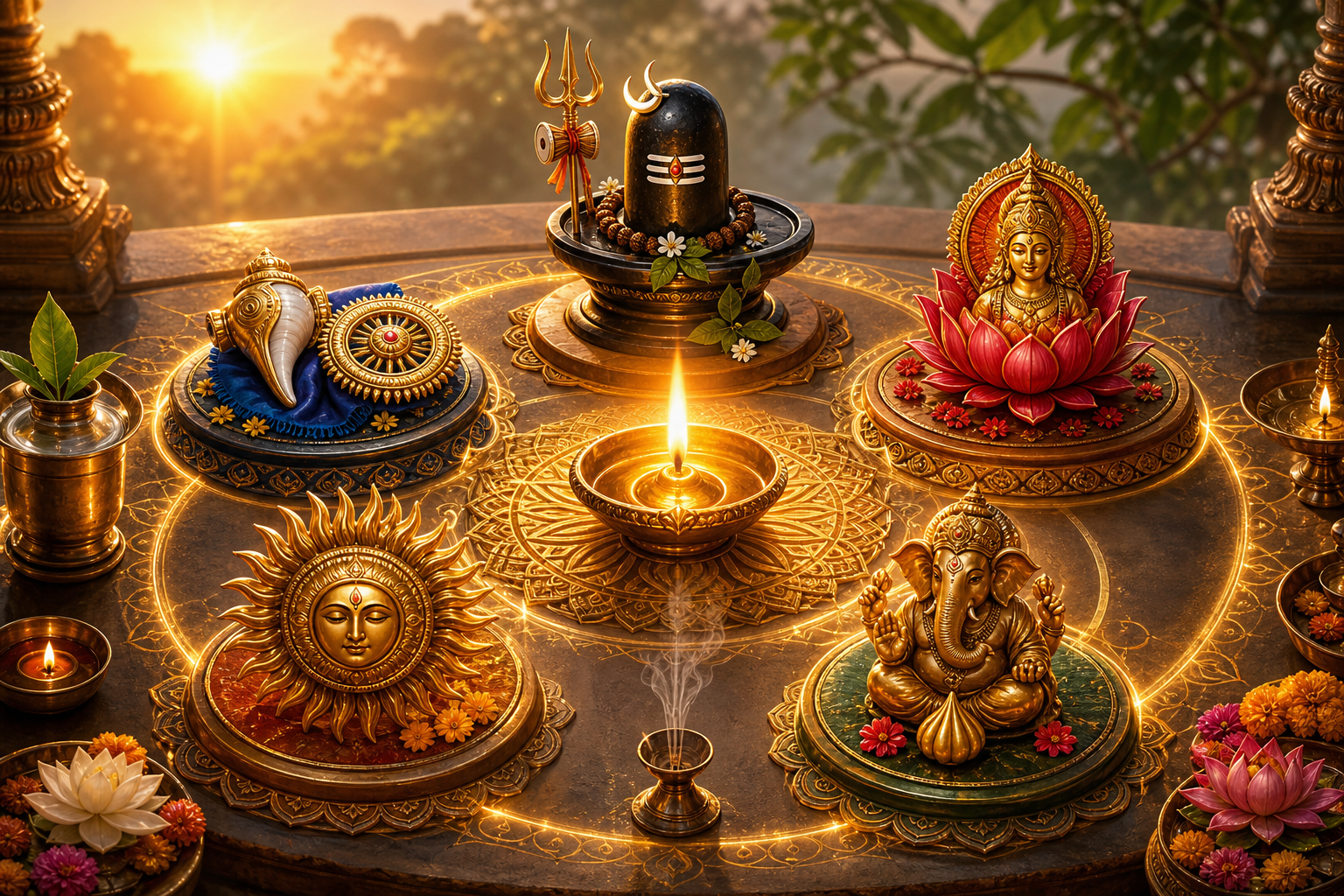
    Panchopakas in Hinduism: Powerful Unity Behind Five Sacred Paths of Devotion

    Panchopakas, also understood through Panchopasana and Panchayatana Puja, presents a powerful Hindu model of unity through five sacred paths. It honors Shiva, Vishnu, Devi, Surya, and Ganesha as distinct yet harmonious approaches to the Divine. The concept explains how Hinduism can sustain deep devotional diversity without losing philosophical coherence. It also clarifies the role of…

  • Ayyappa as Indilayappan: Kerala’s Compassionate Guardian and the Ritual Science of Relief

    Ayyappa as Indilayappan: Kerala’s Compassionate Guardian and the Ritual Science of Relief

    Ayyappa as Indilayappan highlights Kerala’s living synthesis of devotion, ethics, and healing. The article explains how the name Indilayappan foregrounds Ayyappa’s role as remover of distress within the wider identity of Dharma Sastha and Hariharaputra. It traces historical currents that shaped the Sabarimala pilgrimage, unpacks key rituals such as vratham, Irumudi Kettu, neyyabhishekam, and Aravana…

  • The Perils of Kuttichathan Worship in Kali Yuga: Safeguarding Dharma and Peace

    The Perils of Kuttichathan Worship in Kali Yuga: Safeguarding Dharma and Peace

    This analysis examines Kuttichathan within Kerala’s Tantric and folk matrices and explains why, in Kali Yuga, spirit-propitiation invites psychological, ethical, and social risks. Drawing on scriptural priorities for the age and the guna framework, it recommends a shift toward sattvic worship that reliably purifies mind and fosters family harmony. It distinguishes cultural heritage (Theyyam, Bhuta…

  • Chosen People or People Who Choose? A Dharmic Analysis of Free Will, Karma, and Grace

    Chosen People or People Who Choose? A Dharmic Analysis of Free Will, Karma, and Grace

    This long-form, comparative analysis reframes the classic debate over predestination and free will by drawing on Hindu, Buddhist, Jain, and Sikh philosophies. It explains how dharmic traditions balance karma (conditioning causes), meaningful choice (puruṣārtha), disciplined practice (dharma, śīla, simran, seva), and grace (kṛpā/nādar) where affirmed. Rather than privileging an exclusive elect, these frameworks uphold universal…

  • All Faiths Share Core Values – So Why Convert? A Deep, Dharmic, Evidence-Based Guide

    All Faiths Share Core Values – So Why Convert? A Deep, Dharmic, Evidence-Based Guide

    This long-form, evidence-based guide explains why religious conversion persists even when core valuescompassion, truth, service, and self-disciplineare widely shared. It distinguishes ethical convergence from deeper differences in metaphysics, salvation, and institutional identity that often drive conversion debates. Drawing on Hinduism, Buddhism, Jainism, and Sikhism, it highlights Dharmic pluralism through ideas like Ishta and anekantavada, showing…

  • To Know Sanatana Dharma, Become It: Transform Study into Embodied, Breath-by-Breath Wisdom

    To Know Sanatana Dharma, Become It: Transform Study into Embodied, Breath-by-Breath Wisdom

    Studying Sanatana Dharma offers orientation; living it confers transformation. This essay explains how knowledge becomes embodied through śravaṇa–manana–nididhyāsana, prāṇāyāma, meditation, and ethical discipline, aligning ancient insights with contemporary understanding of attention, stress, and habit-formation. It shows how Hinduism, Buddhism, Jainism, and Sikhism converge on shared methodsbreath, mindfulness, vows, and sevawhile honoring pluralism via Ishta and…

  • HH SB Keshava Swami at ISKCON Dallas: Timeless Bhakti-Yoga Wisdom and Dharmic Unity

    HH SB Keshava Swami at ISKCON Dallas: Timeless Bhakti-Yoga Wisdom and Dharmic Unity

    This analysis examines HH SB Keshava Swami’s ISKCON Dallas lecture as a model of rigorous, text-rooted bhakti-yoga tailored for a global audience. It clarifies Gaudiya Vaishnava frameworks such as sambandha–abhideya–prayojana, the nine limbs of devotion, and the acintya-bhedabheda philosophy. Readers gain practical methods to integrate mantra meditation, kirtan, seva, and shastra study into daily life.…

  • Beyond 330 Million Gods: How Hinduism Unites Many Deities into One Supreme Reality

    Beyond 330 Million Gods: How Hinduism Unites Many Deities into One Supreme Reality

    The familiar claim that Hinduism has 33 crores (330 million) gods is a popular misreading; classical sources enumerate thirty-three devaseight Vasus, eleven Rudras, twelve Adityas, plus Indra and Prajapati. By clarifying the Sanskrit term koṭi (class/category vs. crore), the article shows how Vedic and Upanishadic texts integrate divine plurality within a single metaphysical reality. It…

  • Choosing a Mahavidya for Navratri: Scholarly, Horoscope‑Aligned, Ethical, Transformative Guide

    Choosing a Mahavidya for Navratri: Scholarly, Horoscope‑Aligned, Ethical, Transformative Guide

    This research‑informed guide shows how to choose a Mahavidya for Navratri using three converging lenses: present life needs, Jyotisha (Vedic astrology) indications, and spiritual readiness. It summarizes the core strengths, indications, and household‑friendly practices for all ten Mahavidyas, with clear ethical safeguards. Readers learn how to align sadhana with dasha cycles and graha conditions, how…

  • Are the Puranas Just Fiction? A Rigorous, Heart-Centered Guide to Finding God and Trusting Truth

    Are the Puranas Just Fiction? A Rigorous, Heart-Centered Guide to Finding God and Trusting Truth

    Are the Puranas fiction or a reservoir of living wisdom? This analysis explains how Puranic narratives operate beyond a literal-versus-fable dichotomy by integrating mythic memory, ethics, ritual rationale, and contemplative instruction. Drawing on Indian epistemology (pramāṇa), it clarifies how śabda (trustworthy testimony), anumāna (inference), and yogic pratyakṣa (direct insight) jointly ground a rational, testable faith.…

  • Spiritual Thirst: Building Unshakable, Heartfelt Devotion across Dharmic Traditions

    Spiritual Thirst: Building Unshakable, Heartfelt Devotion across Dharmic Traditions

    Spiritual thirst is the disciplined, whole‑hearted longing for the Divine or ultimate truth, expressed across Hinduism, Buddhism, Jainism, and Sikhism through listening, singing, remembrance, contemplation, and seva. Drawing on Yoga Sutra principles such as tivra samvega and nairantarya abhyase, it emphasizes intensity and unbroken practice over half‑hearted effort. The Varkari saints exemplify steadiness through kirtan,…

  • When Darkness Becomes Light: Dharmic Perspectives for Clarity, Compassion, and Unity

    When Darkness Becomes Light: Dharmic Perspectives for Clarity, Compassion, and Unity

    This essay unpacks the metaphor “Darkness from one side is light from the other side” through Hindu philosophy and its sister Dharmic traditionsBuddhism, Jainism, and Sikhism. Drawing on the Upanishads, the Bhagavad Gita, Advaita Vedanta, Nyaya, Samkhya, and Yoga, it explains why perspectives diverge and how disciplined methods convert contradiction into clarity. Jain Anekantavada and…

  • Ultimate Reality Cannot Be Taught: Profound, Experiential Wisdom in Hinduism and Dharmic Paths

    Ultimate Reality Cannot Be Taught: Profound, Experiential Wisdom in Hinduism and Dharmic Paths

    This long-form exploration clarifies why Ultimate Reality in Hindu philosophy cannot be taught as a mere concept and must be realized through direct experience. It maps the classical triad of śravaṇa–manana–nididhyāsana and the role of Guru–Shishya Tradition, highlighting how scripture and guidance remove ignorance rather than transfer realization. Readers gain a technically sound overview of…

  • From Ritual to Realization: Ending Barren Devotion with Dharmic Discipline and Insight

    From Ritual to Realization: Ending Barren Devotion with Dharmic Discipline and Insight

    Modern worship often looks vibrant yet feels spiritually thin. This long-form, academic analysis explains why devotion turns barrentransactional aims, inattentive ritual, neglected ethics, and fragmented attentionand details what Hindu, Buddhist, Jain, and Sikh scriptures actually prescribe for transformation. It offers an integrated method grounded in yama–niyama or śīla, daily abhyasa of japa or dhyana, breath…

  • Sri Aurobindo’s Inner Yajna: How Heart-Centered Worship Outshines Outer Rituals

    Sri Aurobindo’s Inner Yajna: How Heart-Centered Worship Outshines Outer Rituals

    Sri Aurobindo distinguishes outer ritual from inner yajna and shows why inner worship transforms consciousness more reliably than external observance. Drawing on Vedic philosophy, the Bhagavad Gita, and integral methods from Karma Yoga, Bhakti, Jnana, and Raja Yoga, the discussion explains how sacrifice progresses from the gross to the subtle, purifying manas, buddhi, and chitta.…

  • The Thirst That Remains: A Transformative Journey Across Hindu, Buddhist, Jain, and Sikh Wisdom

    The Thirst That Remains: A Transformative Journey Across Hindu, Buddhist, Jain, and Sikh Wisdom

    This long-form reflection reads the “thirst that remains” as a unifying metaphor across Hindu, Buddhist, Jain, and Sikh wisdom, showing how diverse practices meet a common aspiration for freedom and compassion. It maps core goalsmoksha, nirvana, kevala-jñāna, and muktiwhile explaining shared ethics like ahimsa, satya, dana/dasvandh, and aparigraha. It outlines practical contemplative methodsAṣṭāṅga Yoga, ānāpānasati…

  • Sankalpa to Samadhi: How Focused Intention Forges Divine Union Across Dharmic Paths

    Sankalpa to Samadhi: How Focused Intention Forges Divine Union Across Dharmic Paths

    This article examines how strong intentionsaṅkalpa, cetanā, bhāvanā, or alignment with Hukambecomes the central engine of transformation across Hinduism, Buddhism, Jainism, and Sikhism. It explains the shared architecture that links ethics, attention training, contemplative absorption, and compassionate action, showing how these elements cohere into divine union or ultimate realization. Drawing on the Bhagavad Gita, the…

  • Beyond Names and Forms: Embracing the Infinite Nature of God in Dharmic Wisdom

    Beyond Names and Forms: Embracing the Infinite Nature of God in Dharmic Wisdom

    Hinduism teaches that the divine is infinite and cannot be confined to one form or name, as expressed in the Upanishadic dictum “Ekam Sat Vipra Bahudha Vadanti.” This perspective affirms religious pluralism through Ishta, allowing varied yet valid approaches to the sacred. Related dharmic traditions reinforce this vision: Jainism’s Anekantavada, Buddhism’s skillful means, and Sikhism’s…