
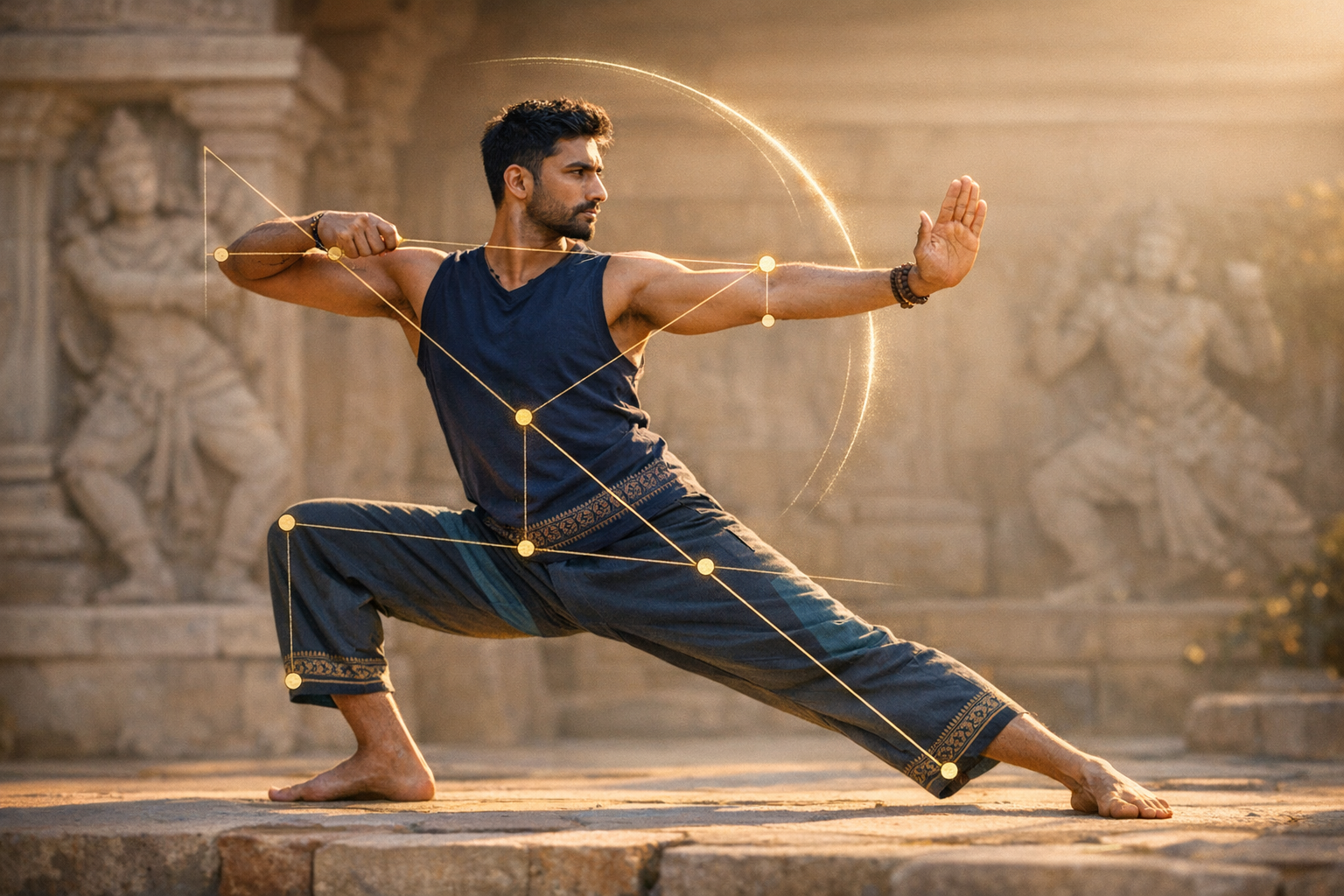
Alidhasana (also written as Alīḍha or Ālīḍha) is a defining warrior stance in Hindu iconography and yogic embodiment, recognized for projecting aggression, readiness, and disciplined power. In temple sculpture, dance, and martial traditions, this diagonal, lunging posture compresses movement into stillness, broadcasting the emotional tenor of vīra (heroic) and raudra (fierce) bhāvas while remaining anchored in dharma. Its persistence across centuriesand its appearance in related forms within Buddhism, Jain attendant imagery, and Sikh martial artsreveals a shared, pan‑Dharmic grammar of protection, courage, and ethical restraint.
Classical textual traditions identify the posture with precision. The Nāṭyaśāstra and allied Śilpa-śāstra corpora describe Ālīḍha and its mirror, Pratyālīḍha, as archetypal martial stances used in drama, dance, and sculptural canon. These manuals specify the geometric relations of feet, knees, pelvis, and torso that visually communicate latent motion, enabling artists and performers to standardize a language of valor intelligible across regions and eras.
Formally, Alidhasana is a deep, diagonal lunge. The left leg is bent at the knee, providing a stable and grounded base, while the right leg typically extends back and laterally, with the rear foot angled and the heel pressing into the ground. The pelvis faces broadly side-on, the torso is slightly spiraled toward the forward leg, and the arms are set to convey imminent actiongripping weapons, drawing a bow, or raising a hand in protection. Pratyālīḍha simply inverts this geometry, placing the opposite leg forward and reversing the spiral.
In sculptural practice, the stance is less a snapshot of movement than a coded statement of intention. Diagonal lines created by the legs and torso translate kinetic energy into iconographic clarity, ensuring that viewers grasp the deity’s roleguardian, vanquisher, or cosmic regulatorat a glance. The stance’s asymmetry also breaks frontal monotony, bringing narrative depth to temple façades, door guardians, and battle friezes.
Hindu iconography frequently deploys Alidhasana for Shaiva and Shakta forms: Bhairava and Vīrabhadra often stand in a forceful alīḍha/pratyālīḍha to index kṣatra (protective sovereignty), while Durgā and Caṇḍikā/Chamunda use the stance to project decisive, compassionate ferocity in the subjugation of adharma. The posture signals not gratuitous violence but dharma-yuddharighteous, proportionate force marshaled to restore balance.
Historical styles refine but do not dilute the stance’s meaning. From the narrative panels of early-medieval North India through the Chola and Hoysala idioms in the South, Alidhasana anchors battle compositions, amplifies the volume of diagonals in relief, and secures visual stability against crowded backgrounds. Khajuraho, Thanjavur, Halebidu, and other centers preserve sophisticated examples in which the stance orchestrates attention across multiple figures and tiers.
Dvārapālas (door guardians) commonly exploit pratyālīḍha to convey vigilant readiness at thresholds, their weight-bearing front leg and flared rear foot forming a protective wedge. Attendant ganas, yakṣas, or regional guardian figures sometimes echo the same grammar, mirroring the theological emphasis on layered, concentric protection around sanctums.
Parallel idioms extend beyond Hindu sculpture. Tantric Buddhist (Vajrayāna) imagery in Eastern India, Nepal, and Tibet employs alīḍha/pratyālīḍha for wrathful deities to mark subjugation of inner and outer obstacles while expressing upāya (skillful means). The visual message is homologous: disciplined power, ethically bounded, in service of liberation.
In Jain contexts, the Tīrthaṅkaras remain in kayotsarga or lotus, but attendant yakṣa-yakṣiṇī figures and protective guardians occasionally adopt dynamic, alīḍha-like lunges to signal functional guardianship. This selective use harmonizes with Jain theological priorities while sharing the wider subcontinental visual lexicon of protection.
Within Sikh martial heritage, Gatka routinely trains deep, angled lunges and diagonals comparable to Alidhasana to cultivate grounded mobility, line control, and readiness. While terminology differs, the kinesthetic intelligencerooting through the front leg, driving power from the back line, and maintaining an elastic spineis recognizably part of the same civilizational movement science.
Rasa theory clarifies why the stance is so effective. Vīra and raudra rasas require unmistakable cues: firm base, compressed spring, weapon-bearing arms, and a torso spiral charged with potential. Alidhasana concentrates these cues into a single, legible configuration, allowing sculptors and dancers to broadcast affect with minimal ambiguity.
Architecturally, the stance integrates with temple composition. Its diagonals counterbalance vertical pilasters and curving moldings, animating plinth friezes and lending legibility at distance. In crowded narrative registers, the alīḍha geometry becomes a visual hinge, directing the eye across episodes while preserving structural rhythm.
Performance traditions preserve the stance through the Nāṭyaśāstra’s 108 karaṇas, which include Ālīḍha and Pratyālīḍha as fundamental units. Bharatanatyam, Kathakali, and allied styles retain cognate legwork, using the lunge and spiral to represent archers, warriors, and protectors, while martial arts such as kalaripayattu codify analogous vāḍivu (animal forms) and combat-ready lunges for functional application.
In modern haṭha practice, Alidhasana maps closely to the deep warrior lunge family (akin to Virabhadrāsana variations) and, in some lineages, to an “archer’s pose.” Alignment principles remain constant: the forward knee tracks the second toe and stacks above the ankle; the back heel roots with the foot angled appropriately; the pelvis remains neutral to slightly externally rotated; the spine lengthens with the lower ribs contained; and the shoulder girdle stabilizes as the arms extend in purposeful vectors.
Breath-led execution refines the posture’s intent. Inhalation expands the back line from rear heel to crown; exhalation coils strength into the front leg and pelvic floor (mūla-bandha), directing awareness to the contact of the forward foot with the ground. Drishti may follow the line of an extended hand or remain soft at horizon to balance focus with situational awarenessan ethic shared by dance and martial training.
Modifications serve accessibility and longevity. Practitioners with knee or hip sensitivity may reduce lunge depth, elevate the rear heel, or use supports to maintain neutral tracking. Those with sacroiliac instability can shorten stance length, while hypermobile athletes should prioritize eccentric strength and proprioceptive cues over range. The pedagogic arc is progressive: establish stable base, layer spiral, then add arm pathways and breath ratios.
Energetically, the stance emphasizes mūlādhāra (grounding) and maṇipūra (agency), integrating apāna’s downward stability with prāṇa’s upward clarity. The result is embodied sovereigntystrength without rigidity, alertness without agitationaligned with the dharmic ideal of proportionate response.
From a movement-science perspective, Alidhasana develops quadriceps and gluteals in the forward leg, hamstrings and calves along the rear chain, and deep hip rotators and adductors that control frontal-plane drift. The diagonal fascial lines (spiral and functional lines) are recruited to transmit force efficiently, a fact long intuited by martial lineages and now corroborated by contemporary biomechanics.
Comparatively, Indian art deploys Alidhasana to encode narrative energy, much as Greco-Roman contrapposto encodes poised rest. Where contrapposto redistributes weight along a vertical axis to signal relaxed grace, alīḍha redistributes it along a diagonal axis to signal decisive motion. Both are sophisticated solutions to the same artistic problem: making stone breathe.
The stance’s transregional life is visible across South and Southeast Asia. Khmer ateliers at Angkor refined dynamic lunges for deities, guardians, and battle tableaux, a testimony to how Śilpa-śāstra principles traveled with artisans, pilgrims, and patrons. The continuity of form underwrites a continuity of values: protection of the sacred, ethical use of strength, and communal well-being.
For viewers and practitioners alike, Alidhasana offers a method of seeing and doing. In sculpture, trace the line from forward foot through knee, hip, and shoulder to the extended hand; in practice, recreate that line with breath, attention, and restraint. The same geometry that animates a Chola bronze can anchor a modern mat sequence or a classical dance phrasedifferent media, one civilizational intelligence.
In sum, Alidhasana is more than a pose. It is a portable blueprint for grounded courage that unites Hindu iconography, haṭha yoga, classical performance, and martial disciplines. Its cognates in Buddhist, Jain (attendant), and Sikh martial contexts reinforce a shared Dharmic commitment: power yoked to compassion, readiness guided by ethics, and beauty inseparable from responsibility.
Inspired by this post on Hindu Blog.
