In a judgment delivered on 15 May 2026, the Madhya Pradesh High Court declared the disputed precinct within the Bhojshala complex at Dhar to be a Hindu temple, expressly drawing on doctrinal tests articulated by the Supreme Court in the Ayodhya verdict. Framed as a heritage and constitutional law decision, the ruling underscores that disputes over religious character must be resolved through rigorous evidence, archaeological science, and the constitutional guarantees of religious freedom and public order.
The Bhojshala complex, historically associated with King Bhoj (c. 11th century) and the veneration of Vagdevi (Saraswati), holds an exceptional place in India’s cultural memory. Over many centuries, the site accrued layered architectural phases, including the Kamal Maula mosque precinct, before coming under the custodianship of the Archaeological Survey of India (ASI). For years, regulated schedules for worship sought to balance overlapping practices, revealing both the delicacy and urgency of a law-anchored, evidence-based settlement.
Situated in Dhar, a region rich in medieval history and epigraphic heritage, the complex has long been a focal point of public interest and scholarly inquiry. For many families, the name “Bhojshala” evokes schoolbook references, memories of intergenerational storytelling about Saraswati worship, and field visits that nurtured curiosity about inscriptions, temple typology, and the shared civilizational fabric of India.
The High Court’s declaration directly engages the central legal question of “religious character” and title without losing sight of constitutional imperatives: Articles 25 and 26 protect religious freedom while obligating the State to uphold public order, morality, and health. By grounding its analysis in Ayodhya’s evidentiary method, the court reiterates that judicial findings must rest on records, credible testimony, and material proof rather than assertion alone.
Ayodhya established several working principles now reflected here: that courts evaluate competing title claims through documentary and oral evidence; that archaeological findings can illuminate the historical character of a site; that long-standing patterns of worship, when shown through reliable sources, bear on the legal character; and that remedies must be carefully tailored to secure rule of law, deter illegality, and protect the rights of all communities.
Within this framework, the court’s determination of Bhojshala’s religious character turns on a composite evidentiary matrix: epigraphy, iconographic and architectural typology, historical records, travelogues and gazetteers, ASI field documentation, and witness testimony about worship practices. The resulting declaration identifies the disputed precinct as a Hindu temple, distinguishing the legal concept of “religious character” from issues of mere physical possession.
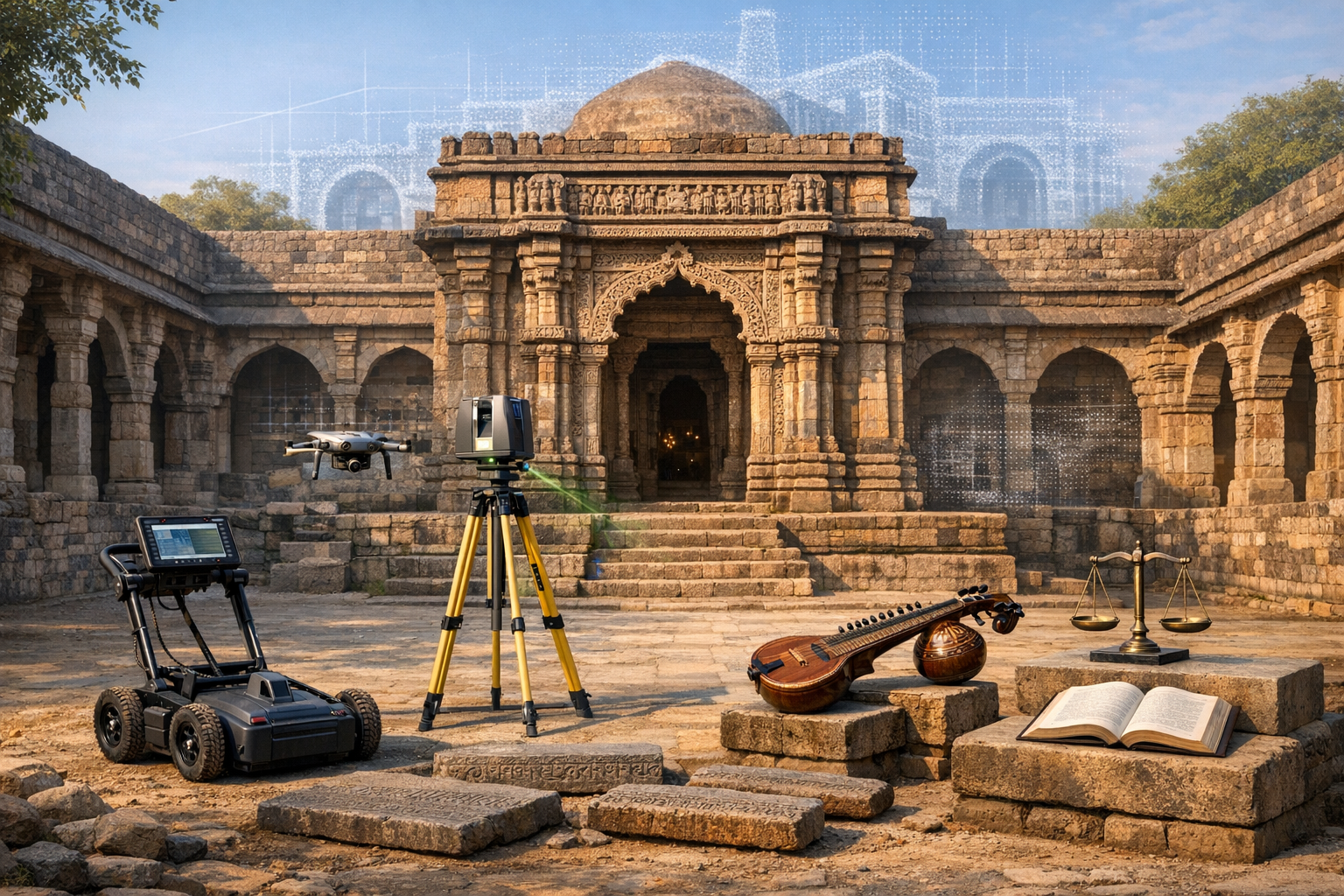
The role of archaeology is central. Standard ASI-aligned methodologiesnon-invasive ground-penetrating radar (GPR), high-resolution photogrammetry, 3D laser scanning, comparative stonework analysis, and epigraphic studyenable a layered reading of structures built, repurposed, or restored over time. Chain-of-custody protocols and inter-disciplinary peer review further bolster reliability, enabling courts to translate specialist findings into clear legal conclusions.
Wherever inscriptions, sculptural fragments, or architectural members demonstrably align with temple typology, courts typically assess their provenance, stratigraphic context, and congruence with historical records. In Bhojshala’s case, such technical evidenceread alongside testimonies on patterns of worshipassumes determinative significance in light of Ayodhya’s insistence on evidence over assertion.
The decision is also informed by a precise distinction: a judicial “declaration” of pre-existing religious character recognizes what the evidence shows to be true historically; it does not itself “convert” the character through judicial fiat. This distinction, emphasized in post-Ayodhya jurisprudence, helps courts remain faithful to both constitutional neutrality and the historical record.
The Places of Worship (Special Provisions) Act, 1991, forms part of the legal canvas. In line with Ayodhya’s reasoning, courts may treat the determination of historical character as an incident of adjudication rather than as an impermissible conversion of character. While challenges to the Act’s scope have arisen nationally, the High Court’s analysis here is presented as consistent with binding precedent, carefully distinguishing between establishing a site’s historical identity and altering it contrary to statute.
From a constitutional perspective, the judgment knits together heritage law, religious freedom, and public order. It locates the right to worship within Articles 25–26 while acknowledging the State’s duty to ensure safety, to prevent violence, and to conserve heritage through institutions like the ASI and the regime under the AMASR (Ancient Monuments and Archaeological Sites and Remains) Act.
Following a declaration of religious character, standard post-judgment processes typically include administrative directions to secure the site, undertake a scientific inventory of movable and immovable heritage, and frame a conservation-led management plan. Such steps guard against loss of artifacts, ensure respectful worship, and preserve the integrity of every historical layer of the structure.
A robust Conservation Management Plan (CMP) for Bhojshala would ordinarily include a condition assessment, a schedule of reversible conservation interventions, a risk register for structural and social risks, an incident‑response protocol, and monitoring through crack gauges and environmental sensors. These measures reflect best practices familiar from international charters and India’s own conservation codes.
Visitor management is equally important. Clear entry and exit flows, multi-lingual interpretive signage, regulated viewing galleries, and crowd-density thresholds help protect both worship and conservation. Digital ticketing where appropriate, real-time footfall dashboards, and festival-specific crowd management keep the site safe and accessible.
Modern documentation tools3D models, orthoimagery, structured photo archives, and open metadataaid transparency, scholarly access, and rapid disaster recovery. Publicly accessible, peer-reviewed digital archives reduce misinformation, foster trust, and allow students and researchers to engage responsibly with the site’s history.
Socially, the judgment arrives with responsibility. The court’s findings must be implemented with dignity, restraint, and empathy for all who hold the site dear. Community briefings, transparent timelines, and a grievance redressal desk signal respect for citizens while reinforcing that heritage belongs to everyone and violence has no place near sacred spaces.
In the Indian civilizational tapestry, Dharmic traditionsHinduism, Buddhism, Jainism, and Sikhismshare a profound commitment to learning, non‑violence, and seva. Educational programming at Bhojshala can reflect this unity by hosting non-proselytizing exhibitions on Sanskrit, Prakrit, and Pali learning, showcasing shared values like ahiṃsā and satya, and celebrating the intellectual legacy of India’s many sampradāyas.
For many students in central India, early visits to Dhar became their first practical lesson in reading inscriptions and recognizing temple typologies. For elders, the name “Bhojshala” often conjures memories of devotional songs to Saraswati and family tales about the pursuit of knowledge. Implemented well, the judgment can renew these living bonds across generations.
Heritage-sensitive policing and on-site mediation can reduce friction during peak hours or festivals. Trained volunteers, gender-sensitive facilities, shaded queues, and medical first-aid points serve all visitors equally and communicate that safety, care, and compassion are integral to worship and heritage alike.
The local economy stands to benefit responsibly through community-owned servicesguided walks, craft kiosks, and heritage homestayscurated under fair standards that prevent exploitative commercialization. Revenue-sharing models can be tied to conservation goals to ensure that tourism supports, rather than strains, the monument.
In law, a “temple” often denotes a place used as of right by the Hindu community for public religious worship, anchored in recognized rituals and the presence of consecrated icons or sanctified spaces. Courts typically read this concept flexibly yet cautiously, testing it against historical usage, documentary records, and material remains so that the legal label matches the site’s lived and recorded history.
Conservation ethics also matter. Internationally recognized doctrines encourage respect for all chronological layers of a monument. Where later additions possess heritage value of their own, sensitive preservationrather than erasurehonors history while allowing courts to recognize the core religious character of the contested precinct.
From a governance standpoint, multi-stakeholder oversightbringing together the ASI, district administration, conservation architects, and community representativeshelps reconcile daily worship with long-term preservation. Periodic public reports, audit trails for artifact handling, and open channels for scholars build confidence and reduce rumor.
Legally, parties may seek appellate review in the Supreme Court of India. Until then, compliance with the High Court’s directions, measured by clear administrative orders and site protocols, remains crucial. Responsible public communicationeschewing sensationalismhelps maintain the peace that the Constitution demands around places of worship.
Beyond the law, the Bhojshala ruling invites a wider cultural reflection. It demonstrates how evidence-based adjudication, careful conservation, and civic empathy can coexist. When the public sees that the rule of law protects both faith and history, trust deepens and social harmony is strengthened.
The long arc of Indian jurisprudence, from heritage disputes to protection of fundamental rights, has steadily moved toward principled, evidence-led decision making. This judgment continues that trajectory, elevating archaeological competence, documentary rigor, and constitutional fidelity over speculation or partisanship.
Ultimately, Bhojshala’s future should be shaped by three commitments: truth established by evidence, preservation guided by science, and coexistence grounded in compassion. If these pillars hold, the complex can stand not only as a legally recognized Hindu temple but also as a living classroom for unity within India’s Dharmic traditions.
This analysis reflects the publicly reported contours of the 15 May 2026 judgment and established legal principles after Ayodhya. Readers and practitioners should consult the certified text of the decision and operative administrative orders for precise directions, timelines, and compliance requirements.
Inspired by this post on Struggle for Hindu Existence.