-
At Bhojshala After MP High Court Order: Uninterrupted Hindu Worship and a Call for Harmony

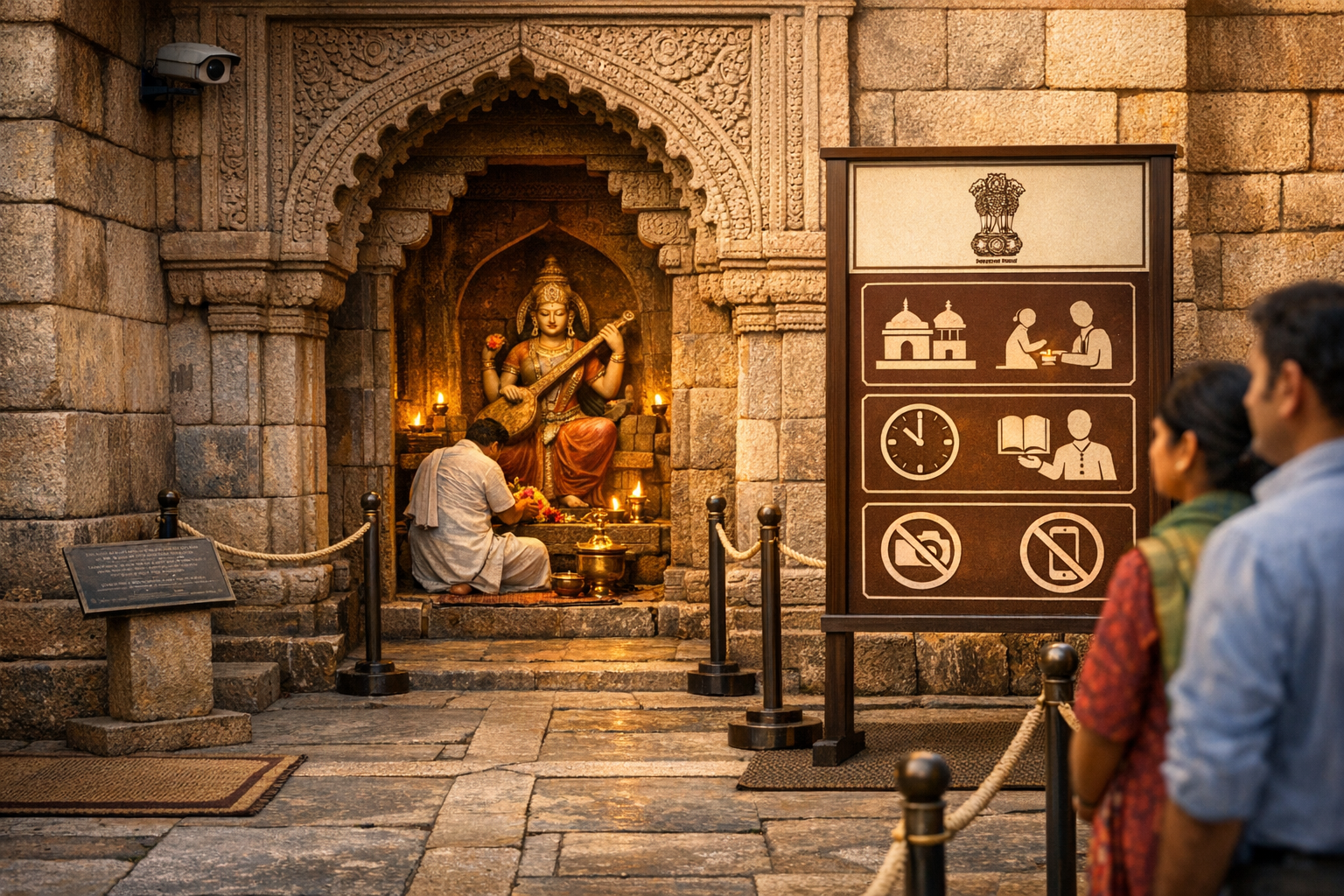
Following the Madhya Pradesh High Court’s directives, Bhojshala in Dhar hosted uninterrupted Hindu worship on the first Friday after the order, while Friday namaz did not occur at the monument that day, according to official reports. This analysis explains why the moment is significant, distinguishing symbolic claims (such as “700 years”) from verifiable chronology. It…
-
Bhojshala at a crossroads: Saraswati idol reportedly installed; entry rules tighten after court

Reports from Dhar, Madhya Pradesh suggest that a consecrated idol of Mata Saraswati has been installed at Bhojshala with daily worship commencing, and that entry protocols have tightened following a court directive. This analysis explains the legal frameworks (Articles 25–26, AMASR Act, and the Places of Worship Act) that shape permissible action. It outlines how…
-
Historic MP High Court Verdict Affirms Bhojshala as Saraswati Temple: Devotees Pray Peacefully

A day after the Madhya Pradesh High Court affirmed Bhojshala as the Mata Saraswati temple, Hindu devotees in Dhar offered prayers peacefully under a robust security plan. The verdict clarifies the site’s religious character while embedding worship within heritage protection norms and public-order protocols. Historical and archaeological evidence—documented by the Archaeological Survey of India—underpins the…
-
MP High Court Recognizes Dhar’s Bhojshala as a Hindu Temple: Evidence, Law, and Legacy

The Madhya Pradesh High Court has recognized Dhar’s Bhojshala complex as a Hindu temple, grounding its decision in corroborated archaeological, epigraphic, and archival evidence. The ruling operates within India’s constitutional guarantees under Articles 25 and 26 and aligns with heritage conservation duties under the AMASR framework. Readers will gain a clear view of how courts…
-
MP High Court Declares Bhojshala a Hindu Temple: Landmark Ruling, Ayodhya Principles, ASI Proof

The Madhya Pradesh High Court has declared the disputed precinct within the Bhojshala complex a Hindu temple, expressly invoking the Supreme Court’s Ayodhya principles. This long-form analysis explains what the ruling means in constitutional and heritage law, how courts distinguish historical “religious character” from mere possession, and why archaeology and epigraphy matter. It unpacks the…
-
Bangladesh High Court Rejects Bail for Monk Chinmoy Krishna Das amid Minority Safety Fears

Bangladesh’s High Court Division has denied bail to Hindu monk Chinmoy Krishna Das, intensifying debate over due process and the safety of religious minorities. The analysis explains how Bangladesh’s CrPC framework guides bail decisions and situates the ruling within constitutional guarantees and ICCPR obligations. It highlights the difference between bail adjudication and determinations of guilt,…
-
High Court Halts Peterborough Temple Sale: What It Means for Fairness and Community Cohesion

A High Court injunction has temporarily halted Peterborough City Council’s planned sale of the New England Complex, home to the Bharat Hindu Samaj Mandir since 1986. The order by Mr Justice Fordham preserves the status quo while the court examines whether the council lawfully selected the Khadija Mosque as preferred purchaser after a tender weighted…
-
The Kerala Story 2 clears legal hurdles: High Court nod sparks X reviews calling it a warning

‘The Kerala Story 2- Goes Beyond’ released after legal hurdles with a High Court verdict enabling its exhibition, and producer Vipul Shah welcomed the decision. Early X reactions frame the work as “not just a film, it’s a warning,” prompting calls for family viewing. This analysis situates the release within India’s constitutional framework, summarizing how…
-
Landmark ASI survey at Dhar Bhojshala reveals extensive temple spolia in Kamal Maula Masjid

The Archaeological Survey of India informed the Indore Bench of the Madhya Pradesh High Court that Kamal Maula Masjid at Dhar Bhojshala incorporates reused temple materials—architectural members, sculptural fragments, and inscriptions—revealing a stratified building history. This evidence of spolia, identified through standard archaeological methods including architectural typology and epigraphic analysis, places the complex within well-known…
-
Telangana High Court Clears ‘Jago Bhagyanagar – Chalo Balapur’ Rally, Peace and Public Order First

The Telangana High Court on 22 January 2026 cleared the ‘Jago Bhagyanagar – Chalo Balapur’ mobilisation in Hyderabad, permitting it to proceed within legal and administrative safeguards. The decision reflects the constitutional balance between peaceful assembly and public order. Effective preparation—route management, clear advisories, and trained volunteer marshals—can minimise disruption and support civic confidence. Emphasising…
-
Madras HC Bans ‘Scandalous’ Book Targeting Judge, Safeguards Karthigai Deepam Verdict

Madras High Court has banned a “scandalous” book that targeted a judge linked to the Stone Pillar Karthigai Deepam verdict at Thiruparankundram. The court found the publication contemptuous for undermining public confidence in the judiciary. The decision reaffirms that critique of judgments is legitimate, but vilifying judges erodes the rule of law. By doing so,…
-
Allahabad HC declares ‘Sar Tan Se Juda’ an offence against the State, reinforcing unity and rule of law

The Allahabad High Court ruled that the slogan ‘Sar Tan Se Juda’ is an offence against the State because it challenges India’s sovereignty and incites armed rebellion. The decision clarifies the constitutional limits of free speech by distinguishing lawful dissent from explicit advocacy of violence. It offers actionable guidance for police, prosecutors, and lower courts…
-
Justice G.R. Swaminathan Impeachment: Why Judicial Independence and Dharmic Harmony Matter

This analysis situates the impeachment motion against Justice G.R. Swaminathan within India’s constitutional framework and a longer jurisprudential history dating back to Nani Palkhivala’s warnings in 1970. It explains why the constitutional standard for impeachment is intentionally exacting and why judicial independence must remain insulated from political pressures. It contextualizes the Thirupparankundram case by tracing…
-
Legal Shockwave: Nasha Virodhi Sangharsh Abhiyan Warns Sunburn Over Safety, Drugs

A legal notice from Nasha Virodhi Sangharsh Abhiyan to the Sunburn Festival organisers raises urgent concerns about public safety, drug-related incidents, and regulatory compliance. Organisers have been given 72 hours to submit a detailed safety action plan. If they fail, a petition seeking a stay may be filed in the High Court. The situation underscores…
-
Landmark Karnataka HC Ruling Upholds Peaceful Assembly, Nixes Blanket Curbs on RSS March

The Karnataka High Court has signaled that blanket restrictions on public gatherings, including a proposed RSS route march in Bengaluru, cannot replace proportionate, evidence-based safeguards. The ruling centers Article 19 rights, clarifying that peaceful assembly may be regulated but not indiscriminately curtailed. It encourages targeted conditions—route diversions, time limits, and security protocols—over outright bans. The…
-
Karnataka HC stays Dharmasthala ‘mass burial’ SIT probe, prioritizing due process and unity

The Karnataka High Court has issued an interim stay on the SIT investigation into the alleged ‘mass burial’ at Dharmasthala, emphasizing due process and judicial oversight. Petitioners linked to the original complaint asked the court to quash or withdraw aspects of their filing, prompting careful judicial review. The stay is not a verdict but a…
-
Chhattisgarh HC on Pastor Hoardings: Tribal Rights, Religious Freedom, Harmony

Reports from 3 Nov 2025 suggest the Chhattisgarh High Court declined to interfere with village hoardings restricting pastor entry, citing local concerns about forced conversions among tribal communities. As the official text of the order was not cited, definitive conclusions should await the published judgment. The legal balance in India involves protecting freedom to profess…
-
Himachal HC Safeguards Temple Funds: Deity’s Ownership Affirmed, Public Trust Reinforced

The Himachal Pradesh High Court has ruled that temple funds belong to the Deity and cannot be diverted to Government welfare schemes or non-religious activities. This clarity strengthens accountability and transparency in temple governance while protecting donor intent and sacred purpose. Devotees benefit from renewed trust that offerings will support rituals, heritage conservation, and temple-linked…
-
Kerala HC’s Proven Breakthrough: Declaring Munambam Land as Waqf Was ‘Bad in Law’

A division bench of the Kerala High Court held that the Kerala Waqf Board’s declaration of the disputed Munambam land as waqf was “bad in law,” describing it as a “land-grabbing tactic.” The ruling reaffirms that religious endowments must be managed through due process, evidence, and transparency. It strengthens property rights and institutional trust by…
-
The Crisis In Manipur : An Assessment

In Manipur, a state in northeastern India, the situation remains unresolved, with ongoing violence and a cloud of uncertainty shrouding the truth. The narrative surrounding this violence is heavily influenced by the ethnicity and perspective of those who share it. Manipur, geographically bordered by Nagaland, Mizoram, and Assam, also shares volatile borders with Myanmar, particularly…